The Bible Examiner — Vol. 4, No. 10 (1849)
Download: PDF — The Bible Examiner — Vol. 4, No. 10 (1849)
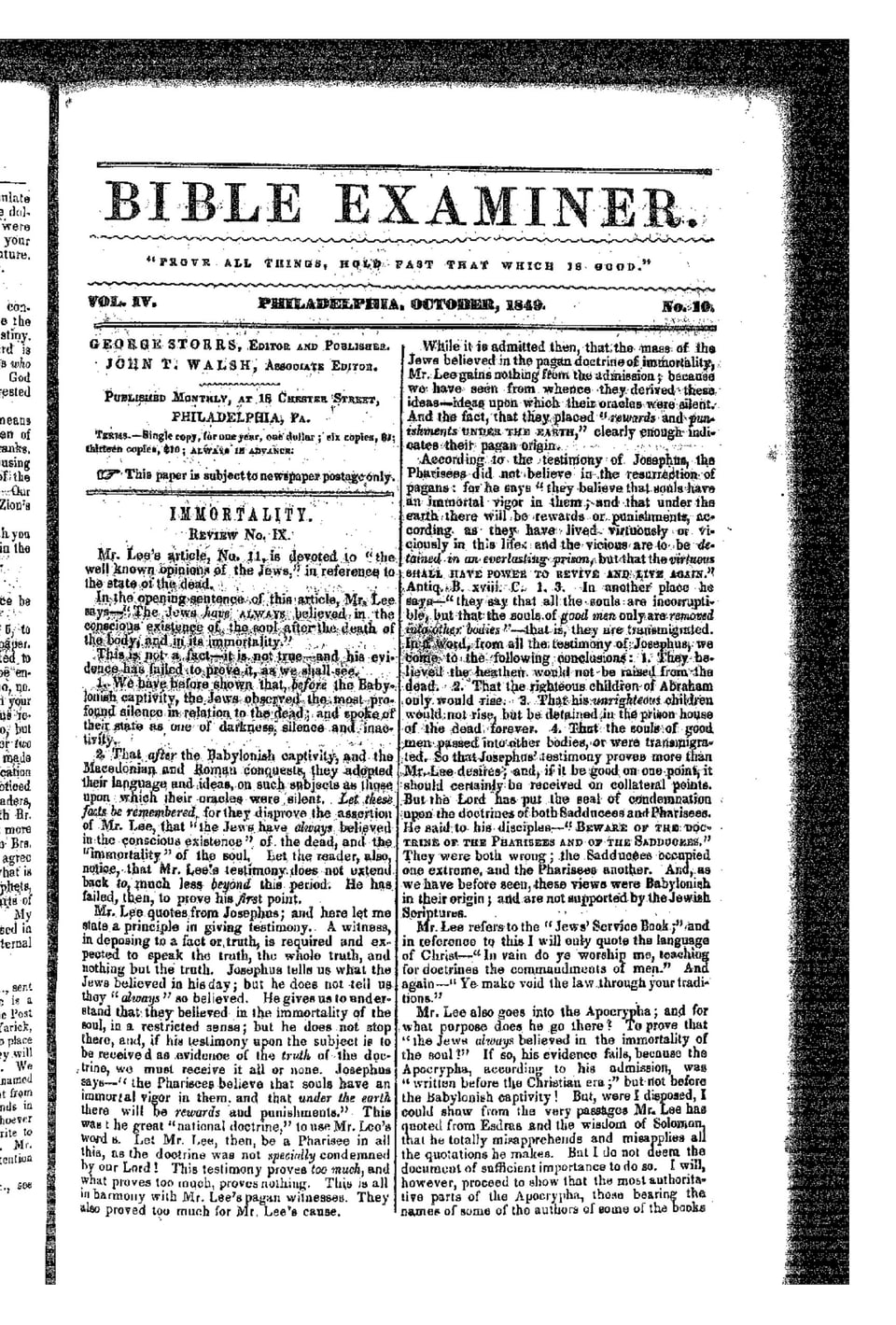
BIBLE EXAMINER.
"PROVE ALL THINGS, HOLD FAST THAT WHICH IS GOOD."
VOL. IV.
PHILADELPHIA, OCTOBER, 1849.
No.10.
GEORGE STORRS, EDITOR AND PUBLISHER. JOHN T. WALSH, ASSOCIATE EDITOR.
PUBLISHED MONTHLY, AT 16 CHESTER STREET PHILADELPHIA, PA.
Texas. — Single copy, for one year, one dollar; six copies, $1;
thirteen copies,$ 10; ALWAYS IN ADVANCE:
This paper is subject to newspaper postage only.
IMMORTALITY.
REVIEW No. IX.
Mr. Lee's article, No. 11, is devoted to "the well known opinions of the Jews," in reference to the state of the dead.
In the opening sentence of this article, Mr. Lee says—"The Jews have always believed in the conscious existence of, the soul after the death of the body, and in its immortality."
This is not a fact—it is not true—and his evidence has failed to prove it, as we shall see.
We have before shown that, before the Babylonish captivity, the Jews observed the most profound silence in relation to the dead; and spoke of their state as one of darkness, silence and inactivity.
That after the Babylonish captivity, and the Macedonian and Roman conquests, they adopted their language and ideas, on such subjects as those upon which their oracles were silent. Let these facts be remembered, for they disprove the assertion of Mr. Lee, that "the Jews have always believed in the conscious existence" of the dead, and the "immortality" of the soul. Let the reader, also, notice, that Mr. Lee's testimony does not extend back to much less beyond this period. He has failed, then, to prove his first point.
Mr. Lee quotes from Josephus; and here let me state a principle in giving testimony. A witness, in deposing to a fact or truth, is required and expected to speak the truth, the whole truth, and nothing but the truth. Josephus tells us what the Jews believed in his day; but he does not tell us they "always" so believed. He gives us to understand that they believed in the immortality of the soul, in a restricted sense; but he does not stop there, and, if his testimony upon the subject is to be received as evidence of the truth of the doctrine, we must receive it all or none. Josephus says—"the Pharisees believe that souls have an immortal vigor in them, and that under the earth there will be rewards and punishments." This was the great "national doctrine," to use Mr. Loo's word. Let Mr. Lee, then, be a Pharisee in all this, as the doctrine was not specially condemned by our Lord! This testimony proves too much, and what proves too much, proves nothing. This is all in harmony with Mr. Lee's pagan witnesses. They also proved too much for Mr. Lee's cause.
While it is admitted then, that the mass of the Jews believed in the pagan doctrine of immortality, Mr. Lee gains nothing from the admission; because we have seen from whence they derived these ideas—ideas upon which their oracles were silent. And the fact, that they placed "rewards and punishments UNDER THE EARTH," clearly enough indicates their pagan origin.
According to the testimony of Josephus, the Pharisees did not believe in the resurrection of pagans; for he says "they believe that souls have an immortal vigor in them; and that under the earth there will be rewards or punishments, according as they have lived virtuously or viciously in this life; and the vicious are to be detained in an everlasting prison, but that the virtuous shall have power to revive and live again." Antiq. B. xviii. C. 1. 3. In another place he says—"they say that all the souls are incorruptible, but that the souls of good men only are removed into other bodies"—that is, they are transmigrated. In a word, from all the testimony of Josephus, we come to the following conclusions: 1. They believed the heathen would not be raised from the dead. 2. That the righteous children of Abraham only would rise. 3. That his unrighteous children would not rise, but be detained in the prison house of the dead forever. 4. That the souls of good men passed into other bodies, or were transmigrated. So that Josephus' testimony proves more than Mr. Lee desires; and, if it be good on one point, it should certainly be received on collateral points. But the Lord has put the seal of condemnation upon the doctrines of both Sadducees and Pharisees. He said to his disciples—"Beware of the doctrine of the Pharisees and of the Sadducees." They were both wrong; the Sadducees occupied one extreme, and the Pharisees another. And, as we have before seen, these views were Babylonish in their origin; and are not supported by the Jewish Scriptures.
Mr. Lee refers to the "Jews' Service Book;" and in reference to this I will only quote the language of Christ—"In vain do ye worship me, teaching for doctrines the commandments of men." And again—"Ye make void the law through your traditions."
Mr. Lee also goes into the Apocrypha; and for what purpose does he go there? To prove that "the Jews always believed in the immortality of the soul?" If so, his evidence fails, because the Apocrypha, according to his admission, was "written before the Christian era;" but not before the Babylonish captivity! But, were I disposed, I could show from the very passages Mr. Lee has quoted from Esdras and the wisdom of Solomon, that he totally misapprehends and misapplies all the quotations he makes. But I do not deem the document of sufficient importance to do so. I will, however, proceed to show that the most authoritative parts of the Apocrypha, those bearing the names of some of the authors of some of the books composing the Bible, teach a very different doctrine from Mr. Lee's.
First, then, as a specimen, read 2 Esdras vii. 31,
"And after seven days the world, that yet waketh not, shall be raised up, and that shall die that is corrupt." If this refer to the resurrection, which it appears to do, from the context, then it proves the "second death" of the "corrupt," which Mr. Lee denies. Again, at the 15th verse—"Now therefore, why disquietest thou thyself, seeing thou art but a corruptible man? and why art thou moved, whereas thou art but mortal?"
But let us examine the "Wisdom of Solomon," which has a much higher claim than the Book of Eudras, and see what he says on the question of death and immortality. Chapter i. 12, 13, 14, 15, 16—"Seek not death in the error of your life; and pull not upon yourselves destruction with the works of your hands." For God made not death: neither hath he pleasure in the destruction of the living. For he created all things that they might have their being: and the generations of the world were healthful; and there is no poison of destruction in them, nor the kingdom of death upon the earth: (For righteousness is immortal;) but ungodly men with their works and words called it to them: for when they thought to have it their friend, they consumed to naught, and made a covenant with it, because they are worthy to take part with it." This certainly does not teach the natural immortality of the soul. Again, in the 2d chapter, "For God created man to be immortal, and made him to be an image of his own eternity; nevertheless," notwithstanding this purpose on the part of God; "through envy of the devil came death into the world; and they that do hold of his side DO FIND IT." Here it is clearly taught, that God, when he created man, designed his immortality—his eternal life, but that through the envy of the devil, death came into the world, and those who hold of his side, find death their portion. The passage Mr. Lee quotes from the 3d chapter, he totally misapplies. "In the sight of the unwise they seemed to die;" in the Sadducean sense of not living again, "but they are in peace." "This hope is full of immortality," which it could not be, if they already possessed it, for "hope" relates to the future—"the time of their visitation," which is spoken of in the 7th and 8th verses. The reader is requested to turn to the 7th chapter of the Wisdom of Solomon, and read the five first verses, and compare it with what we have already quoted here; and, also, what we have elsewhere said on the nature of man.
I will quote one passage more from the Apocrypha; it is found in Ecclesiasticus xvii. 27-32. "Who shall praise the most high in the grave, instead of them which live and give thanks! Thanksgiving PERISHETH FROM THE DEAD, AS FROM ONE THAT is not: the living and sound in heart shall praise the Lord. For all things cannot be in men, BECAUSE THE SON OF MAN IS NOT IMMORTAL." Again, he says—"All men are but earth and ashes." The Wisdom of Solomon was doubtless written before the Babylonian Captivity, and Ecclesiasticus appears to have been written about, or a little after that time. Thus we have proved, first, that the Jews did not "always" believe in the immortality of the soul; and, secondly, that, even after their return from Babylon, one of their principal writers, the author of Ecclesiasticus, did not teach it; all of which is in harmony with the Bible. Mr. Lee's
cause has gained nothing, I apprehend by going into the Apocrypha!
He next appeals to the Bible; but, alas! for his theory, he crucifies it afresh, and puts it to public shame! He quotes Math. xiv. 26; and Luke xxiv. 36-39, Mark vi. 49.
In Matthew and Mark the original word is phantasma, a phantom; and such is also the marginal reading in Luke. In the cases recorded by Matthew and Mark, the disciples thought they saw a phantom, but they were mistaken, as all other persons have been ever since. Let the reader notice, then, that in the only cases recorded, where the disciples supposed they saw a phantom—ghost, they were deceived; and that there is not a case differing from this on record!
In the case referred to by Luke, we have the subject presented in all its power and force. The Lord Jesus had arisen from the dead; his Father "had shown him the path of life," and "demonstrated him as his son, by his resurrection from the dead"—"death" now "had no more dominion over him,"—he was immortal—and as such he appears in their midst! "They were terrified and affrighted and supposed they had seen a spirit—a phantasma, or phantom—ghost. And now he proceeds to correct their ideas of such things by asking, "Why are ye troubled? and why do thoughts arise in your hearts! Behold my hands and my feet; that it is I, myself: handle me, and see; for a spirit—a phantasma—hath not flesh and bones, as you see me have. And when he had thus spoken, he showed them his hands and his feet." Thus correcting their errors on the subject of spirit, or phantoms, and at the same time, demonstrating the MATERIALITY OF SPIRITUAL BODIES!
Hero is "a quickening spirit;" as Paul says, with "flesh and bones, hands and feet." Here we have a glorious specimen of a spiritual, immortal body—not "immaterial," but material—real—tangible; something which could be "handled" and "sleep!" What becomes of Mr. Lee's "immaterial soul" in the light of this fact? His theory is exploded! his foundation demolished! his superscience crumbled into dust, and his theology a thing of nought! the ignis fulius of a day! This fact, I repeat it, sweeps away Mr. Lee's whole theory of "immateriality," demolishes Mr. Drew's logic, and nullifies all the rhetoric of Pythagoras, Plato, Socrates, and Zoroaster. It eclipses all the philosophy of Babylonia, Egypt, Media, Persia, Greece and Rome! It swallows up all the traditions of the Jewish Service Book, Josephus, and the Apocrypha! It casts into the shade all the learning of Pharisees and Sadducees, ancient or modern! because it is LIFE AND IMMORTALITY BROUGHT TO LIGHT!!"
Mr. Lee refers to Acts xxiii. 8. Mr. Brewster made a better use of this than Mr. Lee has done; and as we have fully responded to his arguments on this point, we must refer the reader to our discussion with Rev. Wm. H. Brewster. Mr. Leo's logical reputation is greater than his philosophical and scriptural strength. Truth is mighty above all things, and will prevail! J. T. w.
The Editor of the Examiner, in his late visit east, had a good time with friends in Boston and Cabotville, Mass.; and preached three times in the latter, and five times in the former place, to good and attentive congregations.
IMMATERIALITY.
The following communication is from a Methodist Minister; who, though not with us on all points, says, in a private note,—"On the great question—'What will be the doom of the wicked?' I am fully with you; and intend ere long to give public utterance to the truth of God on this awful subject." He adds—"I feel thankful to God that I have seen your Sermons and Dobney's book. For years my mind has been painfully perplexed with the doctrine of interminable suffering. I have thought and read of hell as a world of immortal wo, where countless millions curse themselves, each other, and the Almighty, until I have been confounded: but I have done with the doctrine and all its perplexities. The wicked shall be burnt up with unquenchable fire; and afterwards every creature in heaven and on earth shall ascribe blessing, &c., to Him that sitteth on the throne and to the Lamb for ever."
The name of the author of this communication has never appeared in the Examiner: he is therefore a new accession to this side of the question; but he alone is responsible for the sentiments of his article. We hope to hear from him again.
If the Human Soul be Immaterial, how can we account for the origin of its existence?
Ba. Stories:-I have recently been much interested in this question. The following article is submitted to your consideration, which you may print if you think proper to do so, and if not, you may return it at my expense.
Admitting the human soul to be immaterial; there are four ways, in any one of which we may suppose it to have originated. 1st. We can suppose it to have been created out of previously existing immaterial substance. 2d. We can suppose it to have been created out of the immaterial substance of one or of both the parents who were the means of its existence. 3d. We can suppose it created out of the Divine substance. 4th. We can suppose it to have been created out of nothing. These include every possible mode of accounting for the origin of the soul, if the soul be an immaterial essence. Assuming this view of the nature of the soul, I propose to show that it could not in any of the above ways come into being, and therefore there is no such immaterial soul in existence.
Did God create the soul out of previously existing immaterial substance? I answer, 1st. The existence of such substance is hypothetical. I do not know of any immaterialist of the present day, who maintains such an opinion respecting the origin of the soul. 2d. If such immaterial substance did exist previous to the creation of our immaterial soul, it either possessed the essential properties of spirit, or it did not. If it did not, then immaterial substance is not necessarily spirit. Suppose then this substance did possess the essential properties of spirit. In this case, according to immaterialists, it must have had thought, consciousness, and all the elements of personality. In other words, it must have been an intelligent, spiritual being;
essentially one and the same; immutably and eternally incapable of multiplication or division. Immaterialists themselves being the judges, our immaterial soul could not be created out of the essence of such a being.
Let us suppose this immaterial substance to have been impersonal, unconscious, and unintelligent. Still it must have been essentially one, or it must have been multifarious. If essentially one, then it is plain it could become the subject of only one consciousness and personality. No more than one soul could be created out of it. If there were different kinds of such substance, then each kind might become one soul; and only one. Where must then have been as many different immaterial substances as there have been human souls in existence. Such a notion is surely too absurd to be maintained by the advocates of immaterialism.
If, however, any should incline to adopt this method of accounting for the origin of the soul, we have other difficulties to suggest to them. How came this previously existing immaterial substance into being? How could immaterial substance exist, and yet be utterly destitute of moral and intellectual properties? How could an unconscious and unintelligent substance be rendered conscious, intelligent, and the subject of personality? Immaterialists tell us that what is not matter is spirit, and that spirit is essentially conscious, intelligent, and active. Of course, if this be so, there could not be any unconscious, unintelligent, immaterial substance, out of which human souls were created.
Does God create the souls of children out of the immaterial substance of one or both of their parents?
Suppose the soul of a child to be created out of the immaterial substance of its father. But here we are in difficulty again. The soul of the father, we are told, is essentially an unit; it is indivisible. It cannot, then, be divided. It cannot furnish from its own essence the elements of a new existence. Passing over this difficulty, we will still suppose the soul of the child created from the soul of its father, and another difficulty is presented as formidable as the last. The father having parted with a portion of his immaterial essence, no longer has a soul, whole and entire. The second child of the same father must be supposed to receive another portion of his spirit, and so of all the succeeding children. Thus the father, after communicating, at different times, portions of his own essence to a score of children, can hardly be supposed to have any soul left. It is also evident, that before he became a father he must have had twenty times more immaterial substance, or soul, than any one of his children. Thus souls are diminishing in quantity, or amount of essence, every generation. In the course of ages, souls may become as small as immaterialists affirm them to be—without extent, having no size, in other words, they exist nowhere.
The idea that the soul of a child is created out of the soul of his father, is evidently absurd, and must be abandoned. And if we suppose the soul of the infant to be created out of the immaterial essences of both parents, absurdities are increased and multiplied. In this, as in the former case, we have indivisible spirits divided, which is a contradiction. Neither father nor mother has a complete soul after the production of the child. And as the child is supposed to have a soul, which is compounded of the substance of two immaterial, conscious, and immortal spirits, he must have in himself a double life, a double consciousness, a double identity; he must be the subject of a two-fold immortal existence.
Such are the contradictions and impossibilities in which we are involved, by supposing the soul of a child to be created out of the immaterial substance, of one, or both of its parents.
This cannot be, according to immaterialists, for they tell us God is one, and indivisible for ever. But if souls be created out of the divine essence, God is divided into as many parts as there are human souls in existence.
III. Does God create souls out of his own essence?
If the human soul be a part of the essence of God, it must be a partaker of the attributes of God. The attributes of God inhere, essentially and eternally, in the divine substance. If, then, human souls are portions of the divine essence, they must share in the divine perfections, many of which are said to be incommunicable. In reality, God is the only intelligent Being. Every human mind is a ray of the infinite light; a drop of the eternal ocean. In the language of Pope:
"All are but parts of one stupendous whole, Whose body nature is, and God the soul."
It either follows, then, that whatever is, is right, or if there be such a thing as moral evil, the Divine Being, in his innumerable individualizations, is the only transgressor of moral law. Every false opinion, every evil passion, every wrong action, is thus charged upon that great and glorious Being who is Light and Love, and in whom there is no darkness at all.' Now, no immaterialist will contend for such absurdities. We are thus forced to the conclusion, that God does not create human souls of his own essence.
1V. Does God create human souls out of nothing?
I formerly entertained the common opinion of the origin of the Universe, that it was produced out of nothing. But I have been compelled to abandon that idea, as involving an absolute impossibility. None will pretend that finite immaterial minds can create something out of nothing; while many do maintain that the Almighty did, from nonentity, call all things into being. Let me ever speak of God with the deepest reverence. I believe he can do whatever in the nature of things is possible; but there are some things which are beyond the limits of omnipotence. God cannot annihilate his own being. He could not create a being equal to himself. I doubt whether God could compress all the matter in the Universe, so that it would occupy no more space than a grain of sand. According to immaterialists, God cannot divide a soul into parts, nor destroy a soul by the action of matter upon it. I do not accuse them of irreverence for holding such opinion, nor shall I be rashly censured by candid men, when I assign the following reasons for not believing in the production of something out of nothing.
1st. I cannot find that the Bible anywhere teaches the creation of anything out of nothing.
2d. If something was produced out of nothing, it must have been so produced by the action of
Deity. But action necessarily implies two things: I am thus led to the conclusion that an imma1st, an actor; 2d, an object acted upon. The material soul could not be created out of previously
1st. Does God produce immaterial souls by acting on himself?
actor may act upon himself, or upon something which is not himself. Let us try both cases.
This could not be, according to most immaterialists, for they tell us there was a period when only God existed. Besides himself, there was neither matter nor spirit. Of course, then, out of himself there was no object to act upon. Now, as an exercise of power necessarily implies an object to be acted upon, it follows, that if there ever was a period when nothing besides God existed, nothing but God could have existed to all eternity.
This brings us to view the subject again, very nearly in the light in which it is presented in our third supposition. Now, if we answer the question just proposed in the affirmative, we must maintain that God has divided his indivisible essence into parts, and of these parts constituted human souls. Here we have a contradiction and an absurdity,—a contradiction, because an indivisible essence cannot be divided; and an absurdity, because, according to this view, every human soul, and every devil, is a part of God.
Again: These separate parts of the divine substance, which are supposed to be individualized in different souls, either have their original properties or they have not; if they have, then the consciousness of every soul is the consciousness of God; the will of every soul is the will of God; and the errors of every soul are the errors of God. This will not be maintained by immaterialists. Let us, then, suppose that these portions of the divine substance have not their original properties. Here are two difficulties: 1st. These parts of the divine essence could not exist for a moment, after being deprived of their essential properties. 2d. New properties in the abstract could not be created and made to inhere in these parts of the divine nature. It is therefore impossible for human souls to be created out of the essence of God, by the action of God upon himself.
I may here remark, that if God could produce souls by acting on his own nature, these souls would not be created out of nothing, which is the point now under consideration.
Does God, then, create souls by acting on something which is not himself?
All will admit that the creation of something out of nothing is an impossibility with finite beings; but many will maintain that such a creation is possible with God because he is omnipotent. I believe in the divine omnipotence; but what can omnipotence do without materials to work upon? What can it effect when set in operation (if this were possible) on boundless nonentity? In the arithmetic of mortals, a thousand times nothing amounts to nothing, and this is an absolute and immutable truth in the multiplication table of God Almighty. The fact that our power is limited, and God's power is infinite, does not touch the question. No being, finite nor infinite, can think without a subject of thought. No being can exercise desire or love without some object to be desired or loved. None will pretend that God could exercise his benevolence upon nonentity. So neither can power act upon nonentity. Hence the production of souls out of nothing is an infinite and eternal impossibility.
existing immaterial substance, nor out of the souls of parents, nor out of the divine essence, nor out of nothing. And as an immaterial soul could not be produced in any other way, I am compelled to believe there is no such thing in existence.
As my sheet is not full, I will suggest whether the notion, that the soul was created by God out of nothing, is not utterly inconsistent with the doctrine of man's constitutional depravity. Here let me quote Wesley, who represents the thoughts of millions on this subject. "In Adam all died, all human kind, all the children of men who were then in Adam's loins. The natural consequence of this is, that every one descended from him comes into the world spiritually dead, dead to God, wholly dead in sin; entirely devoid of the life of God; void of the image of God, of all that righteousness and holiness wherein Adam was created. Instead of thin, every man born into the world now bears the image of the devil, in pride and self-will; the image of the beast, in sensual appetites and desires. This, then, is the foundation of the New Earth,—the entire corruption of our nature." Such is said to be the state of a human being "when he comes into the world." This is affirmed of the immaterial soul, and of it only; for immaterialists tell us the body possesses no quality of an intellectual or moral nature: every such quality belongs to the soul. Now, if the soul be made out of nothing, a human father can have no more to do with the production of the souls of his children, than with the creation of so many worlds. How, then, can a father's acts affect the moral nature and condition of the souls of his children, and the relation of these souls to God? To me this seems impossible. If the soul alone develops thought and volition, and if it be created by God out of nothing, then we must refer the first moral state of the soul to God, and not to Adam. If the soul is naturally destitute of holiness, God made it so. If the soul has in itself the germs of pride, malice, envy, bitterness and blasphemy, God put these germs into it. If the soul go astray from the womb, speaking lies, God interweave a principle of falsehood in its constitution. Whatever is natural to the soul must be referred to the being who gave the soul its nature, and not to the beings who were merely the instruments of providing for it a house of clay, in which it might pass a short term of existence.
Mass _{2} September. 14th, 1849.
DR. I. F. LEE, AND THE BAPTISTS.
TO THE BARRIERS scattered throughout the bounds of the Moriah Association, and elsewhere, greeting:
Whereas the Meadow Branch Baptist Church has charged the undersigned with the promulgation of sentiments heretical, and subversive of the Christian system, thereby justifying themselves in his exclusion from their body, hoping that no church will receive the letter of dismission granted him upwards of two years ago, and which they are led to think he still retains, contrary to the wish of said church: Be it known unto you, 1st. That the sentiments, which the undersigned has promulgated, are not contrary to Scripture. 2d. They are not therefore either heretical, or subversive of the Christian system. 3d. As to the letter of dismission, he neither retains it still, nor
holds it contrary to the wish of the Church, and therefore cannot present it to any other church whatever. The letter than of the Meadow Branch Baptist Church is a misrepresentation from beginning to end. The undersigned might, in strict propriety, let the matter here rest, and demand the proof of their assertions, but he prefers an exposure of the misrepresentation, believing it will be acceptable to his friends, serviceable to his enemies, and instead of subverting the Christian system, establish the truth of those sentiments, and prove hermeneutically that they are the Revelation of the Almighty, and not the inventions of man.
The Meadow Branch Baptist Church was apprised of the fact, that he was not a member of their church at the time (Feb. 1849) nor for upwards of twelve months previous; that he had disposed of the letter of dismission in the summer of 1847. What then, dear brethren, can you think of a church, who wilfully, and deliberately publish that which they know is a misrepresentation? What could have prompted them to such an act? It has been said that it was slavish, servile fear—the fear of man—the fear of the Moriah Baptist Association! That if they did not exclude Dr. Lee, the Association would exclude them!! That is, if they did not exclude an individual who was not a member of their church at the time—an impossibility—aye, if they did not commit an impossibility, the Moriah Association would sever them from her sisterhood!! And this egregious folly was premeditated by a very few, (it is feared; not some of that few who are saved;) while the majority, an overwhelming majority, of the Association knew nothing of the plot. How strange! to bear false testimony against a neighbor, to indulge in wilful misrepresentations, to take Action for fact, and fact for fiction; to take Scripture for heresy, and Bible sentiment as subversive of the Bible; and call all this orthodoxy! Strange as it may seem, it is nothing more than the Meadow Branch Baptist Church has done, under the penal law of the Moriah Baptist Association. Two or three very active agents in the plot believe that the soul of man is the essence of God! And that the wicked will be raised incorruptible, immortal—spiritual bodies. Glorious! For, saith one of these essences of Deity; Paul, in the 16th chapter of 1st Christians, is speaking of the resurrection of the wicked as well as the saints! Is this orthodoxy! It may be the Moriah Baptist Association sentiments, but not surely the declaration of God. But what are these sentiments which the Meadow Branch Baptist Church, in common with the Association of which she is a beloved and pliant sister, believe to be heretical and subversive of the Christian system, and a renunciation of which would be a great recommendation to an ordained minister of the glorious gospel of Jeans Christ? Let us look into that gospel, and examine and see if it contains such sentiments as Dr. Lee has openly promulgated! And if, after impartial and thorough examination according to the sacred canon, we find sentiments verbally, hermeneutically such as Dr. Lee believes and has promulgated, it must necessarily follow that they are scriptural, not heretical; and instead of subverting Christianity, they are in verity a part of that Divine system itself, how subversive soever of the sentiments of those who reject the word of God, and prefer the blasphemous idea that the soul of the wicked is the essence of Deity, and therefore is undying, and must live forever!
To the law and the testimony. 1st. Dr. Lee believes and has promulgated the following sentiments, which the Meadow Branch Church pronounces heretical and subversive of the Christian system.
Gen. 3: 22: 'And now, lest he put forth his hand, and take also of the tree of life, and out, and live for evor: Therefore,' &c. 23. The sentence of death is passed, and, in mercy, God expels Adam and Eve from Paradise, or the garden of Eden; for he did not wish them to live for ever in a state so wretched. The penalty of mortality was not remitted, for "dust thou art," &c., and the penalty of the law, death, eternal death, were it not for the interposition of mercy, through a Saviour, would have been inflicted on Adam and Eve.
37 Ezekiel 18:40. 'The soul that sinneth, it shall die.' Rom. 6:23. 'For the wages of sin is death.' 21. 'The end of those things is death.' 2:12. 'For as many as have sinned without law, shall also perish without law'—16—'in the day when God shall judge the secrets of men by Jesus Christ, according to my gospel.' 1:32. 'Who, knowing the judgment of God, that they which commit such things are worthy of death.' This, then, is the judgment of God, that the wicked are worthy of death—that they shall perish in the day when God shall judge the secrets of men by Jesus Christ, according to my gospel. What doth it profit a man if he gain the whole world and lose his own soul, his life? Or what is a man profited, if he shall gain the whole world, and lose his own soul—his own life?
Job 21:30. "The wicked is reserved unto the day of destruction—they shall be brought forth to day of wrath"—death—eternal death. Ezk. 18:18, 24, 31, 32, 26. 33:9 13, 18. Matt. 3:10, 12. 5:29, 30. 7:13, 16, 19. 10:28. 13:40, 50, 16:25, 28. 18:8, 9. Acts 3:23. 9:20 2 Peter 2:1, 17. Here it is declared that the wicked shall be destroyed—shall lose their life—be burnt up—shall perish—utterly perish. Again. John 3:36. 'he that believeth not the Son shall not see life.' And again, Malachi 4:1. 'For, behold, the day cometh that shall burn as an oven; and all the proud, yea, and all that do wickedly, shall be stubble; and the day that cometh shall burn them up, saith the Lord of hosts, that it shall leave them neither root nor branch.' From the foregoing passages it is evident that the final destiny of the wicked is destruction, everlasting destruction, death, eternal death. And we think we have the mind of the Lord when we say, that eternal death, and not eternal life in misery, is the judgment of God against the wicked. This we believe from the force of testimony more numerous and overwhelming, in one sense of the word, than that in favor of baptism being immersion. We have one solitary word to prove immersion, i.e. baptizo. This, with the phrase, going down into the water, &c., in Jordan, and buried with him in baptism, &c., constitutes all the proof we have, and all that we require. Let us now return to the future punishment of the wicked, and what hermeneutically is the testimony in its favor, and who is the author of that testimony or evidence by which we believe? Consume, devour, destroy, destruction, perdition, die, death, perish, utterly perish, everlasting destruction, eternal death, are the words
chiefly employed, when speaking of the future and final punishment of the wicked, &c. We would request then that you study them hermeneutically, and consult a Latin Dictionary. Look carefully and critically at the words, consumo, destruo, devoro, destructio, perco (from per and ev literally, to depart wholly,) perditio (from perdo, entire loss, utter destruction,) and then turn to Webster's large, and enlarged Dictionary, last published, 1848—and say whether these sentiments are heretical and subversive of the Christian system? But the public mind, says Mr. Forcible Feeble, is against the doctrine, aye, and the overwhelming prejudices of the churches. Yea, verily, adus Deacon S.; and then how are we to alarm sinners, if we take away the fear of undying torture in eternal and devouring fire? Alas! the man who will yield to public opinion or the prejudices of the whole religious world, when that opinion and prejudice is contrary to the word of God, is not fit for the Church of God, and is a dishonor to the ministry. We know we have the mind of the Lord when we say, that it is not the fear of undying torture, but the goodness of God, that leadeth man to repentance.
All the classic Greek writers, all Lexicons, have been sifted and examined, minutely, thoroughly, to prove what? That baptize means to dip, plunge, immerse. Must a man, then, renounce his reason, his knowledge of other words besides baptise—deny the import and meaning of the words used in speaking of the punishment of the wicked—declare that the judgment of God relative to the wicked is heresy! and that the doctrine contained in the word of God is contrary to the word of God; and that God, therefore, does not mean what he says;—must a man do all this before he can be received again into full fellowship and fellow feeling with the Meadow Branch Baptish Church? The import of words must first be changed; all Dictionaries and Lexicons altered essentially—nay, even then the judgment of God remains immutably the same. Think you, brethren, that all the proofs in favor of the punishment of the wicked being that of utter destruction and not eternal life in misery, have been enumerated? Throughout the whole Bible there is not one passage, not one solitary phrase, that favors the common notion of immortality in sin, or eternal life to the wicked. No, not one text to show the soul is in its present condition undying or immortal. True, that immortality is promised to those who, by patient continuance in well-doing, are seeking for honor and glory and immortality, eternal life. These great and glorious blessings are promised to the saints, through Jesus Christ. They are not inherent in man—not even in the righteous, much less in the wicked. Nor are they conferred on mortals, before the resurrection. Corruption must put on incorruption—mortality, immortality; the natural body must be raised a spiritual body. When does this take place? At death? Nay, but in the resurrection.
Christ was manifested in the flesh, that he might destroy the works of the devil. This the devil himself believes. Art thou come to destroy us before the time? The belief of the Meadow Branch Church, then, is not so correct on this point as that of the devil. He knows the truth in this respect, believes it, and trembles. But the Meadow Branch Baptist Church denies the truth of God, and neither fears nor trembles, but unblushingly publishes to the world that the truth of God is heresy! Would to
God that they had the wisdom of the serpent, and the harmlessness of the dove.
LETTER FROM BR. J. B. FRISBIE.
The writer of the following letter has been a minister, and traveling elder, we believe, in the Protestant Methodist Church, for a number of years. Some months ago our Six Sermons were put into his hands, if we recollect right, by Br. Catlin of Kingsbury, Ind., which he has examined with Dobney on Future Punishment, comparing them with the Scriptures, the result of which will be learned from his letter. Our Br. Catlin and other brethren in the west are doing their work faithfully in scattering the doctrine of immortality only through Christ, and that by a resurrection from the dead; thus showing the importance of the "second advent," as our only hope for a future life. We trust they will abide in this good work and not compromise it to please men.
SYLVAN, Mteh., Sept. 7th, 1849.
BROTHER STORRS,—it is with pleasure I now inform you that I have closely examined your Six Sermons, and also Mr. Dobney on Future Punishment: able works, the truth of which nothing but prejudice, and a blind zeal for creeds, sects, and parties, can gainsay or resist. With much interest I have perused your valuable paper, and have been delighted with the discussions therein, and have faithfully compared them all with the Bible.
About seven years since I was fully convinced that the idea of the natural immortality of the soul was a heathen doctrine; but have believed that immortality was in Christ, by virtue of the atonement, for all, but am now ready to acknowledge that the Bible does not teach the immortality and eternal life (which I consider synonymous) for any but those, "who, by patient continuance in well doing, seek for glory and honor and immortality, ETERNAL LIFE." It appears that Christ, by his obedience and death, abolished death, and brought life and immortality to light through the gospel: 2 Tim. 1: 10. It is strange, that some should labor to prove that life and immortality should be brought to light through the light of the impress of the heathens, or reason, or the light of nature. To "put on immortality," [1 Cor. 15: 53, 54,] does not look much like an immortal soul's putting on an immortal body, or a mortal body's putting on an immortal soul, but "this mortal shall put on immortality," in the resurrection. Under this I will place, "The soul that sinneth it shall die." Ezek. 18: 4 and 20. Also, "Let him know that he which converteth the sinner from the error of his way shall save a soul from death." James 5: 20, does teach that a sinner's soul may die. Solomon says, "Man hath no pre-eminence above a beast" at death: Eccl. 3: 19. "The dead know not anything." David says, man without redemption is "like the beasts that perish;" Ps. 49. "While I live I will praise the Lord—while I have any being"—"his breath goeth forth, he returneth to his earth; in that very day his thoughts perish."
Ps. 146:2 and 4. I am not so clear on the intermediate state as I could wish. One reason why, I suppose, is, I had imbibed the notion that demons were the spirits of the wicked dead, according to Josephus, W.B.7, sec. 6.
As to the destruction of the wicked after death, I feel very well satisfied on that point, at present. As sure as eternal life means future and endless life, so sure the opposite must be future and endless death, perish, and destruction, which are the common terms in contrast with life, eternal life, &c. Nowhere can I find that the wicked are to have eternal life, or that they are immortal, or are so put on immortality in the resurrection. For this is spoken only of brethren or Christians, who have sought immortality: Rom. 2: 7; they put on immortality in the resurrection. 1 Cotth. 15: 50—54. "He that hath sown to the flesh shall of the flesh reap corruption." Now this I see is not the first death that we inherited in Adam. For, this is for our own deeds, and contrasted with life everlasting, which places it in the future, viz., the second death—"Death unto death"—"Utterly perish"—"End destruction"—"Destroy both soul and body in hell"—"punished with everlasting destruction." A word as to the resurrection, then I close this article. I came to the firm conclusion that if I could find proof in the scriptures that the wicked might rise mortal, that assuredly they would die again. No sooner had I come to this conclusion than this text came to my mind, satisfactory to the point—"Women received their dead raised to life again; and others were tortured, not accepting deliverance that they might obtain a better resurrection:" Heb. 11: 35. The contrast is between the women's children raised by the prophet back to this mortal life, and the better, or immortal resurrection. If these worthies had accepted deliverance, it appears they would never had a better resurrection than a mortal one, and die again. This is in exact agreement with the text, "He that loveth his life shall lose it; and he that hateth his life in this world, shall keep it into life eternal." Here the contrast is between the life in this world and life eternal; which makes its loss one with death eternal. See Mat. 10: 39, Mar. 8: 35. Yours in the hope of immortality.
J. B. FRISBLE
"INFANTS—SOUL AND BODY."
"INFANTS—SOUL AND BODY."
Under this caption, the True Wesleyan, for Sept. 1, takes exceptions to a sentiment of some of its exchanges, which is this, "the body of the infant is corrupt or fallen, and depraved. This depravity is hereditary; but the soul is a new creation of God, not derived from the earthly parent." The Wesleyan uses up this notion very handsomely, and says, "The Bible affirms that God is the Maker of the body as clearly as it does that he is the Maker of the soul." It adds, "'Abraham begat Isaac, and Isaac begat Jacob.' But if souls are not begotten as well as bodies, Abraham did not beget Isaac, or else the term Isaac does not include a soul. If men are not begotten, then souls are no part of men."
The Wesleyan overthrows its exchange in the argument, but demolishes itself along with it, for the doctrine of the Wesleyan is, that the soul is "immaterial, uncompounded, and indivisible."
Now if it is "immaterial," how does the action of matter, in generation, communicate it? And if it is indivisible, how could Abraham give or communicate a soul to Isaac? It could not be an offshoot from his own, for that would make his soul divisible, and the Wesleyan says it is "indivisible." We cannot see, if Abraham communicated Isaac's soul to him, but what it must still have been Abraham's soul in Isaac, if the soul is not divisible; and then we do not see how there can be more than one soul for the whole human family; and as that is "indivisible," it is a family soul: hence it follows that the action of any one man must be the action of the family soul; so if one man sins, it is a family sin, or if one man acts virtuously it is a family virtue. Again, as the soul is "indivisible," all men must have the same common destiny: say, for example, that if Abraham should be lost, Isaac must be lost, for the soul can't be divided; and so, whatever is the fate of the first man, Adam, must be the fate of all the men of his race, or else the soul must be divisible; and then, what would become of the Wesleyan's theory of its indivisibility? Happy for man, however, we have the assurance that Abraham, Isaac and Jacob are saved, and that proves Adam and Eve were, and that all their posterity must inevitably be so too—for "the soul is indivisible." Truly the Wesleyan has helped our opponents to a short and certain route to universal salvation. Can you get out of that dilemma, Br. Wesleyan, without abandoning your theory? The Examiner is open for your answer, and we will show you how we can equal you in "courtesy."
We see Br. Lee's difficulty. It all grows out of the assumption that the soul is an entity—a real being or existence—and not an attribute. The soul of man is an attribute of man, an inherent quality, that which pertains to man as man, as an organism. To use one of Br. Lee's own expressions, "The soul, whose very existence is thought." Never did a theologian better define the soul than he has done, fatal as it is to his entire theory, which he has labored to sustain in "22" articles in the True Wesleyan.
The question between the Wesleyan and its "exchange" stands thus: Are the souls [thoughts] of men, or of infants, a new creation of God, or are they propagated by generation from father to child?
According to Br. Lee, (see last Examiner) the soul is a "living consciousness," and "is known to exist only from its thoughts;" now, how little "living consciousness" does an "infant" manifest? and as the soul "is known to exist only from its thoughts," how will Br. Lee prove that "infants" have any souls at all? Does he know anything of their thoughts? He has said that "animals do not think;" that what appears to be the result of thought in them is only instinct. There are very few animals but what are quite equal in this respect to infants just born. After all, then, Br. Wealeyan, may it not be, according to your theory, that infants have no souls at all? So that you and your exchange may both be wrong.
The matter how seems to stand thus :---
But the infant is not KNOWN to think:
The soul is thoughts, and can be known only by its thoughts :
THEREFORE, the infant has no soul, so far as known. Is this position true? And if not, how will our Br. Wesleyan disprove it, without abandoning some
of his main arguments? Again, we say, the Examiner is open for Br. Lee's answer, with this proviso, viz., if we can possibly get funds to continue our paper. Now is a chance to prove our generosity.
BIBLE EXAMINER.
PHILADELPHIA, OCTOBER, 1849.
ENDLESS LIFE ONLY IN CHRIST. "He that hath the Son hath life : he that hath not the San of God hath not life."—1 John 5: 12.
BIBLE EXAMINER.—The present number of our paper has been delayed from two causes; first, absence of funds; second, our own absence from the city. Since our last we have visited New England, and conversed with numbers of our friends, all of whom express the desire that we should continue to issue the Examiner; and are unanimous that the subscription price ought to be increased to one dollar per year; they assure us they will cheerfully pay that sum. Several persons have pledged themselves to be responsible for subscribers to the amount of the following sums for the coming year; vis:
Adam Warthman, Philadelphia,
$15.00
Jacob Johnson, Millville, N.J.
10.00
P. Dickinson, Boston, Mass.
10.00
R. E. Ladd, Springfield, Mass.
25.00
Br. Wm. Swinbue, Patterson N. J., writes, that we may calculate upon six or eight subscribers there for next year, where there were only four the present. Here is a good and encouraging beginning.
Let us now hear from all our friends at once; because, we wish to be able to determine how many papers we shall print monthly before we commence the new volume. To print more than are called for is a loss to us, and not printing enough we shall fail to supply new subscribers. Cannot our friends say at once for how many dollars they will be responsible during the coming year? They need not remit to us only as they obtain subscribers, but let us know how much we may certainly depend upon from you to help us through the next volume. A monthly issue is all we can promise at present. We have no funds on hand for the November and December numbers of the Examiner, yet we shall issue them during those months in full faith that the expense will be met.
THE TERMS of the Examiner hereafter will be one dollar per year. For five dollars six copies will be given; and for ten dollars thirteen. Having made this arrangement it is thought advisable to withdraw the offer of a "premium" made in the August number. The back numbers for 1848 and '49 will be furnished at the same price as heretofore. All communications and remittances relating to the
Examiner should be directed "Geo. Storrs, Philadelphia, Pa."
THE NEW HYMN BOOK We invite the attention of our friends to this work. We believe it to be at least equal to any other: modesty perhaps forbids us to say more; but, we should be glad to have it compared in the matter it contains and its neatness of execution with any other. It is free from sectarianism, and we believe can be used by "all christians." It contains 205 choice Psalms and Hymns, selected, but altered and abridged, of such character, we think, as are fitting to be sung in public assemblies. Lighter hymns may be used at other times; and a plenty such can be found in every place without our contributing to multiply them. Several congregations besides ours in Philadelphia have procured our "Christian Psalmody." For price see last page.
MORE ENCOURAGEMENT.
FROM Ba. Wm. SWINE.
PATTERSON, Sept. 10, 1849.
Br. Storrs — Enclosed you will find 2 from Br. Isaac Van Blurcom and myself, to be appropriated for the continuance of the Bible Examiner, to aid you through the present year. We think your valuable paper is worth one dollar a year, and we would prefer giving 2 per annum if the paper could be issued weekly or semi-monthly. We think some six or eight subscribers could be obtained here another year, at 1 monthly or 2 published oftener. Your article in the last number, on the "signs of the times" was rich, and well worth attention. We should like to hear more on the same subject. My own opinion is, that the sons of Judah will not start for the land of their fathers until after the first resurrection. I feel fully satisfied that the battle of the great day has already commenced.
FROM EDWARD TURNER.
BLACKWOODTOWN, N. J., Sept. 21, 1849.
Mr. Storrs:—Dear Sir.—Enclosed I send you $1 to be added to what I paid for the 'Examiner' the present year, being satisfied all the while you were publishing too low by one half or more. I should be sorry not to have the pleasure of reading the 'Examiner,' at even four times its present cost; and think a large majority of your subscribers would be of the same opinion.
I, therefore, would suggest, that you should at once make an estimate of the cost for publishing the 'Examiner,' together with a sufficient sum to pay all labor, expenses, &c. Then make a division of the deficiency amongst your subscribers, and I think there would not be one who would be dissatisfied with the amount extra they would have to pay, and would most gladly do so, rather than have the paper discontinued.
ADDITIONAL DONATIONS since our last to finish the present volume.
Adam Warthman, Philadelphia, $5.00
C. Thompson, Harriaburg, Pa., 5.00
A friend in New York City, 3.00
Henry Harris; Free Union, Va., 1.50
Joseph White; Heath, Mass., 1.00
J. Simpson, and R. Malone, Richmond, Va., 5.00
Various other friends. 2.00
IMMORTALITY.
A REVIEW OF REV. LUTHER LEE.
This work is now being stereotyped, and will make about 120 pages. The subject of immortality is philosophically and scripturally discussed. The work discusses the immortality of the soul, the consciousness of the dead, and the destiny of the wicked. It will be ready for delivery about the first of November, at 25 cts. per copy, or five copies for a dollar in paper covers, and mailable. About one half the matter has appeared in the "Bible Examiner," but the remainder will not be published in the paper as that course would very much delay the appearance of the book. Persons desirous the work will please address their orders immediately to John T. Walsh, 63 Ogden street, Philadelphia, Pa.
ALBANY AND UTICA, N. Y.—The Editor of the Examiner designs to spend Lord's day, the 21st inst., in Albany, and remain there till the latter part of that week; then go to Utica to spend Lord's day the 28th, and continue there a few days. He will be glad to meet in either place those who desire to see him.
NOTES ON "ATHANASIA." No. II.
Mr. Hinton uses Luke 20: 48, "Neither can they die any more," as a positive declaration of the immortality of all men. He makes the question our Lord answers to be one about the "future life," excluding its exclusive application to the resurrection. If so, the text does not prove a resurrection at all on his own principles, elsewhere laid down, that a word cannot have its literal and analogical meaning at the same time. Hence this text is fairly given up by him as proof of the resurrection, the term being used analogically for "future life," [see p. 427.] there may be no resurrection of the dead at all for all this text proves. Again, as the term "die" has an analogical signification, it may be, for all Mr. H. can prove from the text or context, on his theory, used to signify misery, or unhappiness. Then the text means, "Neither can they be unhappy any more;" and as he supposes he has proved its applicability to all men, or all the human race, has not proved all a universalist could desire?
Thus all men shall be possessed of a future life—then they cannot be unhappy any more, "but are as the angels of God in heaven;" Matthew. This expression of Matthew, Mr. II. endeavors to avoid by saying it does not relate to their moral character or holiness; p. 437. If it has no relation to a resemblance in holiness, it has the appearance of excluding wicked angels from the possession of that which these men possess, or there would have been no need to say angels of God in heaven. But Mr. H. says, p. 436, "The point of similarity intended is only that they will 'neither marry nor be given in marriage since they cannot die any more.'" Still we ask—Why contrast good and bad men with the angels in heaven? If all men are included, as Mr. H. contends, irrespective of character, why not all angels be the pattern without selecting the good only?
By Adam came death, by Christ came the resurrection from the dead; hence it follows—if the death of Adam was literal, the resurrection is literal; "not die any more" refers to a like death, and Mr. H. admits die in this text has "the sense of extinction;" p. 479: then the first death must have been "extinction;" for the text plainly has reference to the first death by the words "any more." Further: if resurrection in this text is to be understood only as a "future life," as Mr. H. contends, and the soul does not die at all with the body, then the phrase neither can they die any more is without any obvious sense or force; for the words "any more" import that those of whom they are spoken had died once; but according to Mr. H., their souls had not died at all. Then these words are a redundance; and to prove Mr. H.'s view should have been omitted. But if they had been, it would still make the expression quite useless; for, it might as well be said of men in this state they cannot die, as the future; for death cannot touch the soul now according to his theory. There would have been much more force in the words, if Mr. H. is correct in his theory, to have predicated that future existence itself upon the deathless nature of the soul now; but as our Lord did base his argument for a future life on resurrection, as is evident from his adding the words "any more" to the expression, we are safe in concluding that Mr. H.'s exposition of the text is erroneous. Nor will Mr. H.'s definition of death help him here. Let us look at it. "Death," he says, "in its strict and primary import, signifies nothing more than that condition of an organized substance in which the organic functions have ceased;" p. 38. This then cannot be the death of which our Lord speaks, if Mr. H.'s theory be the true one, for the soul is necessarily spoken of according to him; and yet he admits that our Lord uses the term die, in this text in "the sense of extinction." Yet, he says, p. 448-9, "A dead man" is "a man in whom the functions of the animal organization are no longer performed but the man still exists... nothing has occurred but the stoppage of certain organic functions, entailing a change in the condition, or mode of existence, of the being concerned. This is death," he adds. Such a death surely, Mr. H. will not pretend our Lord spoke of if he was talking of the future life before the resurrection, as he maintains; and yet it is most evident our Lord speaks of a like death to one previously experienced, when he adds the words "any more." Let us take
still another amplification of the meaning of death. Mr. H. says, "In the case of man, the cessation of the animal functions terminates his connection with this world, because it reduces him to a mode of existence to which this world is not adapted; but it involves no cessation of existence in either body or soul:" p. 479. Such a death as this then our Lord did not speak of Lk. 20: 36; for Mr. H. has admitted that the term "die," there, is used in "the sense of extinction." In Mr. H.'s expression that the "cessation of the animal functions" in death "involves no cessation of existence in either body or soul," he makes an admission which will put him to the proof that the soul does not become equally unconscious as the body. Thus the body exists, though the animal functions have ceased: the soul also exists, but where is the evidence of its consciousness?
Again, Mr. H. says, "Death is a change in the mode of human existence, affected by the cessation of the organic functions, but one not interrupting the conscious being of the individual;" p. 136. Then we remark once more, that our Lord could not have been speaking of the future state prior to the resurrection, Lk. 20:36, when he said "Neither can they die any more;" because, if the soul has any organism, it has not died once, if Mr. H.'s theory be true; hence, the expression "neither can they die any more" is inapplicable to the soul; therefore our Lord was not speaking of a "future state" prior to the resurrection. If Mr. H. chooses to take the ground that the soul has no organism, it does not help the matter; for that which has no organism is without beginning—is eternal—uncreated; consequently cannot be spoken of as though it was not "any more" subject to death, because it never did die, never was subject to death; and hence it would be useless to say neither can it die any more. Thus, whatever view we take of the subject, we are irresistibly led to the conclusion that our Lord spoke of the dead subsequently to the resurrection, and not prior to it; and therefore our friend Mr. Hinton loses all countenance from this text, that the dead are conscious, though they "exist"—and we readily grant that both soul and body exist after death—and he also fails to establish that all men will live for ever; or, to use his borrowed pagan sentiment, he has failed to prove that "Those who die are immortal, since they will not die any more." From this sentiment we appeal to the Scriptures, and especially to Luke 20, that it is the children of God, in the restricted sense of the phrase, and they only—and that after the resurrection—that cannot die any more, and therefore are immortal. For God calls himself "the God of Abraham, and the God of Isaac, and the God of Jacob," as quoted by our Lord, Lk. 20:37, we apprehend, in the same sense that Paul uses it when speaking of the faith of ancient worthies, Heb. 11:16, and says—"Wherefore God is not ashamed to be called their God; for he hath prepared for them a city." In this connection Abraham, Isaac, and Jacob are specially mentioned, and Paul evidently refers to the same passage in Moses' writings as does our Lord in Lk. 20. Here is certain evidence from Paul that God called himself the God of these patriarchs in special reference to their faith and obedience. Did not our Lord assert the same truth? If so, the point is settled that he did not speak of all men. Luke 20.
…