The Bible Examiner — Vol. 3, No. 8 (1848)
Download: PDF — The Bible Examiner — Vol. 3, No. 8 (1848)
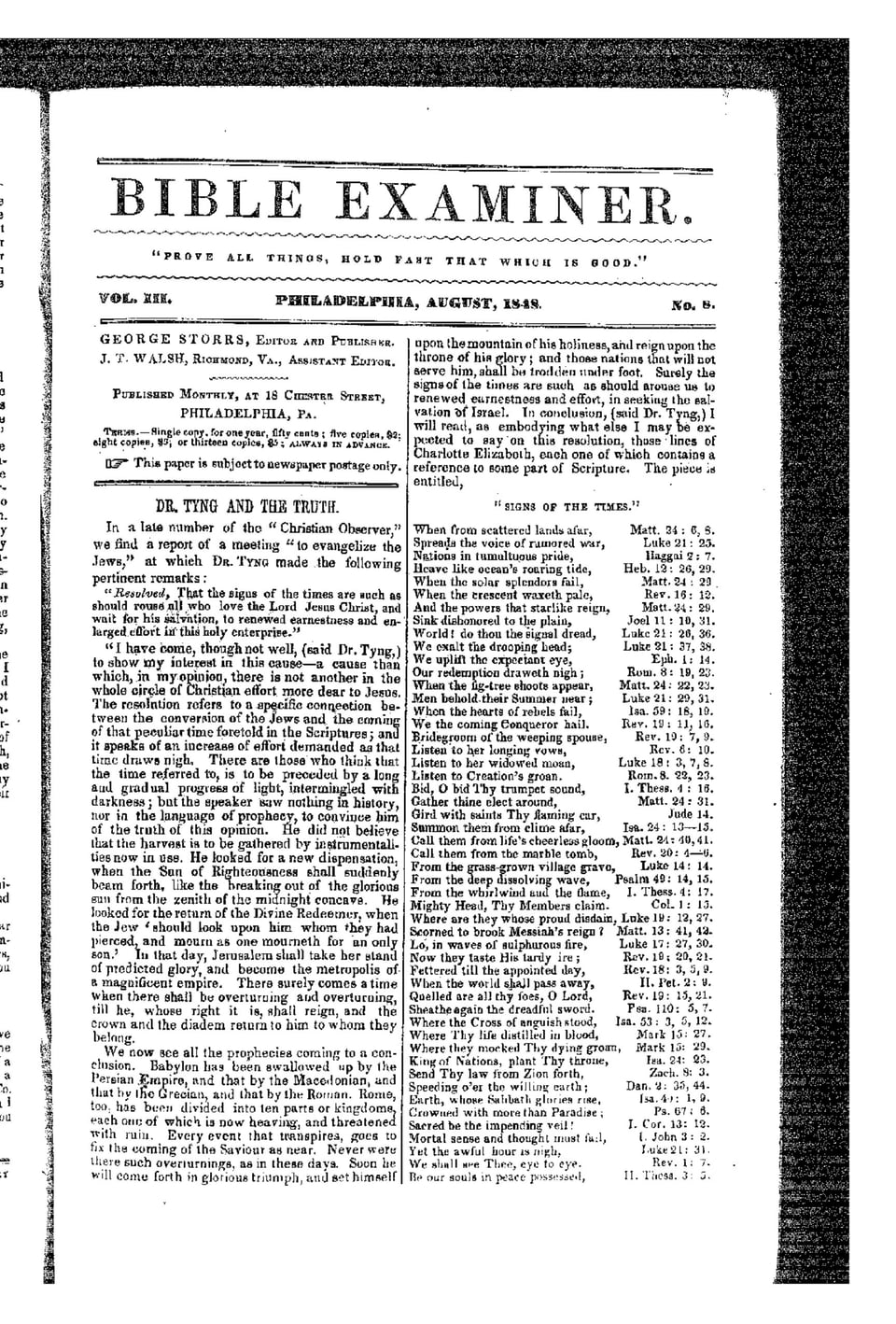
BIBLE EXAMINER.
"PROVE ALL THINGS, HOLD FAST THAT WHICH IS GOOD."
VOL. XII.
PHILADELPHIA, AUGUST, 1848.
No. 8.
GEORGE STORRS, EDITOR AND PUBLISHER. J.T.WALSH, RICHMOND, VA., ASSISTANT EDITOR.
PUBLISHED MONTHLY, AT 18 CHESTER STREET PHILADELPHIA, PA.
Terms. — Single copy, for one year, fifty cents; five copies, $2;
eight copies,5; or thirteen copies,5; ALWAYS IN ADVANCE.
This paper is subject to newspaper postage only.
DR. TYNG AND THE TRUTH.
In a late number of the "Christian Observer," we find a report of a meeting "to evangelize the Jews," at which Dr. Tyng made the following pertinent remarks:
"Resolved, That the signs of the times are such as should rouse all who love the Lord Jesus Christ, and wait for his salvation, to renewed earnestness and enlarged effort in this holy enterprise."
"I have come, though not well, (said Dr. Tyng,) to show my interest in this cause—a cause than which, in my opinion, there is not another in the whole circle of Christian effort more dear to Jesus. The resolution refers to a specific connection between the conversion of the Jews and the coming of that peculiar time foretold in the Scriptures; and it speaks of an increase of effort demanded as that time draws nigh. There are those who think that the time referred to, is to be preceded by a long and gradual progress of light, intermingled with darkness; but the speaker saw nothing in history, nor in the language of prophecy, to convince him of the truth of this opinion. He did not believe that the harvest is to be gathered by instrumentalities now in use. He looked for a new dispensation, when the Sun of Righteousness shall suddenly beam forth, like the breaking out of the glorious sun from the zenith of the midnight concave. He looked for the return of the Divine Redeemer, when the Jew 'should look upon him whom they had pierced, and mourn as one mourneth for an only son.' In that day, Jerusalem shall take her stand of predicted glory, and become the metropolis of a magnificent empire. There surely comes a time when there shall be overturning and overturning, till he, whose right it is, shall reign, and the crown and the diadem return to him to whom they belong.
We now see all the prophecies coming to a conclusion. Babylon has been swallowed up by the Persian Empire, and that by the Macedonian, and that by the Grecian, and that by the Roman. Rome, too, has been divided into ten parts or kingdoms, each one of which is now heaving, and threatened with ruin. Every event that transpires, goes to fix the coming of the Saviour as near. Never were there such overturnings, as in these days. Soon he will come forth in glorious triumph, and set himself
upon the mountain of his holiness, and reign upon the throne of his glory; and those nations that will not serve him, shall be trodden under foot. Surely the signs of the times are such as should arouse us to renewed earnestness and effort, in seeking the salvation of Israel. In conclusion, (said Dr. Tyng,) I will read, as embodying what else I may be expected to say on this resolution, those lines of Charlotte Elizabeth, each one of which contains a reference to some part of Scripture. The piece is entitled,
"SIGNS OF THE TIMES."
When from scattered lands afar,
Matt. 24: 6, 8.
Spreads the voice of rumored war,
Luke 21: 25.
Nations in tumultuous pride,
Haggai 2: 7.
Heave like ocean's roaring tide,
Heb. 12: 26, 29.
When the solar splendors fail,
Matt. 24: 29.
When the crescent waxeth pale,
Rev. 16: 12.
And the powers that starlike reign,
Matt. 24: 29.
Sink dishonored to the plain,
Joel 11: 10, 31.
World! do thou the signal dread,
Luke 21: 26, 36.
We exalt the drooping head;
Luke 21: 37, 38.
We uplift the expectant eye,
Eph. 1: 14.
Our redemption draweth nigh;
Rom. 8: 19, 23.
When the fig-tree shoots appear,
Matt. 24: 22, 23.
Men behold their Summer near;
Luke 21: 29, 31.
When the hearts of rebels fail,
Isa. 59: 18, 19.
We the coming Conqueror hail.
Rev. 19: 11, 16.
Bridegroom of the weeping spouse,
Rev. 19: 7, 9.
Listen to her longing vows,
Rev. 6: 10.
Listen to her widowed moan,
Luke 18: 3, 7, 8.
Listen to Creation's groan.
Rom. 8: 22, 23.
Bid, O bid Thy trumpet sound,
I. Thess. 4: 16.
Gather thine elect around,
Matt. 24: 31.
Gird with saints Thy flaming car,
Jude 14.
Summon them from clime afar,
Isa. 24: 13—15.
Call them from life's cheerless gloom,
Matt. 24: 40, 41.
Call them from the marble tomb,
Rev. 20: 4—6.
From the grass-grown village grave,
Luke 14: 14.
From the deep dissolving wave,
Psalm 49: 14, 15.
From the whirlwind and the flame,
I. Thess. 4: 17.
Mighty Head, Thy Members claim.
Col. 1: 15.
Where are they whose proud disdain,
Luke 19: 12, 27.
Scorned to brook Messiah's reign?
Matt. 13: 41, 42.
Lo, in waves of sulphurous fire,
Luke 17: 27, 30.
Now they taste His tardy fire;
Rev. 19: 20, 21.
Fettered till the appointed day,
Rev. 18: 3, 5, 9.
When the world shall pass away,
II. Pet. 2: 9.
Quelled are all thy foes, O Lord,
Rev. 19: 15, 21.
Sheathe again the dreadful sword.
Psa. 110: 5, 7.
Where the Cross of anguish stood,
Isa. 53: 3, 5, 12.
Where Thy life distilled in blood,
Mark 15: 27.
Where they mocked Thy dying groan,
Mark 15: 29.
King of Nations, plant Thy throne,
Isa. 24: 25.
Send Thy law from Zion forth,
Zach. 8: 3.
Speeding o'er the willing earth;
Dan. 2: 35, 44.
Earth, whose Sabbath glories rise,
Isa. 40: 1, 9.
Crowned with more than Paradise;
Ps. 67: 6.
Sacred be the impending veil!
I. Cor. 13: 12.
Mortal sense and thought must fail,
I. John 3: 2.
Yet the awful hour is high,
Luke 21: 31.
We shall see Thee, eye to eye.
Rev. 1: 7.
Be our souls in peace possessed,
II. Thess. 3: 5.
While we seek our promised rest, Heb. 4: 9.
And from every heart and home, II. Tim. 4: 8.
Breathe the prayer, "O Jesus, come!" Rev. 22: 20.
Haste to set the captive free, Isa. 49: 9.
All Creation groans for Thee, Rom. 8: 19.
We invite the attention of Presbyterians, and all others influenced by the Doctor's authority, to the following items in the above extract:
1st. Dr.Tyng "did not believe that the harvest is to be gathered by instrumentalities now in use." 2d. "He looked for a new dispensation."
3d. He looked for the return of the Divine Redeemer, when the Jews "should look upon him whom they had pierced, and mourn as one moun-eth for an only son."
4th. "In that day, JERUSALEM SHALL TAKE HER STAND OF PREDICTED GLORY, AND BECOME THE METROPOLIS OF A MAGNIFICENT EMPIRE." 5th. "We now see all the prophecies coming to a conclusion."
6th. "Every event that transpires, goes to fix the coming of the Saviour near."
The above points embody important truths concerning the Kingdom of God; and we cordially commend them to the attention of our readers.
A SECOND REJOINDER TO DR. THOMAS BY HENRY GREW.
The essential importance to salvation of believing and obeying the Gospel of the Kingdom in respect to those who hear the Gospel, is as much my "impregnable position" as it is that of my friend; nor am I conscious of cherishing any more "love" or "charity," which is not in accordance with truth, than he has expressed. He remarks that "The truth belongs to God, not to me." True, but he must excuse me for not admitting that all his explanations of the truth belong to God. I trust that, by divine favor, it is my love to God's truth, or what I understand to be such, that I oppose some of his views. My innost soul responds to his remarks on the importance of an inflexible adherence to the word of the Lord.
NO MEN DIE PENITENT WITHOUT FORGIVENESS.
On Matthew 12:32, Dr. T., in a former article, remarked—"Does not this imply that there are some offences, whether of omission or commission, that will be forgiven in a future age?" Had I not reason to suppose that my friend thought that some dying in impenitence would be forgiven? He however now explains more fully, and without affirming, he thinks it to be according to "the scope of the word," that some men of "penitence" must wait for forgiveness till the "Future Age;" because, forsooth, the committee of the church had not the power of forgiving their sins in this! It appears to me that this speculation is a violation of an important principle of the divine government, and of the plain teaching of the Spirit of Truth, that "he that confesseth and forgaketh his sin shall find mercy." It was necessary indeed for the reformed Corinthian to receive forgiveness from the Church, in order to be restored to their
fellowship, but this was not necessary in order to his being forgiven of God. If a man in similar circumstances, as my friend's case to illustrate the subject supposes, truly repents, God waits for no committees or churches to pardon him. "Let the wicked forsake his way—and let him return unto the Lord who will have mercy, and to our God who will abundantly pardon." So the Publican found it without going to the Council or Sanhedrim. Churches and Committees may err through partiality or imperfect judgment. Our intelligent friend, admitting that men dying in impenitence are never forgiven, asks, "What has that to do with men of faith, dying in sins 'not unto death'?" Here is another anomaly! What prophet or apostle ever taught that men of faith die in sins? If men of dead faith were intended, it is perfectly correct, but I do not so understand Mr. Thomas. I would remind my friend that Paul directed the Corinthian Church and not a "Committee of brethren," to "deliver" the offender "to Satan for the destruction of the flesh," &c.
UNIVERSAL RESURRECTION.
I have now to examine the single passage adduced by Mr. Thomas to prove the "non-resurrection of millions." Isa 26:14. Isa. 25:11, and 26:13 are quoted, but the 14 ver. is the only one that has any word on the subject of "non-resurrection." Who are the lords that "had dominion" over Israel, of whom it is said "they shall not rise?" Nations, as my friend justly remarks, "Egyptians, Philistines," &c. This is confirmed by the 15 ver. It is the "nation" that the Lord removed far unto all the ends of the earth, thus scattering and destroying it. This explains the subject of their death, or destruction, or non-resurrection. As nations "they are dead," as nations "they shall not live." As nations "they are deceased, they shall not rise." Such is the fact respecting those powerful nations which once "tyrannized over Israel." The connection of the passage thus teaches that it is in perfect harmony with the plain declarations of inspired truth, that "ALL that are in the graves shall hear his voice, and shall come forth," &c. "there shall be a resurrection—of the just and unjust." "And I saw the dead, small and great, stand before God," &c. I object to our friend's comment on the word ALL in John 5:28. Our Savior does not say, all that have done good or evil shall come forth, neither does the connection require us to limit his words to such. He says, "all that are in the graves shall come forth." All in the graves, whether "small" or "great," as John saw in prophetic vision, Rev. 20:12, whether capable of moral action or not. The "all" in the 28 ver. therefore "is (not fully) defined in the next." The fact of those who are morally responsible for their actions receiving their due reward, is perfectly consistent with the resurrection of those who died too "small" to be thus accountable. The connexion consequently does not warrant the limitation. If it did, it would surely avail little to prove the non-resurrection of the lords over Israel, who did "evil" by wholesale. The word "all," if limited to those who have actually done good and evil, must include them.
Dr. T. remarks, "As to the Gentiles who had sinned without law," they perish. True, but when will they finally perish? "In the day when God shall judge the secrets of men by Jesus
Christ." Rom. 2: 12 to 16. This proves their resurrection. It is equally evident from the 12 ver. and connection that those who "have sinned without law" (i.e. the written law) and those who have sinned in the law, shall be judged on the same day or period. By what authority does my friend connect the 16th ver. with a part of the 12th only? The apostle makes no such distinction as his remarks imply. He asks, "How would friend Grew judge Cossacks, Hottentots, Caffres," &c. "by Paul's Gospel, or Moses' law, who had never heard of the one or the other?"—"Where no law is, there is no transgression," and "without faith it is impossible to please God." These two principles decide the fate of millions. "Where there is no vision the people perish." Here I learn the source of my friend's error respecting the "non-resurrection of millions." It is a consistent inference from false premises. If indeed there is no other law given to man than the law of Moses and the Gospel, then have many no law by which they may justly be condemned. It is not so. "Cannot the reader see," and cannot Mr. T. see, that "the gentiles which have not the law (or the Gospel) are a law unto themselves, which show the work of the law written in their hearts, their conscience also bearing witness, and their thoughts the meanwhile accusing or else excusing one another!" Rom. 2: 14, 15. No rational men are without all law, "because that which may be known of God is manifest in them; for God hath showed it unto them. For the invisible things of him from the creation of the world are clearly seen, being understood by the things that are made, even his eternal power and Godhead; so that they are without excuse; because that when they knew God they glorified him not as God," &c. Rom. 1: 19—21.
I can assure Mr. T. that my vision is not at all bewildered by "that little monosyllable 'all.'" That it is often used in a limited sense, I am fully aware; nor is my belief that it is sometimes used in a literal sense, any proof to the contrary. Quoting Heb. 9: 27 from memory, I made a common mistake, inserting the word "all." I did not, however, give it in capitals, as my friend incorrectly quotes me. The passage is equally pertinent to my argument without that word as with it. My object was not to prove that all men die, but that all who do die are to be raised. "It is appointed unto men once to die; but after this the judgment."
It appears to me that Paul teaches that death and subsequent judgment are appointed unto the same persons, at least to those who are morally accountable, which the "lords" who had "dominion" over Israel certainly were.
FAITH IN PROPHETIC TRUTH NECESSARY.
Mr. T. observes: "Mr. Grew doth not like my position, that 'a man cannot be saved in any sense, unless he also believe the prophetic truths concerning the kingdom of God.'" This is not a fair version of the matter. This is not the position which I object to. I know that "the subject matter of these truths is the kingdom, and the kingdom is the subject of the Gospel." "The testimony of Jesus is the spirit of prophecy." The position I object to, is this, "we must believe the whole truth, or—be dashed to atoms." So affirms the Doctor. I have put the objectionable words in capitals. The two positions are vastly different, as every intelligent reader must perceive. No
man can believe the gospel without believing prophetic truths. "He that believeth not (the gospel) shall be condemned." Millions, however, have believed and obeyed the gospel, who have died without a knowledge of "the whole truth." If my learned friend is an exception, I believe him to be the first, except "the faithful witness," since the foundation of the world.
I am happy to see him recede from this position as he does in his last article. To "believe the whole truth," implies, as I have wrote before, that we "discern accurately all things which all the prophets have foretold concerning the kingdom of God, and the true periods of their fulfilment." i.e. so far as these periods are recorded. Mr. T. himself says that "an incorrect belief of doctrine and facts is a belief of error." Mr. T. now says, "I am far from saying, that such a discernment is necessary to entitle a man to entrance in the kingdom of God." Very good. We will now hope that we shall not be "dashed to atoms," although we have not yet attained, neither are already perfect in the knowledge of "the whole truth." My friend will now have to furnish himself with an answer to such of his questions to me as the following:
"Which of those particular truths have we authority to dispense with as unnecessary to salvation?" Most cordially do I join with him in saying "that illumination in the one thing is essential, not as a mere matter of knowledge, but that this knowledge may effect a renewal unto life through a participation in the divine nature." It will be in good time to call upon me "to adduce chapter and verse" to prove that men can "be saved without faith in the kingdom;" when I affirm it. I respectfully ask my friend to exercise his rational powers sufficiently to discern the difference between having "faith in the kingdom," and having knowledge of "the whole truth;" also to discern the distinction between quoting the words of an author, as a happy expression of your own thoughts, and quoting him as "authority." No "Johns of any sect" will I "introduce," as authority, except the inspired Johns of the sect of the Nazarene.
IMMERSION NOT ABSOLUTELY ESSENTIAL TO SALVATION.
Dr. T. maintains that "repentance, immersion and holiness, are indivisibly essential to salvation in the kingdom of God." I object to this sentiment as unscriptural and absurd. I am, however, inaccurately represented in the following remarks: "The apostle Paul says: 'Repent and be baptised, every one of you, in the name of Jesus Christ.' It is not absolutely necessary, says Mr. Grew, for 'the immersed are not excluded from the holy kingdom of God.'" Now I say that it is absolutely necessary, in order to stand complete in all the will of God, but not to salvation. With respect to those who know it to be their Master's will, I do not deny that it is essential to salvation. I deny that "the effect of such teaching" is to influence any not to conform to the commandment, except it be those selfish souls who have no right to the ordinance, until they have love for God sufficient to induce them to do something more for his glory than what they suppose to be absolutely essential to their own salvation.
Dr. This distinction between being "weak in faith," and being "weak in the faith," is of no avail to set aside the proof from Rom. 14:1, that we are bound by Christian law to receive those "who are in the faith" of Christ, who are weak or erroneous on the subject of immersion.
To this law, which is as positive and important at least as that of immersion, there is no exception. A single exception would divide the body of Christ. The command requires the forbearance of all errors of judgment which are not totally incompatible with being in the faith of Jesus Christ.
So far from immersion being essential to being "in the faith," no man has any right to immersion who is not already in it. When the Eunuch declared his faith in Jesus Christ as the Son of God, Philip recognized him as a Christian and baptised him as such. It is true faith in Christ, which implies the principle of love, and willing subjection to Jesus, which constitutes us Christians. It is not necessary to "adduce a single case from the New Testament" of a person being recognised as a Christian who was weak or erroneous on the subject of immersion. It does not appear that there were any such. There was no occasion for it. The teaching of the apostles was perfectly harmonious, not diverse as that of the sects of later ages. The law of Rom. 11:1 is just as authoritative now, as it would be if it had been applied to a thousand such cases in the apostolic age. The law itself is authority sufficient without any example. There is no way of evading it but by denying that the unimmersed are "in the faith." You may find "a white crow or a black swan" as easily as a single case in the New Testament of a person being recognised as a Christian who believed the Deity is three persons; shall we therefore deny the christianity of all such? My argument from 1 Cor. 8:11, remains unrefuted. It is indeed easy to say, "this is no case in point," and as easy for me to say that it is. My friend says of the person referred to in the 7th verse, "His 'views of the unity of God and of idols were' not 'incorrect.' I say that the apostle affirms that they were. Now for the proof. "But to us there is one God, the Father of whom are all things and we in him; and our Lord Jesus Christ, by whom are all things, and we by him. Howbeit there is not in every man that knowledge; for some with conscience of the idol unto this hour eat it as a thing offered unto an idol; and their conscience being weak is defiled." Yet the Doctor says his views of the unity of God and of idols are not incorrect! Why then, I ask, was his conscience weak and defiled, any more than that of the apostle and others in eating such meat if he knew correctly, like them, "that an idol is nothing in the world, and that there is none other God but one?" I ask the reader to peruse the entire chapter and see whether or not the apostle does not argue the indivisibility of a correct knowledge of the unity of God and a correct knowledge of idols. It is manifest from the 7th verse that the person referred to had not a correct knowledge of idols; and from the whole connection it appears, that it was because he had not a correct knowledge of the unity of God, as the apostle most plainly declares in the 7th verse, the antecedent of which, is the unity of God in the 6th.
But "we all have knowledge" on those things, says Paul, my friend remarks, to prove that the views of the person referred to respecting the unity of God and idols were not incorrect. Paul shall explain himself how he uses the word "all" in this case. "We know that we all have knowledge—as
concerning therefore the eating of those things offered in sacrifice unto idols, we know that an idol is nothing. Howheit, there is not in every man that knowledge," &c. Such is the apostle's version of the word "all." Mr. Thomas contends for an exception in the word "all" in John 5:28, where Jesus Christ makes none, but rejects one which the apostle here plainly and positively makes. Was it because "that he sees it dancing before his eyes like a will-o-the-wisp?"
BORN OF WATER.
Notwithstanding Dr. T.'s assurance, I am "rash enough to say" that this term does not necessarily mean baptism. As he excludes from salvation all the unimmersed. I hold him to adduce one passage which necessarily implies their exclusion from the kingdom of God. John 3:5 is not such a passage. "Mr. Grew (does) regard Jesus as authority" in all cases; but not men's explanations of his words. I object to affixing the sense of literal immersion in water to this term "born of water" in this passage:
Because it is not according to the order of the Gospel to represent our being first baptized and then born of the Spirit, or to represent that these things are simultaneous. Men are born of the Spirit previous to their being qualified for baptism.
Because such a construction is a violation of those passages which connect salvation and inheritance in the kingdom of God with true repentance towards God and faith in our Lord Jesus Christ, which precede immersion in water, according to the order of the Gospel. It may be said that according to this reasoning the penitent believer may be saved without subsequent obedience to the commands of the gospel. It is not so. True repentance, is reformation, and necessarily implies obedience to all the known commands of God, but it does not necessarily imply the knowledge of, or obedience to, the ordinance of immersion. There are true disciples of Christ who could not be immersed without sin; for "whatsoever is not of faith is sin." On this subject they are "weak, (i.e., erroneous,) though in the faith.
Because the scriptures of truth furnish a better and more consistent construction. Compare Eph. 5:25 to 27. "Christ also loved the church, and gave himself for it; that he might sanctify and cleanse it with the washing of water by the word," &c. Here the renewing and sanctifying influence of the truth on the soul is represented by the washing of water. In John 3:6 the same blessed work of divine favour is represented by being "born of water." Nor is there any tautology. Mr. T.'s "perfect reductio ad absurdum," is a man of straw of his own creation. We are under no necessity of giving his version of our views; "Except a man be born of spirit and of spirit." The phrase "born of water," refers to the means by which the work of renewing is done; born of the Spirit to the agent that does it. "Of his own will begat he us with the word of truth." The phrase born of water by the word, would be as proper as the phrase "washing of water by the word," found in Eph. 5:26. Mr. T.'s positiveness respecting the import of the passage is the more remarkable, as he himself confesses that the word "born" is used as a "metaphor." Of what avail then is it for him to say that to be literally born, is "an emergence from a place in which the subject was previously out of sight." Does he not abandon this idea in respect to the term, born of the Spirit?
Surely he will not say that being born of the Spirit is "an emergence from (the Spirit)—in which the subject was previously out of sight;" but if a man may be metaphorically born of the Spirit without such an emergence, he may be metaphorically born of water, without such an emergence.
Finally, I object to the exposition because it involves the absurdity of the Almighty excluding from his kingdom those who love and serve him better than some whom he receives. It is in vain to deny that there are believers in the Gospel who, through false teaching, are in error on the subject of immersion, who, on the whole, are more like Christ, more devoted to the service of God, more obedient to his commands, more dead to the world, and better practical Christians, than some real Christians who are immersed. Surely we may demand something more than a "metaphor" to sustain such an incongruity in the divine government as this.
The fact of immersion being "a gracious privilege" is no proof that "it is not the duty" of the believer. It is both. Being a command, it is our duty to obey. Its being "worth nothing," if "submitted to as a mere duty," on the principle of selfishness, is no proof that it is not a duty.
I thank my respected friend for his caution. If, however, I am an "apologist for error, ignorance and disobedience," because I deny the absolute necessity of a discernment and practice of "the whole truth" in order to be saved, the Doctor now is so likewise, for he remarks, "I am very far from saying, that such a discernment is necessary to entitle a man to entrance into the kingdom of God." If to oppose the magnifying of error beyond truth, is to be an apologist for error, I wish to be such. Let my friend also "beware" and listen to a caution of higher authority: "Why dost thou judge thy brother, or why dost thou set at nought thy brother?" The unimmersed believers are not to be excluded from the christian brotherhood.
I would suggest for serious consideration, whether we do not break (I do not say one of the least, but) one of the important commandments in breaking the law of christian forbearance? Rom. 14: 1-4; 15: 7. It is because I wish to "do and teach" all the King's commandments, that I am endeavoring to teach my friend this law, and save him from the evil of rejecting those whom Christ receives, Rom. 15: 7; and of offending the little ones who believe in him.
In conclusion, noticing that my dissent from the construction given to Isa 26:13,14 subjects me to the charge of being "no sane man," I beg leave to say, "I am not mad, most" modest Doctor, "but speak the words of truth and soberness."
HENRY GREW.
CHRISTIAN FELLOWSHIP—NO. III.
VI. HUMAN CREEDS PREVENT THE SPREAD OF THE GOSPEL—ROB GOD AND HIS POOR.
What is the greatest obstacle to the triumph of the Gospel among ourselves? It may be said—"The corruption of the human heart." But we ask, again, if the sectarian divisions, caused by the introduction of human creeds, as tests of our Christian regard, do not furnish the largest portion of the food by which the "corrupt heart" is nourished? Do not the unconverted find their strongest apology for neglecting religion, in the fact, that religionists cannot agree among themselves! He looks at the different creeds, conflicting as they do, and all claiming to be right,
as so many proofs that Revelation is full of contradictions; and therefore unworthy his belief at all; and when he further sees the spirit, which these conflicting systems inspire, he concludes it is the natural result of the religion of the Bible, and so rejects that blessed book altogether, or concludes to have nothing to do with religion till its professors shall be more agreed among themselves. He says, it may be, I have peace with my neighbors, but if I become a religionist, I must take sides with some of these parties; this he resolves not to do; and, therefore, resolves not to have anything to do with a religion that must bring strife and contention where he now has peace. Multitudes, it is to be feared, are thus stumbling into perdition through the instrumentality of creed makers, and the divisions which are the result of these inventions of men. How many revivals have been prematurely brought to a close by beginning to creedise young converts, and even those under conviction, till their souls have been turned back to destruction.
Another way, in which human creeds prevent the spread of the Gospel, is, The different creedists spend much time and labor to prove that their opponent's creed is false and absurd. How much time is spent in this way it is impossible to tell! but, that very much is thus spent, none will deny. An aged minister once said, it was his opinion, that at least one half the time of ministers was taken up in this work. Perhaps he was not far out of the way, if we reckon private as well as public labor.
In consequence of the creed system, there must be two, three, four, or more, ministers employed in a field where one, with the assistance of experienced laymen, would be all that is necessary. Here, then, is a drawback to the spread of the Gospel, by taking the extra number from destitute places.
These extra ministers, in one place, not only prevent the spread of the Gospel, by being cut off from destitute fields, but absorb, for their support, the money that is needed to send the Gospel elsewhere. Nor is their support the only item; meeting houses must be built for each of them, and the people divest themselves of the means of sending the Gospel to the destitute, and perhaps involve themselves in debt and thus rob God, and cause their charities to the poor to be meagre indeed; and all for what? To keep up these man-made arrangements human creeds and sectarian divisions.
Now, look at that country place, or small village where there are just enough, if they were left untrammelled with human creeds, to sustain an humble minister of Christ. The different creed-makers have corrupted their minds so that they cannot agree; and each party must content themselves with "occasional preaching." Each party, too, is jealous of the other, and if anything is preached by the occasional preacher that is opposed to the other's creed, their preacher, when he comes round, must spend his time, in his occasional sermon, in vindicating his own creed, and showing the absurdity of his opponent's. Thus neither party, in fact, is supplied with the pure preaching of the Gospel, or only in a very limited manner.
Let us see if this creed business has no effect in preventing the spread of the Gospel among the heathen. In the first place, by absorbing the funds of Christians, as stated above, and requiring more ministers than are necessary, were it not for these human creeds, the Gospel is hindered from being sent abroad.
In the next place, if you can raise funds, and find men to go, if they are of different sects, they must either lay aside their creeds, from the sight of the heathen, or be subjected to all the drawbacks and hinderances already mentioned, at home; and greater hinderances, too; because, the heathen must, and will, judge of the Gospel by the influence it has upon these missionaries; and if they see them divided, so that they cannot walk together, they must be led to doubt the reality and importance of a religion, professing to be a religion of love, which, as they suppose, inspires hostility among its votaries. If these missionaries do lay aside their creeds, on heathen shores, and labor together as brethren, in order that the cause may not be hindered, it is proof that these human creeds are not only useless but pernicious; and that men, while they have only one object in view, viz: the glory of God and the salvation of men, practically acknowledge the fact of their pernicious influence. Let them, then, be given to the "moles and the bats" along with all other "idols."
Once more—Suppose a missionary should go to a heathen land alone, and commence his labors by exhibiting, the prayer of our Lord, in the 17 chap. of John, together with his "new commandment," and the Saviour's testimony, that "all men" should know his disciples by their "love one to another." A heathen, who is jealous of any new religion, begins to inquire, whether Christians in America, are all one, and do all love one another? The honest missionary must tell the truth, or remain silent. If he remains silent, would it not throw a suspicion over him that would be likely to destroy confidence in his cause? But if he tells the truth, would not the astonished heathen naturally conclude his religion was a deception? That it does not accomplish what it professes? That its professed votaries, so far from being one and loving one another, are tens, yea hundreds of parties? And would he not say, "Go home and carry out the principles your Bible professes, and then it will be time enough for you to ask us to embrace your religion."
LETTER FROM BR. P. M. WAY.
The writer of the following letter is a minister of the Gospel, of the Methodist persuasion, with whom we have had many pleasing interviews, and under whose ministry we often sat in 1836-7, when residing in the city of Utica, N. Y. We shall append some remarks on the closing part of his letter, and hope he will favour us with a reply.
Br. Storras.—"I have considered the doctrine of the annihilation of the wicked, and believe I have gone deep into its investigation, and am frank to admit, if it be an error, it has more apparent support from the Bible than any error with which I am acquainted, and I probably should have embraced it as truth, had not light been thrown on my mind by reading some of the writings of Swedenborg. And yet I cannot adopt one peculiar sentiment of that author. I look upon his writings as the emanation of a great mind in ruins. Newman, in a little work on "Fascination," has probably given him a correct character. I confess to you, that, in my opinion, the character generally ascribed to God, as "A just God," dealing with sinners, by most preachers, is as dishonorable to God as the Alcoran is to our Lord Jesus Christ. I will merely say, without arguing the point, it appears plain to my mind, that it takes all of life to form a character for the future; and that character abides with us when probation ends. We may, or we may not, conform ourself to God's laws; and the result of either course is as certain as the laws of attraction. It is enough that "the reward of every man's hands shall be given him." To exclude the sinner from heaven is the best that God can do for him, and banishment from his revealed presence and glory is more tolerable than to dwell in its full blaze.
As it respects the unconscious state of the dead, between death and the resurrection, I am fairly at issue with your opinion. I need not say, perhaps, it is a pleasing hope that when this life of toil and suffering shall end, I expect to associate with my good brother Storms, and all who love the Saviour, in scenes of blessedness, "Where we shall know as we are known," whilst the scenes of time are still being enacted, till earth's drama closes and Christ comes to reign. I readily call to my mind a number of passages that confirm this hope. "In my Father's house are many mansions. I go to prepare a place for you. Where I am there ye shall be also." "We know if our earthly house of this tabernacle were dissolved, we have a building of God, eternal in the heavens." This hope inspires the suffering, toil-worn pilgrim with a "desire to depart and be with Christ, which is far better." Texts like the above, and there are not a few, establish the doctrine beyond a doubt, in my mind, and no criticism, that I have seen, has raised even a question. If so plain a truth must be denied to sustain another theory, it certainly throws doubt on that theory.
Yours for truth,
P. M. WAY.
Syracuse, N. Y., July 15th, 1848.
REMARKS ON THE FOREGOING.
We certainly shall not quarrel with Br. Way, nor any one else, merely because he does not see as we do as to the state of the dead. We are glad to have him express his "issue" with us frankly. We would suggest, however, that to cut down a tree we must lay the axe at its roots. The root of the whole subject lies in this one question—"Is man immortal by creation, or generation?" If he is, then the texts Br. Way has presented are good and valid in proof of his consciousness when dead: but if he is not, then those texts must have some other application than that he gives them. The sense of these texts all turns on this point. To prove man immortal by creation or generation, we must have some plain Scripture testimony-inference cannot do it. Here, then, we join "issue" with all who dissent from our views, and affirm There is not a solitary text in the Bible that affirms immortality of man, except as the gift of God at the resurrection; and then only given to those who by patient continuance in well doing seek for it. Compare Rom. 2:7, with 1 Cor. 15:16-18, 53, 54.
The first three chapters in Genesis establish on an immovable basis the fact that man was not created immortal. To threaten an immortal being with death would surely be a very great anomaly, if not a palpable contradiction. The term immortal signifies "exempt from death;" "im" signifying "not;" thus prefixed to "mortal" makes "not mortal." or "exempt from death." Such was not Adam by creation—such are none of his posterity by any law of their being. The plain declaration
of the scriptures of truth, with respect to Adam, after he sinned, is, that God excluded him from the tree of life "lest he take and eat of it and live forever;" or, become immortal in sin. Here the evidence is clear, that man was not immortal by his creation, or he would not need the tree of life to perpetuate his life; and it is equally clear that his Creator determined on the death of the man he had made without the exception of any part of him; or, in other words, he determined to reduce man to the elements from which he came; and as he was unconscious before creation, so at his death he became unconscious again; or else Adam did not die, and the serpent told the truth.
If this position is correct, then we need and must have, in order to faith, a plain revelation of the fact that man has an immortal part, if such is the fact. Will any man pretend that we have any such revelation? Tell us where it is to be found. We again affirm, as our conviction, it is no where in the Bible. If it is, those who are at issue with us can show it; and we will give them ample room in the Examiner to do so.
We will notice at this time only one of the texts presented to us by Br. Way, in proof that the dead are conscious, viz.: "In my Father's house are many mansions, I go to prepare a place for you. Where I am there ye shall be also." This text contains a delightful truth; and the only difference between Br. Way and ourselves, on it, relates to time. The connection settles that. "If I go and prepare a place for you, I will come again and receive you unto myself," &c. John 14: 3. Now the simple question is this—Does Christ come again at the death of his saints? To settle that point, we ask for a single text of Scripture that says so. But secondly. How did he go away? Was it personally—bodily—visibly, or otherwise? Let the first chapter of the Acts of the Apostles forever settle that point. As he goes up, or went "away" he is visible, and the "white apparel" men, or angels, that appeared on that occasion, testified in accordance with our Lord's assurance in John 14th, quoted by Brother Way and ourselves, "This same Jesus shall so come in like manner as ye have seen him go into heaven." Here, then, is the identical coming again of which Jesus spake: and it is not at death; for so he never did come at any man's death. Besides, it is clear, the disciples did not understand our Lord's promise of coming again to refer to death at all; for, when he said concerning John: "If I will that he tarry till I come, what is that to thee?" the disciples concluded, that, John "should not die." But upon the common theory, had they believed it, they could not have come to any such conclusion.
The time; then, when Jesus will come again and receive his saints unto himself is, "at the last day," as may be clearly seen in John 6: 39, 40, 44, 54, where our Lord four times declares, concerning those to whom he will give eternal life, "I will raise him up at the last day;" that is the time when he "will come again and receive" his people unto himself, that where he is they may be also.
The fact that "it is a pleasing hope that when this life is" ended, we shall at once "associate with" our "good" brethren "in scenes of blessedness, whilst the scenes of time are still enacted, till earth's drama closes and Christ comes to reign," does not prove that such hope is well founded. The apostle presented another and a very different
"hope" concerning Christians: 1 Thess. 4: 13.
He there says: "I would not have you to be ignorant, brethren, concerning them which are asleep, [not associating in scenes of blessedness] that ye sorrow not even as others which have no hope."
No hope of what? Clearly no hope of a resurrection, without which, he had declared, 1 Corth. 15: 18, they "are PERISHED," or would have no future life; making it all turn on the fact of a resurrection—that was the apostle's "pleasing hope;" as the next verse shows; "for," he says, "if we believe that Jesus died and rose again, even so them also which sleep in Jesus will God bring with him" from the dead; for, "the God of peace brought again from the dead our Lord Jesus." [See Heb. 19: 20.] But when shall this hope be realized, Paul?
The answer is, when "the Lord himself shall descend from heaven with a shout, with the voice of the archangel, and with the trump of God;" then "the dead in Christ," however long they have been asleep, "shall rise first; then we which are alive and remain shall be caught up together with them to meet the Lord in the air; and so shall be ever with the Lord. Wherefore, comfort one another with these words." This is "the pleasing hope" that the Bible holds out to us; this is the glorious "association" to be realized when our Lord shall "come again and receive" all his loving followers unto himself, that where he is there they may be also. Blessed day; glorious hope. Soon may that day arrive. All other hopes of being with Christ we consider delusive hopes. But, some perhaps will say, "If it is a delusion it is a blessed delusion."
We answer, not so; for the common hope of professed Christians causes them to lose sight of two of the most glorious doctrines of the Bible—doctrines too, which the apostles dwelt upon more than any other, and which the present churches seem to think less of than any other, viz: THE SECOND PERSONAL ADVENT OF CHRIST, AND THE RESURRECTION OF THE DEAD. Any doctrine which puts these two great events in the back ground, or causes them to be looked at as of little importance, cannot be a "blessed delusion;" but the doctrine of man's natural immortality, and, by consequence, consciousness when dead, does obscure and eclipse these two grand events, and makes the coming of Christ and the resurrection of no apparent importance, and substitutes another hope, viz.: that of "going to heaven at death." But "the dead praise not the Lord." Psa. 115: 17; and "there is no knowledge in sheol"—the state of the dead. Eccl. 9: 10. All our hope, then, is in the coming again of Christ, at the last day, and the resurrection of the dead.
"TRUTH TESTED BY SCRIPTURE, In Six Letters to a Friend."—We have received a copy of this work from the author, Br. A. B. Magruder, Charlotteville, Va. It is a very well arranged Scripture presentation of truth, on the end of the wicked and state of the dead. We hope it may be widely circulated. If we can find room we shall give extracts from it. It is a pamphlet of thirty-two pages, octavo. The price is not stated.
THE EDITION of this paper precludes every Lord's day at Commissioners Hall. Third street, below Green, east side; at 10, A. M., and in the evening at a quarter before 6 o'clock.
BIBLE EXAMINER.
PHILADELPHIA, AUGUST, 1848.
ARE THE WICKED IMMORTAL?
"The soul that sinneth it shall die."—Bible.
CONTROVERSY.—Some men think controversy a dreadful matter, and should be avoided. Such a cry we regard as the offspring of bigotry and sectarianism. When individuals or associate bodies become determined not to make any further progress, controversy to them is a ruinous matter! What truth was ever elicited without controversy? None, except by direct revelation, and then it never spread without it. The whole life of our Saviour was one of facts and controversy; nor were the apostles less favored in that respect. Martin Luther and the Reformers had to travel the same road; the Pope was greatly offended with it, as all bigoted sectarians have been ever since, and always will be. Controversy is essential to progress in knowledge, and the development of truth: but, the spirit in which it is often conducted is not essential. Let men guard their spirit, but never cease controversy. Lazy drones, who hate the labour necessary to progress, and those who fear the light, lost their bantling sect should be dissolved, may cry out against it, and glory that they "never change," and that they have not a new notion in their heads, but, he who would obey the divine injunction, to "grow in knowledge," must be wide awake to the work.
We are glad, in the discussion going on in the Examiner, between Br. Grew and Dr. Thomas, that we have two such able men engaged; and, especially so, that they are both believers in immersion as the only mode of baptism. It is not the mode of the ordinance that they discues, but the importance of it. We have been repeatedly urged to give our views on the subject of baptism. We will do it in few words: "Let every man be fully persuaded in his own mind." If we see a necessity to say more hereafter, we shall do so. If we can say nothing new we choose to keep silence. We are often astonished with the arguments some men use in advocating their peculiar views of the subject; but they satisfy their own minds, and we should not be likely to convince them of error. Dr. Thomas maintains that immersion is essential for admission into the kingdom of God, but that it is to be administered only to those who "believe the word of the truth of the Gospel." On the other hand, the "Christian Magazine," Nashville, Tenn., is just as strenuous for immersion as essential "for the re-mission of sins." The latter, probably, can tell us now was consumed after immersion are to be pardoned without being immersed again, or, how the "penitent thief" obtained "remission of sins;" and the former, doubtless, can tell us how the dying thief is to entor "Paradise," if such a case ever occurs; or, how any other dying "believer," whose circumstances have prevented his immersion, is ever to enter the kingdom of God. It took a vision to convince Peter, even "after the day of Pentecost," that all salvation was not confined to the Jews; but, he was convinced and made his confession—"Of a truth, I perceive that God is no respecter of persons; but in every nation he that feareth him, and worketh righteousness, [according to the light he hath] is accepted with him." For, saith our Lord, "This is the condemnation, that light has come into the world, and men loved darkness rather than light, because their deeds are evil." It is rejecting light, and sinning against it, from love to gain, applause, power, or sinful indulgences, that will be the condemnation of men at "the Judgment seat of Christ."
We suggest to Brethren Grew and Thomas, if they choose to continue the discussion, that they take up one of the topics at a time, embraced in their controversy; so as to shorten, if possible, their articles, but still freely and fully examining all the points, though it may take them longer to accomplish their object. We ought perhaps to have stated, at the time, that we took the liberty of inserting the index heads through Br. Thomas' last article. We think such heads give more interest to lengthy articles; especially where several topics are embraced.
"Born of Water."—We have long since adopted the principle that where any doubt may arise as to the meaning of an expression uttered by our Lord, the safe course is, to inquire how the disciples understood it "after the day of Pentecost." Some affirm that a man must actually "hate his wife" to be a disciple of Christ; reasoning from Lk. 14:26; while an apostle of Christ commands—"Husbands love your wives;" Eph. 5:25. Our Lord says, "Except ye eat the flesh of the son of man, and drink his blood, ye have no life in you." Some of his hearers understood this expression carnally, and thus committed a blunder that proved fatal to them, and caused them to forsake him wholly. The Saviour afterwards explains his words by saying—"It is the spirit that quickeneth; the flesh profiteeth nothing: the words I speak unto you they are spirit and they are life."
Whatever may be said in favour of immersion, we are satisfied it is a total misapprehension of our Lord's words, John 3:5, to apply them to water baptism. "Except a man be born of water and the spirit he cannot enter into the kingdom of God." But, "water does" not "mean spirit" here; but it
does mean that which purifies, cleanses, or sanctifies; for, "without holiness no man shall see the Lord;" or, shall "see the kingdom of God." Peter says: "Being born again, not of corruptible seed, [as they would be, if born of that "compound of oxygen and hydrogen upon which Noah's ark floated;" and of which, or in which they were actually born from their "mother's womb;" or when "born of the flesh;"] but of incorruptible, by the word of God, which liveth and abideth forever;" 1 Peter 1: 23: therefore, as they are born again of this word, they live forever, or "enter the kingdom of God." Agreeably to this testimony of Peter, Paul declares that "Christ loved the Church, and gave himself for it; that he might sanctify and cleanse it with the washing of water by the word:" Eph. 5: 25, 26. And both agree with our Lord who prayed to God, his Father—"Sanctify them through thy truth, thy word is truth;" John 17: 17. Thus we arrive at the certain conclusion, "in the mouth of three witnesses," that to be "born of water," is "not an emergence from that compound of oxygen and hydrogen upon which Noah's ark floated;" but, emerging from the love and practice of sin, in which men are held by ignorance and error, into the love and practice of holiness "by the word of God," or the power of truth. This is the first item in being born again; and is being born of water—i.e. "the word;" its completion will be in the resurrection of the dead, "at the last day," by "the Spirit of Him who raised up Jesus from the dead."
In the remarks on being "born of water," in the last Examiner, it is asked—"What does being born of anything consist in? Is it not an emergence from a place in which the subject was previously out of sight?" The writer adds—"If then earth be the matrix of which a thing is born, would not being born of earth, consist in coming up out of the ground in which the subject had been previously concealed? And doth the substitution of water for earth make any difference in the idea of birth?" He goes on to say—"To be born of water, then, is also to come up out of the water in which the person had been deposited, for there can be no emergence without previous immersion."
We would just suggest, if this logic is good, then the other part of the text may be interpreted by the same rule and make sense. Let us test it by this principle. "What does being born of any thing consist in? Is it not an emergence from a place in which the subject was previously out of sight? If then the earth be the matrix of which a thing is born, would not being born of earth, consist in coming up out of the ground in which the subject had been previously concealed? And doth the substitution of" Spirit "for earth make any difference in the idea of birth? To be born of" the Spirit, "then,
is to come up out of the" Spirit "in which the person had been deposited, for there can be no emergence without previous immersion."
According to this logic the baptism of the Spirit, or being "born of the Spirit," is to emerge from, or come up out of the Spirit. The person was first "out of sight," in the Spirit; then he comes up out of it, and he is "born of the Spirit." While we do not believe our worthy brother, of whom we speak, is thus born of the Spirit; we fear many are. Alas, that many who "begin in the Spirit" should afterwards seem to think they "are made perfect by the flesh."
CHRISTIAN PHILOSOPHY.—Br. Walsh has not furnished No. 3 yet; but it will appear in our next. The only article we have from him, for this month, is "Dr. Tyng and the Truth." Our readers we know will regret that we have not more.
THE "GREAT EARTHQUAKE:" ANOTHER SHOCK. The horrid slaughter in Paris, in the late attempt to overthrow the new government in France, seems to confirm the view we took of the late French Revolution, in the May number of the Examiner. Will our readers examine that article again? We are not disposed to take the positive ground some have taken on these convulsions. We have been of the opinion for three or four years past, that the seven last plagues, of Rev. 16th, were all to be poured out before the Advent, and that the image, Dan. 2d, was to be smitten and broken before. For these, and kindred views, we have received not a little abuse and scorn from certain would-be-orthodox "Adventists." No sooner do the very events begin to come to pass, which they did not believe would occur till after the advent, than they make the land ring with the proclamation that these events prove they have been right! even without waiting to see the result of these revolutions. It makes us think of the Catholic Priest who, in his funeral oration, declared that "Daniel O'Connell" was "in heaven looking down on the Irish people with deep sympathy;" and on the next Sunday said a mass "for the release of O'Connell's soul from purgatory!" The fact is, there are those who never say not do wrong; or, what is worse, never confess when they have. So, after having denounced us because we could not work in their traces, they claim the very events that we looked for, and they did not, as proof that they were right!! We have only to say now, "Be patient, brethren, unto the coming of the Lord, for the coming of the Lord draweth night;" but still further shocks of the earthquake are to be realized, if, as we are still disposed to believe, the present convulsions are the "great earthquake," under the seventh vial. We beseech all to avoid undue excitement. We have need to keep our minds in peace, trusting in God in those days of excitement.
We cannot hurry the purposes of God, they will have their course; but we may hurry ourselves to destruction and ruin, by undue agitation. We need calm, sober reflection; with strict attention to the word and providence of God, and much prayer.
Signs of the Times.—We give the following as one of the signs of the times, and as an important item in the "Peace and Safety" cry, which is immediately to precede the "Sudden Destruction" that "shall come upon" those that slight or despise the truth of God. Another remark we would make is—While God is about to do, or is doing, a great work, the agents of Satan will always try to get up an imitation. See the case of the magicians in Egypt that withstood Moses. But "evil men and seducers shall wax worse and worse, deceiving and being deceived" down to the very time of the second advent of the "King of kings." And because they hate the truth and love lies, "God shall send them strong delusions to believe a lie, that they all may be condemned who believe not the truth, but obey unrighteousness." The following "important prediction" combines some truths and some fatal errors. That there will be "a new state of society," soon, we fully believe; but that it will be the advent of Robert Owenism, instead of the advent of the King of kings, we do not believe. That "man is a creature of circumstances," to some extent, we freely admit: but that all those circumstances are "independent of his will" is a fatal and destroying error. Such a doctrine is the fruit of high Calvinism, and is fatalism; which is only another name for the atheistical doctrine—"There is no God." When men come to years of understanding they can discover the difference between good and evil to some extent; and they are endowed by their Creator with the high attribute—the power of choice. Man does not "receive" all "his feelings and convictions independently of his will." To affirm he does is to abolish all distinction between right and wrong—good and evil: it is to convert man into a mere machine—a mere tool of fate—the sport of blind chance; it is to condemn all law—to abolish all order, it is to reduce the earth and its inhabitants to chaos, or to that confusion found in earth when it "was without form and void; and darkness was upon the face of the deep." We may notice this subject more fully hereafter. Now for the wonderful "Prediction."
"IMPORTANT PREDICTION - A New State of Society in 1900! The year 1900 will find this world and its inhabitants in a state of Perfection, Beauty, and Happiness never imagined. ROBERT OWEN'S HYBETEM OF SOCIETY will then be universal; mankind will be united into one harmonious brotherhood, enjoying health, happiness and long life. The above system of Society is founded upon the FIVE FACTS OF NATURE
which follow :—1st—MAN is a compound being, whose character is formed of his constitution or organization at birth, and of the effects of External Circumstances upon it from birth to death—such original organization and external influences continually acting and re-acting each upon the other. 2d—Man receives his feelings and convictions independently of his will. 3d—The feelings or the convictions, or both united, create the motive to action called the will, which stimulates him to act, and decides his actions. 4th—The organization of no two human beings is ever precisely similar at birth; nor can art form any two individuals, from infancy to maturity, to be precisely similar. 5th—The constitution of every infant, except in case of organic disease, can be formed into a VERY INFERTOR or a VERY SUPERIOR being, according to the circumstances allowed to influence that constitution from birth.
A further analysis of the foundation of the above system is found below, consisting of two facts only—1st, Man is the Creature of Circumstances; 2d, The instinctive desire for HAPPINESS is the only cause of all action. The System of Society by Robert Owen, founded upon the above Facts of Nature, is the only System which can confer upon the world HEALTH, HAPPINESS and LONG LIFE. In the year 1900, it WILL! IT MUET!! IT SHALL!!! be universal. Sam Slee.
…