The Bible Examiner — Vol. 3, No. 7 (1848)
Download: PDF — The Bible Examiner — Vol. 3, No. 7 (1848)
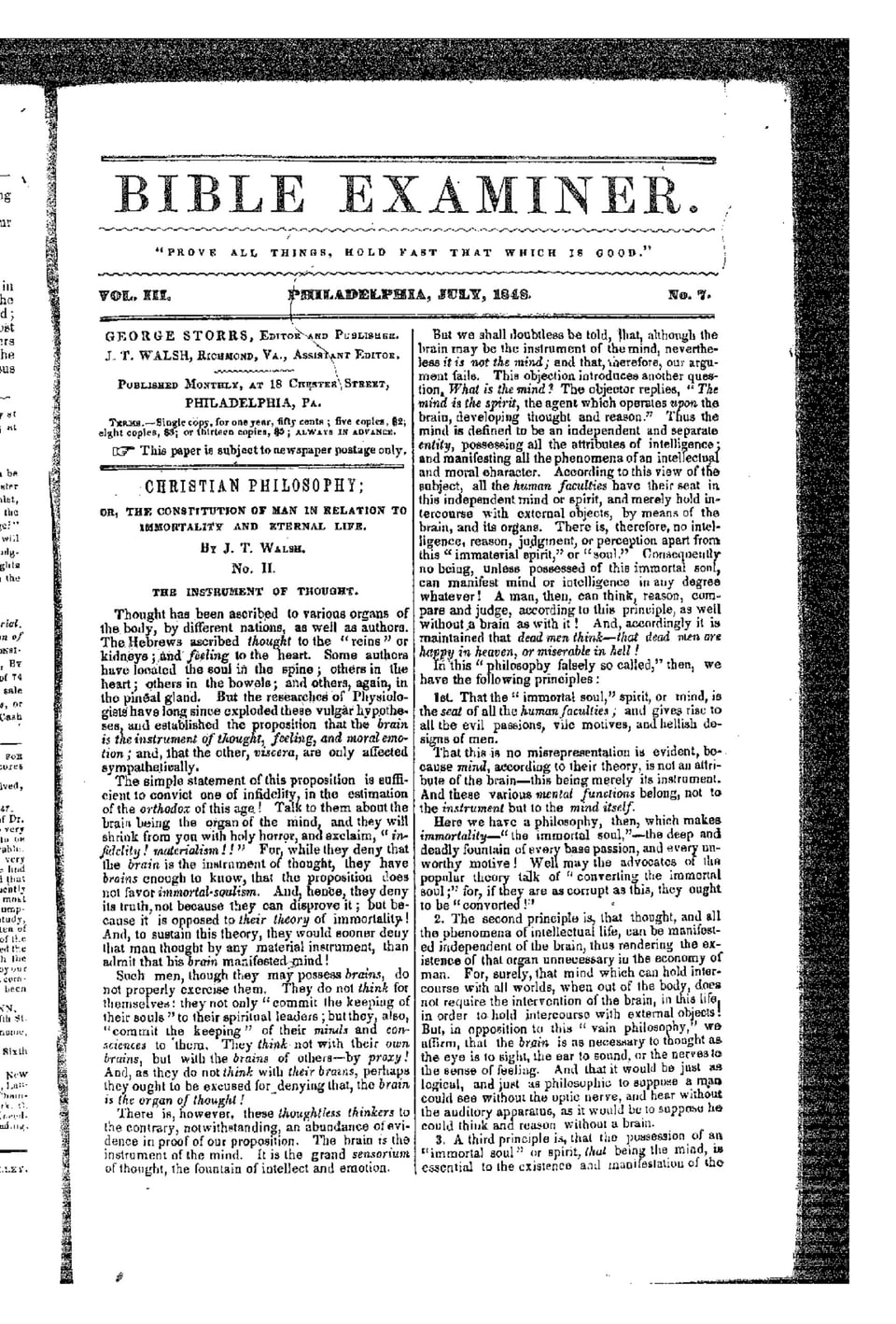
BIBLE EXAMINER.
"PROVE ALL THINGS, HOLD FAST THAT WHICH IS GOOD."
VOL. XII.
PHILADELPHIA, JULY, 1848.
No. 7.
GEORGE STORRS, EDITOR AND PUBLISHER. J.T.WALSH, RICHMOND, VA., ASSISTANT EDITOR.
PUBLISHED MONTHLY, AT 18 CHESTER STREET PHILADELPHIA, PA.
TERMS.—Single copy, for one year, fifty cents; five copies, $2;
eight copies,3; or thirteen copies,5; ALWAYS IN ADVANCE.
This paper is subject to newspaper postage only.
CHRISTIAN PHILOSOPHY;
OR, THE CONSTITUTION OF MAN IN RELATION TO IMMORTALITY AND ETERNAL LIFE.
BY J. T. WALSH.
No. 11.
THE INSTRUMENT OF THOUGHT.
Thought has been ascribed to various organs of the body, by different nations, as well as authors. The Hebrews ascribed thought to the "reins" or kidneys; and feeling to the heart. Some authors have located the soul in the spine; others in the heart; others in the bowels; and others, again, in the pineal gland. But the researches of Physiologists have long since exploded these vulgar hypotheses, and established the proposition that the brain is the instrument of thought, feeling, and moral emotion; and, that the other, viscera, are only affected sympathetically.
The simple statement of this proposition is sufficient to convict one of infidelity, in the estimation of the orthodox of this age! Talk to them about the brain being the organ of the mind, and they will shrink from you with holy horror, and exclaim, "infidelity! materialism!!" For, while they deny that the brain is the instrument of thought, they have brains enough to know, that the proposition does not favor immortal-soulism. And, hence, they deny its truth, not because they can disprove it; but because it is opposed to their theory of immortality! And, to sustain this theory, they would sooner deny that man thought by any material instrument, than admit that his brain manifested mind!
Such men, though they may possess brains, do not properly exercise them. They do not think for themselves: they not only "commit the keeping of their souls" to their spiritual leaders; but they, also, "commit the keeping" of their minds and consciences to them. They think not with their own brains, but with the brains of others—by proxy! And, as they do not think with their brains, perhaps they ought to be excused for denying that, the brain is the organ of thought!
There is, however, these thoughtless thinkers to the contrary, notwithstanding, an abundance of evidence in proof of our proposition. The brain is the instrument of the mind. It is the grand sensorium of thought, the fountain of intellect and emotion.
But we shall doubtless be told, that, although the brain may be the instrument of the mind, nevertheless it is not the mind; and that, therefore, our argument fails. This objection introduces another question. What is the mind? The objector replies, "The mind is the spirit, the agent which operates upon the brain, developing thought and reason." Thus the mind is defined to be an independent and separate entity, possessing all the attributes of intelligence; and manifesting all the phenomena of an intellectual and moral character. According to this view of the subject, all the human faculties have their seat in this independent mind or spirit, and merely hold intercourse with external objects, by means of the brain, and its organs. There is, therefore, no intelligence, reason, judgment, or perception apart from this "immaterial spirit," or "soul." Consequently no being, unless possessed of this immortal soul, can manifest mind or intelligence in any degree whatever! A man, then, can think, reason, compare and judge, according to this principle, as well without a brain as with it! And, accordingly it is maintained that dead men think—that dead men are happy in heaven, or miserable in hell!
In this "philosophy falsely so called," then, we have the following principles :
1st. That the "immortal soul," spirit, or mind, is the seat of all the human faculties; and gives rise to all the evil passions, vile motives, and hellish designs of men.
That this is no misrepresentation is evident, because mind, according to their theory, is not an attribute of the brain—this being merely its instrument. And these various mental functions belong, not to the instrument but to the mind itself.
Here we have a philosophy, then, which makes immortality—"the immortal soul,"—the deep and deadly fountain of every base passion, and every unworthy motive! Well may the advocates of the popular theory talk of "converting the immortal soul;" for, if they are as corrupt as this, they ought to be "converted!"
The second principle is, that thought, and all the phenomena of intellectual life, can be manifested independent of the brain, thus rendering the existence of that organ unnecessary in the economy of man. For, surely, that mind which can hold intercourse with all worlds, when out of the body, does not require the intervention of the brain, in this life in order to hold intercourse with external objects! But, in opposition to this "vain philosophy," we affirm, that the brain is as necessary to thought as the eye is to sight, the ear to sound, or the nerves to the sense of feeling. And that it would be just as logical, and just as philosophic to suppose a man could see without the optic nerve, and hear without the auditory apparatus, as it would be to suppose he could think and reason without a brain.
A third principle is, that the possession of an "immortal soul" or spirit, that being the mind, is essential to the existence and manifestation of the intellectual faculties.
And that, consequently where there is no "immortal spirit" there is no mind.
where there is no " immortal spirit." there is no mind. Upon this hypothesis the " beasts" possess " immortal spirits," for they certainly think! What will the advocates of the " immortal-soul-system" do with this dilemma? What disposition will they make of this Bruto-immortal-soul? Will they take the position of Mr. Wesley, that the beasts will be raised from the dead!
1st. Either that the possession of an "immortal spirit" is not necessary to the manifestation of mind : or,
Here they are certainly in a strait; for they must take one or the other of the following positions:
2d. That, if it be, the beasts are "immortal."
3d. And that they will be raised from the dead And 2
4th. That they are, also, in as much as they are "immortal," conscious in death.
We hope the advocates of the popular theory will meet these difficulties, and look them fully in the face. For, we feel confident, that they are here stranded, and must either yield to the omnipotence of truth, or maintain a position utterly subversive of revelation, philosophy, and common sense.
Now we put the emphatic question, "Is the possession of an immortal-soul essential to thought? Will the advocates of the popular view take this position? If they do, we repeat it, they will be forced to the conclusion that, the beasts have immortality. And, if they possess immortality, what disposition will they make of this brutal soul, when the brute dies? Will it not be conscious? And, if conscious, will it be happy or miserable? Let not our opponents evade these questions, for these are the legitimate consequences of the teaching that an immortal soul is essential to the production of mental phenomena. Either answer them, or admit the truth we advocate.
But we are not reduced to this dilemma. We deny, and challenge our opponents to the proof, that an immortal soul or spirit is necessary to thought. The function of an organ depends upon its vital chemical organization. This gives character to the muscles, the tendons, the ligaments, the nerves, brain, and all the various organs and viscera of the body. These organs, thus chemically constituted by that Being who understands every law in his vast universe, being acted on by the positive and negative electro-magnetic forces, develop the peculiar function of each organ. It is thus that the muscles contract and expand; the liver secretes bile; the stomach digests food; and that all the various organs perform their respective functions.
Now, we might as well assume that the function of every living tissue depended on an "immortal principle," as to maintain that immortality is essential to the manifestation of the functions of the brain and nervous system generally. The grand argument of our opponents is, that thought is not an attribute, or function of matter, no matter how organized. This, as we have seen, leads to the conclusion that the beasts possess immortal souls, for they certainly think. We all agree that man thinks, but by what means does he think? Does he think, feel, and reason because he has an immortal soul? Does he not think and reason by means of his brain? Are thought, feeling, and sentiment attributes of immortality only? Then it follows that all animals, not possessed of an immortal mind, are incapable of thought, reason, and sentiment; consequently all
the lower animals, as well as all idiots, simpletons or fools, have no imminortality about them; because they are incapable of displaying these mental phenomena! This argument, therefore, proves too much for the advocates of the immortal-soul system. It proves that some men have no immortality! Here the opposition are certainly in a dilemma, from which no rules of logic on earth can deliver them! While it may be, however, that idiots think, their thoughts and sentiments are not such as we should expect from a mind endowed with the principle of immortality and incorruptibility. Does it not follow, then, if some men, such as idiots, &c., display no trace of incorruptibility, that this principle is not congenital? For, if it were congenital, or hereditary, all men would be in possession of it.
Matter, organized, refined, and endowed with life is capable of thought in the ratio of its perfection of organization. That this is true we see demonstrated before our eyes by observing the organization of different genera, species, and varieties in the animal world, from the smallest animalcule up to man, the noblest work of God. Every link we mark in this great chain of organization, bears upon its face the degree of intelligence it possesses, and establishes the proposition, that intellect, other things being equal, is always in proportion to the perfection of its constitution. Unorganized matter is incapable of thought. Moreover, it is not enough that matter should be organized in order to produce mental phenomena, but it must also be endowed with life, as we have already stated. And to those who deny that organized matter, endowed with life, can think, we will put a few questions. If matter, organized, refined, sublimated, and endowed with life, is incapable of thought, by what means do the beasts think? Thought, you affirm, is not a function of matter, and yet the beasts that perish THINK! Is thought a function of matter in this case? Again, we would ask, seeing they are all endowed with instinct, if this is an attribute or function of matter? Will you affirm that sight, hearing, tasting, smelling, ar. feeling are functions of matter, when moulded and fashioned by the hand of God? Is it not preposterous to say that matter can see? That matter can taste? That matter can smell? That matter can feel? And yet you are bound to admit this, or else be driven to the conclusion, THAT EVERY LIVING THING IN THE UNIVERSE OF GOD HAS AN IMMORTAL SOURCE! Are you prepared for this? Or do you shrink back from this position? If so, you must admit that your views of the subject are unround, and consequently untenable. And if all the functions of the five senses are manifested by matter, why may not reason, perception, judgment, and imagination also be developed by matter still more exquisitely organized? If the stomach can digest food, the liver secrete bile, and the heart propel the blood, why may not the brain, acted upon by electro-magnetism, secreta thought? Is there any thing more incompatible in the one case, than in the other? We come, therefore, to this conclusion, that matter, organized as we behold it in man, and endowed with life from God, is capable of manifesting moral and intellectual functions.
We have now shown, that immortality is not essential to thought, reason, &c., or that, if it be, every living thing, possessing the five senses, must be in possession of it; and having made these general remarks, we shall proceed to examine the mind and some of its attributes in detail. And,
1st Of PERSONAL IDENTITY. A great many singular ideas prevail on the subject of Personal Identity. Those who hold the doctrine of "hereditary immortality," suppose that the soul, or spirit of man constitutes his identity. Supposing then, for the sake of argument, that the soul or spirit, in the popular sense, constitutes man's personal identity, what is it that speaks when the language "my soul," "my spirit," "my body," or "my mind" is used? A man speaks of himself, and says he has a mind, a soul, a body, a head and a heart, &c. What is it that possesses all these? Is it not that which is the representative of them all? In other words, is it not that which supplies the I of consciousness—that which gives rise to the sentiment of personal identity? To affirm the contrary would be to represent the soul or spirit as saying my soul, or my spirit. Has the soul possession of another soul? Does the spirit possess a spirit? This view of the case, then, is at once reduced to an absurdity. The scriptures do not thus trifle with the understanding of man. It is utterly beneath the dignity of the spirit of wisdom and knowledge thus to speak. Moreover, if the soul constitute the personal identity of man, what becomes of its immortality when the feeling of self-consciousness is deranged so that the person shall imagine himself to be a very extraordinary personage, a king, an emperor, and even God himself? Can this derangement be affirmed of an immortal soul? Again, as we have organs for the manifestation of all our other feelings and faculties, it is certainly reasonable to suppose that there is an organ, the manifestation of whose function would give rise to the sentiment of I, myself. And when that organ is diseased, its function becomes the subject of that kind of derangement of which we have spoken. While, therefore, it is clear that man has a material organ, whose office it is to create the feeling of personality, or self-consciousness, it is also evident that man is not to be dissected and examined in that state; but that he is to be the subject of a sound, rational, and philosophical analysis, in order to arrive at the truth upon this subject. We would ask one question—if the spirit, mind, or soul, in the popular sense of these words, does everything of a moral and mental nature, by means of material organs, what is left for the MAN to do? for it is evident that the spirit is not the man! These acts, to which we have referred, should be affirmed of man, as such, in THE AGGREATE, and not of his mind, soul, or spirit. Therefore, when a man (not spirit) sees, he sees by means of the optic nerve; when he hears, it is by means of the ear; when he thinks, reasons, reflects and perceives, it is by means of his brain. And as he has organs by which to operate on the world, and by which external objects operate upon him, so it is fair to conclude that every feeling, every moral sentiment, and every intellectual faculty, has its appropriate organ, or instrument, in the brain; and that of personal identity among the number. There is nothing in personal identity, than, to favor the popular view of immortality. Let us now turn our attention,
2d. To the Memory. It is said, man has such powers of mind—such vast intellectual faculties—such a comprehensive judgment, and such a prodigious memory, that his mind must be immortal. If this be so, why is it that all men do not possess these noble powers of mind, seeing that they all have immortal souls, if the popular hypothesis but true? Why
is it that we have youthful idiots? adult simpletons, and the dotage of the evening of life? Why is it that these incorruptible fires of mind do not kindle, blaze and burn with equal brightness in youth, manhood, and old age, seeing the same immortal genius-inspiring agent breathes its life-giving spirit upon the strings of the exquisitely tuned instrument, at each of these stages alike? If the mind be essentially immortal, why are its fortunes through life so variant? Ah! the answer is, that the instrument is imperfect in childhood, and out of order in old age. So it appears that every thing depends upon the perfection of the instrument at last, and thus the immortal mind, as our opponents will have it, is cast into the shade, and is made only of secondary importance in the manifestation of intellect! But more of this, when we come to speak of mental diseases. We grant that the memory of a cultivated mind is very comprehensive, but, alas! how little is remembered of one's history and of the history of the world! The mind of man is exceedingly treacherous. The most important facts, the most startling truths, and the most overwhelming considerations are soon forgotten, vanished like the baseless fabric of a vision, leaving not a wreck behind! Reason declares that forgetfulness is not an attribute of an incorruptible mind or memory. An incorruptible mind must have an incorruptible memory. The impressions made upon a mind that is mortal or corruptible, will be like those made upon the sand, while those made upon an immortal mind, will be like those engraved upon the solid marble, and will never be effaced. The Angels are not forgetful. There is no forgetfulness in Heaven—this is an attribute of "dull mortality," and not of incorruptibility! Impressions made upon an immortal mind, are stereotyped by Jebovah, and will remain indelible through the eternal ages! Memory, then, affords no proof of man's immortality here, but the reverse. So long as impressions fade from the tablet of his mind, just so long will that mind prove itself corruptible. Besides, it is a remarkable fact, that the memory is more treacherous upon some subjects than upon others. This is incompatible with the notion that memory is an attribute of an incorruptible principle in man; for, in that event, every fact and circumstance would be retained alike.
In concluding this article, we will add a few words on the Love of Life, which, as Plato is made to say, causes "the soul to shrink back on herself, and startle at the idea of destruction." In that popular soliloquy to which we have alluded, we have the following: "It must be so, Plato, thou reasonest well." "It must be" what? Why the soul "must be" immortal. But why "must it be" immortal? Here is the answer—"Else whence this fond desire, this PLEASING HOPE, this LONGING AFTER IMMORTALITY?" "Plato, thou reasonest well!" Because man has a "fond desire," a "pleasing hope," and a "longing after immortality," therefore, he is immortal! Because a man "desires," "hopes," and "longs" for a thing, therefore he has that thing!! Truly, "Plato, thou reasonest well!!" And, then again, if the soul be not immortal, why should "she shrink back on herself," at the approach of death, and startle at" the very idea of "destruction!" The Platonic answer is, "tin the divinity that arises within us." The "divinity shrinks back on itself, and startles at destruction!" Cogent reasoning! Profound logic! But although the soul has such a horror of death and destruction, yet, "secure in herself, BIBLE EXAMINER.
she smiles at the drawn dagger, and defies it's point? And, though the moon and stars may fade from the heavens, "and the sun himself grow dim," the soul shall flourish in immortal youth, unhurt amid "the wreck of matter and the crush of worlds." This is pure Platonism, as well as the essence of modern Christianity. But we shall reverse Plato's reasoning, although it is said he "reasoned well." The very truth, that there is in man a "fond desire." though you rescue them by violence; it is the cheat of hypocrisy and infidelity—it is to put the poisoned chalice of deceit to their lips, to soften down the asperity and sternness of the truth lest it should hurt the feelings or morbid sensitiveness of the "carnal mind," which is "enmity against God," and rebellion against his law. I have no sympathy with that sort of "love" which leaves men to die in error, which "knowledge" teaches is damnable. John Wesley is no authority with me. He was doubtless
BIBLE EXAMINER.
duced, the apostle wrote, saying, "sufficient to such a man is this punishment, which is of the many;" forgive him, therefore, and comfort him, lest perhaps he be swallowed up of overmuch sorrow: their forgiveness the apostle recognizes as his, and his own as forgiveness from the Lord; therefore, when he appears in the day of Christ he will no more be called to account for this sin. This is one view of the ease before us; let us now look at the other side.
stroved them, and made all their memory to perish. Isa. 25:11; 26:13, 14; From this we learn the non-resurrection of millions of lords, who have tyrannized over Israel—Egyptians, Philistines, Midianites, Assyrians, Chaldeans, Medo-Persians, Macedonians, Romans, Russians, Turks, &c., &c. The text is so striking and emphatic, that no same man can misunderstand it. Those who are not to live nor rise again once lived; for it styles them "dead" and "deceased" which are only offered of the
a pleasing hope, and a longing after multitude, is good evidence that he is not in possession of it. Why should a man desire, hope, and long for an object already in his possession? There is an innate dread of "shrinking into nought," and a longing after life implanted in every man; and no person, unless deranged, will commit suicide. A poet, whose name I have never known, has given a very different description of the soul's exit from the one indicated in the above allusions. Speaking of a death scene, he says: "At that dread moment the soul rises round the walls of her clay tenement; runs to each avenue and shrieks for help, but shrieks in vain! Her very eyes weep blood, and every sigh is big with horror." Here we have the monstrous doctrine of an immortal soul raving round the walls of her clay tenement, running to each avenue and shrieking for help, but shrieking in vain! This immortal soul, too, can weep tears of blood, and utter sighs big with the horror of prospective damnation! And yet, this is the "divinity" that stirs within us, smiles at the drawn dagger, and defies its point! What a libel upon the truth of God!
But let us turn from the contemplation of this
But let us turn from the contemplation of this damnable heresy, to the glorious truths of the Aposa very pious, a very sincere errorist. His system proves him to have been ignorant, and therefore, faithless of the Gospel of the Kingdom; so that his opinion of how many truths we may die in ignorance of, and be saved, weighs not a feather, in my estimation, however potent it may be with others. Knowledge will avail us nothing without that "love" of which Paul speaks; but then, that charity, or love, "rejoiceth in the truth; believeth all things; and hopeth all things:" hence, much as "charity" or "love" are on the lips of men, he who is ignorant of the truth, believeth not and hopeth not in all things of that truth, is utterly destitute of the true love and charity so highly exiled by the Apostle. Men mistake a natural amiability of disposition, decorated after a certain fashion with sectarian piety, for love, for charity, for godliness! But this is a mere substitute for scriptural love, a maudlin, spurious affair. Gospel love is the fulfilling of the law in the faith and disposition of Abraham, the father of the faithful and the friend of God. No, no; he that believeth THE GOSPEL, and is baptized, shall be saved; there is no evading this: "charity," "piety," "penitence," without this, are but the
A disciple in the 19th century, as really a disciple in faith as the Corinthian, commits, we suppose, precisely the same offence. A committee of brethren adjudge him to Satan for the destruction of the flesh. They have pronounced their sentence; they no more keep company with him, nor eat with him—turn him out of the Body of Christ they cannot do; this is beyond their ability, no matter how many thunders of excommunication they may hurl against him—but still Satan does not destroy his flesh; and, if he were to become "weak and sickly"—1 Cor. 11:30—and this painful wasting of his flesh were to bring him to the same penitence as his Corinthian parallel, the committee not having the power of healing and forgiving sins, he might "fall asleep" in utter despair, and Satan get the advantage. Now the offender before us would die unforgiven in this age; the question therefore is, would he be forgiven in the next or Future Age? And as then "we" are to receive in body according to what we have done;" and seeing that our modern disciple did not receive in body according to his deed as the Corinthian did, we ask further, will be not in the Future Age receive in like manner for his crime, and afterwards
living. It also teaches us the meaning of "destroyed," to wit, that which shall not live by a resurrection unto life—this is to perish. But, as to the faithful, it says, "thy Dead shall live, as my Dead Body shall they arise;" therefore. "Awake and sing, ye that dwell in the dust; for thy dew (O Sun of Righteousness) is as the dew of herbs, and the earth shall cast out the (Lord's) dead." Verse 19.
The foregoing is quite in harmony with "the literal import of John 5: 28." The "all" in this verse is defined in the next. All who? "They that have done good" and "they that have done evil." But, this does not include all mankind; for there are multitudes who come into and go out of the world, that do neither good nor evil. "Just" and "unjust" are terms of relation, not absolutes; and are predicable only of those who live under times of knowledge. Sinners are just or unjust relatively to the Gospel of the Kingdom; absolutely, they are "sinners," and "the wicked." It no where teaches in the word that all "sinners" and "all the wicked" shall be raised from the dead; yet it doth teach the resurrection of the just and unjust. Every man according to his deeds," "every soul of man
folio proclamation. And let the reader remember, that God will only render eternal life to those, who, by a patient continuance in well doing, seek for GLORY, HONOR, AND INCORRUPTIBILITY.
In our next article, we shall take up the subject of mental diseases.
[For Bible Examiner.]
BR. THOMAS' REJOINDER TO BR. GREW. "LOVE," OR "CHARITY."
Having been requested to make some remarks on "H. Grew's Response" in No. 5, p. 68, I proceed to observe that friend Grew attributes to me inferentially an opinion which I do not entertain, namely, that men dying in impertience will in some cases be forgiven. On the contrary, I believe, that men dying in impertence will in no case, and under no circumstances be forgiven. I believe further, that no man's sins will be forgiven, however "pious" he may be, or however "sorry" he may be, if, before he die, he has not believed and obeyed the Gospel of the Kingdom in the name of Jesus, and walked worthy of the high vocation to which he has been called. It is no business of mine to build on a walt
righteousness or bity rags.
MEN DYING IMPENITENT, NEVER FORGIVEN.
The proposition then before us is, that men dying faithless or impenitent, or both, will never be forgiven. This we believe the scriptures teach. But what has that to do with men of faith, dying in sins "not unto death?" Paul saith, "We must all appear at the judgment seat of Christ, that every one may receive the things in body, according to that he hath done, whether good or bad." The "we" referred to in this text, are not all mankind, but all of a class, and that class the aggregate of believers. Now, by way of illustration, let us suppose a case.
One of the Corinthian disciples committed a great crime. Paul, though absent, judged his case from the report laid-before him. He commanded the Elders to put in force the sentence he pronounced in the name of the Lord, to wit, that they should deliver the criminal to Sutan for the destruction of the flesh, and keep no company with him, nor even eat with him. This sentence they executed and persisted in, until they heard from the apostle again. After a certain time had elapsed he wrote, and sent the offender a pardon; and because the punishment
be forgiven, but have no part in the honour and glory of the Kingdom, though he may without dying again live for ever, a saved man upon earth, after the Kingdom is delivered up to the Father? This we think is the scope of the word; but that there are some offences, commissible by believers, which "are unto death," and for which there is no forgiveness in this world, nor in the age to come. For sins unto death, committed by believers, it is no use asking or expecting forgiveness; for it will not be granted; of this class are "speaking against the Holy Spirit," and murder, and "treading under foot the blood of the Son of God," &c. But, John says, there are sins not unto death; for these there is forgiveness for the faithful, with chastisement according to the offence, in the age to come. Hence, the necessity of a Future Age to afford scope as to time, place and circumstances, for a recompense appropriate to the viciousness as well as the virtues of those upon whom the name of Christ is named. There is much to be said upon this topic which cannot be said now. The reader must follow out the train of thought suggested for himself.
NON-RESURRECTION OF MILLIONS.
that doeth evil," and "every man that worketh good," are all phrases of relation, and embraced in the "we" who are to appear before the judgment seat of Christ as limited by the subject of which the apostle treats. He is not speaking about all mankind, but of Jews whom he apostrophizes from Rom. 2: 1—29. As to the Gentiles who had "sinned without law," they perish; while those, both Jews and Gentiles, who are under law, shall be judged by the law in the day when God shall judge the secrets of men by Jesus Christ, according to Paul's gospel." How would friend Grew judge Cossacks, Hotentots, Caffres, Hindoos, Chinese, &c., by Paul's gospel, or Moses' law, who had never heard of the one or the other? To declare them just or unjust by these, would be as reasonable and fit as to justify or condemn the Irish sedition-mougers by the law of the United States. Cannot the reader see that a Russian is neither just nor unjust, innocent nor guilty, vicious nor vicious, whatever may be his absolute or real character, according to the law of England or these States? And why? Because there is no relation subsisting between him and these constitutions. He is not under law to Britain, therefore he will perish without that law speaking for or against him.
of casuistry around this impregnable position, by which to mask its formidable appearance. This frowning fortress of the truth may dismay the timid heart of ignorance and unbelief, and cause it to apostrophize the air with lack-a-daisy exclamations about "love" and "charity!" This is no affair of mine. The truth belongs to God, not to me; and godlike love and charity consists in plain, unvarnished exhibitions of that truth in such unmistakable and intelligible terms, that men may be able to comprehend it, and be saved by it. It is a godlike charity to pluck men like brands from the burning,
had brought him to a deep conviction of the enormity of his sin, and a sincere contrition for it. This was the object of the chastisement, namely, that when the offender shall appear at the judgment seat of Christ in the day of the Lord Jesus, "the spirit may be saved." To this person it might be said, "in being thus judged, you are chastened of the Lord, that you should not be condemned with the world." If the chastisement had failed to bring him to such a state of mind as the Lord will acknowledge, in the Future Age he would be condemned with the world. But seeing the happy effect pro-
Friend Grew asks, where do the scriptures teach the non-resurrection of millions? This question can be answered in the twinkling of an eye. When "the Lord shall spread forth his hands in the midst of Israel, as he that swimmeth spreadeth forth his hands to swim, * in that day shall this song be sung in the Land of Judah." Now in this song the Israelites sing, "O Lord our God, lords beside these have had dominion over us: by these only will we make mention of thy name. They are dead, they SHALL NOT LIVE; they are deceased, THEY SHALL NOT RISE: therefore hast thou visited and pre-
"Where no law is, there is no transgression;" and "without faith it is impossible to please God." These two principles decide the fate of millions. "Where there is no vision the people perish."
That little monosyllable "all," or its ghost, so haunts the incubations of our venerable and respected friend, that he sees it dancing before his eyes like a will-o-the-wisp, on whichever side he turns his vision. He quotes Heb. 9:27, and there he thrusts it in as if the apostle had really placed it there! "It is appointed unto all men once to die, but after this the judgment." Paul does not say so; he says, "it is appointed unto men once to die," &c.
If he had said what Mr. Grew makes him testify, he would contradict himself; for in another place he saith, "We shall not all sleep," or die, "but we shall all be changed in a moment, in the twinkling of an eye, at the last (seventh) trumpet; for the trumpet shall sound, and the righteous dead shall be raised incorruptible, and we (all) shall be changed." But, we will not press our friend too hard in this place, for he makes an admission immediately after which concedes to us all we demand. "If, indeed," saith he, "we have any plain, positive declarations that some of the human family will never be raised from the dead, we must unders and these universal terms in a limited sense, but not otherwise." Will the Doctor favour us with the chapter and verse? Yes; this we have already done.
FAITH IN PROPHETIC TRUTHS NECESSARY.
Mr. Grew doth not like my position, that "a man cannot be saved in any sense, unless he also believe the prophetic truths concerning the Kingdom of God." Now the subject matter of these truths is the Kingdom, and the Kingdom is the subject of the Gospel. No KINGDOM, NO GOSPEL. My proposition, therefore, is convertible into this: that no man can be saved without faith in the Kingdom. Mr. G. in disputing my position, necessarily affirms the contrary; I call upon him, therefore, as he calls upon me elsewhere, to adduce "chapter and verse" in proof that man or woman, infant or suckling, can be saved in any sense without faith in the prophetic Kingdom.
"To THE LAW AND THE TESTIMONY, IF THEY SPEAK NOT ACCORDING TO THIS WORD, IT IS BECAUSE THERE IS NO LIGHT IN THEM." It will save time and space to adhere to this exclusively, and not to introduce the Johns of any sect. They are of no value in any question at issue between the searchers after truth in this century. They belong to the darkness of times bygone.
$
\text {R E P E N I A N C E , I M M E R S I O N , A N D H O L I N E S S , I N D I V I B I E L E .}
$
"A correct belief of doctrine and facts" is a belief of the truth; an incorrect belief of doctrine and facts is a belief of error. Mr. G. places himself in opposition to the principle, that a belief of the truth with repentance, immersion and holiness, are indivisibly essential to salvation in the Kingdom of God, and affirms, that "we have scriptural truth and fact to the contrary." Now we invite the reader's attention to this, namely, that Mr. Grew cannot adduce a single case from the New Testament of Jew or Gentile being recognized as a Christian after the day of Pentecost (see Acts 2.) who did not believe the Gospel of the Kingdom as promised in the word—the things concerning Jesus—whose repentance was not evinced by turning from a justification by law to that of Christ; and who was not immersed. He has doubtless selected the strongest evidence he could find. Hence he sends us to I Cor. 8:11. But this is no case in point. The individual was already in a saved state, and he was put into that state as the rest of his brethren in Corinth were, namely, by "hearing, believing and being baptized." What did they hear? Luke says they heard "THE WORD." What is the Word? "The Law and the Testimony." both of prophets and apostles. Hence Paul reminds them that he preached the Gospel to them, which he styles its logos, A CERTAIN WORD,
"by which ye are saved if ye keep it in memory." But the man referred to had been long a pagan worshipper. The word preached laid hold of him with such power, that the least approximation to idolatrous observances on the part of any brother, defiled or wounded his sensitive conscience exceedingly. This was a laudable Christian weakness on the right side. He had still what Paul terms "the correcience of the idol," but not an idolatrous conscience. The meat offered to an idol always reminded him of the worship connected with it; and that as an idolater, the eating of such meat was esteemed by him a part of the idol worship. Now, although he knew an idol was nothing, and that all meats were cutable by Christians, save blood and things strangled, yet he could not get rid of the original impressions; so that when he saw a brother eating such meat, the eating would force itself upon his conscience as idolairy, while the eater ate of it with contempt for the idol. The apostle commands the latter to forbear eating, lest it might become an occasion of stumbling to the brother of tender conscience. His "views of the unity of God and of idols were" not "incorrect." "We all have knowledge" on these things, says Paul. It was, as shown, the accuracy of his knowledge which made him so unhappy when he saw brethren too much at home in idol temples and festivals.
NOT WEALK IN FAITH.
We need not repeat here what we have said before about weak in faith, and weak in the faith. He of Rom. 14: 1, was not weak in faith. He was not "erroneous or ignorant in respect to" the word of the truth of the gospel. He was "in the faith," which he could only be by believing the Gospel and being baptized; but he was "weak," or sensitively conscientious, as to eating all things indiscriminately. If he were a Jew, he still had the conscience of the law; or, if a Gontilo, he still had the conscience of the idol, in relation to meats and herbs. He was not weak in faith, but strong; for it is not persons of weak faith that brave death in turning from Judaism to Christ, or from dumb idols to serve the living and true God.
BORN OF WATER.
Mr. Grew says: "In the various passages, which state particularly the characters which have no inheritance in the Kingdom of God, the unwimmersed are never mentioned." Does Mr. Grew regard Jesus as authority in the case? He says, "except a man be born of water and of spirit, he cannot enter into the Kingdom of God. Some one may possibly be rash enough to say, that to be "born of water" is not baptism! Does water mean water here? Some say yes, some no! According to these, water means spirit, which makes nonsense of the passage; "except a man be born of spirit and of spirit" is a perfect reductio ad absurdum. Such critics are either above reason or below it; and as we claim to be reasonable, we leave them to their vain imaginations. Some have sense enough to admit, that water, in this text, means that compound of oxygen and hydrogen upon which Noah's Ark floated. With these, then, we talk. The metaphor connected with water is a being horn. What does being born of any thing consist in? Is it not an emergence from a place in which the subject was previously out of sight? Admitted. If then earth be the matrix of which a thing is born, would
not a being born of earth, consist in coming up out of the ground in which the subject had been previously concealed? And doth the substitution of water for earth make any difference in the idea of birth? To be born of water, then, is also to come up out of water in which the person had been deposited, for there can be no emergence without previous immersion. No man who hath any regard for his intellect, will venture to say, that baptism is not a birth of water, and a birth of water, baptism. Jesus then saith, that except a man believe the gospel, which is to be begotten of the spirit; and be baptized, or born of water, he cannot be saved, or enter the Kingdom of God. As to "the characters;" Mr. G. refers to, the apostle addresses himself to immersed believers, and therefore it would have been superfluous to have told them "the unimmersed should not enter the Kingdom." He had told them that before they became Christians, as we have shown; it was unnecessary to repeat then what nobody in that age, Jew or Pagan, ever dreamed of omitting to do.
Immersion is not "the duty," but a gracious privilege granted to every believer of the things of the Kingdom of God, and the name of the Lord Jesus. Immersion submitted to as a mere duty, is worth nothing. It is a privilege to which no one is intitled who is not a true believer; that is, an Abrahamic believer of the Truth. It is the last thing that ought to be preached; and thousands are preached into the water that are utterly and astoundingly ignorant of "the word of the truth of the gospel." The one thing needful to this generation is faith, without which immersion is a mere form of godliness, devoid of all efficacy and power.
"It is an undeniable fact," says Mr. Grew, "that there are many real Christians who are unimmersed," &c. No doubt the unimmersed will be highly delighted with Mr. Grew's "charity," and proportionally indignant at the man who has hardihood enough to deny Mr. Grew's "undeniable fact." An "unimmersed Christian" in New Testament times, was a phenomenon as extraordinary as a white crow, or a black swan! I have never discovered one yet among all the cases on record in the Scriptures since Pentecost. I have heard of multitudes of such Christians in the dominion of Rome; but I have never yet seen one in the Body of Christ; nor do I expect to see such a one in the Kingdom of God, if the words of Jesus were spoken in the soberness and simplicity of truth.
NECESSITY AND USE OF KNOWLEDGE.
"The eyes of your understanding being enlightened in the hope of the calling, and the riches of the glory of the Inheritance in the Sainte," is one thing; and to "discern accurately all things which all the prophets have foretold concerning the Kingdom of God, and the true periods of their fulfilment," is another thing!
I am very far from saying, that such a discernment is necessary to entitle a man to entrance into the Kingdom of God; but I do say, that illumination in the one thing is essential, not as a mere matter of knowledge, but that this knowledge may effect a renewal unto life through a participation in the divine nature. "Grace and peace be multiplied to you through the knowledge of God and of our Lord Jesus Christ, according as his divine power hath given unto us all things that pertain to life
and godliness, through the knowledge of Him that hath called us to glory and virtue; whereby are given to us exceeding great and precious promises; that by these ye might be partakers of the Divine Nature." This is the necessity and use of knowledge, without which we are the sport of every wind of doctrine, and vain conceit, and assimilate to the demon of ignorance and superstition, and become an easy prey to the things which are earthly, sensual and devilish. Without supposing that "I only am left," I am deeply penetrated with the conviction, that of this generation, they are few who will find eternal life.
THE UNIMMERSED AND FRARFUL EXCLUDED THE KINGDOM.
"The unimmersed," says Mr. Grew, "are not excluded from the Kingdom of God." Wonder if Mr. Grew believes, that the fearful are excluded? Why doth our venerable friend turn special pleader for the unimmersed, and not extend his labour of "love" and "charity" to the timid? There is a vastly greater number in jeopardy of damnation from their cowardice, than from their non-immersedness. A man may have a correct theory, be duly dipped, and very "pious," but fearful withal; one, of whom it cannot be said, in spirit or fact, that "he overcame by the blood of the Lamb, and by the word of his testimony; and loved not his life unto the death." Such an one may deceive himself, but he cannot impose upon God: unless God repeal his law, it is impossible he can be saved. Let then, our venerable friend, beware! An advocate may be "fearful," while he is the apologist for error, ignorance, and disobedience. The Apostle Peter says: "Repent and be baptised, every one or you, in the name of Jesus Christ;" it is not absolutely necessary, says Mr. Grew, for "the unimmersed are not excluded from the holy kingdom of God." Hence, instead of "every one" doing the command, some conform, and others do not. Such is the effect of Mr. Grew's teaching. Well, if he effect an entrance for himself, let him bear in mind the word, that "whosoever shall break one of these least commandments, and shall teach men so, he shall be called the least in the kingdom of heaven; but whosoever shall do and teach them the same, shall be called great; for I say unto you, that except your righteousness shall exceed that of the Scribes and Pharisees, you shall in no case enter into the Kingdom of God."
JOHN THOMAS Richmond, Va., May 15, A. M. 5934.
"It is good to be scarcely afflicted always in a good thing."
—Gal. 4: 18.
RELIGIOUS ZEAL.—" Zeal, says a celebrated writer, 'is a passionate ardour for any person or cause. There are various kinds of zeal; as, 1, An ignorant zeal, as in Romana 10: 2, 3, where some are said to have a zeal of God, but not according to knowledge. 2. A persecuting zeal, as in Philippians 3: 6, where Paul recounted his former earnest endeavours to destroy the Church of Christ. There is also a superstitious zeal, a hypocritical zeal, a party zeal, &c. But the zeal which the Lord approves is a genuine zeal in a good cause. Such a zeal as seeks for the Glory of God and the good of man.
It is founded in knowledge, faith and perseverance, and will manifest itself in love and constancy toward a good cause, and generally results in final success. Such is the certain result where pure religion is the object it seeks to promote, and wisdom and knowledge its attendant guides."—Selected.
BIBLE EXAMINER.
PHILADELPHIA, JULY, 1848.
ARE THE WICKED IMMORTAL?
"The soul that sinneth it shall die."—Bible.
TRUTH SEEKERS.
We have no sympathy for that spirit which, having attained a certain point in theology, or any other investigation, requires that all who are recognized as brethren, or fellow-laborers, should refrain from further investigations, or from a calm and fearless expression of the result of their labors in search after truth. All new sects have commenced with professions of liberality and denouncing the illiberality of others for not allowing them to express, among them, new truths, or new light upon old truths, which they believe they have discovered. They avow their determination never to organize a sect; and sometimes declare—"If we ever become a sect we shall be the youngest daughter of the old Mother of Harlots." A few years pass away and the leaders in these movements find persons among them that think they have discovered further light on important subjects, and who dare to give utterance to the convictions of their own free thoughts. Then those, who professed they never would be a sect, find it necessary to take counsel together, and, lest they should be suspected of being tinctured with the heresy, they must make a formal declaration of principles; "not a Creed," to be sure; that would be too bare-faced an act for the "youngest daughter" just yet; but, some standard principles, by which, gradually, they can, under the presence of harmony, pernade most, who have been tinctured with the views they wish to suppress, to fall back on the "important point" of their theory, and give up the free expression of other things, even "if they are truth," well knowing if they can only persuade men to "put their light under a bushel" it will go out; or, which is the same thing, it will give light to no one, and so prove harmless. Where all things are thus well arranged, then all that do not come into this organization are "disorganizers;" and anything else that will tend to destroy their influence may be end of them; and, in all that, be doing "God service." Then they, the "youngest daughter," must
take good care to let it be known that they occupy the true apostolic ground, and are persecuted with the approbious name "Pope," and as having gone into "Popery." The sect, now, have only to pass resolutions expressing the fullest confidence in every thing their Leaders have done and are doing, and the work is complete—the sect is organized; but they don't "know it" themselves, and are not likely ever to see it; or if they do, it will not do to own it—for the leaders must never "confess;" if they do they will be suspected of lacking "infallibility."
It is the intention of the conductors of the Bible Examiner to strive to avoid such a shipwreck; and to exclude no theological subject from their columns merely because it is new, unpopular, or in opposition to their own views or the views of a portion of their patrons. We intend to make the Examiner a medium of thought for all who deal in argument, soberly expressed; and who do not employ personalities. All writers for the Examiner will be responsible for the sentiments they express, and they only. The editors are not to be understood as assuming it, merely because they give place to the article. We choose to give our readers a chance to judge for themselves, without having an editorial veto on every thing that differs from their present views. Our object is to elicit Truth. How is that to be done if no doubt must ever be permitted to arise as to any point we now hold as truth? That is the sin of all the sects: not that they have no truth, but they are determined that no new truth, or light, shall be elicited that might conflict with their stereotyped declaration of principles, or creeds.
We cannot better express our object and aim than in the language of the Editor of "The Truth Seeker and Christian Thinker," published in Leeds, England, by Dr. Frederick R. Lees, F. S. A. He says:
I. "By 'TRUTH-SEEKER,' we do not signify that no truth is found, nor have we reference to our own opinions exclusively. The title is rather intended to express the character of the Work, as an organ for the discussion and discovery of Truth, than the position of any individual writer. In the spirit of the Jewish sage, we exhort all men, everywhere, to 'get wisdom,' and 'get understanding;' not implying thereby that they are destitute of all wisdom and intelligence, but that wisdom is a fountain, and knowledge a stream, of which all men may drink forever—living and inexhaustible waters flowing from the throne of God—upspringing from the INFINITE DEPTHS of His everlasting being. In the words of the same inspired thoughtman, we say—'Buy the truth and sell it not;—not meaning by these words that we have no truth now, or that in a coming day we shall have acquired all truth, and then cease to be truth-seekers; but, on the contrary, we mean to affirm, that of all commerce, that in wisdom is the richest and noblest; that 'Truth' is a treasure more precious than fine gold, 'a pearl beyond price'—an infinite treasure, the
splendor and beauties of which it is the sphere of the infinite ages to unfold to the growing and progressing faculties of man. It must be purchased by toil and thought, and, even then, it will not be revealed, save to its sincere worshippers; it is a sacred treasure forever hidden to the gaze of purblind prejudice.
"Truth, we contend, must be to every man subjective—that which to each seems best to express the Facts of Nature and the Truths of God. Whatever may be the sense, the impression, left on any individual soul, by unbiased contact with the word or the works of God—that must be his truth, calling for sacred reverence as the revelation of God to him, and for constant or consistent obedience. If party, or passion, or power, or pelf, or fear, or favor, shall urge him to let it go, see that he do it not! Rather, bind it fast round his heart of hearts; it has been bought of God, and is a sacred deposit. 'Sell it not.'
"The impression on our God-made intellect is the result of God-made Laws: it is the most sacred law and the highest rule of life. Hence, the great duty of every man to prepare himself conscientiously for the calm reception of that truth by which he must live. This is the primal duty—but how despised! Let us learn, then, to seek God and Truth—let our spirits lie in reversential silence before Him, so that, no disturbing passion or prejudice intervening to refract the rays of truth, we may receive the right impression. Let the soul be daguerreotyped in the sun light of the Eternal. Thus, and thus only, can we worthily worship the Highest in the highest way—in spirit and in truth."
"With such opinions we necessarily discard all one-sided views of truth, and insist on each writer standing on his own responsibility. We shall afford to truth-seekers, therefore, a fitting medium for tolerant exposition and unshackled enquiry, apart from all sect or party. The claim of infallibility, by Pope or Protestant, wo utterly despise. We stand or fall by these principles—that the duty of truth seeking is paramount to all others—that it is a crime against God and against man to hold out hope or fear, reward or loss, with the view of determining the judgment of men on this side or on that—that it is a vice of the worst kind, leading to spiritual death, to give up the use of your own talent, the exercise of your own reason, to priest or sect—that truth is subjective to every one, and, therefore, that it is the duty of every individual, to put by all who dare presumptuously to step in between the soul and God, and solemnly to determine for himself according to the value and weight of the evidence before him, what is Truth and what is Error. The Reformed Churches have hitherto equally denied these great principles—they have overlooked the fact, that hope and fear are no instruments of discovery. The only difference is this—that once Rome had a monopoly of infallibility and swayed the sceptre of spiritual despotism over willing slaves and undivided empire, whereas Protestanism is a competition of infallibilities, exhibiting the partial union of sects in conjunction with universal warfare. It is mere fiction to call the Reformed Churches a Republic, as contra-distinguished from the mighty monarchy of the Church of Rome. A Republic invokes equality of claim, and negatives all separate, distinct ascendancy. But is it so among the sects? Nearly all claim 'divine right'—not merely to judge for themselves, but for others; each
speaks of the rest, not as citizen of citizen, but as prince speaks of pretender. Accordingly, each sect aspires to be Pope—mimics the spiritual policy of the triple-crown, and echoes with its tin trumpets the thunder-voice of the vatican! But it shall not be so amongst 'truth-seekers:' they shall unite in bringing about a wiser and worthier reformation, in enforcing the morality of enquiry, and of achieving the downfall of sectarian intolerance. To this grand object we shall devote our work and consecrate our powers. This Reformation will discard the angry intolerance with which men look upon doubt, and consecrate it as a mental state necessary and natural in passing from a lower to a higher point of intellectual progress. It will affix to all wilful favoritism in the treatment of evidence, a sentiment of stern disapprobation, and direct the feeling of moral responsibility towards keeping the process of enquiry perfectly free from partiality or bias. Really believing in the truth, and that true religion is indeed reasonable—'the Logos, or reason of God, which, in the beginning, was with God'—men will cease to hoodwink the faculty within them, and fearlessly look truth in the face! He who does not will be branded as coward and criminal—traitor to truth, infidel to faith."
Such sentiments we ardently hope may animate us in our work. We beg our readers to ponder well the extract we have given them; especially the paragraphs 2 and 4. We heard the sound of such a Periodical as the "Truth Seeker" last winter for the first time, and gave our readers an able article; second handed, from that paper in our January and February numbers. We knew not where in England it was published; but we ventured to send two numbers of the Examiner, directed to London, soliciting an exchange. A few days since we received the following letter from Dr. "F. R. Lees," dated
"LEEDS, (England,) May 20th, 1848.
"My DEAR SIR,-I have this week received, in my London parcel, two copies of the BIBLE EXAMINER, (viz. the numbers for March and April,) and shall be glad to exchange with you. *
I rejoice to see an organ devoted, like my own, to free and fearless discussion, confident as I am, that Truth must prevail; and especially glad to see you so ably demolishing the pernicious absurdity of the natural-immortality-dogma. You will find articles on that subject occasionally in the Truth-Seeker. Please direct to me here, and send me the back numbers, as I should like my set to be complete.
"Wishing you success in your efforts at a Reform of Thought, and every blessing in Christ Jesus our Lord,
$
I \mathrm {r e m a i n}, \quad Y o u r e, t r u l y, \quad F. R. L E E S. ^ {\prime \prime}
$
Dr. Lees may be assured his expression of sympathy for us is like "cold water to a thirsty soul." We hope soon to be further enabled to enrich our paper not only by extracts from the Truth Seeker, but by the writings of able men in England, direct for the Examiner.
Now, friends of the Examiner, shall we be seatrained in continuing and enlarging this paper?
We feel very little doubt we shall be able to accomplish the present volume without any other pecuniary loss than that of our time; though, as yet, we have not funds to complete the year. Shall we continue and enlarge the paper? Let us hear from all our friends soon on this subject. The field of thought and matter widens before us. Shall we have a paper that has room for it?
"NOBILITY OF THE SOUL."—A preacher, not long since, in expatiating upon the "nobility of the soul," said "It is the Essence of Deity." And he concluded he had "demolished [annihilated!] Geo. Storrs." No wonder he should think so; for instead of a trinity Deity, his Deity's "name is Legion,"—yea, "Legions;" and as he has thus, to the extent of his power, demolished "the Lord, our God," who "is one Lord," it was an easy matter to demolish so small a fragment of him as "George Storrs."
But seriously. The immortal-soulists are hard pressed when they are so manifestly driven back on Paganism to maintain life. Let us see what this theory comes to. First.—If the soul is the essence of Deity, then God is not one and indivisible; but a multitude. Second.—On that theory, either there is no such thing as sin, or a part of God sins; if a part of God sins, then some parts of him are opposed to other parts of him; and thus God is divided against himself; "How, then, shall his kingdom stand?" Third.—As the soul is sometimes unhappy, it follows, on that theory, that a part of God is sometimes unhappy; and if the "endless misery" doctrine be true, then many parts of God will be endlessly miserable. That is not all: as those in endless torment are represented, by the immortal soul theorists, as eternally cursing God and blaspheming his name, then many parts of the "essence of Deity" will be eternally cursing the other parts of the "essence of Deity!" unless those theorists can make out, some how, that these immortal souls get so wicked that they cease to be of the "essence of the Deity!" But if so, a part of the Deity is annihilated; or, which is the same thing, a part of the essence of Deity is converted into that which is not a part of himself; and so when God swore by himself as "I live," his path is not to be depended on, because a large part of his "essence" is not to live as his "essence."
…