The Bible Examiner — Vol. 3, No. 4 (1848)
Download: PDF — The Bible Examiner — Vol. 3, No. 4 (1848)
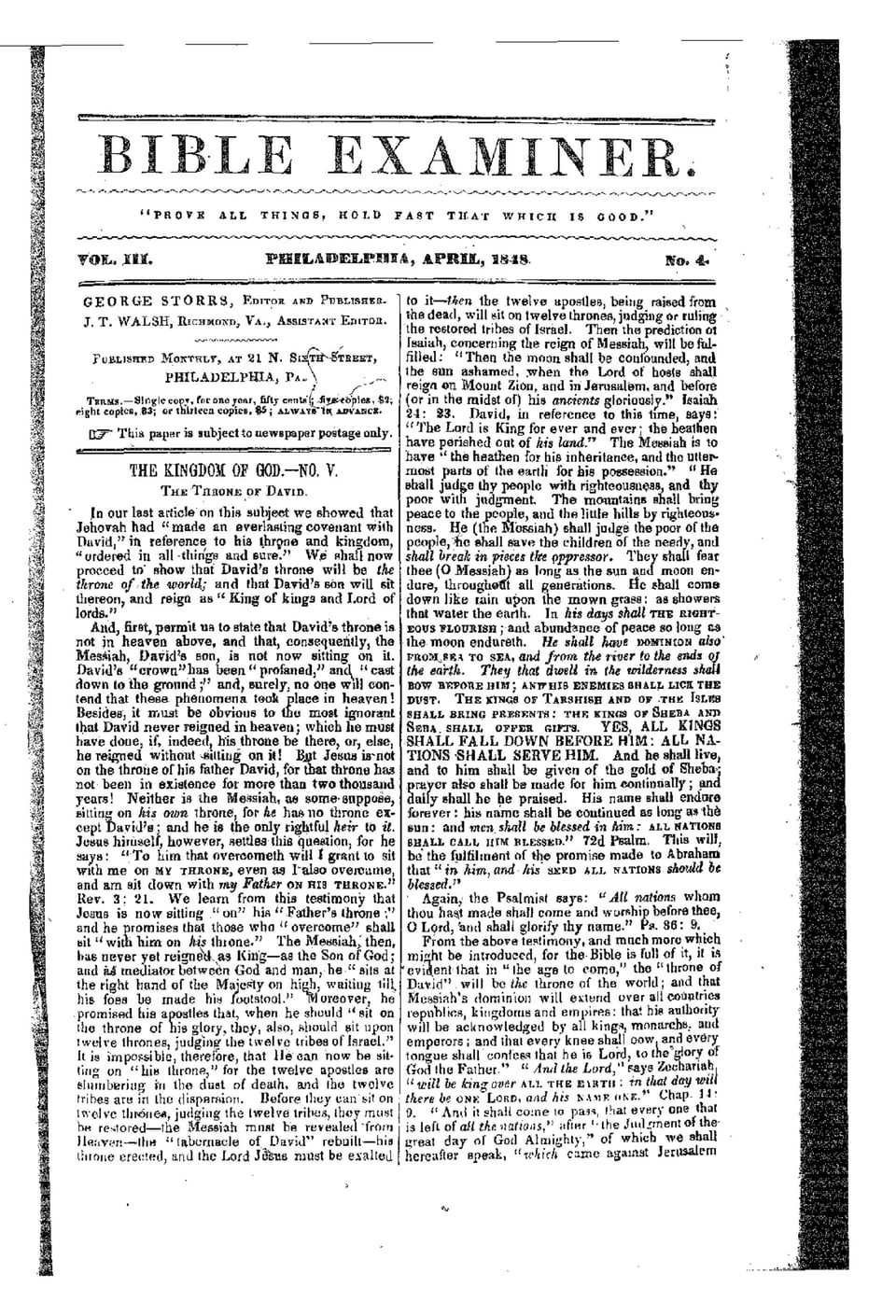
BIBLE EXAMINER.
"PROVE ALL THINGS, HOLD FAST THAT WHICH IS GOOD."
VOL. III.
PHILADELPHIA, APRIL, 1848.
No. 4.
GEORGE STORRS, EDITOR AND PUBLISHER J. T. WALSH, RICHMOND, VA., ASSISTANT EDITOR.
to it—then the twelve apostles, being raised from the dead, will sit on twelve thrones, judging or ruling the postured tithe of Israel.
PUBLISHED MONTHLY, AT 21 N. SIXTH STREET PHILADELPHIA, PA.
TERMS.—Single copy, for one year, fifty cents; five copies, $2;
eight copies,3; or thirteen copies,5; ALWAYS IN ADVANCE.
This paper is subject to newspaper postage only.
THE KINGDOM OF GOD.—NO. V.
THE THRONE OF DAVID.
In our last article on this subject we showed that Jehovah had "made an everlasting covenant with David, in reference to his throne and kingdom, ordered in all things and sure." We shall now proceed to show that David's throne will be the throne of the world; and that David's son will sit thereon, and reign as "King of kings and Lord of lords."
And, first, permit us to state that David's throne is not in heaven above, and that, consequently, the Messiah David's son is not now sitting on it.
the restored tribes of Israel. Then the prediction of Isaiah, concerning the reign of Messiah, will be fulfilled: "Then the moon shall be confounded, and the sun ashamed, when the Lord of hosts shall reign on Mount Zion, and in Jerusalem, and before (or in the midst of) his ancients gloriously." Isaiah 21: 23. David, in reference to this time, says: "The Lord is King for ever and ever; the heathen have perished out of his land." The Messiah is to have "the heathen for his inheritance, and the uttermost parts of the earth for his possession." "He shall judge thy people with righteousness, and thy poor with judgment. The mountains shall bring peace to the people, and the little hills by righteousness. He (the Mossiah) shall judge the poor of the people, he shall save the children of the needy, and shall break in pieces the oppressor. They shall fear thee (O Messiah) as long as the sun and moon endure, throughout all generations. He shall come down like rain upon the mown grass: as showers that water the earth. In his days shall THE RIGHTEOUS FLOURISH; and abundance of peace so long as the moon endureth. He shall have DOMINION also FROM SEA TO SEA, and from the river to the ends of
David's "crown" has been "profaned," and "cast down to the ground;" and, surely, no one will contend that these phenomena took place in heaven! Besides, it must be obvious to the most ignorant that David never reigned in heaven; which he must have done, if, indeed, his throne be there, or, else, he reigned without sitting on it! But Jesus is not on the throne of his father David, for that throne has not been in existence for more than two thousand years! Neither is the Messiah, as some suppose, sitting on his own throne, for he has no throne except David's; and he is the only rightful heir to it. Jesus hirself, however, settles this question, for he says: "To him that overcometh will I grant to sit with me on MY THRONE, even as I also overcame, and am sit down with my Father ON HIS THRONE." Rev. 3:21. We learn from this testimony that Jesus is now sitting "on" his "Father's throne"; and he promises that those who "overcome" shall sit "with him on his throne." The Messiah, then, has never yet reigned as King—as the Son of God; and as mediator between God and man, he "sits at the right hand of the Majesty on high, waiting till
the earth. They that dwell in the wilderness shall BOW BEFORE HIM; AND THIS ENEMIES SHALL LICK THE DUST. THE KINGS OF TARSHISH AND OF THE ISLES SHALL BRING PRESENTS: THE KINGS OF SHEBA AND SERA, SHALL OFFER GIFTS. YES, ALL KINGS SHALL FALL DOWN BEFORE HIM: ALL NATIONS SHALL SERVE HIM. And he shall live, and to him shall be given of the gold of Sheba; prayer also shall be made for him continually; and daily shall he be praised. His name shall endure forever: his name shall be continued as long as the sun: and men shall be blessed in him: ALL NATIONS SHALL CALL HIM BLESSED." 72d Psalm. This will, be the fulfilment of the promise made to Abraham that "in him, and his seed all nations should be blessed."
Again, the Psalmist says: "All nations whom thou hast made shall come and worship before thee, O Lord, and shall glorify thy name." Pa. 86: 9.
From the above testimony, and much more which might be introduced, for the Bible is full of it, it is evident that in "the age to come," the "throne of Durid" will be the throne of the world; and that
his foes be made his footstool." Moreover, he promised his apostles that, when he should "sit on the throne of his glory, they, also, should sit upon twelve thrones, judging the twelve tribes of Israel." It is impossible, therefore, that He can now be sitting on "his throne," for the twelve apostles are slumbering in the dust of death, and the twelve tribes are in the dispersion. Before they can sit on twelve thrones, judging the twelve tribes, they must be restored—the Messiah must be revealed from Heaven—the "tabernacle of David" rebuilt—his throne erected, and the Lord Jesus must be exalted
Messiah's dominion will extend over all countries republics, kingdoms and empires: that his authority will be acknowledged by all kings, monarchs, and emperors; and that every knee shall bow, and every tongue shall confess that he is Lord, to the glory of God the Father." "And the Lord," says Zechariah, "will be king over ALL THE EARTH: in that day will there be ONE LORD, and his NAME ONE." Chap. 11: 9. "And it shall come to pass, that every one that is left of all the nations," after "the Judgment of the great day of God Almighty," of which we shall hereafter speak, "which came against Jerusalem BIBLE EXAMINER.
shall even go up from year to year to worship the serve these shall perish: YES, THOSE NATIONS SHALL BE King the Lord of hosts, and to keep the feast of UTTERLY WASTED. Isaiah 60.
shall even go up from year to year to worship the King, the Lord of hosts, and to keep the feast of tabernacles." which will be the unitype of the Jewish feast. "And it shall be, that whoever will not come up of all the families of the earth to JERUSALEM to worship the King, the Lord of hosts, even upon them shall be no rain. And if the family of Egypt shall not go up, and shall not come, that have no rain; there shall be the plague, with which the Lord will smite the heathen that come not up to keep the feast of tabernacles. This shall be the punishment of Egypt, and the punishment of all nations that
But we must turn from the contemplation of the authority and dominion of the Lord of hosts, and the glory, splendor, and magnificence of Jerusalem, when it shall be the metropolis of his empire—when all the kings, monarchs, emperors, and great men of the earth, shall surrender their authority, power, and wealth, and lay them at the feet of the King of kings and Lord of lords—we must turn, for the present, from this glorious and spirit-stirring theme to the RESTORATION OF ISRAEL which will be the
BIBLE EXAMINER.
siah, "there shall be a root of Jesse, which shall stand for an ensign of the people; to it shall the Gentiles seek: and his rest shall be glorious. And it shall come to pass in that day, that the Lord will set his hand again the second time to recover the remnant of his people, which shall be left, from Assyria, and from Egypt, and from Pathros, and from Cush, and from Elam, and from Shinar, and from Hamath, and from the isles of the Sea. And he shall set up an ensign for the nations, and shall assemble THE OUTCASTS OF ISRAEL, and GATHER THE DISPERSED OF JUDAH FROM THE FOUR CORNERS OF THE
And it shall come to pass, when you shall be multiplied and increased in the land, in those days, saith the Lord, they shall say no more. The ark of the covenant of the Lord: neither shall it come to mind; neither shall they remember it; neither shall they visit it; neither shall that be done any more. At THAT TIME THEY SHALL CALL JERUSALEM THE THRONE OF THE LORD; and all nations shall be gathered to it, to the name of the Lord, to JERUSALEM; neither shall they walk any more after the imagination of an evil heart. In those days the house of Judah shall walk with the house of Israel, and they
come not up to keep the feast of tabernacles."
Here we have several important truths presented to our consideration :
That in the age to come, when Jerusalem shall be the metropolis of the world, and Messiah shall be reigning on the throne of his Father David. "all nations shall go up to Jerusalem to worship the King, the Lord of hosts." We are not, however, to understand that every person who shall then compose the nations of the earth will go up to Jerusalem, (although the increased facilities for travelling might render even this practicable;) but, that all nations, by their Representatives, should go up to worship the Lord. Who these representatives shall be, will claim our attention hereafter.
We have the punishment which shall be inflicted upon the nation, or nations, that shall refuse to go up to Mount Zion to worship the King, the Lord of hosts they shall have no rain.
But as this would be no punishment to Egypt, seeing they have no rain, special provision is made for them as a nation they are to have the "plague." Thus we have indicated a part of the policy, which
subject of our next number. J. T. W.
THE KINGDOM OF GOD.—NO. VI.
THE RESTORATION OF ISRAEL.
Will Israel ever be restored? is a question of the first importance in the consideration of this subject. Some deny that they will ever be restored to their own land; but it would be easy to show that the destiny of the world turns upon the truth of this doctrine. We do not, however, design to go very extensively into a discussion of this point. We wish to give the general outlines of the things relating to the "Kingdom of God;" in this series of articles; and to fill them up at some future time. The restoration of Israel, alone, would fill a volume. We shall, therefore, content ourselves with the presentation of a few testimonies on the question. We shall accompany the testimony with a few remarks.
In the eleventh chapter of Isaiah we have a prediction concerning, first, the birth of the Messiah: "And there shall come forth a rod out of the
EARTH. The envy also of Ephraim shall depart, and the adversaries of Judah shall be cut off: Ephraim shall not envy Judah, and Judah shall not distress Ephraim."
This prophecy refers to "the whole house of Israel"—that is, to the twelve tribes—Israel and Judah being included. And they are here distinguished by "the outcasts of Israel," and "the dispersed of Judah." And they are represented as being carried westward; they, therefore, come from the east—from the north-east of Asia, and those other countries already referred to, to which the ten tribes were carried away captive by Shalmaneser, king of Assyria, and from which they have never yet returned. The Lord, by his great power, will prepare an "highway," for the return of his people, by "utterly destroying the tongue of the Egyptian sea;" "he will shake his hand over the river" of Egypt, and will "smite it in the seven streams" thereof, and "make them go over dry shod, as it was to Israel in the day that he came up from the land of Egypt."
Again, in the 27th chapter of Isaiah, we have
shall come together from the land of the north to the land that I have given for an INHERITANCE TO YOUR FATHERS.
The hostility which obtained between Judah and Israel will then be removed, and they will worship the Messiah together on the holy mount at Jerusalem.
Again, we have another prediction: "Therefore, behold, the days come, saith the Lord, that it shall no more be said, The Lord liveth that brought the children of Israel out of the land of Egpyt; but, The Lord liveth, that brought the children of Israel from the land of the north, and from all the lands whither he had driven them: and I will bring them again into their land that I gave to their fathers.
Behold, I will send for many fishers, saith the Lord, and they shall fish them; and afterwards will I send for many hunters, and they shall hunt them from every mountain, and from every hill, and out of the holes of the rocks." Jeremiah, 16:14-16.
Once more, the Lord has said: "For lo! the days come, that I will bring again the captivity of Israel and Judah, saith the Lord: and I will cause them to
will obtain, nationally, in the age to come.
Let the reader remember the quotation from the Psalms, which declares that "the kings of Sheba and Seba shall bring presents, and offer gifts;" and then read the following in reference to the glory of Mount Zion and Jerusalem, when that state of things to which we have adverted, shall obtain: "And the Gentiles shall come to thy light, and kings to the brightness of thy rising. Lift up thy eyes around, and see; all they assemble themselves, they come to thee; thy sons shall come from far, and thy daughters shall be nursed at thy side. Then thou shalt see, and flow together, and thy heart shall fear, and be enlarged; because the abundance of the sea shall be converted (or turned) to thee, the forces (or wealth) of the Gentiles shall come to thee. The multitude of camels shall cover thee, the dromedaries of Midian and Ephah; all they from Sheba shall come; they shall bring gold and incense; and they shall show forth the praises of the Lord. All the flocks of Kedar shall be gathered to thee; they shall come up with acceptance on my altar, and I (the Lord) will glorify the house of my glory. Surely
stem of Jesse, and a branch shall grow out of his roots."
We have his character indicated: "And the spirit of the Lord will rest upon him, the spirit of wisdom and understanding, the spirit of counsel and might, the spirit of knowledge and of the fear of the Lord: And will make him of quick understanding in the fear of the Lord: and he will not judge after the sight of his eyes, neither reprove after the hearing of his ears: But with righteousness will he judge the poor, and reprove with equity for the meek of the earth."
We have a prediction, which evidently relates to the future, concerning a judgment which he will execute upon the wicked: "And he will smite the earth with the rod of his mouth, and with the breath of his lips will be slay the wicked."
We have a prophecy concerning the nature of Messiah's reign: "And righteousness shall be the girdle of his loins, and faithfulness the girdle of his reins. The wolf also shall dwell with the lamb, and the leopard shall lie down with the kid; and the calf, and the young lion, and the fatling together,
this testimony: "And it shall come to pass in that day," in the "day the Lord with his keen and great and strong sword will punish leviathan, the piercing serpent," and "slay the dragon that is in the sea"—"in that day the Lord shall gather from the channel of the river (Euphrates) to the stream of Egypt, (the Nile,) and you shall be gathered one by one. O ye CHILDREN OF ISRAEL. And it shall come to pass in that day, that the great trumpet shall be blown, and they shall come who were ready to perish in the land of Assyria, and the outcests in the land of Egypt, and SHALL WORSHIP THE LORD ON THE HOLY MOUNT AT JERUSALEM." Again: "In that day will the Lord of hosts be for a crown of glory, and for a diadem of beauty, to the residue of his people." Ch. 28: 5. Moreover, it is declared, that "Israel shall be saved in the Lord with an everlasting salvation: you shall not be confounded nor ashamed world without END." Ch. 45: 17. This prediction has never yet been fulfilled; for they have been "ashamed" and "confounded," for more than two thousand years. Let us now turn to the testimony of the prophet Jeremiah, ch. 3: 12. "Go and proclaim these words
return to the land that I gave to their fathers, and they shall possess it." Ch. 30: 3. And when they are thus restored, the Prophet declares that "they shall serve the Lord their God, and DAVID THEIR KING, whom I will raise up to them." Verses 8, 9.
From the testimony submitted we learn, that Israel and Judah will be restored; and that, when restored to their own land, they shall dwell together in peace; and serve the Lord their God, and the BELOVEN, (for such is the English of David.) whom Jehovah will raise up to them.
But, although we have scarcely commenced giving the testimony of the prophets upon this interesting question, we must leave them, and turn our attention to the evidence of the Apostle Paul: In his Epistle to the Romans, he argues the question of the fall of Israel, an account of their unbelief—their being cut off from their own olive, and the grafting in of the Gentiles. He informs the Romans "that blindness had happened to Israel, until the fulness of the Gentiles shall be come in;" and concludes by asserting that "All Israel shall be saved;" and then quotes this authority—"As it is
the isles shall wait for me (the Lord of hosts) and the ships of Tarshish first, to bring thy sons (OZion) from far; their silver and their gold with them, to the name of the Lord thy God, and to the Holy One of Israel, because he hath glorified thee." O Jerusalem! "And the sons of strangers shall build up thy walls, and their kings shall minister to thee; for in my wrath I smote thee, but in my favour have I had mercy on thee. Therefore thy gates shall be open continually; they shall not be shut day nor night; that men may bring to thee the forces (or wealth) of the Gentiles, and that their kings may be brought. For the nation and kingdom that will not and a little child shall lead them. And the cow and the bear shall feed; their young ones shall lie down together, and the lion shall eat straw like the ox. And the suckling child shall play on the hole of the asp, and the weaned child shall put his hand on the den of the basilisk. They shall not hurt nor destroy in all my holy mountain: For the earth shall be full of the knowledge of the Lord, as the waters cover the sea."
We then have a glowing prediction relative to the restoration of Israel—a prediction, which the student of the Bible will at once perceive, has never been fulfilled: "And in that day," the day of Mestowards the north, and say, Return thou backsliding Israel, saith the Lord; and I will not cause my anger to fall upon you: for I am merciful, saith the Lord; and I will not keep anger for ever. Only acknowledge thy iniquity, that thou has transgressed against the Lord thy God, and hast scattered thy ways to the strangers under every green tree, and you have not obeyed my voice, saith the Lord. Turn, O backsliding children, saith the Lord; for I am married to you: and I will take you one of a city, and two of a family, And I will bring you to Zion: And I will give you pastors according to my heart, who shall feed you with knowledge and understanding.
written, there shall come out of Sion (or 'to Sion,' as it ought to be rendered) the Deliverer, and shall turn away ungodliness from Jacob." Romans. 11. We are not to understand, however, that every Israelite will be saved; for the apostle says elsewhere, that "a remnant" shall be saved; but that all the twelve tribes are to be the subjects of the salvation spoken of by the Prophets. It will be a national salvation, political and ecclesiastical in its nature.
The twelve tribes then, gathered out of all the countries whither the Lord has driven them, and restored to the land of their fathers—the land promised to Abraham, Isaac, and Jacob, will be mortal men and women, organized under the new covenant which Jehovah will give to the house of Israel and the house of Judah.
Messiah will be their king; and the twelve apostles will be associated with him in the administration of the affairs of the kingdom of God. These restored Israelites will not "inherit the kingdom," but they will be subjects; for the Messiah, according to the Prophets, is "to reign over the house of Israel for ever." How beautiful! how forcible!! and how sublime!!! is the language of Jesus to his apostles, when he said: "Verily I say to you, that ye who have followed me, in the regeneration, WHEN THE SON OF MAN SHALL SIT ON THE THRONE OF HIS GLORY, YOU, ALSO, SHALL SIT UPON TWELVE THRONES, JUDGING THE TWELVE TRIBES OF ISRAEL" Matt. 19:28.
Here we behold the Messiah, the Prince and Author of life, who was "born that he might be a king," promising to those "who had followed him," that, "in the regeneration"—the grand era of the new creation—the creation of the new earth and heavens—"when the Son of man should sit upon THE THRONE OF HIS GLORY," the twelve apostles "should also sit upon TWELVE THRONES judging the twelve tribes of Israel!"
And how short-sighted are those who refer the fulfilment of this sublime promise to the "day of Pentecost." For, at that time, the ten tribes were far away from the land of their fathers; Jesus was not "sitting on the throne of his glory," but on the "throne of his Father;" and the apostles, so far from sitting on "twelve thrones, judging the twelve tribes of Israel," were, with other disciples, assembled in an "upper room for fear of the Jews."
This, then, is all in the future; and it opens up to us a scene of glory, grandeur, and sublimity, far transcending the Royal Courts of this perishing state! Alas! what a dreaming world this is! Their eyes are shut to the glory of the future! Their ears are deaf to the voice of inspiration! They are "without hope and without God in the world."
J. T. W.
END OF THE WICKED.
"Is ANNIHILATION THE PENALTY OF THE LAW?"
The editor of the "True Wesleyan," Luther Lee, takes up the above question in his paper of December 25th. The following review of Br. Lee, is by Br. Crew, of this city. Though it may be thought somewhat long, we were unwilling to divide it, and it will well pay for a careful perusal. The late Orange Scott once said to us, "If any body can answer your argument on the End of the Wicked, Luther Lee can." We bid him welcome to the work, or any one else. We want nothing but the truth; if we have it not, we desire to know where it is.
REVIEW OF LUTHER LEE.
When my mind was first enlightened to understand, as I humbly trust, the great truth that "the wages of sin in Death," the main arguments now offered by Mr. Lee, editor of the True Wesleyan, to sustain his views, were carefully examined. They may be found in Edwards' answer to Chauncy. I beg the reader's candid consideration of my reply to these arguments
ARGUMENT 1.
"The Scriptures represent the punishment of the wicked as consisting in positive suffering, rather than in merely ceasing to exist. Luke 16:23. 'And in hell he lifted up his eyes, being in torment.' ver. 24. 'I am tormented in this flame.' verse 25. 'Now he is comforted and thou art tormented.' Matt. 18:34, 35. 'And his Lord was wroth and delivered him to the tormentors till he should pay all that was due unto him. So shall my heavenly Father do also unto you, if you from your hearts forgive not every one his brother.' Rev. 14:11. 'The smoke of their torment ascendeth up forever.' Matt. 8:12. 'There shall be weeping and gnashing of teeth.' These Scriptures, with many more which might be quoted, describe the punishment of sin, but they do not describe annihilation, nor is it possible for what is here described to co-exist with annihilation."
Now I ask, how do these passages prove that "the punishment of the wicked" consists "in positive suffering rather than in merely ceasing to exist?" I affirm that these passages do not provo it, because,
Not one of them declares this.
Not one of them necessarily implies endless suffering. Rev. 14: 11, is not an exception. It is an undeniable truth that the inspired writers often use the terms translated "ever" and "forever and ever," &c., in reference to subjects which have a limited duration. Indeed, the original term aion, properly imports limited duration, age, ages, &c. It is worthy of consideration that terms implying unlimited duration, as aphthartos (immortal, incorruptible,) atharutos (never dying,) akatalutos (indissoluble,) which are applied to the life and felicity of the righteous, are never, in the Scriptures of truth, applied to the life and misery of the wicked. It pertains to those who prefer the words which man's wisdom teacheth to those which the Holy Ghost teacheth, (though they may not intend this) to teach the tradition of immortal wo.
If then these passages do not necessarily imply endless suffering, or declare that the suffering, whatever it may be, is the punishment of sin rather than ceasing to exist, how do they prove it?
I affirm that these passages do not prove it, because.
We are to learn what is the chief penalty of the law or wages of sin, from those passages which plainly declare it, rather than from parables, or even from plain threatenings of some of the evil consequences of transgression. The word of the Lord is perfectly plain on this subject. Alas! how has the counsel of the Lord been darkened by words without knowledge. What was the declaration of the Almighty respecting the penalty for transgression when he first gave law to man? Was it thou shalt suffer immortal wo, or endless torments? No "Thou shalt surely die," or rather "dying thou shalt die." The same plain truth is repeated. "The soul that sinneth it shall die." Again. "The wages of sin is DEATH." When the inspired apostle would exhibit the great penal consequence and desert of sin, he uses, not the term suffering or torment, but DEATH. Now I ask, if we affirm that suffering rather than death, (which is a cessation of life or conscious being,) is the wages of sin, do we teach according to the oracles of God?
These passages, which exhibit only a part of the evil consequences of sin, fail to prove that conscious suffering, rather than cessation of existence is the great penalty of the law, because.
The terms used by the Spirit of Truth to describe the future and final punishment of the wicked accord with the first great threatening of death to the sinner. These terms are "destruction," "perdition," "lost," "consumed," "burnt up," "devourcd," &c. Concerning the import of these terms, we need not doubt, for the destruction threatened is declared to be a "destruction from the presence of the Lord, and from the glory of his power," which fills the universe; and a destruction, not of happiness or well-being merely, but a destruction of "soul and body in hell." Matt. 10:28. Surely the husbandman puts the fire to the chaff which he allows no one to quench, with the design to burn it up and not to preserve it forever. So our Lord plainly teaches that the tares, the children of the wicked one, will be burned up.
These passages, none of which necessarily imply unlimited suffering, cannot prove that cessation of being is not the great penalty of the law of God, because,
Destruction from the presence of the Lord and from the glory of his power is a punishment of loss of far greater magnitude, and much more to be dreaded than any limited suffering which man can endure. Suppose a man to suffer a million of ages all that he is capable of suffering, mentally and physically, and then by some dispensation of divine mercy, he should be introduced into the presence of the Lord to enjoy his glory eternally! How trifling would all his sufferings be when compared with the "far more exceeding and eternal weight of glory."
It is said that "these Scriptures—describe the punishment of sin, but they do not describe annihilation." "Annihilation" is an unscriptural term. If by it is meant only an entire destruction of conscious being, or, as our Lord teaches, of "soul and body;" I have no objection to it. As, however, it is used by our opponents, as the basis of a philosophical objection, I do not use it in reference to the subject at issue. I affirm that "these Scriptures" express only a part of the punishment of sin. They do not state what the Scriptures declare the wages of sin to be, nor what God threatened Adam if he sinned. The fact that these particular passages do not describe utter destruction of being, is no more proof against such destruction, than the fact that some passages which describe the future felicity of the righteous, do not affirm its duration, is proof that it is not endless. The silence of one passage of Scripture is not to be adduced to oppose the plain and positive testimony of another.
The actual sufferings described in the passages quoted, cannot indeed "co-exist with annihilation" or conscious being, but this is no proof that they will not end in such destruction.
MR. LEE'S SECOND OBJECTION.
It is as follows: "The Scriptures represent the punishment of the wicked as being inflicted in degrees, proportionate to the different degrees of ill desert on the part of sinners, individually; but annihilation admits of no degrees." "If annihilation be the penalty of the law, no man can receive a greater condemnation than annihilation, which the least must receive, who are condemned at all, for it admits of no degrees." To this I reply,
The fact that the Scriptures represent that
divine justice will be honored by the infliction of various degrees of suffering, antecedent to final destruction from the presence of the Lord, and the glory of his power, is no proof that THE great penalty of the law does not consist in this destruction. This may reasonably be, as in fact we have seen it is, God's great and chief threatening for rebellion although it will be preceded by different degrees of suffering.
Although subsequent to utter destruction, sinners of different degrees will be on a level; it is not true that God's manner of destroying sinners "admits of no degrees."
It is no more true than that his supposed act of holding all impenitent sinners in eternal misery admits of no degrees. If God can hold all sinners in eternal misery with different degrees of suffering, he can destroy all sinners with different degrees of suffering. As the first death is attended by various degrees of suffering, so will it be with the second, which will terminate existence forever.
Mr. L. remarks, that "the common reply" to the two arguments above considered, "is, that the penalty of the law is neither suffering nor annihilation, by themselves, but is made up in part of both." To which he replies: "1. It is absurd to suppose that the penalty of the law is two things, and neither. It must be the one or the other, but not both. 2. This view is wholly unfounded in Scripture. We venture that not one text can be adduced which refers to any such division in the claims of the law, in the kind of punishment it demands."
I understand Mr. Lee, here to represent that every text which refers to the punishment of sin, refers to punishment of the same kind of one kind only, and that of "positive suffering." The texts he has quoted to prove what the punishment is, all imply "positive suffering." He quoted no text which threatens death, destruction, perdition, &c. I shall now quote 2 Thess. 1:9, "Who shall be punished with everlasting destruction from the presence of the Lord and from the glory of his power." I affirm that the manifest import of this threatening is a destruction of persons, or, as our Lord teaches "of soul and body." Matt. 10:28. The passage contains no threatening of any "positive suffering," but what is implied in their destruction. It is a most solemn threatening of the doom of the wicked at the second coming of the Lord Jesus. Whether the doctrine of eternal misery is true or false, this passage plainly teaches that the punishment of sin consists in loss, and not in "positive suffering" only; it consists, certainly in part or in whole, of banishment from the glorious presence of the Lord, whether the destruction be a destruction of "soul and body" or not. If then the scriptural declarations of the manner in which God will punish the wicked teach us what is the penalty of the law as Mr. Lee himself argues, then it follows from 2 Thess. 1:9, and all the passages which declare that punishment to be death, perdition, destruction, &c., that such destruction, &c., pertains to the penalty of the law.
Whether it is most proper to consider the penalty of the law as consisting in destruction of being only, or in such destruction and different degrees of previous suffering, I ask for the proof that "it is absurd to suppose that the penalty of the law is two things." Is it absurd for a legislature to make the penalty of transgressing a law, both fine and imprisonment? He who can believe that it is reasonable and just for "the Father of Mercies" to punish a man for a single sin, and that the least which he can commit, by holding him in never ending torment, is the last person to charge others with absurdities.
Although the loss of being and of the eternal enjoyment of the ever blessed God is a punishment of such magnitude as not to be compared with any antecedent suffering, and consequently is most properly to be considered as the penalty of the law, it is quite immaterial to the question at issue, whether we consider the penalty of the law to consist in this only, or in this and antecedent positive suffering. The term "penalty of the law," is not scriptural. However, we may argue about it, it is an undeniable fact that the Scriptures of truth plainly teach these two things; 1. that God will punish the finally impenitent with the "positive suffering" of many or few stripes, according to the different degrees of their criminality; and 2. That he will punish them with everlasting destruction from his presence and glory; with "the second death," "perdition," being "burnt up," "utterly consumed," destruction of "both soul and body in hell." So far from this being "absurd," it is precisely the reverse. It would be absurd not to do it. It would be "absurd" for the just God to adopt destruction of being simply, without any different degrees of preceding positive suffering, as his punishment of sinners.
MR. LEE'S THIRD OBJECTION.
"If annihilation be any part of the penalty of the law, it must be the smallest degree of punishment awarded to any sinner, and of course, all punishment over the smallest degree must consist in suffering, and not in annihilation. Suppose then a man to die after committing his first sin, for that one sin he must be annihilated. Suppose another man to commit ten thousand sins, and die a hundred years old. The punishment of one sin is annihilation, and of course the punishment of the 9999 sins is previous suffering; the one part ending all the rest, must be a blessing and can be no part of a curse. Again, if 9999 parts of the penalty of the law can be met in suffering, we are able to see no good reason why the one additional part could not be met in the same way and supercede the necessity of annihilation."
Let us first apply this reasoning to Mr. Lee's own opinion. "If (eternal misery) be any part of the penalty of the law, it must be the smallest degree of punishment awarded to any sinner, and of course, all punishment over the smallest degree must consist in (greater degree of suffering,) and not (simply in eternal misery.) Suppose, then, a man to die after committing his first sin, for that one sin he must suffer (eternal misery.) Suppose another man to commit ten thousand sins, and die a hundred years old. The punishment of one sin is (eternal misery,) and of course the punishment of the 9999 is (greater degrees of suffering.) Again, if 9999 parts of the penalty of the law can be met in (greater degrees of suffering,) we are able to see no good reason why the one additional part could not be met in the same way, and supercede the necessity of (eternal misery)."
This reasoning is more ingenious than solid. If future punishment is eternal misery, it is the eternity which constitutes the greatness of the punishment. If it is destruction of being, it is the loss of the eternal enjoyment of the blessed God which constitutes its greatness. Destruction of being, involving this incalculable loss, must, in itself considered, be, in all circumstances, "a curse," not "a blessing." That it may be a less curse than such endless torments in hell, as some men describe, I freely admit to the honor of the divine character; but the terms less "curse," and "a blessing," can hardly be considered synonymous. Dors the law threaten the murderer with "a blessing" because death terminates the agonies of strangulation?
MR. LEE'S FOURTH OBJECTION.
"The punishment of the wicked is associated with the punishment of the devil and the fallen angels, which does not appear to be annihilation." Matt. 25:41. 2 Peter 2:4. Jude 6. — hark! the devils cry out—'what have we to do with thee, Jesus thou Son of God? art thou come to torment us before the time?' It was not annihilation then that they feared," &c.
If our brother had done the devils justice, and hearkened to them a little longer to hear all their testimony on the subject, instead of turning away when he had heard just enough to suit his own theory, he might have received some good instruction by hearing them cry, "art thou come to destroy us?" Matt. 8:29. Mark 1:24. By all they said, it is evident that they expect to be tormented in a manner which will issue in their destruction. Be this as it may, the testimony of the Spirit of Truth must not be rejected. "Forasmuch then as the children are partakers of flesh and blood, he also himself likewise took part of the same; that through death he might destroy him that had the power of death, that is the devil." Heb. 2:14.
The reference of Jude to the cities of Sodom and
The reference of Jude to the cities of Sodom and Gomorrah, "suffering the vengeance of" aionion (age, lasting,) fire, is a reference to an example set forth and seen in this present world in the destruction of those cities for their iniquities.
"The Scriptures describe the fearfulness of the punishment of the wicked, by the character and duration of the suffering which is to constitute such punishment. 'Cast into hell; into the fire that never shall be quenched—where their worm dieth not, and the fire is not quenched; these shall go away into everlasting punishment.'"
Mr. LEE'S FIFTH OBJECTION.
I affirm that the Scriptures describe the fearfulness of the punishment of the wicked by the terms "death," "second death," destruction of the soul and body, i.e. of conscious being, by coming to an "end;" by perishing, by being utterly consumed, by not entering into life, and by the tremendous consequence of their destruction in the loss of the everduring joys and glories of "Immortality," in "the presence of the Lord," and "the glory of his power." Mark 9:45, 46, proves the very opposite to that for which it is adduced. Let Scripture explain Scripture. See Matt. 13:40—"As therefore the tares are gathered and burned in the fire; so shall it be in the end of this world." Christ "will gather his wheat into his garner, and he will burn up the chaff with unquenchable fire." If the fire "is not quenched," the tares, or chaff, will be entirely consumed. If the worm dies not, the carcase is wholly devoured. The wicked will indeed go away "into everlasting punishment." As the punishment is destruction, and that destruction is
everlasting, it necessarily follows that their punishment is everlasting.
MR. JEEE'S LAST ARGUMENT.
"The expressions 'death,' 'shall die,' 'destruction,' 'shall be destroyed.' &c., are all used in other senses than that of annihilation."
senses than that of annihilation."
That these terms, which, in their proper and literal import, as applied to man, plainly import the cessation of conscious existence, are sometimes used in a secondary or figurative sense, is true. This, however, gives us no authority to set aside their primary and literal import where there is no necessity to do so. If we do so, we make the Scriptures a nose of wax, and can prove any thing we please. God threatens the violator of his law with death. Sin is the transgression of the law. Death is the opposite of life, the cessation of it.
"The soul that sinnath, it shall die." "The wages of sin is death." Does the Almighty promulgate the fearful penalty of his law in figurative terms? Does any earthly legislator do this? If the terms death, destruction, destroy soul and body, perdition, burned up, utterly consumed, &c., &c., are to be understood figuratively, who shall determine their import? If, indeed, the word of the Lord as plainly declared that the wages of sin is immortal wo, or eternal life in misery, as it declares that the wages of sin is death; if it as plainly and positively declared that the soul that sinneth shall live forever in torment, as it does that the soul that sinneth shall die, then indeed we might enquire after some figurative import for the one or the other of these contradictory passages. But when these threatenings of death, destruction, &c., which are so plain that he runs may read and understand, are not even apparently contradicted by a single passage in the original Scriptures connecting actual suffering with endless duration, it appears to me a great perversion of scripture to set aside their literal import to twist them into harmony with this horrible doctrine. So far from the justice, or any other perfection, of the Almighty, requiring any greater punishment than is implied in the literal import of those dreadful threatenings, it is an impeachment of those perfections to suppose it. That the entire and everlasting destruction of the sinner from the presence and glory of God, attended with various degrees of torment as justice can apportion antecedent to cessation of being, is an adequate manifestation of the great evil of sin and of the divine displeasure against it, is a proposition which no man can reasonably deny. Mr. L. remarks: "The expression 'cut him asunder' as clearly expresses the act of taking away existence, as any term used; and yet, after they are cut asunder, they receive their portion and weep and gnash their teeth." I reply that our Lord's declaration does not necessarily imply any thing more than that destruction shall be connected with weeping and gnashing of teeth. If this is denied, we may refer the expression, "cut him asunder," to the first death, which is expressed by the terms "cut off," "cut down," which is perfectly compatible with the destruction of his being, by the second death, in the lake of fire where there will be weeping, wailing, &c. However we may understand the passage, it certainly is not true that the phrase "cut him asunder." "as clearly expresses the act of taking away existence (forever) as any term used." The declaration, "whose end is destruction," and the expressions "everlasting destruction," "destroyed
forever," "perdition," "lost," all express it more clearly.
"How futile is it then, to pretend that any or all of" the passages adduced by Mr. Lee, prove that sinners will exist in endless misery, "in the face of so much proof," that "they shall be destroyed forever." Ps. 92: 7. HENRY GREW.
ANOTHER LETTER OF CHAS. FITCH'S.
The following extract of a letter was written to the Editor of the Examiner by the late Charles Fitch, a few months before he "fell asleep." We see that Br. J. B. Cook has placed it in the "Appendix" to his work on "The True Source of Immortality;" but, we are sorry he should have omitted to state to whom the letter was addressed. It there appears as if it was written to himself. For the information of those of our readers who may never have heard of Br. Fitch, we would say, he was a holy, able, and faithful minister of the gospel: one who did not shun to declare the whole counsel of God, as he understood it, whatever reproach he might suffer for it. He fell asleep in Jesus, at Buffalo, N.Y., in Sept. or Oct. 1844.
CLEAVELAND, [Ohio] May 25th, 1844.
DEAR BROTHER STORRS:—I have received a long letter from Brother Litch, touching the state of the dead, the end of the wicked, &c. It would be exceedingly pleasant to me, to be able to please him, and the dear brethren who agree with him, for I love them all, and would rejoice to concede anything but truth, to be able to harmonize with them in my views. But there is a Friend who has bought me with his blood, and I take more pleasure in pleasing Him, than in pleasing all the world besides. I never preached my present views touching the state of the dead, and the destruction of the wicked, until fully convinced that I could no longer withhold them without displeasing my blessed Lord and Master. Most sincerely and truly can I call God to record upon my soul, that I have never been influenced in this matter except by a full, solemn and irrepressible conviction to Him who died that I might live. I held my peace, most gladly, I can assure you, just as long as I dared to do it; and when I felt that I had no more right to be ashamed of God's truth on one subject than another, I bowed to His will and consented, henceforth, to believe and teach, that when a man is dead, he is dead; and that when a man is cast into a lake of fire and brimstone, and burned up, root and branch, and utterly consumed with terrors, he cannot, after that, be eternally alive. The idea that man is a being made up of parts, some of which may be dead, and others alive, at the same time, is to me a pagan superstition, out of which the Papists have contrived to raise large sums of money for their own vile purposes: nothing moved by the tremendous fact, that they were robbing God of the glory of being alone immortal, and Christ of the power of having immortality to give.
With regard to those brothren who feel called on to contend against the truths that the dead are dead, and that the destruction which awaits the wicked is destruction, and not something else, I have no feelings. I think, but those of brotherly love. They cannot feel any more confident that we are mistaken, than I do that they are; nor can my reasoning on the subject seem to them more futile, frivolous and inconclusive, than theirs does to me.
I certainly have not adopted the views I entertain to gain any worldly good, nor can I ever renounce them for such a purpose. Having been led into them by firm conviction, and through the fear of God alone, nothing else can ever lead me back. And I feel as ready to defend the truth on these subjects in one place as in another; and I might as well attempt to suppress my breath, as to suppress these truths when I preach. I know that by the great body of Second Advent believers, with whom I am acquainted, they are admitted as truth; though ideas of expediency may induce them to be silent. I have heard a few object, but I feel persuaded that it is in some instances through fear that the promulgation of these truths will be detrimental to the influence of truth, touching the coming of the Lord. With this I have nothing to do. God will take care that the preaching of one truth shall not hinder the influence of another. I have been in Buffalo, Rochester and Cincinnati during the last two months, and I have not shunned to declare the whole counsel of God upon these subjects; nor can I, wherever I may be called to preach. I have no wish to differ from my brethren, but if they ask me to withhold God's truth, on any subject to please them, they ask what I am at no liberty to grant.
God willing, I shall see you at no distant day. My faith in the Lord's appearing is unshaken; and I long for it, more than I can express; and that, irrespective of my own interests. I want my Lord Jesus to wear His crown, and fully to taste the joy set before Him when He "endured the cross, despising the shame;" and I want the martyrs, who have bled for Christ, to live and reign with Him.
Yours, in the glorious hope. CHAS. FITCH.
BIBLE EXAMINER.
PHILADELPHIA, APRIL, 1848. ARE THE WICKED IMMORTAL? "The soul that sinneth it shall die."—Bible.
PAGANISM IN THE NINETEENTH CENTURY.—We were forebly struck at noticing the influence the Pagan Fable of an Immortal Soul has upon otherwise intelligent minds, in this age of the world, and under the light of the Bible; by the following editorial scrap in a paper of this city, the day previous to the funeral of John Q. Adams. It is as follows:
"Obsequies of Mr. Adams.—From the preparations making, it is believed that the funeral honour to the remains of the illustrious ex-President Adams, on their arrival in this city to-morrow afternoon, will be of such a character as will reflect credit upon the patriotism of Philadelphia. In view of the hallowed associations, what a beautiful and sublime feature will be the resting of the corpse of this patriot of four-score, for a night in Independence Hall. If the spirits of 'the just made perfect,' are permitted to mingle, invisible to mortal ken, on this earth, what a meeting will that be BETWEEN FATHER AND SON, in the sacred hall where American Liberty first drew its breath."
The italicising is our own. Here is "the corpse of this patriot in Independence Hall." What next? "If spirits" of the departed signers of the Declaration of Independence, among whom is John Adams, father of him whose "corpse" is to be in the old "Hall," "are to mingle on this earth, what a meeting will that be between father and son, in the sacred hall," &c. It must be indeed a wonderful meeting for a "disembodied, immortal spirit" to come to old Independence Hall to meet a "corpse!!!" In the mean time where is the "spirit" of John Q. Adams? Has it had no "meeting" with the "spirit" of his "father?" And must the "spirit of" his "father" come down to Independence Hall to meet "the corpse of" the son in order to have a wonderful "meeting"!! It is difficult to portray in language sufficiently vivid the folly that the immortal-soul theory leads men into. Truly, "like priest, like people." The Priests of "undying soul"-ism talk about departed spirits hovering over friends left behind; and no wonder political Editors should talk of "what a meeting between" the "spirit of" a "father and" the "corpse" of his "son"! Surely it must be a very wonderful meeting! What a glorious likeness between them! An immortal spirit and a corpse! What a similarity of feeling they will have! How exactly they will tally together! What a perfect sympathy! What exquisite philosophy!
"The dead know not anything;" Eccl. 9: 5. "If the dead rise not, then they that are fallen asleep in Christ are perished;" 1 Corth. 15: 16-18.
THE DEATH BY ADAM.—That death entered into the world by Adam's sin, we believe is a truth admitted by all Christians. They may, and do, differ about the character of that death; but that it involves the unbuilding of all men, so that they pass under what we all call death, is not disputed. Is this unbuilding of men the penalty of the personal sins of Adam's posterity? Seminally, or in Adam's loins, we "all have sinned," as Levi seminally, in Abram's loins, paid tithes to Melchisedec, [Heb. 7:9, 10.] Whatever death was the penalty of the Adamic law all his posterity were liable to, whether they personally sinned or not. Hence we see multitudes of little children die who have never personally sinned. The death penalty, then, for Adam's sin, is not the penalty for the personal offences of his posterity: men do not, therefore, receive the penalty of their own sins by the corruption and death flowing from Adam's transgression. But the unchangeable law of God is—"The soul that sinneth it shall die"—and "The wages of sin is death." The Second Adam reverses not the penalty of the Adamic law, but restores again to life, all men, after the penalty has been inflicted. But the continuance in life, after such restoration, is another, and a very different matter; that depends on
personal character. Those who during their personal trial, "receive abundance of grace, and of the gift of righteousness, shall reign in life, by Jesus Christ;" not only live again, but live forever: "die no more—death hath no more dominion over them." But, if men "will not come to" Christ, "that they might have life," while "the accepted time and day of salvation" continues, they die for their personal transgressions; and this death must necessarily be after the restoration from that dath brought on all men by Adam's sin.
Whether those restored to life will have inflicted upon them "the second death," who have not been "enlightened" by revelation, or by the Gospel of the Kingdom in some age, or dispensation past, till they shall have it presented to their minds and personally reject it, is a point about which Christian men may differ. But it is enough for us to know, that men who have been enlightened, and have rejected the light, from love to sin, or "love darkness rather than light because their deeds are evil," will "be punished with everlasting destruction from the presence of the Lord, and from the glory of his power; when he shall come to be glorified in his holy ones and to be admired in all them that believe IN THAT DAY." That punishment, we learn from the Scriptures, is to die the second time; from this death, which is the wages of personal sins, we have yet to learn where the text is to be found that gives any hope of a resurrection. It is "eternal," "everlasting:" no hope—no recovery. To that death every impenitent sinner is exposed; that death every sinner, who has been called by the truth of God, will experience, except he repent and seeks the remission of his sins, through the "one Mediator." There must be repentance towards God, and a forsaking our personal sins; and the punishment must be remitted, not inflicted, or there is no eternal life in us, nor for us. The punishment of our personal sins never has been borne by another. If it had been, it would be mockery to offer to forgive the debt. What! first demand and receive payment for our debts, and then turn to us and offer to forgive those debts!! After they are paid profess the debts are still due! No, no; Christ paid no man's debts; and he taught us to pray, "forgive us our debts." But if the common notion that Christ paid our debts is true, we should pray, "Lord, thou wouldst not forgive us our debts, and now thy Son has paid them for us: so we will deal with our debtors; somebody shall pay their debts to us."
Christ redeems us from the curse of the Adamic law, and restores all men to life, so that what we lost by Adam we regain by Christ; and, furthermore, he has become our kinsman, redeemer, and the "one Mediator," through and by whom we can now approach unto God and receive a pardon
of our personal sins, or the remission of the punishment due to us for those sins, and obtain "the gift of God, ETERNAL LIFE," and "not be hurt of tho SECOND DEATH."
PROPHETIC PERIODS.—NO. VI.
"The wise shall understand" is a phrase that has been much used by those who have contended that the definite time of the second advent of our Lord is revealed in the prophetic numbers, in Daniel. That the wise will understand some things, at a given point of time, we have no doubt. That there may be prophetic events, yet future, marked by the commencement of some prophetic period that may give the wise to understand, more definitely than some have supposed, the exact time of the advent, we think, is possible. That any past events connected with prophetic periods reveal that time, by means of those periods, we do not believe, unless the 1260 years of Papacy should be found to do it.
The time has not yet arrived, nor have the events occurred which are to give us the scriptural clue to the time of the advent. Dan. 12:7, concludes, in our translation, with these words—"When he shall have accomplished to scatter the power of the holy people all these things shall be finished." The Septuagint reads, as translated by Thompson, John Q. Adam's favorite translation—"When an end is put to THE DISPERSION, they will know all these things." This translation, with present light, we adopt: and think till that "dispersion" of the Jews, "Daniel's people," is ended, vain will be all attempts to arrive at any thing like certainty as to the time of the advent. That dispersion is evidently ending, but is not yet ended. It becomes us to "watch"—to mark the passing events of providence; particularly in relation to that long dispersed people, the Jews. Think of it as men will, they are now, and will continue to be "a sign" to all who regard the Bible as a revelation from God. The dealings of God with that people reveals the truth of prophecy and revelation with a clearness and conviction that nothing else ever has; and we doubt not they will continue to be a most prominent sign of the coming and reign of Messiah on David's throne. For one, we feel bound, in the name of the Lord, to sound it in the ears of all who hate, despise, or treat with contempt, the literal posterity of Jacob, or who would rob them of the promises made to them, as a people, the awful words of inspiration uttered first by Isaac, Gen. 27:29—"Cursed be every one that curseth thee, and blessed be he that blesseth thee," and repeated in Numb. 24:9, at a time when Balak was anxious to have Balaam curse that people; but God said, no. "He conched, he lay down as a lion, and as a great lion; who shall stir him up?
Blessed is he that blesseth thee, and cursed is he that curseth thee. The nations, churches, or individuals who have treated that people with scorn, and attempted to rob them of the promises God has made to them, may well tremble in view of the awful responsibility they have assumed.
When the "dispersion" has an end put to it we may expect, very soon, to see events take place so clearly showing themselves as the events predicted, to be connected with the advent, as to remove all doubt from the minds of the watchful and wise, as to the immediate appearing of the Lord of Glory. We are disposed to believe the 1290 and 1335 days, Dan. 12th, are literal days, and belong to future events. Our reason for this is, that the prophecy of Dan. 10th to 12th is a historical prophecy, and not a symbolical one. It is a literal history of events, giving in detail the great outlines of things future. Hence we are not at liberty to make any part of it symbolical—the time any more than the facts. Besides, the term rendered days, in this chapter, is the same term used in chapter 10: 13, "The prince of the kingdom of Persia withstood me one and twenty days," where no one doubts but that literal days are intended; and it is not the same term translated days, chapter 8th, "Unto 2300 days," &c. We conclude, therefore, that the 1290 and 1335 days are literal, and fall within the life time of individuals who will live after the "dispersion" is ended: and perhaps relate to the conduct of the "wilful king," chap. 11th, whose manifestation may yet be future. That this king is an individual king we are constrained to believe, for the same reason that we believe the days are literal. What reason, on earth, can be assigned for making all the other kings in this prophecy individual kings, as is manifest they are, and then convert this wilful one into a symbol to represent a system? The prophecy contemplates "a time of trouble" connected with the reign of this wilful king, or at the close, connected with which is the taking away the daily and setting up of the abomination that astonisheth: from that point there are 1290 days of trouble; and at the close of 1335 days those that have been waiting, and have endured, will be "blessed."
From the Sunday Dispatch.
SIGNS OF THE TIMES.
THE INGATHERING OF THE JEWS. -The Jewish race, kept distinct from all others, and retaining peculiar characteristics for so many centuries, it seems is about to make a movement toward the repossession of the promised land and the holy city.
The Rothschilds, the richest family in the world, and the acknowledged financial head of all the tribes of Israel, have bought the whole land of Canaan—at least, they have the refusal of it, at a price within their means, and can close the bargain whenever they choose to do so.
"They are not wanting in power to sustain themselves in this position. They have a sufficient diplomatic influence in every court in Europe, and nothing is wanting but the complete removal of Jewish disabilities in England, to give them all the influence that they require. The liberal views and conduct of the present Pope are favourable to the great movement, which cannot be far distant.
…