The Bible Examiner — Vol. 3, No. 3 (1848)
Download: PDF — The Bible Examiner — Vol. 3, No. 3 (1848)
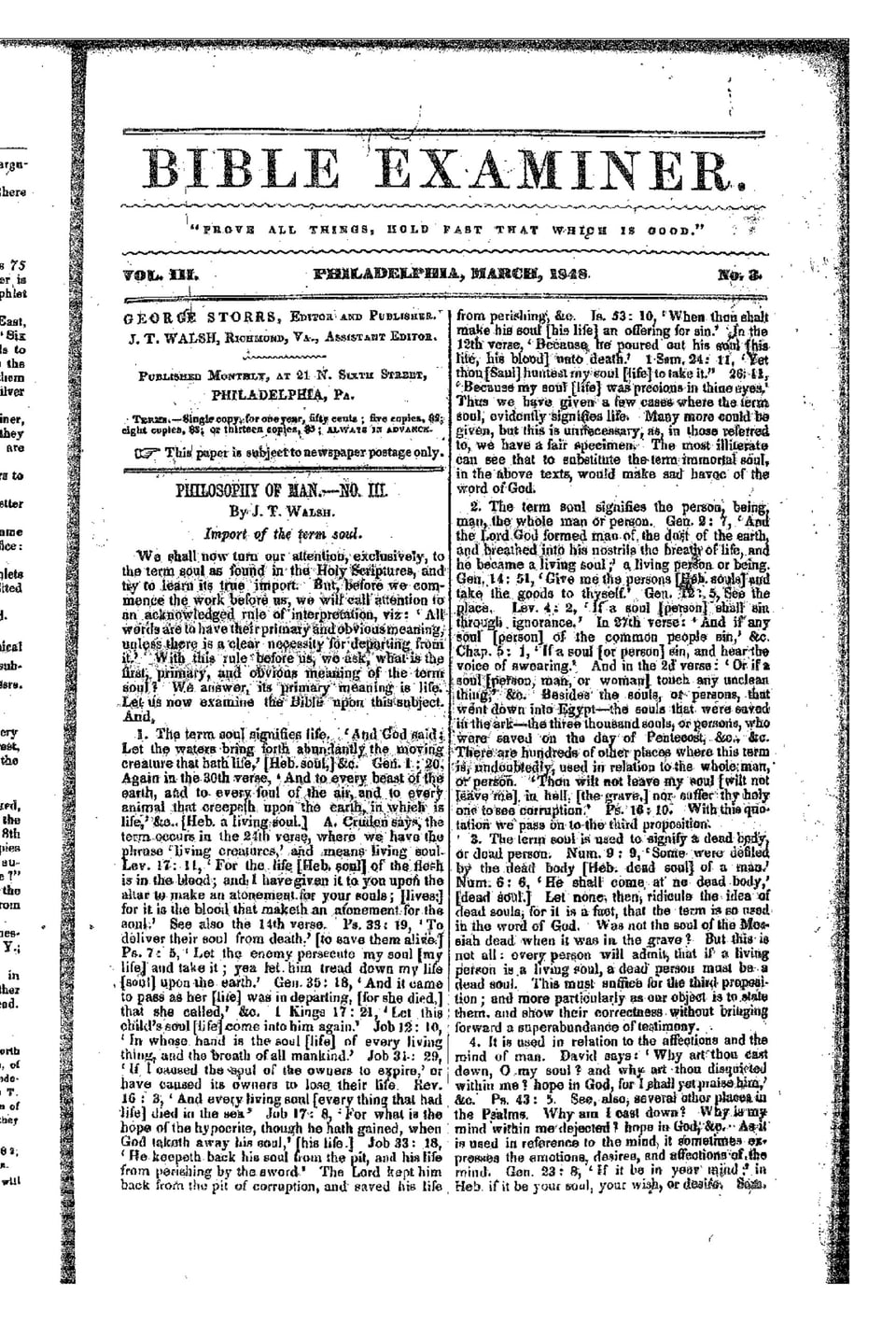
BIBLE EXAMINER.
"PROVE ALL THINGS, HOLD FAST THAT WHICH IS GOOD."
VOL. III.
EHNLADELEPHIA, WANCHER, 1848.
No. 3
GEORGE STORRS, EDITOR AND PUBLISHER. J.T.WALSH, RICHMOND, VA., ASSISTANT EDITOR.
i
PUBLISHED MONTHLY, AT 21 N. SIXTH STREET PHILADELPHIA, PA.
This paper is subject to newspaper postage only.
TENAIS.—Single copy, for one year, fifty cents; five copies, $9;
eight copies,8; or thirteen copies,3; ALWAYS IN ADVANCEfrom perishing, &c. Ia. 53:10, 'When thou shalt make his soul [his life] an offering for sin.' In the 12th verse, 'Because he poured out his soul [this life, his blood] unto death.' 1.Sam, 24:11, 'Yet thon [Saul] huntest my soul [life] to take it.' 26:11, 'Because my soul [life] was precious in thine eyes.' Thus we have given a few cases where the term soul, evidently signifies life. Many more could be given, but this is unnecessary, as, in those referred to, we have a fair specimen. The most illiterate can see that to substitute the term immortal soul, in the above texts, would make sad havoc of the word of God.
PHILOSOPHY OF MAN.----NO. III.
By J. T. WALSH.
Import of the term soul.
We shall now turn our attention, exclusively, to the term soul as found in the Holy Scriptures, and try to learn its true import. But, before we commence the work before us, we will call attention to an acknowledged rule of interpretation, viz: 'All words are to have their primary and obvious meaning, unless there is a clear necessity for departing from it.' With this rule before us, we ask, what is the first, primary, and obvious meaning of the term soul? We answer, its primary meaning is life. Let us now examine the Bible upon this subject. And,
The term soul signifies life, 'And God said; Let the waters bring forth abundantly the moving creature that hath life,' [Heb. soul.] &c. Gen. 1:20. Again in the 30th verse, 'And to every beast of the earth, and to every soul of the air, and to every animal that creepeth upon the earth, in which is life,' &c., [Heb. a living soul.] A. Cruden says, the term occurs in the 24th verse, where we have the phrase 'living creatures,' and means living soul. Lev. 17:11, 'For the life [Heb. soul] of the flesh is in the blood; and I have given it to you upon the altar to make an atonement for your souls; [lives;] for it is the blood that maketh an atonement for the soul.' See also the 14th verse. Ps. 33:19, 'To deliver their soul from death.' [to save them alive.] Ps. 7:5, 'Let the enemy persecute my soul [my life] and take it; yea let him tread down my life [soul] upon the earth.' Gen. 35:18, 'And it came to pass as her [life] was in departing, [for she died,] that she called,' &c. 1 Kings 17:21, 'Let this child's soul [life] come into him again.' Job 12:10, 'In whose hand is the soul [life] of every living thing, and the breath of all mankind.' Job 31:29, 'If I caused the soul of the owners to expire, or have caused its owners to lose their life. Rev. 16:3, 'And every living soul [every thing that had life] died in the sea.' Job 17:8, 'For what is the hope of the hypocrite, though he hath gained, when God taketh away his soul,' [his life.] Job 33:18, 'He keepeth back his soul from the pit, and his life from perishing by the award.' The Lord kept him back from the pit of corruption, and saved his life
The term soul signifies the person, being man, the whole man or person. Gen. 2:7, 'And the Lord God formed man of the dust of the earth, and breathed into his nostrils the breath of life, and he became a living soul;' a living person or being. Gen. 14:51, 'Give me the persons [Heb. souls] and take the goods to thyself.' Gen. 12:5, See the place. Lev. 4:2, 'If a soul [person] shall sin through ignorance.' In 27th verse: 'And if any soul [person] of the common people sin,' &c. Chap. 5:1, 'If a soul [or person] sin, and hear the voice of swearing.' And in the 2d verse: 'Or if a soul [person, man, or woman] touch any unclean thing,' &c. Besides the souls, or persons, that went down into Egypt—the souls that were saved in the ark—the three thousand souls, or persons, who were saved on the day of Pentecost, &c., &c. There are hundreds of other places where this term is, undoubtedly, used in relation to the whole man, or person. 'Thou wilt not leave my soul [will not save me], in hell; [the grave,] nor suffer thy holy one to see corruption.' Ps. 16:10. With this quotation we pass on to the third proposition.
The term soul is used to signify a dead body, or dead person. Num. 9: 9, 'Some were defiled by the dead body [Heb. dead soul] of a man.' Num. 6: 6, 'He shall come at no dead body,' [dead soul.] Let none, then, ridicule the idea of dead souls; for it is a fact, that the term is so used in the word of God. Was not the soul of the Mosaiah dead when it was in the grave? But this is not all: every person will admit, that if a living person is a living soul, a dead person must be a dead soul. This must suffice for the third proposition; and more particularly as our object is to state them, and show their correctness without bringing forward a superabundance of testimony.
It is used in relation to the affections and the mind of man. David says: 'Why art thou cast down, O my soul? and why art thou disquieted within me? hope in God, for I shall yet praise him,' &c. Ps. 43:5. See, also, several other places in the Psalms. Why am I cast down? Why is my mind within me dejected? hope in God, &p... As it is used in reference to the mind, it sometimes expresses the emotions, desires, and affections of the mind. Gen. 23:8, 'If it be in your mind? in Heb. if it be your soul, your wish, or desire.'
18:1, 'The soul of Jonathan was knit with the soul of David; he had a great love and affection for him.' Prov. 27:7,'The full soul;" that is, a man whose desire or appetite is fully satisfied.
It is used as a figure of personification. Rev. 6: 6; 20: 4, 'I saw under the altar the souls of them that were slain for the word of God and for the testimony which they held.' &c. 'And I saw the souls of them that were beheaded for the testimony of Jesus, and for the word of God, and who had not worshipped the beast, neither his image, neither had received his mark upon their foreheads, or in their hands; and they [the souls] lived [they then were dead once] and reigned with Christ a thousand years. But the rest of the dead lived not again until the thousand years were finished. This is the first resurrection.' 5th verse: 'John saw these souls as he saw the hundred and forty and four thousand, having their Father's name written on their foreheads.' And as he saw the sea of glass, and those who had gotten the victory over the beast, &c., standing on it praising God. He was in the isle of Patmos, and saw spread out before him the history of the future fortunes of God's church and people. He saw that many of the saints would be martyred for the testimony which they bore to the truth and for the word of God, and represents them, by the figure of personification, as being under the altar, upon which, no doubt, they had been immolated, crying for vengeance upon those who had put them to death. The same figure is used when the blood of Abel is represented as crying to God from the earth. God said to Gain, 'the voice of thy brother's blood cryeth to me from the ground.'
The term soul is used for being or existence. Perhaps some will think that this proposition is embraced in, and established by those to which we have already directed your attention. This, in fact, is true; but any object in making it a distinct one must be answered an objective upon this subject, which is based upon the words of Christ in Matt. 19:20. And fear not them who kill the body, but see not able to kill the soul, but rather fear them who are able to destroy both work and body in hell. Hence the term with suggestion being, or existence. That is one of the meanings of the original term, as given in the Lectionary. Chasing them good to kill displeasure. And fear not known whose kill the body, but not able to put an end to great evil on existence. One author says what no able to dismay, or punish and so the existence of death worth and beauty as best. Where it fails. Our attitude always is youthful a cause of unwillingness to witness world for this virtue and hence its real evil, but the other arising of these humanities, like life, its spring, misgivement. The woman with a three years of preparation for his service. To take up her duty of these duties has till this lower and more difficult part. But if she will prepare your attention and still time. These things often affect our own health, health,
WITCHCRAFT UNVEILED.—NO. 111.
What can be said in favour of the phraseology of Samuel, on the supposition that Jehovah sent the spirit of the departed prophet to commune with Saul, and to announce to him the consummation of the predictions of offended Heaven? Saul's application to this infamous and impious woman, praying her to assume the attribute or power of the Deity, and to coerce the spirit of the pious dead to come at her bidding, for his pleasure, or in obedience to his will, because he considered himself foreaken by Heaven, and would employ Sorcerers, or resort to any thing in his desperation, and in open defiance to all authority, whether human or divine—this new and impious crime of Saul would have been the theme of Samuel, and would, most certainly, have been placed in the list, and at the top of his offences. Burning words, indignation, tribulation and wrath, for so high-handed and heavendaring an offence, as Saul's last act must be branded, would have burst from the lips of the prophet, and an appeal to Saul's reason followed; instead of the recital of an old prediction, and a whining inquiry, to learn the cause of being thus disquised!
WOULD THE SPIRIT OF A DEPARTED PROPHET, SENT BACK TO THE WORLD BY THE DEITY, ON AN ERRAND FROM HEAVEN, AS MUST HAVE BEEN THE CASE IN THIS INSTANCE, IF SAMUEL REALLY APPEARED, CALL IT BEING DISQUIETED, AND TACITLY CONSENT TO THE EFFICIENCY OF THE POWER OF AN INFAMOUS WITCH, A MISCREANT TOO VILE TO BE PERMITTED TO CUMBER THE EARTH? No! THE BARE IDEA IS ABSURD.
I affirm, most unhesitatingly, that the Witch of Endor needed no other auxiliary qualification, although it is probable that she possessed a very powerful one, to effect her purpose of deceiving Saul, than the very common one of modulating her voice, and addressing Saul when she personated Samuel, in a different tone from that used by her during her previous interview with the mad King of Israel.
Josmina, however, says, that the orders of Saul to his servants signified. "That they should seek out for him one of those women that could speak out of their bellies, and call forth the souls of the dead; that by this means he might know if his affairs should succeed. For this sort of bully-speakers can bring up the souls of the dead, and by their help can fortell favorites." In plain English the Witch of Eador, in modern parlance, was a Venetian woman, and possessed her art only in a private and mysterious manner, to further aid her decepam sore distressed; for the Philistines make war against me, AND GOD IS DEPARTED FROM ME, and answereth me no more, neither by prophets, nor by dreams—thorfore I have called thee, that thou mayest make known unto me what I shall do." The Witch is now qualified to end the farce, and knowing the prediction, which, it was notorious throughout all Israel, hung over the head of Saul, and over his house, she tells over again an old story THAT EVERY MAN, WOMAN AND CHILD IN SAUL'S DOMINIONS WERE PRIVY TO. Therefore, again personating the spirit of Samuel, she continues the farce—"Wherefore, then, dost thou ask of me, seeing the Lord has departed from thee, and is become thy enemy?" And in her malicious triumph, she calls to her aid her well-tried impudence, and without waiting for a reply from Saul, proceeds: "AND THE LORD HATH DONE TO HIM, AS HE SPARE BY ME; for the Lord hath rent the kingdom out of three hand, and given it to thy neighbour, even to David; because thou obeyedest not the voice of the Lord, nor executedst his fierce wrath upon Amalek, therefore hath the Lord done this thing unto thee this day."
The whole composition of our constitution, the present of its constitution, is very different. The which has accompanied to our eminent travails; and doubt, have constituted change, as happened in the past, in the transitory generations of the same system of the separated groups. This has also international consequences that govern the affairs of the people, and not only the actions of individual states; inflicting great harm to other countries. We have thus governed them, and we are committed to their welfare.
It should be borne in mind, that impostors of this class are very particular in acquiring a readiness of utterance, in appropriate terms, of their oracular speeches; and that this woman would be particular in her imitation of the prophets of Israel, in any repetition that she should attempt of their prediction. The conclusion of the Witch's speech, in the character of Samuel, was undoubtedly dictated by her cunning and resentment. Her impudence was quite sufficient to enable her to risk all consequences. Therefore she adds, "Moreover the Lord will also deliver Israel with thee into the hand of the Philistines; and to morrow shall thou and thy sons be with me; the Lord also shall deliver the host of Israel into the hand of the Philistines." This woman must have known one thing, which stood prominently conscious in the dealings of God with the Israelites, viz.: That, in all cases, when the Lord signifies through the agency of his prophets or the priesthood, his disapprobation of the people or their rulers, they were sure to be defeated in their battles with their enemies. Her prediction, therefore, of Saul's defeat and death, was not only sanctioned by the old prediction of Samuel, but, in her opinion, rendered certain, from the information she had just received from Saul. The opportunity, therefore, for avenging herself on Saul, by her denunciations, which he was duped to believe were fresh from the mouth of Samuel, would facilitate the destruction of her enemy, Saul, by increasing his panic, and depriving him of his remaining courage and providence. However, "the Hebrew word rendered "to-morrow," which the Witch used, is an indefinite, as to time, that Paul's subsequent defeat and death, in any battle with the Philistines, would have fulfilled her predic
God had commanded their extermination— "thou shalt not suffer a Witch to live."
In the practice of their art, they professed to consult the dead; and were in the habit of "peeping" and "muttering."
JEHOVAH had forsaken Saul, and become his enemy; so that he answered him not—neither by prophet, nor by priest, nor by dreams.
Saul, in a perfect state of desperation, goes to the Witch, as the last resort to "seek from the living to the deal."
He visits her in "the night," a time most favourable to the practice of her imposture. And, lastly, she professess to bring Samuel up, where he was not buried. He was, we believe, interred at Ramah, some forty or fifty miles from Endor, at which place the Witch resided.
Now, is it reasonable to suppose, that God, who had refused to answer Saul in any way whatever, would, by the hands of a Witch, make known Saul's destiny to him—a destiny which he had previously fully and explicitly announced to him by Samuel the prophet? God had said, "thou shalt not suffer a Witch to live;" and, if they were too vile to live, would God make use of them as instruments of communicating with Saul, with whom he had refused all communication by prophets and priests? This is not reasonable. Will the reader turn to Isaiah, and read the following: "And when they shall say to you, Seek to them that have familiar spirits and to wizards that peep and that mutter: SHOULD NOT A PEOPLE SEEK TO THEIR GOD—FOR THE LIVING TO THE DEAD?" Chap. viii. 19.
Here two questions are propounded.—1st, "Should not a people seek to their God"? 2nd, "For the living to the dead"? The last question is eliptical, and the two, when paraphrased, would read thus: "Should not a people seek to their God? Will you seek for the living to the dead?" Thus the Jews, in the days of Isaiah, were rebuked for consulting wizards and witches. They were taught the folly, the idolatry, the blasphemy, of "seeking unto the dead," for the benefit of "the living." And the reason of this is obvious; for "the dead know nothing," and, therefore, it is impossible to learn from them. And this fact is not sufficiently guarded by the Witch of Endor in her personification of Samuel; for she makes him ask Saul, "Why he had disquieted him?" when, in fact, upon the popular supposition, Samuel knew without asking the question!
May we not conclude, then, in the language of Isaiah, "To the law and to the testimony, for if they speak not according to this word, it is because there is no light in them?"
In conclusion, we hope the articles on this subject, which precede these remarks, will be read attentively; and if any friend, or foo, can give a better exposition, an exposition more consonant with the character of God and his Word, we hope they will enlighten the world on the subject.
IS ERROR CONSISTENT WITH SALVATION
" " universal and the experimental use in an oblivious sense, that in an leisurey.
We certainly think each belief has a tendency to run more men than any one creed ever introduced into the church. Not that it immediately results in the death of those who embrace it, but its natural and legitimate tendency is to sap the foundation of the whole system of gospel truth. We wish it distinctly understood that we do not en-
which, in its logical bearing upon those truths, rendered them vain, as of no practical use." Now, I affirm that it is not true that if a man believes all the truths of the gospel, but this one truth, of the resurrection of the bodies of the souls, that his unbelief in respect to this truth, renders other truths "vam, or of no practical use," in fast. Whatever may be the "logical bearing," or the inconsistency of his unbelief respocting that truth,
tion. Yet he believes that in his highest nature as the divine Son of God, the Saviour never died or suffered at all. Now, I affirm that he holds a principle which, in its nature, is subversive of what he believes; a principle which theoretically renders the means of atonement or reconciliation totally inadequate. Far be it, however, that I should affirm that this imperfection of his faith "is tantamount to his not believing" in the Saviour "at all." He has faith in the Son of God which works by
modified, and, in various degrees, neutralized by truth.
That, to say that the Divine Son of God never died or suffered at all, is to hold a principle which theoretically renders the means of atonement or reconciliation totally inadequate; yet Mr. Grow will not affirm that such a man's faith is vain.
The foregoing items seem to constitute the "pith and marrow" of our venerable friend's strictures.
dores all that is said in either communication. We let both speak, and others must judge what is truth. With present light, we do not at all assent to the doctrine that "the Scriptures teach the non-resurrection" of any one.
STRICTURES BY H. GREW.
Ba. Sroars:—In your December number you have verily given us a notable example of the fact that "man is prone to extremes." It is found in the article from the "Her. Future Age," in which the learned editor reasons himself out of reason by coming to the conclusion that "believing in the immortality of the soul is a damnable heresy!" Thus he consigns millions of true penitent believers on the Son of God, and followers of the Lamb, to the lake of fire, which is the second death. Do you really believe, that if you had died previous to your present view of the subject, that you would have been condemned to eternal perdition? Such extravagant representations injure the cause of truth as they tend to prejudice
he is, in just, imminent to penitence, to a reliance on the Son of God for salvation, and to practical holiness, by the belief of other truths, and will consequently be saved.
It is also remarked—"You (Corinthians) say you believe that Christ was raised, as I preached; but this will avail you nothing, for in saying that there is no future resurrection, you affirm a principle which overturns the fact of the resurrection of Christ, as far as you are concerned."
There are persons who erroneously believe the body to be the mere present tenement of the soul, which they believe is immortal. Their principle, therefore, theoretically overturns the fact of the resurrection of Christ, only so far as the resurrection of their body is concerned. The connexion of the resurrection of Christ and their immortal bliss may be fully believed, notwithstanding their error concerning the dead body. To affirm that their belief in the resurrection of Christ and other important truths, will avail them nothing, is assuming the unwarrantable position that our Father in Heaven will condemn and reject the
love and overcomes the world;
We know that there are Christians who believe in "The immortality of the Soul," whose minds and daily practice are influenced to holiness and the love of God and man, "by the truths they profess to believe." It is not true that by all, or even by much erroneous belief, men "place themselves in a state of alienation from the truth of God; by which they prevent themselves from being benefitted by the truths they profess to believe." They lose the present enjoyment and holy influence of the truths they do not believe; they may, however, believe important truths, and be benefitted by their sacred power and influence, in respect to their present holiness and comfort, and eternal salvation. HENRY GREW.
DR. THOMAS' REPLY TO BR. GREW.
The following points in Mr. Grow's strictures, seem to demand a little attention. In the preceding critique he says:
That, in the article alluded to, Dr. Thomas
one after the other, numbering my paragraphs according to the numbering of the points.
It does not necessarily follow, that if a man be not saved, he is therefore consigned to the lake of fire, which is the second death. It is written,
"Whosoever speaketh against the Holy Spirit; it shall not be forgiven him, neither in this world (aion, age or dispensation) nor in that to come"
Matt. xii. 32. Does not this imply that there are some offences, whether of omission or commission, that will be forgiven in the Future Age? Without discussing this point, doth not the reader see the probability of men rising from the dead, who, though not saved in the sense of possessing the Kingdom, may yet not be consigned to the flames of the second death. We do not affirm that it will be thus; we state the idea hypothetically, by way of illustration.
Is there no alternative to the resurrected be-
Is there no alternative to the resurrected between possessing the Kingdom and being destroyed in the lake of fire? The scriptures teach the non-resurrection of "millions." The Scriptures
with, as they tend to prejudice the indivi against what we advocate, which is true.
This preposterous conclusion of the writer is traceable to two errors. First, confounding the importance of the existence of a fact, with the importance of a correct belief in the fact. Secondly, confounding the belief of an error with the belief of every other error with which that error is logically connected, or with the denial of every truth of which that error is "logically destructive."
The fact of the Son of God being what he really is, in respect to his nature, and of his doing what he really has done, i.e., dying for us and rising from the dead, are of such importance as to be essential to the salvation of perishing men; but it does not necessarily follow that a correct belief in these facts is thus essential. To sustain this conclusion, it must be proved, either that God has maffle the correct knowledge and belief of what his Son is, and of what he has done for us, without exception, thus essential, or that he has made the correct knowledge and belief of these particular
weak in the faith, although he has commanded his church to receive them.
Such is the imperfection of the human mind that it really embraces principles which are theoretically inconsistent with each other. Therefore, I cannot admit the correctness of what the writer considers "an important truth," viz:
"A man may believe all things, but if he holds a principle which in its nature is subversive of what he believes, it is tantamount, in his case, to not believing at all."
Error in the human mind is often modified, and, in various degrees, neutralized by truth. The Calvinist believes the truth that men are blameable for their evil deeds. The Arminian says that in believing that all moral actions are decreed by the Almighty, he holds a principle which in its nature is subversive of what he believes. Now, whether the doctrine of the divine decrees of moral actions is true or false, in the mind of the Calvinist, it is not subversive of his belief of moral accountability, therefore it is not 'tantamount, in his case, to not believing at all" in such accountaconsigns millions of true penitent believers on the Son of God, and followers of the Lamb, to the lake of fire, which is the second death.
That he confounds the importance of the existence of a fact with the importance of u correct belief in the fact.
That he confounds the belief of an error with the belief of every other error with which that error is logically connected, or with the denial of every truth of which that error is "logically destructive."
That the fact of Jesus being what he naturally is, and of his dying and rising again from the dead, are essential to the salvation of men; but a correct belief in these facts is not essential.
That Paul does not say, that men are in their sins, if they maintain that there is no resurrection from the dead.
That we have no authority to make the belief of any particular truth essential to salvation, which the word of the Lord does not plainly declare to be so.
That it is not true, i.e. Mr. Grew is of opinion
do not teach that the destiny of mortal men is either to be saved or burned in fire; these are not necessary alternatives. The Scriptures speak of "times of ignorance," and of God "winking at" the things done by men in such times; but they do not therefore teach that ignorant men are "blessed" and shall "inherit the Kingdom prepared from the foundation of the world." Though men boast in the present times as "the glorious and enlightened nineteenth century," the age is less enlightened in the gospel than was the age of the apostles. These are emphatically times of gospel ignorance; and whether God will "wink at" them as he did at the ignorant doings of the old Pagan world, I am not prepared to say; be this as it may, with the Scriptures in hand, I see no ground to believe that such "true penitent believers" as our venerable friend indicates, will ever possess the Kingdom, unless they believe the gospel concerning it; nor does it necessarily follow that they will be consigned to the lake of fire.
We do not make the confusion expressed in
We do not make the confusion expressed in No. 2; it is our worthy friend, who doth not per-
Paul wrote to the Corinthians, "If Christ be not raised, your faith is vain, and ye are yet in your sins." This proves that the fact of his resurrection is essential to salvation. But in the dialogue, in the "Her, Future Age," he is made to say, "If you maintain this (i.e. that there is no resurrection of the dead saints') you are in your sins." Paul does not say this. We have no authority to make the belief of any particular truth essential to salvation which the word of the Lord does not plainly declare to be so.
The writer's argument is, "that these Corinthians seem to have believed all the truths but this one truth; yet the belief of the whole is regarded as valueless, because they affirmed a proposition,
bility. The Arminian believes that God foreknows all things. The Calvinist says, that in denying the doctrine of divine decrees, in reference to moral actions, he holds a principle which in its nature is subversive of what he believes, for nothing which is ungratitude can be foreknown, and nothing can be certain without decree. Be this, however, as it may, the doctrine of the divine prescience is not subverted in the mind of the Arminian by the principle that moral actions are not the subjects of decree, consequently it is not "tantamount, in his case, to not believing at all" in foreknowledge.
One more illustration. A man believes in the Lord Jesus Christ as his Saviour. He believes that his obedience unto death is the adequate foundation of the sinner's hope and eternal salvation.
that it is not true, that, if a man believes all the truths of the Gospel, but this one truth of the resurrection of the bodies of the saints, that his unbelief in respect of this truth, renders other truths " vain, or of no practical use."
That the belief that the body is the more present tenement of an immortal soul, is erroneous; this principle, therefore, theoretically overturns the fact of the resurrection of Christ, as far as the resurrection of their body is concerned. Such are "weak in the faith."
That God will not condemn the "weak in the faith," because he has commanded the church to receive them.
That error in the human mind is often
ceive the essentiality of a "correct belief" or important facts, to the obtaining of the Kingdom of God. Salvation is not predicated on the belief of mere past facts. We invite Mr. Grew's attention to this, that a man may believe all important historical facts concerning Jesus, but he cannot be saved; in any sense, unless he also believe the prophetist truths concerning the Kingdom of God. One of these truths is, that the saints shall arise bodily to "possess the Kingdom." This will come to pass whether we believe it or not. But if we deny it, or hold to that which subverts it, we theoretically overthrow the doctrine of the Kingdom, and therefore cut ourselves off from salvation in that Kingdom; for we are saved by the mindful belief of that doctrine, as well as, or in connection with—inseparable connection with—belief of the important facts alluded to.
A correct belief of an important fact, is not only to believe that the thing happened, but also the meaning, doctrine, or truth, affirmed in connexion with it. That Jesus rose, is a fact; that he rose for the justification of believers in the Gospel of the Kingdom, which Gospel teaches the bodily resurrection of the dead saints, is the true doctrine of that fact; to believe the fact, and to be ignorant or infidel of its doctrine, is to have no part in that resurrection, into the hope of which the enlightened believer is immersed, and of which the Son of God is the "First Fruits"
I do not perpetrate the confusion indicated in No. 3. One error is as fatal to a man's salvation as multitude of errors believed; and the belief of a multitude of truths is impotent to save, if the vigil truth of the whole be omitted, or denied, or if an error be held which demolishes them. "A little leaven leavens the whole lump;" therefore, howare of the leaven of the Saribes and Pharisees, who say that "the soul is immortal and goes to glory at death;" for if it is so, there is no "resurrection unto life," or Kingdom of God to come. The doctrine is destroyed, and the gospel hope is gone.
There is a very fatal and universal error expressed in item 4. All "Christendom" supposes that belief in the "Messenger" is the matter of faith alone essential to salvation. Hence, "every one believes" that Jesus is the Son of God; that he died for sins and rose again. Yes, they believe after a fashion. Some piously believe; while multitudes believe in Jesus, as Turks believe in Mohammed—because every one believes in him in Turkey. But while they cry "Lord, Lord," how few believe his doctrine or obey his voice! Mankind do not believe his Message. He says he was sent to preach the Gospel of the Kingdom of God. Belief in God's Messenger alone will not save a man, no matter how pious he may be. We must believe in his Messenger and in the Message he has sent by him, if we would be saved. The Gospel of the Kingdom, spoken of in Daniel, and the other prophets, is the Message. "He that believes the Gospel and is baptized shall be saved." The Scripture does not say, he that believes "the Son of God is what he really is in respect to his nature, and of his doing what he really has done," and is baptized, shall be saved; it does not state this as the matter of faith, but the doctrine of the Kingdom and the things pertaining to the Messenger. Hence, when the Samaritans believed Philip preaching the things concerning the Kingdom of God and the name of the Lord Jesus, they were baptized—Acts vol. 12. Baptism, or immersion, is of no value, unless the subject believe these "things," and be brought to repentance by the belief of them. "We are renewed by knowledge," says Paul; ignorance is death. But alas! with Paul we may exclaim, "Who has believed the report?" Isaiah fore saw how few would believe the Report or Message of the Messenger of the Covenant when he should appear; and because of their unbelief in this report, Paul says branch of Israel's olive was about to be cut off; and that, for the same cause, the Gentiles would be separated at the coming of the Lord. Every one believes in Jesus, but scarcely one believes in the Gospel of the Kingdom. This may be termed the sign that the Lord is at hand, and
that the times of the Gentiles are about to close. We differ, therefore, from Mr. Grew, and maintain that a correct belief of doctrine and facts, with repentance, immersion, and holiness, are indivisibly essential to salvation in the Kingdom of God.
But Paul says, that the Corinthians wore in their sins if they did not keep in memory a certain word he preached to them, which is the same thing. He preached the resurrection of the dead saints as a part of the word. Hymeneus taught that there was no future resurrection of the dead. Some believed it; of whom Paul says, "their faith was overthrown." "By grace," says he. "are ye saved through faith"—but if a man's faith is overthrown or shipwrecked, how can he be saved by grace through faith? A shipwrecked faith can no more save a man from death, than a shipwrecked vessel its crew from the briny deep. "We walk by faith,"—we must believe the whole truth, or we shall walk over a precipice and be dashed to atoms.
Granted; but the word of the Lord declares, that he that believes not the Gospel shall be damned. This Gospel is made up of "particular truths," and no one has any authority to say, that any one of them may be dispensed with. It is a "particular truth" of the Gospel, that "some who sleep in the dust of the earth shall wake to everlasting life;" it is a "particular truth" of the Gospel, that these persons "shall take the Kingdom and possess it for ever, even for ever and ever;" it is a "particular truth," that when they possess this Kingdom they "shall reign on the earth" as kings and priests; it is a "particular truth," that when this kingdom exists, they shall have "power over the nations and rule them;" it is a "particular truth" of the Gospel, that they shall rule them with Jesus for 1000 years;—these are all a few particular truths, not facts, of the Gospel, which are demolished and scattered to the four winds by the principle, or error, that the saints are not bodily raised, the direct and inevitable conclusion resulting from the absurd dogma of inherent immortal-soulism, &c. Which of these particular truths have we authority to dispense with as unnecessary to salvation? If we dispense with one, why not with all? which the world has done in fact, and yet maintains that a man may be saved! But the word of the Lord plainly declares against it.
Our previous remarks show, that to believe all truths but the truth of the resurrection, is not to believe "The Truth." Strike out the resurrection from "the truth," and other truths become the mere baseless fabric of a vision; or send "the soul" to glory at death, and the truth of God is rendered of none effect by the tradition.
True; God will receive the "weak in the faith," but not the "weak in faith." It is by faith that men are able to overcome the world, the flesh, and the devil. A weak faith cannot accomplish this: it requires a strong faith to do it. A man who could not conscientiously eat meat offered to idols, though an idol was nothing, was weak in the faith, but his faith was so strong in one only living and true God, that he could have nothing to do with idols in any form without feeling defiled; and on the other hand, also, his faith was so strong in the gospel of the kingdom, &c., that
This item admits the doctrine we contend for, but apologizes for the believer on account of his weakness.
he would have gone to the stake rather than have surrendered an iota of that truth, or have apologized for faithlessness in it. No where in the Word, has the church been "commanded to receive" men who are "weak in faith;" but, on the contrary, to "rebuke them sharply that they may be sound in the faith." Weak faith is the plague of this generation. The reception of such has swamped "the church," which has become faithless, disobedient, and ready to fall in the wilderness, like Israel of old. "Because of unbelief they shall not enter into my rest."
True. Now look on the other side :—truth in the human mind is often modified, and in various degrees neutralized by error, as in the case before us.
The Apostle John forbid the true believer to wish such a person God speed, or to show him hospitality; yet, so charitable is our venerable friend, that he will not venture to "affirm that such a man's faith is vain!"
In relation to faithlessness in one particular truth neutralizing faith in all other truths, I would cite the following example, which is indeed intimately connected with the resurrection of the saints. Paul says, "unto them that look for Him shall Christ appear the second time without a sin-offering unto salvation." After this affirmative declaration, is it necessary for the Apostle to say negatively, that He will not come and save those who do not look for his coming, before we can venture to affirm that to believe in and look for the coming of the Lord is necessary to salvation? When a thing is affirmed, the negative is implied; but weak faith is afraid to make the implication. A man may believe all about the history of Jesus, but if he believes not in the resurrection of the dead saints, or in the coming of the Lord to salvation, "preposterous" as it may seem to our venerable friend, on the faith of the apostle's doctrine, we hesitate not to proclaim upon the house-tops, that "he cannot enter the Kingdom of God."
EDITOR OF THE HERALD OF THE FUTURE AGE. Richmond, Va., Jan. 15th, 1848.
PROPHETIC PERIODS.—NO. V.
THE SEVEN AND SIXTY-TWO WEEKS.
Having shown that the seventy weeks bring us down to the time when Jerusalem was "compassed about with armies, when the "trangression" of Daniel's people was to be no longer "restrained," and the iniquity of that people was "filled up," we now proceed to give our opinion of the sixty-two and seven weeks of Dan. 9. We have said in a previous number that we consider this a distinct period from the 70 weeks, and not a subdivision of it. If our view of the 70 weeks is correct, it is clear the lesser period must be another, and given for another purpose, viz: To give the time of the first advent of "Messiah." We freely admit, at the outset, that there are difficulties on this point; nor do we promise to make this topic as clear as that of the 70 weeks.
After Gabriel had given Daniel the "70 weeks upon thy people and thy holy city, to restrain transgression," [margin] &c., referring to events that would come within that period, he proceeds to give him another period for the coming of Messiah. Our translation reads "Know therefore," &c: some students of Scripture translate the original word "also." Thus the Duke of Manchester, on the "Times of Daniel," reads the verse—"Also thou shalt know and understand from the going forth of the word to cause to return and to build Jerusalem, until Messiah the Prince [are] seven weeks, and sixty-two weeks." He remarks—"Our translators seem to have been influenced in the rendering of the verse by what they supposed must be the connexion and meaning, and they turned a mere copulative into an illative, and the future into an imperative." That is, they made an adverb, which is a mere connecting link in the discourse, to be an inference from that previously spoken. Whereas, Gabriel having given the period allotted to the further trial of Daniel's people and his holy city, next calls his attention to another measure of time which was to bring to pass an event that was to precede the final giving up of Jerusalem, the holy city, to be desolated, and trodden under foot of the Gentiles; and he says—"Know also," or likewise, &c.: in addition to what has been told you, understand how long it will be "to Messiah."
Mr. Greswell in his Dissertations, vol. 4, page 329, speaking of this prophecy, Dan. 9 : 24, 25, says "Two classes of events, which are neither the same in themselves nor in their beginnings and their endings respectively, are connected together in the scope of its disclosures * to one of these classes we may give the name of the facts of the Christian ministry; and to the other that of the facts of the Jewish war."
If then the 62 and 7 weeks are a distinct period from the 70, where did they begin? If the view we have taken in a previous number is correct, viz. that the decree of Cyrus [Coresch] is the true decree for restoring Daniel's people, and to build Jerusalem—and if we have the true date of the 70 weeks, i.e. B. C. 423, or the second year of Darius Nothue, at which time the 70 years desolation of Jerusalem ended, (see Dan. 9:2, and Zech. 1:7, 12, 16.) then the decree to restore (thy people) and to build Jerusalem, could not have been more than eleven years previous, or the year B. C. 434. We have in this view taken the ground that the captivity in Babylon commenced in the eighth year of Nebuchadnezzar; (see 2 Kings, 24:12.) If, however, as some suppose, the captivity commenced in the first year of Nebuchadnezzar, (compare Dan. 1:1, 2, with Jer. 25:1,) then the 70 year captivity would terminate about twenty years prior to 423, or about 443-4 before Christ. If this last period be taken as the true date of the decree of Coresch, or the Scripture Cyrus, then the "7 weeks" counted as allotted to the completion of the Temple, or "46 years," (see John 2:20,) which, though not exactly 7 prophetic weeks, yet, may be considered under the general term of 7 weeks, being 6 full weeks and 4 years into the 7th, then the 7 weeks would end about 398 B. C. Then add 62 weeks, or 434 years to that, and we have A. D. 36. If this view be correct the crucifixion could not have occurred as early as is generally supposed: but the exact year of our Lord's birth has never yet been fixed with certainty; neither has the year of his crucifixion. Different writers divide on the time of the first advent from seven years or more before the common, or vulgar era, to eleven years after. With this uncertainty about the birth of our Lord, it would not be strange if the crucifixion should also be found to be at a later period than has generally been supposed.
If however we should take another view of the subject, we might possibly be extricated from some of these difficulties, though we might encounter others perhaps equally as great. If we were to suppose the 62 weeks are the whole period given from the decree to restore, and to build Jerusalem "to Messiah;" and that the 7 weeks are only the first part of the 62, mentioned with special reference to the work to be accomplished in the first part of the 62, then we should find the 62 weeks, or 434 years, covering the entire period "to Messiah." In that case again, making the termination of the captivity eleven years (as is evidently most in accordance with Scripture) before the end of the 70 years "desolations of Jerusalem," we should be brought back, for the decree of Coresch to B. C. 434, making just 62 weeks to the birth of Messiah, according to the vulgar era. Why should we not understand the language of Gabriel—"to Messiah the Prince," to mean to his birth, or first advent? Certainly he was proclaimed the Messiah at that time. It was revealed to old Simeon, "by the Holy Spirit, that he should not see death, before he had seen the Lord's Christ"—Messiah. When the old man took the child Jesus in his arms, he blessed God and declared that the promise had been fulfilled to him. When Jesus was born "the angel of the Lord" proclaimed him as the Messiah in these remarkable words, Lk. 2:11. "Unto you is born this day in the city of David, a Saviour, which is Christ (Messiah) the Lord."
Surely here is evidence strong as the "Holy Spirit" that was upon Simeon, and "the angel of the Lord," that came to the Shepherds, could make it, that "Messiah" had come; and, hence, that the specified time, given by Gabriel to Daniel, "to Messiah the Prince," was now accomplished. The expression, in Dan. 9th, "after three score and two weeks shall Messiah be cut off," does not define the exact period of that event; it may as well be 30 years after, as three years and a half after, as to any impropriety in the language.
The only difficulty in our mind to this last view of the 62 weeks is, that the language, in Dan. 9: 25, seems to indicate that the 7 weeks and the 62 are a period of 69 weeks: if this is really so, then this lust view cannot be correct. But the expression "after three score and two weeks shall Messiah he cut off," seems also to indicate, that the 62 weeks are the whole period given to bring us "to Messiah." And may it not be possible that the 7 weeks are the first part of the 62, specially noted, because of the work to be done in that period? If this is the case, then the decree of Coresch, B. C. 434, brings us, in 62 prophetic weeks, 434 years, exactly "to Messiah's" birth, when he was proclaimed the promised Messiah, as we have already seen. While we are satisfied that the decree of Coresch, the true Cyrus of the Scriptures, is "the commandment" spoken of by Gabriel, Dan. 9th, we are not satisfied whether that decree was issued B. C. about 444 or 434: one of those points, with present light, we believe is the true date.
We are not entirely alone in the suggestion that the 7 and 62 weeks commence at the same date. The great Joseph Mede says:—"If we must have some limited time of forty-nine years, (7 weeks) I would date it from the same epoch as the sixty-two weeks, and make the times concurrent and not consecutive." He saw at least the possibility that these two periods might begin together.
BIBLE EXAMINER.
PHILADELPHIA. MARCH, 1848.
ARE THE WICKED IMMORTAL?
"The soul that sinneth it shall die."—Bible.
THE CAUSE is onward, and the truth is spreading. We have received more than three hundred new subscribers since the December number was issued. We give a few extracts of letters, in this number, to let our friends see the feeling there is abroad in reference to the Examiner and its objects. Our friends will excuse us "this once," for publishing these tokens of their satisfaction, and others will do the same for not publishing all their expressions of favour. Since our last, the friends in Millville, N. J., have established a meeting where they can worship the living God through His Son, without being subjected to sectarian lordships. In that place, eight months ago, we believe, there was not an individual that sympathized with our views on the sleep of the dead and the destruction of the wicked. Now there are two who were Methodist preachers, at that time, and many more, who being crowded out of the churches for their avowal of these truths, that meet together "in their own hired house," and utter the convictions of their own minds untrammeled. The commencement of this work was a single copy of the "Six Sermons." Within the past two months, one hundred copies of those Sermons have been scattered, by the brethren in Millville, in that part of the State; and they have subscribed freely for the Examiner. Let all the friends, in every place, see that they do not enjoy the light alone. Make one more effort, and let that be a continual one, to help us on in the great work of vindicating God's truth and His blessed name from the reproach which men have heaped upon them in their hot zeal for the traditions of the Pagans, which appeared to them like jewels; and for the defence of which, they have seemed to think, like Jonah, they "do well to be angry." Most sincerely do we pity such, and earnestly desire that they may yet come to the truth, and be made "free" by it.
BE COURTKOUS.—We are sorry the Bible Advocate should be so excited with Dr. Thomas for a simple illustration which he used in reply to Br. Bell in the last Examiner. We hope that paper will keep cool for the time to come. We will only say, it has amazingly perverted both the Doctor's words and his meaning, and built upon that perversion a tirade of abuse ill becoming one who thinks "the Judge standeth at the door." We would like to know where the man is that has no error in his theory? Let him cast the first stone at his brother who differs from him. We certainly differ from Dr. Thomas
in several things; and we equally differ with the Advocate. If we believed to constitute a man a real Christian, he must be perfect in knowledge and judgment, we should never hope to find a Christian on earth, till the next age shall come. If men are sincerely inquiring after truth, and using the best light they have, and do fall into some error, they are no more blame-worthy than they would be for having a fever, or breaking their bones, or being destitute of daily food. We might just as well fall into a passion with our fellow-men for suffering with hunger, being sick, or breaking their bones, as to get out of humor with them for their errors in doctrine, if they manifest the spirit of Christ in their lives, and are using their best endeavours to inform themselves as to what is truth. To be sick, or to be in error, are both misfortunes, and both cause loss and pain to a greater or less extent. The subject of these calamities is to be pitied not abused. We would think him a tiger that would fall upon a man with a broken bone and abuse him. Surely error is worse to the individual than broken bones; and we all have more or less; let us never forget that. Least of all has the Advocate occasion to complain of Dr. Thomas' "absurdities" while it maintains that, the "millennium is past," and that it covered the darkest ages of Papacy!!
The Advocate, and some others who get "impatient,"" dream" dreams, and "interpret" them, in our zeal for "the cause," may possibly be benefited by the following story:
"When Bulstrode Whitelocke was embarking as Cromwell's envoy to Sweden, in 1653, he was much disturbed in mind as he rested in Harwich on the preceding night, which was very stormy, while he reflected on the distracted state of the nation. It happened that a confidential servant slept in an adjacent bed, who, finding that his master could not sleep at length said, "Pray, Sir, will you give me leave to ask you a question?" "Certainly." "Pray, Sir, don't you think that God governed the world very well before you came into it?" "Undoubtedly." "And pray, Sir, don't you think he will govern it quite as well when you are gone out of it?" "Certainly." "Then, Sir, pray excuse me, but don't you think you may trust him to govern it quite as well as long as you live?" To this question Whitelocke had nothing to reply; but turning himself about, soon fell fast asleep till he was summoned to embark."
TENDENCIES OF IMMORTAL SOULISM.
In the "Mysteries of Romanism," exhibiting the "Demoralizing Influences of Popery," we find a Chapter on "The Tendencies of Romish Literature," one paragraph of which is the following:
"Among the late perverts to Home of high degree, we find chronicled the name of Lady Georgiana Fullerton, sister to Lord Grenville, and authoress of "Ellen Middleton." After reading this exciting novel, and observing the peculiar cast of thought and train of remark when advertising to religious exercises and duties, we were not surprised to learn that our authoress had become a full convert to superstition, and at last entered the mystical precincts of Rome. When we see Alice bowing in her closet before a picture of our Saviour, and then holding up the crucifix before the eyes of her dying husband; when we see what sacredness, awe, and efficacy, are attributed to the act of confession to a priest; when we hear Mrs. Tracy, herefore the deadly enemy of Ellen, Middleton, kneeling at her bed side, in hardly articulate tones saying to her, 'Pray for me when you are in heaven;' finally, when we hear Ellen's speech to her husband, in which she says: 'There is a blessed communion in which we both believe, between those who rest in heaven, and those who struggle on earth; you will pray for me when I am gone; and I will pray for you where I go:' who can doubt that the writer's mind was already enslaved to Romanism?
And cannot this Protestant Editor, "Rev. C. Sparry," see, and "who can doubt, that the" immortal soul theory was what led Lady Fullerton straight down the gulph to Romanism; where thousands and tens of thousands more have gone and are going? Had Lady Fullerton fully believed the bible truth, "the dead praise not the Lord."—"the dead know not anything," does the "Rev. Editor," himself, believe she would have found an open door into "Romanism?" She honestly followed out the immortal soul theory. Its legitimate landing place is Romanism or Restorationism: Lady Fullerton landed in the former, and Bishop Newton in the latter. Will Mr. Sparry, or any one else, show us, if they can, the impropriety of asking a dying saint to "pray for" us when they "get to heaven"—or, for that dying saint to say "I will pray for you where I go," on the supposition that the dead do know "more than all the world," and are alive in the presence of God? Are they loss holy there than while here? Are they less interested for friends left behind when they get to heaven than while they were with them on earth? Have they less access to God there than here? If it is answered—"Christ is the intercessor there."—We answer—He is no more the intercessor after saints die than before; and we are commanded to pray for one another; and we know of no Protestant that hesitates to ask a Christian to pray for him. Paul himself said—"Brethren, pray for me." It may be said—"True; we should pray for each other while here." We reply—Paul said, "I will that men pray everywhere." It may be said again—"Paul did not mean when they were dead." He said, "Everywneae;" and from that obligation it is for our opponents to show they are released by death, unless they are unconscious, and therefore incapable of the act. But the objector may say, "We have no Scripture example of living saints asking dying ones to pray for them when they get to heaven." We answer—"Thou hast said truly;" and the reason is obvious—the Bible saints understood that there is no knowledge in sheol, the invisible state, where their dying friends were going; their hope, their one and only hope was in the resurrection; the pagan sable had not obtained among them, that the soul is immortal: they understood their friends were "silent in the grave."
But when the heathen superstition of "disembodied spirits"—"the soul immortal"—"the dead know more than all the world," stole into the church, then her communicants, who embraced this "vain philosophy," were fully prepared to slide into praying to saints—from that to a purgatory—and then into "Romanism" fully developed, or the "man of sin" large as life. No wonder Protestants have made so poor a stand against Romanism. Ever since Luther, by the persuasion of his brother Reformers, was tempted, and fell by the temptation, and gave up, or consented to hide his light on the subject of the non-immortality of the soul., Romanism has marched onward and "prevailed," and will prevail till the doctrine of man's natural, or inherent immortality is once more firmly placed where Luther placed it at the commencement of the reformation, among the "Roman dunghill of decretals." It has no higher authority. The council of Lateran, under Pope Leo X. passed the following "Canon:"—
"Some have dared to assert concerning the nature of the reasonable soul, that it is mortal; we with the approbation of the sacred council do condemn and reproate all such, seeing, according to the canon of Pope Clement the Fifth, that the soul is immortal: and we strictly inhibit all from dogmatising otherwise: and we decree, that all who adhere to the like erroneous assertions, shall be shunned and punished as heretice."—Caranza, page 412-1681.
This canon shows that the doctrine of an "immortal soul," that lives when the man is dead, was supported in those days, as it generally has been since, by the authority of Creeds, rather than by the truth of God. Bishop Tilliston says, in his Sermon, Vol. 2, printed 1774, "The immortality of the soul is rather supposed, or taken for granted, than expressly revealed in the Bible."
Do we not well say then—The tendencies of the immortal soul theory, is to lead men to reverence the creeds of men more than the Bible—their declaration of sentiments—their priestly domination, and hence directly forward into Romanism? The author of the work, "Mysteries of Romanism," tells us, p. 23:
"A court lady, daughter of the Earl of Devonshire, having embraced the catholic religion, (in the reign of Charles I.) was asked by Land the reason of her conversion. 'It is chiefly,' said she, 'because I hate to travel in a crowd.' Being desired to explain her meaning, she replied: 'I perceive your grace, (Land) and many others are making haste to Rome, and therefore, in order to prevent being crowded, I have gone before you."
Multitudes of Protestants, in England and elsewhere, have gone to the Roman religion, because the Reformers did not maintain the principle of Luther when he first saw clearly the light, that the
doctrine of an inherent immortal soul was only a "Roman dunghill decretal:" and multitudes more, in this country, will land there, if this age continued much longer, some of whom make great displays of zeal against her at present. The reason is, they hold substantially with Rome in her pagan fable of the consciousness of dead men.
Math. 6; 33. "Seek ye first the kingdom of God, and his righteousness; and all these things shall be added unto you."
WOULD YOU INHERIT THE KINGDOM?
To understand this text we must view it with its connection. Our Lord had assured his followers "No man can serve two masters—Ye cannot serve God and mammon:" or, ye cannot serve God and a mind bent on the things of this world—such as riches, &c. "Therefore, I say unto you, take no thought for your life, what ye shall eat, or what ye shall drink; nor yet for the body what ye shall put on." This verse and the following have been amazingly perverted by some minds, by not considering that it is common in Scripture to speak of a thing of less importance than another as if it were of no importance. Many examples of this may be given. Our Saviour said, Luke 14:26, "If a man hate not his—wife—and his own life also, he cannot be my disciple." How are we to understand such an expression? By no means in an absolute sense. The apostles are the best commentators on the meaning of our Lord's words that we can have. Do they countenance the absolute sense of these words? See Eph. 5:25, 28, "Husbands, love your wives, even as Christ also loved the church, and gave himself for it." "So ought men to love their wives as their own bodies. He that loveth his wife loveth himself." And in the 29th verse the apostle says,—"No man ever yet hated his own flesh," or himself—his "life." The thing, in an absolute sense, is impossible. Again, our Lord, John 6:27, says, "Labour not for the meat which perisheth, but for that meat which endureth unto everlasting life." This is a text of the same character as the other; not to be explained so as to contradict inspired expositions of man's duty as to the things of this life. When man was placed in Eden, and in innocence, he was placed there "to dress and to keep it." Paul to Timothy, 1 Tim. 5:8, says—"But if any provide not for his own, and especially for those of his own house, he hath denied the faith, and is worse than an infidel." And again, 2 Thes. 3:10—12, he says—"For even when we were with you, this we commanded you, that if any would not work, neither should he eat. For we hear that there are some which walk among you disorderly, working not at all, but are busy-bodies. Now them that are such we command and exhort by our Lord Jesus Christ, that with quietness they work, and eat their own bread."
…