The Day-Star, Vol. 6 (1845)
Download: PDF — The Day-Star, Vol. 6 (1845)
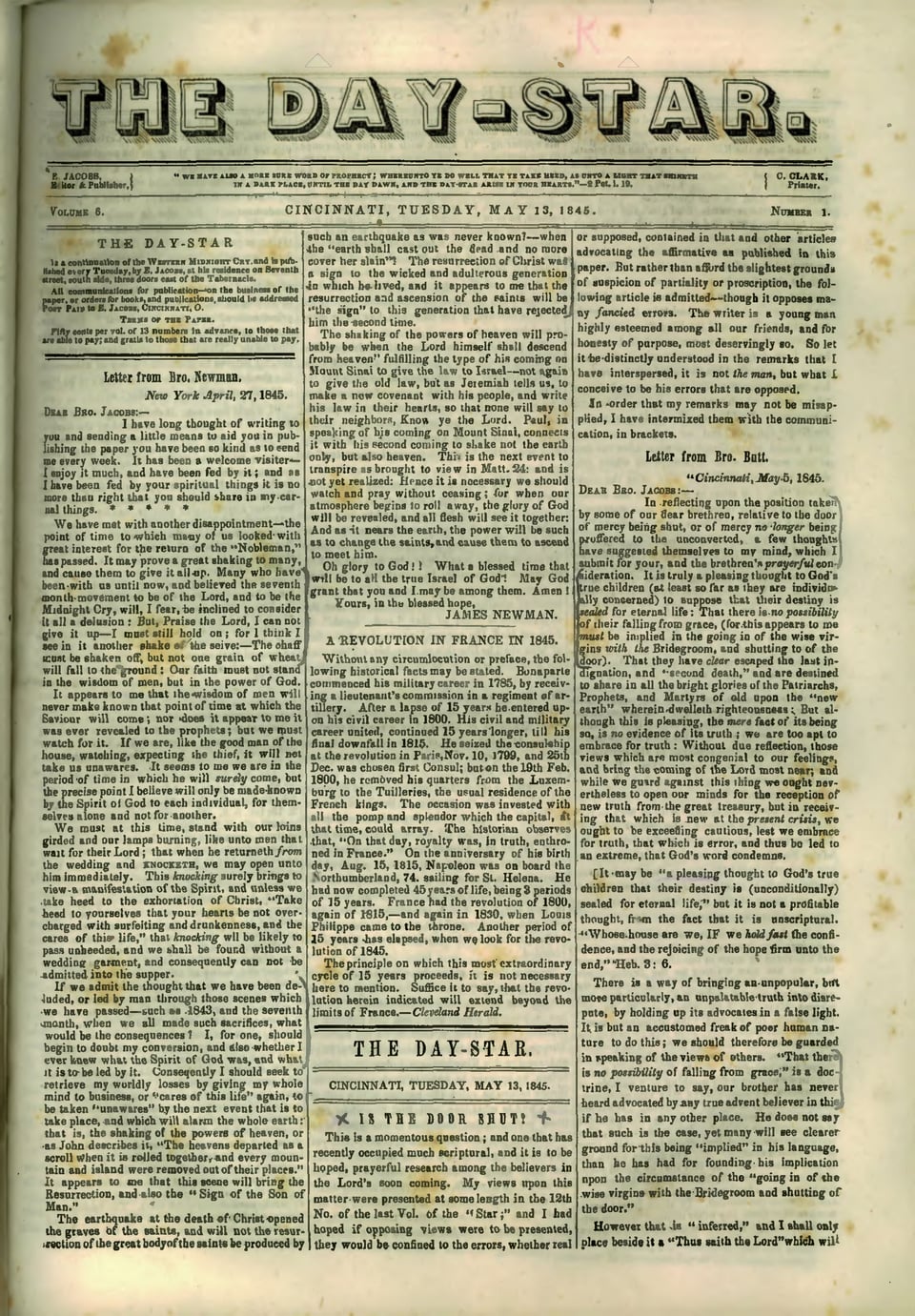
THE DAY-STAR.
E. JACOBB,
Editor & Publisher,
"WE HAVE ALSO A MORE SURE WORD OF PROPHECT; WHEREUNTO YOU DO WELL THAT YOU TAKE HEED, AS UNTO A LIGHT THAT SHINETH IN A DARK PLACE,UNTIL THE DAY DAWN, AND THE DAY-STAR ARRIVE IN YOUR HEARTS."—2 Pct. 1, 19.
C. CLARK,
Printer.
VOLUME 6.
CINCINNATI, TUESDAY, MAY 13, 1845.
THE DAY-STAR
All communications for publication-on the business of the paper, or orders for books,and publications,should be addressed POST PAID to E. JACOBS, CINCINNATI, O.
is a continuation of the WESTERN MIDNIGHT CRY. and is published every Tuesday, by E. Jacobs, at his residence on Seventh street, south side, three doors east of the Tabernacle.
TERMS OF THE PAPER.
Fifty cents per vol. of 13 numbers in advance, to those that are able to pay; and gratis to those that are really unable to pay,
Letter from Bro. Newman.
New York April, 27,1845.
DEAR BRO. JACONS:—
I have long thought of writing to you and sending a little means to aid you in publishing the paper you have been so kind as to send me every week. It has been a welcome visitor I enjoy it much, and have been fed by it; and as I have been fed by your spiritual things it is no more than right that you should share in my carnal things. *
We have met with another disappointment—the point of time to which many of us looked with great interest for the return of the "Nobleman," has passed. It may prove a great shaking to many, and cause them to give it all up. Many who have been with us until now, and believed the seventh month movement to be of the Lord, and to be the Midnight Cry, will, I fear, be inclined to consider it all a delusion: But, Praise the Lord, I can not give it up—I must still hold on; for I think I see in it another shake of the seive:—The chaff must be shaken off, but not one grain of wheat will fall to the ground: Our faith must not stand in the wisdom of men, but in the power of God.
NUMBER 1.
It appears to me that the wisdom of men will never make known that point of time at which the Saviour will come; nor does it appear to me it was ever revealed to the prophets; but we must watch for it. If we are, like the good man of the house, watching, expecting the thief, it will not take us unawares. It seems to me we are in the period of time in which he will surely come, but the precise point I believe will only be made known by the Spirit of God to each individual, for themselves alone and not for another.
We must at this time, stand with our loins girded and our lamps burning, like unto men that wait for their Lord; that when he returneth from the wedding and knocketh, we may open unto him immediately. This knocking surely brings to view a manifestation of the Spirit, and unless we take heed to the exhortation of Christ, "Take head to yourselves that your hearts be not overcharged with surfeiting and drunkenness, and the cares of this life," that knocking will be likely to pass unheeded, and we shall be found without a wedding garment, and consequently can not be admitted into the supper.
If we admit the thought that we have been deduced, or led by man through those scenes which we have passed—such as 1843, and the seventh month, when we all made such sacrifices, what would be the consequences? I, for one, should begin to doubt my conversion, and also whether I ever knew what the Spirit of God was, and what it is to be led by it. Consequently I should seek to retrieve my worldly losses by giving my whole mind to business, or "cares of this life" again, to be taken "unawares" by the next event that is to take place, and which will alarm the whole earth: that is, the shaking of the powers of heaven, or as John describes it, "The heavens departed as a scroll when it is rolled together, and every mountain and island were removed out of their places." It appears to me that this scene will bring the Resurrection, and also the "Sign of the Son of Man."
The earthquake at the death of Christ opened the graves of the saints, and will not the resurrection of the great body of the saints be produced by
such an earthquake as was never known?—when the "earth shall cast out the dead and no more cover her slain"? The resurrection of Christ was a sign to the wicked and adulterous generation in which he lived, and it appears to me that the resurrection and ascension of the saints will be "the sign" to this generation that have rejected him the second time.
The shaking of the powers of heaven will probably be when the Lord himself shall descend from heaven" fulfilling the type of his coming on Mount Sinai to give the law to Israel—not again to give the old law, but as Jeremiah tells us, to make a new covenant with his people, and write his law in their hearts, so that none will say to their neighbors, Know ye the Lord. Paul, in speaking of his coming on Mount Sinai, connects it with his second coming to shake not the earth only, but also heaven. This is the next event to transpire as brought to view in Matt. 24: and is not yet realized: Hence it is necessary we should watch and pray without ceasing; for when our atmosphere begins to roll away, the glory of God will be revealed, and all flesh will see it together: And as it nears the earth, the power will be such as to change the saints, and cause them to ascend to meet him.
Oh glory to God!! What a blessed time that will be to all the true Israel of God? May God grant that you and I may be among them. Amen!
Yours, in the blessed hope,
JAMES NEWMAN.
A REVOLUTION IN FRANCE IN 1845.
Without any circumlocution or preface, the following historical facts may be stated. Bonaparte commenced his military career in 1785, by receiving a lieutenant's commission in a regiment of artillery. After a lapse of 15 years he entered upon his civil career in 1800. His civil and military career united, continued 15 years longer, till his final downfall in 1815. He seized the consulship at the revolution in Paris, Nov. 10, 1799, and 25th Dec. was chosen first Consul; but on the 19th Feb. 1800, he removed his quarters from the Luxemburg to the Tuilleries, the usual residence of the French kings. The occasion was invested with all the pomp and splendor which the capital, at that time, could array. The historian observes that, "On that day, royalty was, in truth, enthroned in France." On the anniversary of his birth day, Aug. 15, 1815, Napoleon was on board the Northumberland, 74. sailing for St. Helena. He had now completed 45 years of life, being 3 periods of 15 years. France had the revolution of 1800, again of 1815,—and again in 1830, when Louis Philippe came to the throne. Another period of 15 years has elapsed, when we look for the revolution of 1845.
The principle on which this most extraordinary cycle of 15 years proceeds, it is not necessary here to mention. Suffice it to say, that the revolution herein indicated will extend beyond the limits of France.—Cleveland Herald.
THE DAY-STAR.
CINCINNATI, TUESDAY, MAY 13, 1845.
× IS THE DOOR SHUT? +
This is a momentous question; and one that has recently occupied much scriptural, and it is to be hoped, prayerful research among the believers in the Lord's soon coming. My views upon this matter were presented at some length in the 12th No. of the last Vol. of the "Star;" and I had hoped if opposing views were to be presented, they would be confined to the errors, whether real
or supposed, contained in that and other articles advocating the affirmative as published in this paper. But rather than afford the slightest grounds of suspicion of partiality or proscription, the following article is admitted--though it opposes many fancied errors. The writer is a young man highly esteemed among all our friends, and for honesty of purpose, most deservingly so. So let it be distinctly understood in the remarks that I have interspersed, it is not the man, but what I conceive to be his errors that are opposed.
In order that my remarks may not be misapplied, I have intermixed them with the communication, in brackets.
Letter from Bro. Butt.
DEAR BRO. JACOBB:—
"Cincinnati, May 5, 1845.
In reflecting upon the position taken by some of our dear brethren, relative to the door of mercy being shut, or of mercy no longer being proffered to the unconverted, a few thoughts have suggested themselves to my mind, which I submit for your, and the brethren's prayerful consideration. It is truly a pleasing thought to God's true children (at least so far as they are individually concerned) to suppose that their destiny is sealed for eternal life: That there is no possibility of their falling from grace, (for this appears to me must be implied in the going in of the wise virgins with the Bridegroom, and shutting to of the door). That they have clear escaped the last indignation, and "second death," and are destined to share in all the bright glories of the Patriarchs, Prophets, and Martyrs of old upon the "new earth" wherein dwelleth righteousness; But although this is pleasing, the mere fact of its being so, is no evidence of its truth; we are too apt to embrace for truth: Without due reflection, those views which are most congenial to our feelings, and bring the coming of the Lord most near; and while we guard against this thing we ought nevertheless to open our minds for the reception of new truth from the great treasury, but in receiving that which is new at the present crisis, we ought to be exceeding cautious, lest we embrace for truth, that which is error, and thus be led to an extreme, that God's word condemns.
[It may be "a pleasing thought to God's true children that their destiny is (unconditionally) sealed for eternal life," but it is not a profitable thought, from the fact that it is unscriptural. "Whose house are we, IF we hold fast the confidence, and the rejoicing of the hope firm unto the end," "Heb. 3:6.
There is a way of bringing an unpopular, but more particularly, an unpalatable truth into disrepute, by holding up its advocates in a false light. It is but an accustomed freak of poor human nature to do this; we should therefore be guarded in speaking of the views of others. "That there is no possibility of falling from grace," is a doctrine, I venture to say, our brother has never heard advocated by any true advent believer in this if he has in any other place. He does not say that such is the case, yet many will see clearer ground for this being "implied" in his language, than he has had for founding his implication upon the circumstance of the "going in of the wise virgins with the Bridegroom and shutting of the door."
However that is "inferred," and I shall only place beside it a "Thus saith the Lord"which will overturn every wrong inference and of course will overturn this.
"And when the King came in to see the guests, he saw there a man which had not on a wedding garment; and he saith unto him, Friend, how camest thou in hither, not having on a wedding garment? And he was speechless. Then said the King to the servants, Bind him hand and foot, and take him away, and cast him into outer darkness."
Yet our brother sees it "implied" that there is no "possibility of their falling," &c. This will help to clear from before our eyes, not a little of this fog, when we see how a "must be implied" is made to walk boldly up and take its station by the side of "Then said the King."
Another thing in the economy of God seems to have been forgotten by our brother in this paragraph; that is, God has arranged all the truths of his word expressly for the accommodation of 'those views' which "bring the coming of the Lord most near." God has no where told us to be "exceedingly cautious" lest we embrace something that would bring Christ too near, after the man of sin was revealed. His word no where condemns an extreme, of this kind after the signs should "begin to come to pass"; yet our brother has found out the importance of such caution.—This is a "new truth" from a new "treasury."]
"If I am not mistaken the conclusion that the door of mercy to the sinner is shut, is predicated upon the supposition that the Bridegroom has already come to the marriage, which of course according to this view, must precede his personal appearing. In reflecting upon this matter my mind has been directed to those portions of the Word revelent to the subject; and so far, I have been unable to come to the above conclusion: If I could only see clear evidence in the Word, proving the door, or means of access to the church militant closed up, (I think if I know my own heart) that I should hail it with welcome; for the sooner Jesus comes, the sooner the conflict will be o'er, and victory perch upon the banner of the cross with the assembling of the hosts of the Lord within the pearly gates of the New Jerusalem.
[The bearing—the tendency of the remarks in this paragraph cannot be mistaken. If I could see the evidence proving the door shut, "I should hail it welcome." Why? "For the sooner Jesus comes the sooner the conflict will be o'er." It is then, one of those steps in "the path of the just" that marks a positive nearness to the "pearly gates of the New Jerusalem"—and those of us that have the 'evidence' that "the door is shut," (which our brother seems to lock), according to his own showing, are happy in the knowledge of being very near the "New Jerusalem."]
"But has the Bridegroom come? And is the marriage already consummated? These questions are answered by some in the affirmative, who say that we are now waiting for the Bridegroom's return from the wedding. In evidence of this we are particularly referred to the parable of the ten virgius, Matt. 25; 1-13; also, Luke 12: 36, 37. In Matt. 25: 10, we read, "the Bridegroom came; and they that were ready, went in with him to the marriage; and the door was shut." The question here arises, Is not the personal appearing of Christ here brought to view? We contend that it is. In determining the meaning of a parable, or illustration, we must always take into consideration the thing, or things illustrated. What did the Saviour intend to illustrate by this parable? It appears to me his object was to show, 1st, The state his professed church would be in at the time of his second coming. 2d, The causes which led to that state. 3d, The fact that he would come as described in the 27, 30, 31, and 50th verses of the preceding chapter, to reward the righteous, and condemn the wicked. In these verses not a word is said about any other coming than his personal appearing: Not the least intimation is given
that he would assume an invisible position in the heavens, or above our atmosphere months before his appearing. (I speak with all due deference to my brethren.) This however must be the case, if the Bridegroom has already come. Such an idea appears to be positively condemned by the Saviour's words, "Therefore if they shall say unto you, Behold, he is in the desert; go not forth: behold, he is in the secret chambers; believe it not. For as the lightning cometh out of the east, and shineth even unto the west; so shall also the coming of the Son of Man be." Matt. 24: 26, 27; Luke 17: 23, 24.
[ I am satisfied that all scripture will harmonize when we have its true rendering. That what is denoted by the marriage, has taken place I no longer doubt.
The parable of the virgins either does or does not, bring to view the personal appearing of Christ. If "the fact that he would come as described in the 27th, 30th, 31st, and 50th verses of the preceding chapter" be what is presented, then the parable would have been perfectly unintelligible to his disciples; for in the above verses, it is granted that none other "than his personal appearing" is spoken of.
How could it have been possible for them to form any idea of going forth to meet, one whose coming had already been explained to be "as the lightning," "with great power" when "ye think not," &c. If we can credit plain Bible language we are certainly bound to believe that the leading design of the parable, is, something other than to represent the personal coming of Christ. The personal coming was already taught under the expressions of "Son of Man," and "Lord." It does not read, the personal appearing of the Son of Man shall be like this or that; but, "Then shall the Kingdom of heaven be likened" &c. Whatever "the Saviour intended to illustrate" I will leave Bro. B.—to continue his speculation upon: The above is what he says. It is given to illustrate "the Kingdom of Heaven" at a certain point of time. At what point of time, is proved by the harmony of verses 7-10, in the parable, compared with ch. 24: 45-49.
Nothing in the parable forms a parallel to verses 50, 51, ch. 24:—the coming of the Lord to "cut asunder" and appoint with hypocrites the portion of the evil servant. Oh no, nothing of this kind here; for we had already learned from Matt. 22: 12, 13, that when the evil servant received his portion, he was taken from the wedding, where of course he had been shut in. Our brother will have to look again, to find a rewarding of the righteous and punishing of the wicked in this parable —though the fixed destinies of all are clearly represented.
Suppose there is not in this place an intimation that Christ will "assume an invisible position in the heavens months before his appearing." Christ has a position somewhere; and that position is invisible: It will not always be on his Father's Throne. He has to come to the Ancient of Days and receive his Kingdom—to judge the nations before he appears to execute it—to receive his throne before he rules the nations with a rod of iron; and in what way will Bro. B. show that these preliminaries described in the Bible, may not require months before he appears: And yet so penetrating is the eye of our Bro. that he can see these things positively condemned by the Saviour's own words, "Wherefore, if they shall say unto you, Behold he is in the desert, go not forth," &c. What a "positive" condemnation of the idea that Christ has come to the Ancient of
Days---that he is seated on the "white cloud &c. Dan. 7: 13; Rev. 14: 16;! Certainly! Do you see that every thing in the neighborhood of the Ancient of days, is quite a "desert," that the "white cloud" and "Throne set in heaven" are secret chambers!! What a "positive condemnation! But who is really saying, the Christ is yet in the "secret chambers," and trying to persuade you to go forth on some T fool's errand with them, for Satan's especial esit? What place is more "secret" than the "He of Holies" in heaven itself, typified by the He of Holies in the tabernacle into which the high priest entered only once in the year! Into the Christ entered until he "obtained eternal redemption for us"; (Heb.9: 12.) Out of this "secret chamber," I believe he came on the day of atonement. But the drift of Bro. B.'s article seems to be "Be hold he is in the secret chamber" still.]
"I would here ask; If the coming of the Bridegroom in the parable was intended by the Saviour merely to represent his coming to the locality where it is supposed the marriage has taken place and not his personal appearing, why does the connection leave us so much in the dark relative to the matter? Now it appears to me that if the Saviour had designed this coming to precede his personal appearing by months, that he would have told us something positive about it; and the more so when we consider that this coming decides the fate of the children of men for the untold ages eternity; but in his exhortation at the close of the parable, 13th verse, he appears to decide the character of this coming by saying, "Watch therefore for ye know neither the day nor the hour wherein the Son of Man cometh." This coming we all admit to be his visible appearing. I know it may be said, this was spoken in the present tense, and had reference to the Saviour's time: but is it not addressed to those to whom the parable specially applies, and is not that application now? I look upon this as being the same as the Bridegroom coming. But it is said that when Christ appears it will be as King and not as Bridegroom: but cannot he sustain these relations at the same time. What are the characters that he has sustained since his ascension to heaven? 1st, That of Prince and Saviour, Acts 5: 31; 2d, Mediator, Advocate, or High-Priest, 1 Tim. 2: 5; 1 John 2: 1; Heb. 4: 14; 3d, Bridegroom, John 3: 25-29; Luke 5: 32-35; 4th, Shepherd, 1 Pet. 5: 4; Heb. 13: 20: 5th, Brother, Mark 3: 31-35; 6th, Father, Heb. 2: 13; Isa. 9: 6. Here we see that Christ in these several places, is represented as sustaining these various characters at the same time to show by these endearing relations, the great love that he bears towards us. Seeing then, that this has been so, is there any thing contradictory in the idea of his being both Bridegroom and King when he appears? I think not. But we read that those who "were ready, went in with him to the marriage and the door was shut." Reference is here made to one point in the ancient marriage custom. Let me illustrate this by an historical reference. "In the celebration of marriages in the east at the present day, many of the peculiar customs of ancient times are observed. At a Hindoo marriage, says a modern missionary, the procession of which I saw some years ago, the bridegroom came from a distance, and the bride lived at Serempore, to which place the bridegroom was to come by water. After waiting two or three hours, at length near midnight, it was announced, in the very words of scripture, Behold, the bridegroom cometh, go ye out to meet him. All the persons employed now lighted their lamps, and ran with them in their hands to fill up their stations in the procession: Some of them had lost their lights, and were unprepared, but it was then too late to seek them, and the cavaleade moved forward to the house of the bride: at which place the company entered a large and splendidly illuminated area, before the house, covered with an awning, where a great multitude of friends, dressed in their best apparel, were seated upon mats. The bridegroom was carried in the arms of a friend, and placed in a superb seat in the midst of the company, where he sat a short time, and then went into the house, the door of which was immediately shut and guarded by sepoys.
I and others expostulated with the door keepers, but in vain. Never was I so struck with our Lord's beautiful parable as at this moment. And the door was shut." See "Union Bible Dictionary," article, marriage, page 423.
I would here ask, When the Cry was made, was it not an intimation of the Bridegroom's personal appearing? Did not those who went forth to meet him see him in person? And was not the entrance into the marriage before the door was shot a personal one? It appears to me that these questions are answered by the above description in the affirmative. What application does our Saviour make of this part of the illustration? Clearly, that the "midnight cry" was to be the harbinger of his visible appearing. The going forth; The work of preparation to meet him with joy. The entering in with him to the marriage. His personal appearing, and rising of the immortalized saints to meet him in the air. The shutting to of the door: The closing up of the Gospel dispensation. If these ideas are correct then the Bridegroom has not yet come.
[The "connexion" can not leave us "in the dark" upon a matter relative to which it has as yet given us no light. Neither in the parable, or argument upon it, have we any proof that the personal appearing is intended; but its connexion does clearly prove the contrary. Luke 12:35,36,is not only a "connexion,"but a part of the same discourse; and this shows that the duty of watching for the Lord, is there suited only to a state of things existing after the wedding. That it is a part of the same discourse, may be settled by comparing Luke 12:39-46,with Matt. 24:43-51.
"The successive steps of the marriage scene are, 1st, The coming of the Bridegroom to the marriage, 2d, The mrrriage itself. 3d, The "return from the wedding." These several steps are brought to view in the parable; and the "connexion" in Luke 12: 35, 36, settles the application of Matt. 25: 13, by showing the coming of the Son of Man there mentioned, to be a coming FROM the wedding. When brethren can walk so lightly over such plain declarations to sustain a theory, there is danger. Can Christ tell us more "positive" than he has here done, that the marriage does "precede his personal appearing"?
"Can not he sustain those relations at the same time!"—that is, of King and Bridegroom.
These, and all the other titles subsequently alluded to, as applied to Christ, have been properly, but prospectively or prophetically applied in all past time. Thus, in addressing the "seven churches," Rev. 2: 3: he assumes a new title at every predicted change of the church—a title expressive of the relation he would at such time sustain to the church: But because Christ has been called an "Advocate, or Mediator," this is no proof that such office is to be filled by him for ever:—Because he has borne the title of "Bridegroom" for 1800 years, this does not prove that "they that were ready" then "went in with him to the marriage" or that the marriage ceremony will last forever being exalted to the Father's right hand "a ce and a Savour"—this coming constitutes a King facto, though he has prophetically no title in all past time. Proof. Dan 8: Psa. 2: 8, 9; Rev. 21: 9, 10; 5; 19: 6-9; Jer. 16, 17.
the last character or office that Christ fills prior to that of King, is that of Bridegroom; when titles and offices are forever merged in this: And the Lord shall be KING over all the earth." 14:9. His Kingdom "shall stand forever." 244.
Christ "sustaining these various characters at the same time" illustrates something more than "the great love he bears towards us." By these titles the Philadelphia church knew when they were addressed, and so of the others. By these titles we were also enabled to know when to cry "Behold he cometh!" and when to sing "the marriage of the Lamb is come"—these different characters are important in guiding the "faithful and wise servant" while he gives "meat in due season";—They also enable him to give a ready response to the inquiry, "Watchman what of the night?"
While we have "positive" proof in the connection of the parable to show that the marriage is celebrated before the personal appearing, it should also be remembered that Christ's personal coming is no where in the Bible brought to view under the figure, or parable of a marriage. The historical account of the marriage in the above paragraph, though it proves nothing, will yet aid in understanding the parable.
Let it be remembered that it is "the Kingdom of heaven" that shall be likened to this marriage, if you please. And what is the Kingdom of heaven at the time in question? A time before the "evil servant" is bound and cast out? "IT shall break in pieces and consume all these Kingdoms, and IT shall stand forever." Dan, 2: 44;
No matter whether in the above case the whole company of wise and footish virgins together, saw the Bridegroom before the marriage or not. This cannot affect the case, while we are told that the watching for "the Son of Man"—"the Lord" is for his return from the wedding. If Bro. B. claims that this would not be like the wedding above, let him remember that carrying out the likeness in all its arts would throw him upon a worse dilemma. If the place where the wise were shut in, was the apartment where the ceremony was performed, then all were shut out. If it were the outer or "guest chamber" then all were shut in. The parables, God has mercifully given us to illustrate truth; but why has he given us any explanation of them whatever, if we are to be permitted to carry out these liknesses according to our own notions, though they run into the face and eyes of God's truth.
That "the entering in with him to the marriage" denotes "his personal appearing, and rising of the immortalized saints" is nothing but assertion, and is just as good authority coming from Bro. B.—as from any body else. It can never be admitted until authority be received from the court of heaven, more direct than by way of the Vattican, for blotting from the sacred record the unalterable words of Christ, "And ye yourselves like unto men that wait for their Lord, when he will return from the wedding."
In justice to others, I can go no further with the above communication this week. So far, it seems to me, but poorly calculated either for food or physic. It can not tear from us our errors, for it is too manifestly full of errors itself. It is not "meat in due season," for there is no season about it; nor the least intimation of "times and seasons." The burden of it is a caution lest we should look too earnestly for our Lord from the wedding, when IF Bro. B.—should be right, and the Bible wrong; the marriage "has not yet come."
We need much comfort at the present trying time for God's dear children that are "groaning
for adoption" and crying day and night to be avenged of their adversaries: But where in this letter thus far, do we find it? O how much better it would be for us when we can not see alike, to engage our whole heart and soul in saying "to them that are of a fearful heart, be strong. Fear not: behold, your God will come with vengeance, even God with a recompense; he will come and save you." Isa. 35:4;
When cautions become necessary,lest we should haste too rapidly "unto the coming of the day of God," those cautions will come to us clothed with something better than human authority.
[TO BE CONTINUED.]
Letter from Bro. Maull.
Cincinnati, May 4, 1845.
I embrace the present opportunity to correct a mistake I think I made in a former letter. In Rev. 21: 2, we have these words: "And I John saw the Holy City New Jerusalem, coming down from God out of heaven, prepared as (but not yet) a bride adorned for her husband." In the first verse we learn, this was after the first heaven and the first earth were passed away, and the new heaven and the new earth created; but leaving this, it appears to me, that the Marriage cannot be consummated until the Bride receives her ornaments: These, I think, she has not yet received. In Rev. 19: 8, we learn that, to her was granted that she should be arrayed in fine linen, clean and (margin, bright) for the fine linen is the righteousness of the saints. Isaiah says, in 49: 18, in addressing Zion or Jerusalem, Lift up thine eyes round about, and behold: all these gather themselves together, and come to thee. As I live, saith the Lord, thou shalt surely clothe thee with them all as with an ornament, and bind them on thee as a bride doth. This appears to me to be positive and plain testimony. The New Jerusalem (the literal city) the Bride,(God's people) her jewels.
A Roman mother on being asked for her jewels, pointed to her sons. Thus with our mother: But has she now her jewels? No. They remain, some under, and some on, the surface of the earth, perplexed, cast down, but not discouraged. This, brother, was my mistake, I thought the Marriage consummated and the Door shut. Therefore I begin to feel again to a small degree at least, as Paul says in Romans 1: 14, 15; I am a debtor to the wise and the unwise, so much as in me is. I am ready to preach the gospel of the Kingdom, and these obligations I expect to cancel, wherever the Lord opens the way. I conclude by remaining your brother, in daily expectation of seeing the King in his beauty.
W. H. MAULL.
That our readers may see what Bro. Maull has retracted, or gone back from, I will here give the extract from the "former letter" that is alluded to.
"The awful and solemn period of the world's history that we are in, presses heavily upon my mind: And can it be that we have come to that place in the prophetic word, where "be that is filthy" or "righteous" are so to remain? That there will be such a time as this, I am satisfied from the following portions of the blessed word, viz., Rev. 22: 11, also in ch. 7: 14, of the same book, and in Dan. 12: 11. Has that time come? is the important question to be solved. This question at this time, assumes the present form: We are either to admit this is the case,—that our work with the nominal church and world is done, or that the proclamation of the 7th month, the "ory" made at "midnight" in the parable of the ten virgins has never been—that we have never been waked up, and are yet slumbering and sleeping in the tarrying of the vision.—This, treacherous as is my memory, I cannot admit. To ascribe the work of the 7th month to the 'devil,' or 'mere human influence' I dare not do. Therefore with trembling I take the position that we are in the 'little while' of 'patience' and 'watching' that will soon terminate in the appearing of the blessed Jesus.
We really have need of patience. I am glad in my soul that our blessed Lord has watchmen still that fearlessly give the time, and that they answer each other with cheerful tone 'The morning cometh'!! Glory be to God!
REMARKS.
How liable are frail mortals to err! And what a blessed thing it is to have a spirit to retract errors into which we unguardedly fall, and which, if wilfully harbored, would like a canker, eat out the very vitals of our blessed hope. But it should also be remembered that it is by no means the least successful art of our common enemy, to work upon an honest heart and tender conscience, through the deceptive devices of agents under the garb of great sanctity, to induce a retraction of the most important truths. Satan is by no means ignorant of the fact that God's method of saving his people, is to sanctify them by the truth; and thus his efforts to stop this all important work.
The retraction of the sentiment that the time has come when "he that is filthy or righteous are so to remain" as argued from the fact of having had a literal fulfillment of the predicted Cry at Midnight—of having been "waked up" by it, is all based upon the ground that the marriage cannot take place before the Lord comes, and his children gathered into immortality.
Here we have before us the two letters of Bro. Maull—The principles declared and retracted : And here also we have the Bible—the balances of the Sanctuary by which to weigh these productions. Surely we need not greatly err.
Now had our good honest brother watched these balances of the Sanctuary, he would have saved himself from a most unpleasant predicament, viz., that of virtually making out the Holy Jerusalem to be a harlot, and all her children "bastards and not sons." These ornaments spoken of by Isaiah, it is admitted are the children: And these she is to point to as her jewels at the time of the marriage ceremony! All her children born before she is married!! Look at it. Our brother certainly can not be ignorant of the fact that when John was shown "the Holy City, the New Jerusalem coming down" she was at that time not only the "bride" but also the "Lamb's WIFE." The marriage had been celebrated. Rev. 21: 9, 10; "Come hither and I will show thee the bride the Lamb's wife" which was "the great City, the Holy Jerusalem, descending out of heaven from God." There is no account of but one descending of this city—this is the same as in v. 2, "coming down" a wife. A wife is a bride after the marriage ceremony is performed, but a bride is not a wife before such ceremony.
When the view is taken that the marriage is consummated before the personal appearance of Christ, all is perfectly natural. We then understand how "One like the Son of Man came to the Ancient of days" and received his Kingdom. Dan. 7:13;—How the "Throne is set in heaven" before the multitude are gathered, Rev. 4: How to wait for the Lord "when he will return from the wedding," Luke 12:36; How the man that has not on "the wedding garment" can be bound hand and foot and cast out, without placing our Lord in the unpleasant predicament of changing one to immortality, and then changing him back again Or of having made a mistake in binding on to the bride a filthy garment, supposing it to be a jewel. (Matt. 22: 11-14.)
The decking of the bride with ornaments, according not only to ancient but modern custom, is a work performed by the Bridegroom's own hand after the marriage ceremony.
With this view, the purity of the character of the Bride and Bridegroom is defended.
After the marriage ceremony, which in this case is on the day of atonement, the church—all those that are the children of God by faith in Christ Jesus are begotten—prepared through a process of trial to come forth,(Eph. 5:26,27;) and are "born from the dead""at once" when Zion travails, Isa. 66: 5-10.
Old Jerusalem is frequently called a harlot, but not the New Jerusalem. Isn. 1:21; Jer. 2:20; &c.
The retracted letter of Bro. M. contains a firm conviction of the nearness of Christ—a longing desire to see him—so much so as to cry out for "patience," a warm and glowing love for the time, and for the watchmen that fearlessly proclaim it, and ends with—"Glory be to God""!
The retraction talks away back about obligations to the wise and unwise, when the time has come to cease from man—about "beginning to feel" like preaching the gospel of the Kingdom when the children are expecting every day to be called from these labors.
To "daily expect the King," is to have every obstacle removed out of the way, and look for nothing else. These are all removed in the retracted note, and again interposed in the other.
I have not time, however, to weigh the two letters, and as our readers all keep the balances, I will tell you where you can find a few weights to try them by.
1 Thess. 5: 23; 1 Cor. 1: 7, 8; Phil. 3: 20; Col. 3: 2-4; 1 Thess. 1: 10; 2: 19; 3: 13; 4: 14-18; d Thess. 1: 10; 2: 1; 1 Tim. 6: 14; 2d Tim, 4: 8; Titus 2: 13; Heb. 9: 28; James 5: 7, 8; 1 Pet. 1: 7-13; 2d Pet. 3: 11, 12; &c.
Do not mistake, and go to weighing our good honest brother,and judging him,in the room of his two letters.
THE TIME.
"But as the days of Noah were, so shall also the coming of the Son of Man be." Matt. 24:37.
In this chapter, Christ is answering the question, "When shall these things be? and what shall be the sign of thy coming, and of the end of the world?" The days of the Son of Man (Luke 17:26;) are to be like the days of Noah: And what were those? Ans. The days in which he was in the ark—The days lying between the "world" that "perished," and "the heavens and earth which are now." (2d Pet. 3:6,7;) Do not the days referred to by the Saviour embrace all the days of Noah's life? Ans. No. For those days were allotted to those that perished, Gen. 6:3; These were the "days before (Noah's days) the flood," Matt. 24:38; The days that Noah was in the ark, were emphatically his—he was sole proprietor of the earth.
THE LIKENESS.
The peculiarity of the closing up of the days before the flood--eating, drinking, &c., (not that they had lived without eating and drinking before) but the excess of it, because their 120 years was ended and they were safe.
The peculiarity of the closing up of the 2800 years—the end of the warning to prepare for the days of the Son of Man, (at the end of 1843, Jewish time,) was characterised by the same excess of feasting, because the time was passed. 700 persons set down to one table in New York to celebrate the event.
When Noah's days came, God spake to him (Gen. 7: 1;)—his work with the world was do he went into the ark—his business was the only with his household.
Since 1843 ended, God has given evidence that he has directed in this matter—He spoke to us "If the vision tarry wait for it"—The vision spec- our work with the world was done—our o work has been with the household--our proclamation was to them, Behold he cometh Noah's ark rested in the 7th month, 17th day after which it never moved.
In the Seventh month, about the 17th day, in the end of the last prepartory excitement in household of faith, since which time nothing blessed, but words of comfort to the wise, or who keep their lamps burning.
At the end of 40 days after the ark rested No opened the window and let in the light.
At the end of about 40 days from the seventh month, light poured in upon us relate to the "Jubilee"—the marriage of the Br groom, &c.
In the first month " Noah looked and saw waters were gone," but the earth not yet fit out upon, though lie was anxious, and nod expected then to go out.
In the first month, we saw every thing filled on earth, and among the people, need to be fulfilled before we went out on to the Earth," yet it was not ready—not purified, we "looked," expected, and was anxious to go then.
Noah's next business was removing the wing off from the ark, which he did sometime fore the 27th day of the second month, at time the heavens and earth which are now dry—ready for him.
Many of God's people have been bursily at in tearing away this covering of the ark since first month came in; and light increases day: "By the same word" that ordered an trolled in bringing Noah and his family from heavens and earth to another, are we to be ered: Yes, God authorizes us to use the word"—The days of the Son of Man and "same" as Noah's.
On the 27th day of the second month, or after; "God spake to Noah, saying, Go the ark, thou, and thy wife, and thy sons, son's wives with thee." &c.
On the 27th day of the second month, will a SPEAK TO HIS WAITING CHILDREN will be 40 days from the Passover, a few before Christ's ascension, a few days before day of Pentecost, &c. There are a train of esting circumstances connected with these days, that are now appropriate, which find my application of them to the 7th month. God had no where recognised that as a month. What then is to be the antitype speaking to Noah on the 27th day of the 2d It is directly connected with going out on Earth. Is not the speaking a parallel with the knocking in Luke 12:36;—the rea Acts 8:19; making known, Matt. 24:36. thoughts are presented for the purpose of ful enquiry, and if they are meat in due God's people will find it out. I have fed u
Letters and Receipts For the week ending, May 10th.
D. Browning, P. M., for F. Glascoe W. Lavance; H. H. Johson, P. M., for 2.00; E. Collins, P. M., for Elder E. Boo R. E. Patterson, P. M.; James Newnan & H. Maull; J. Y. Butt; M. M. F. G. Fry Carr, 1.00; B. Leming, P. M.; C. H. Pi S. Parker; G. Wood, .25; W. Cullen Kimpton, 1.00; P. B. Vail, P. M., for H. kins and J. Baily, each, .50; D. Bartbolom w. J. B. Cook; J. H. Thomas, P. M., .50, and Mary Fall.
THE DAY-STAR.
E. JACOBE,
Editor & Publisher,
"WE HAVE ALSO A MORE SURE WORD OF PROPHECY; WHEREunto WE DO WELL, THAT WE TAKE HEED, AS UNTO A LIGHT THAT SHINETH IN A DARK PLACE,UNTIL THE DAY DAWN; AND THE DAY-STAR ARISING IN YOUR HEARTS."—2 Pg. 1. 13.
C, CLA, K Printer.
VOLUME 6.
CINCINNATI, TUESDAY, MAY 27, 1845.
THE DAY-STAR
In a continuation of the Western Mansion Cay, and is published every Tuesday, by E. Jacone, at his residence on Seventh street, south side, three doors east of the Tabernacle.
TERMS OF THE PAPER.
All communications for publication on the business of the paper, or orders for books, and publications, should be addressed Fort Paid to E. Jacosa, Cincinnati, O.
Fifty cents per vol. of 13 numbers in advance, to those that able to pay; and gratis to those that are really unable to pay.
Letter from Bro. Pickands.
Akron, Ohio, May 14, 1845.
MY DEAR BRO. JACOBS:—
NUMBER 3
Your letter of the 9th inst. was received on Monday evening last. After mature reflection I am constrained to say, in reply to your kind invitation, that in view of circumstances beyond my control, I cannot go to your city at present. If time continue till fall, and the way should be open, I will with much pleasure spend a couple of weeks with your people—at present, duty seems to keep me here. In the mean time I rejoice in the bold and steadfast stand you take in behalf of truth. I agree with you fully, that no good reason has thus far been shown why we should deny the grace of our God in the way he has led us along. I do not doubt that we have entered upon "the day of the Lord," so often spoken of by the Prophets, "in the which" as Peter says, "the heavens shall pass away with a great noise, and the elements shall melt with fervent heat, the earth also, and the works that are therein shall be burned up." I confess I am credulous enough to believe the very remarkable disasters so frequently witnessed about these days as evidences and specimens of God's wrath against an ungodly nation.—I fully expect such things to continue and increase until "the Lord himself shall descend with a shout, with the voice of the archangel and the trump of God, and the dead in Christ shall rise first." God will avenge his own elect which cry unto him day and night. We need now more than ever patience and faith. We have prayed "thy Kingdom come, thy will be done on earth as it is in heaven"—and I have often feared our brethren too frequently used this prayer prospectively, that is, that God's will might be done in the future state.—I do not so understand it, as we should now chiefly use that petition. In the new heavens and earth God's will is to be the universally acknowledged rule of action; there will be no opposition to it among the inhabitants of the earth.—But now amid the constant and almost unanimous opposition of mankind a little handful only are willing that God should rule and execute his purposes of mercy or of wrath in his own way. It is true some of his people may persuade themselves that they do wish to have the will of God done and that their grief and displeasure arise in view of interpretations of scripture which contradict His expressed will. Perhaps they do not perfectly understand, the Lord's will, and it is possible they may sometimes mistake their own will for the Lord's. At any rate it is not best to be too positive or to be too touchy and impatient with those that differ from us. You and I will rejoice in having God's will fully done. Paul tells us to rejoice always, even now, and so we will. Whatever mistakes we may make, the will of God will be done in fulfilling the great and glorious prophecies.—Nay, we may rejoice even now in seeing them fulfilled.
If we should finally be found to have mistaken the character of passing events, still we will "rejoice in the Lord." Thus far we have witnessed events which really do seem to us to be the fulfilment of certain prophecies which immediately betoken the coming of our Lord. We are bound to decide such matters, each man for himself according to the best light we have—and are not at liberty to pin our faith to the sleeve of our distingnished brethren at the East any more than to that of the old Scribes and Priests. It is rather remarkable that certain men "who seemed to be somewhat" should be so irritable and impatient with us seeing they had suffered in like manner from their former masters. Well if we must differ from our leaders we will acknowledge no master but christ. It is a sad & humbling spectacle to behold prominent Adventists prescribing in dogmatical terms the course of conduct to be pursued by the body of believers, and denouncing and disowning those that will not obey them. How ridiculous it is to see them firing off their miserable pop-guns in saint imitation of the thunders of the Vatican. I understand one of the eastern papers announces to the world that those persons who adopt the practice of washing each other's feet, &c., are no longer to be considered Adventists of the orthodox stamp. I have myself read some articles on that subject which were full of a most illiberal and captious spirit. Now it shows great ignorance of the true faith of Jesus Christ and of the present character and temper of Advent believers to treat matters in this style. Do these men suppose the brethren are not as competent to understand the word of God as they are! They certainly write as if they thought the presentation of God's truth and the final salvation of his people depended on their learning, wisdom, prudence and firmness. They are much mistaken. The Advent people have come out of Babylon, meaning thereby an oppressive ecclesiastical despotism, and they will not readily place their necks again under the yoke of bondage. I am not yet satisfied that Christ would have his disciples now publicly wash each other's feet as a religious duty, but I see no reason why I should smite those brethren who do consider this their duty and act accordingly.—And certainly if these brethren are wrong they who are spiritual should restore them in the spirit of meekness.
You will be glad to learn that our brethren in Akron continue rooted and grounded in love and abounding therein. Our confidence in the word of the Lord is unshaken. We are earnestly looking for the actual personal return of "this same Jesus," and though we do not all agree in every opinion or interpretation, yet we are gradually coming nearer to each other as we come nearer to the great gathering of the saints to meet the Lord in the air.
I trust you will be able to continue the publication of your paper, and that you will with your accustomed frankness and simplicity "preach the word." It will console you to know that your "labor is not in vain in the Lord."
We have lately had some very severe frosts which have destroyed most of the fruit, and I have been assured from two different sources entitled to credit that the wheat throughout this region is so far injured that there will be very little if any crop.
You are aware of the very serious prospect of speedy war with England, and of course with Russia, Spain and Portugal, Canada and the Western Indians, and though last not least, with the Slaves of our own Southern States, who will certainly be aroused and armed and disciplined by the English. Every thing around us and in the midst of us is full of alarm and danger, but God has promised to keep him in perfect peace whose mind is stayed on Him. Whatever may happen to the world of the ungodly, the saints of the Most High will inherit the Kingdom. Therefore be of good courage and He will strengthen your heart.
Bro. Cook was here yesterday, having returned from Cleveland, where he spent last Lord's day in the absence of Bro. Robinson who went to teach and comfort the brothren at Elyra and Oberlin. Bro. Cook proposes to start next week ("if the Lord will") for Norwalk, and down to Marysville and out to Indiana to see the scattered brethren
once more, I shall sympathise with your brethren in any disappointment, they may experience on account of my not accepting their invitation, and beg you will assure them of my sincere and hearty esteem and affection for them; I trust we shall soon be done with disappointments and trials and be for ever at rest with our Glorious Head.
In much esteem and affection, I am your brother, in the hope of the Gospel.
J. D. PICKANDS.
Letter from Bre. Bartholomew.
WHO HATH IMMORTALITY, AND WHEN WILL THE RIGHTEOUS RECEIVE THE CROWN OF LIFE!
There is perhaps no subject or doctrine of the Bible, except that of the cross of Christ, and the plan of the redemption of a fallen world, of so deep and thrilling interest, and vital importance to the Christian, as that of the crown of life. Yet perhaps no doctrine, by the great mass of the professing world, less understood, more garbled by tradition and cunning craftiness of men. Hence we often hear professed ministers of the gospel, (whose bare assertion, to a great portion of their too credulous hearers, appears to be more sacred than the word of the Lord) proclaim from the sacred desk to their delight and erring brethren, your friends are now in heaven, waiting and looking for you to come. A good sister said a few days since, we had a good class, all said, with two or three exceptions, they had friends in heaven. Thus ministers and people, are feasting upon a phantom, and following a vain show. Query.—If man, in his fallen state, possesses an inherent principle of immortality, or eternal life, or as some say, an immortal soul, distinct from the body, and capable, or subject to an entire separation from the body at death, and remains in a conscious state of existence after such separation, until the resurrection of the body, where and when, did he receive that principle! Was it created, and has it existed in a conscious state from the first organization of matter? or did it exist seminally in the loins of Adam? or is it imparted to each individual in embryo, or at their birth? If it existed at the creation of the world, or has been imparted at subsequent periods, who created and imparted it? The plain answer is,—God. If then God imparted it, is it not a distinct principle of his Divine nature! if so can that nature ever suffer? I am aware that some may say, Adam was created immortal, and he suffered and died: very true, Adam was created immortal, and in that state he did not suffer, and never would have suffered, had he continued in that state, for death and all its evil effects, entered into the world by sin. When the transgression was complete, that moment, or day, the penalty was executed, which was, In the day thou eatest thereof, thou shall surely dip. The effect was, man lost that principle of immortality, and became mortal, subject to pain and death, and in that body he suffered. But to the subject, Who hath immortality? The answer is plain,—Jesus. For proof, to the law and to the testimony; and if any man speak contrary to this, it is because there is no light in him.
1st. We refer to Paul, 1 Tim. 6: 15, 16, Which in his (Christ's) times he shall shew who is the blessed and only Potentate, the King of kings and Lord of lords, who only hath immortality dwelling in light which no man can approach unto, whom no man hath seen, (since his ascension, nor can see, (until in his times he shall shew it,) to whom be glory, &c. Again, Paul in his first epistle to the Corinthians 15th ch. 50th verse. Now this I say, brethren, that flesh and blood cannot inherit the Kingdom of God; neither doth corruption (this mortal corruptible body) inherit (possess) incorruption, (or a principle of immortality). Psa. 49: 15; But God will redeem (not has redeemed), my soul from the power of the grave, for he shall receive me.
query. If the soul of David, at death, went to heaven, and did not descend into the grave, but possessed a separate, & distinct principle of immortality, why David do you speak of its redemption from the grave! Our modern Theologians, D. D.'s and even our beardless boys in the ministry, have learned more wisdom. They would tell you the way of God more perfectly. They would teach you, that you had a mistaken view of this important doctrine, that your body might lie and moulder in the grave for centuries, but the soul, that immortal something, would go straightway to heaven, that undefinable region, beyond the bounds of time and space, where all your friends have gone. You are mistaken David, it is your body, and not the soul, as you say, that shall be redeemed from the power of the grave. (margin, hell.) at the general
chit, or only germinating principle, could he on any philosophical principle, be said to sow in hope?
So if the soul, which includes the whole man, of which the scriptures abundantly prove, which it is not my purpose here to produce, if that soul is already immortal, and taken at death to heaven, what hope in, or necessity of a resurrection? in that case, the doctrine would lose all its thrilling interest, and prove fallacious. The husbandman would not have to wait with patience, for the latter rain, if the seed sown sprung up, and came to maturity at the early rain, or the moment it was cast into the earth.
But Paul, to make this doctrine more plain proceeds in the 42d to 44th veri. So is the resurrection of the dead, it is sown in corruption it is raised in incorruption, it is sown in dishonor. It
rection, and to this he had particular reference in his 2d epistle to Timothy, 4: 5-8. This was about at the close of his arduous labors. For I am now ready to be offered up, and the time of my departure is at hand, I have fought a good fight, I have finished my course, I have kept the faith, henceforth, (from the present till Christ comes.) there is laid up for me a crown of righteousness, which the Lord, the righteous Judge shall give me at that day; and not to me only, unto all them also that love his appearing. This is in perfect accordance with the declarations Christ and the other apostles.
But, says the objector, there are express declarations to the contrary, viz., the parable of the rich man and Lazarus.—Luke 16: 19, &c. Thi it is contended, is to be taken, or understood its most literal sense, as it reads. Thus T
resurrection ; when all the generations of man, that have ever lived on the earth, both small and great, shall stand of the general Judgment , and then shall that soul of yours , leave those bright regions , return again within the bounds of space , enter again , and reanimate the resurrection body , and then , in that body , enter upon the full enjoyment of heavenly bliss .
Again, we refer to Paul, in his letter to Titus 1:2; declares his hope of eternal life, because God who cannot lie, promised before the world began. Again, 2:13; Looking for the blessed hope, (eternal life or immortality), and the glorious appearing, &c.; 3d ch. 7th ver., That, being justified by his grace, we should be made heirs according to the hope of eternal life. Col.1;5. For the hope that is laid up for you in heaven, &c. 1 John 2:25; And this is the promise that the hath promised us, even eternal life. Judg 21; Keep yourselves in the love of God, looking for the mercy of God unto eternal life!
Now if Paul, who himself declares, and was a confessed servant of God, and an apostle of Jesus Christ, according to the faith of God's elect, had truly, a hope of immortality, as he himself affirms, he could not have been in possession of that principle at that time; if so, he must have
is raised in glory, it is sown in weakness, it is raised in power, it is sown a natural body, it is raised a spiritual body, &c.; and then from the 61st verse onward, we are informed when this will take place; Behold, I shew you a mystery, we shall not all sleep. (or die.) but we (who are Christ's.) shall all be changed in a moment, in the twinkling of an eye. (When, Paul?) at the last trump, for the trumpet shall sound, and the dead shall be raised, incorruptible, and we (who are alive) shall be changed. For this corruptible, (body) must put on incorruption, and this mortal (body) must put on immortality. So when this corruption, shall have put on incorruption, and this mortal, shall have put on immortality, then (and not till then) shall be brought to pass the saying that is written, [see Isa. 25: 8; Heb. 2: 14, 15; Rev. 20: 14;] Death is swallowed up in victory.
I might here close the testimony on this point and submit the case, as clearly established, and satisfactory to every candid mind enquiring for truth. But lest some who wouldain receive the truth, yet have their prepossessions in favor of their long cherished views, received by tradition, in a theory, directly opposed to the foregoing clear and emubatic testimony, we will still draw
was a certain rich man, &c. There has also poor beggar named Lazarus—and it came to pass that the beggar died, and was carried by an into Abraham's bosom: The rich man also died and was buried, and in hell he [the rich man] lifted up his eyes, being in torments, and Abraham after off, and Lazarus in his bosom, he cried, and said, Father Abraham, have me on me, [here is catholism, intercession to sainth and send Lazarus, that he may dip the tip of finger in water, and cool my tongue, for I am mented in this flame. Does not this represent whole bodily organs, of Abraham, the rich and Lazarus?
But, says the objector, the soul was the representative of the body, I do not admit that the life of either, was taken to heaven, or hell. The you abandon the literal construction of the probable, and change your position, for a spiritual figurative one.
…