Miller's Theory Utterly Exploded (1840)
Download: PDF — Miller's Theory Utterly Exploded (1840)
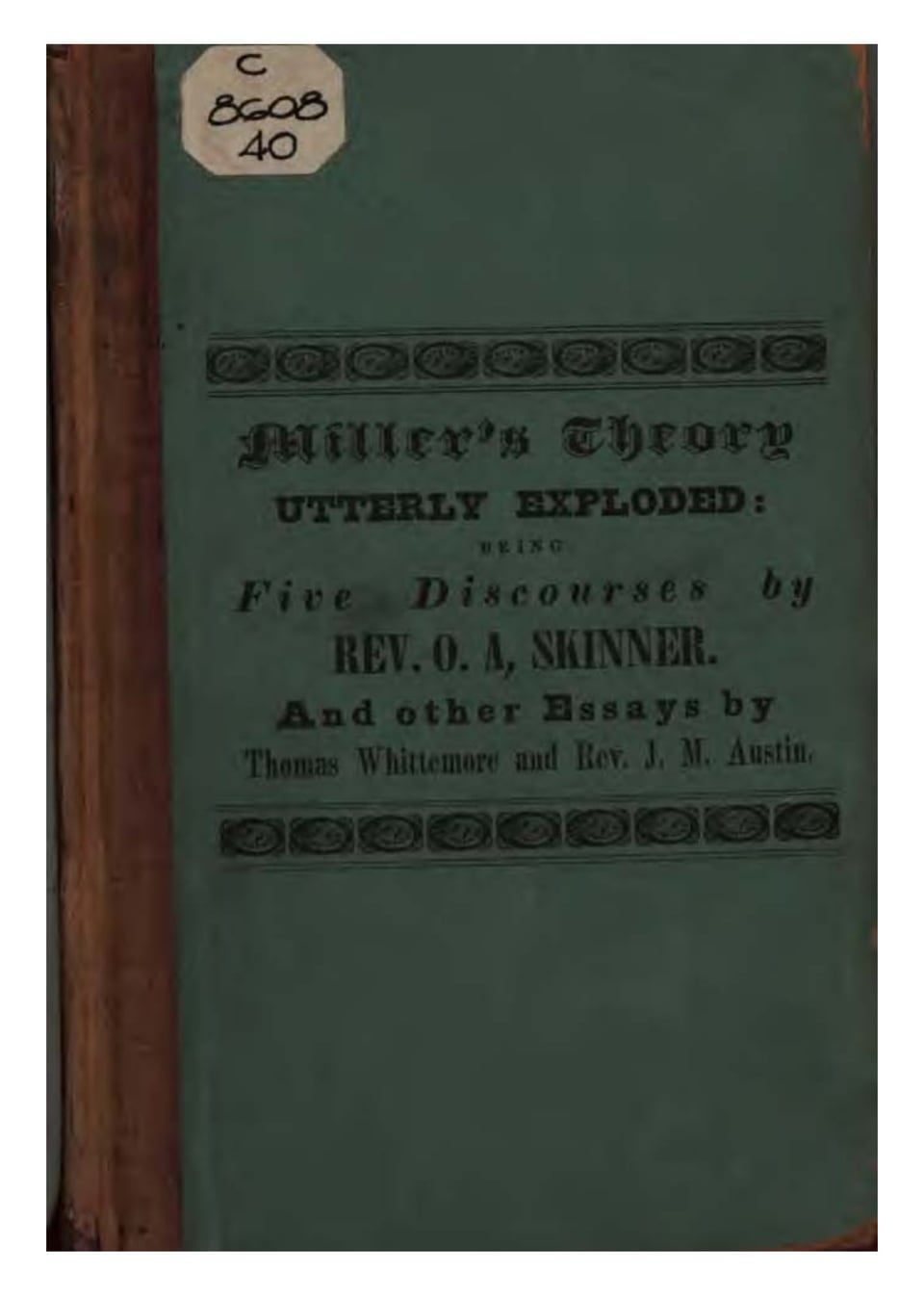
Miller's Theory
UTTERLY EXPLODED:
BEING
Five Discourses by
REV. O. A, SKINNER.
And other Essays by Thomas Whittemore and Rev. J. M. Austin.
THE
THEORY OF WILLIAM MILLER,
CONCERNING
THE END OF THE WORLD IN 1843,
UTTERLY EXPLODED.
BEING FIVE DISCOURSES
By OTIS A. SKINNER,
PASTOR OF THE FIFTH UNIVERSALIST SOCIETY IN BOSTON.
WITH SOME OTHER ESSAYS ON THE SAME SUBJECT.
BOSTON:
THOMAS WHITTEMORE,
37 CORNHILL.
1840.
. C 8 1 0 8 .
Entered according to Act of Congress, in the year 1840, by Thomas WHITTEMORE, in the Clerk's Office of the District Court of the District of Massachusetts.
PREFACE.
THESE sermons are published in the hope, that they may enlighten the community in regard to the important subjects which are therein discussed. William Miller was invited to deliver his lectures in the Baptist Meetinghouse in Cambridgeport; and many efforts were made to get up an excitement, miscalled a revival of religion. Several very respectable citizens of that peaceful village, entirely disapproving the course of those who had introduced Mr. Miller into the place, and wishing to defend the sacred Scriptures against his manifest perversions, so fatally calculated to turn the Bible into ridicule, and lead men into infidelity, invited the Rev. O. A. Skinner to prepare and deliver these discourses in that place; and subsequently obtained the use of the Universalist Chapel for that purpose. Mr. Skinner reluctantly consented to discharge this duty, thinking it a poor compliment to the good sense of community, to judge any formal refutation of so absurd a theory to be necessary.
But it was urged upon his consideration, that much injurious excitement had been already produced; and that men, who, in themselves, are deserving of no attention at all, may be made worthy of it, when those who profess to be the pastors and guides of the flock, make use of them as tools to accomplish sectarian purposes. For these reasons, and these alone, this work is now given to the public. We hope it will be read, not with an idle curiosity, but with a sincere desire to know what the word of God says on the subject of the coming of Christ, and its attendant events. These lectures will be found to cover all the principal ground of Mr. Miller's theory; and they are sent out with the ardent prayer, that they may be instrumental of much good. T. W.
MILLER'S THEORY EXPLODED.
LECTURE I.
CHRIST'S COMING AT THE DESTRUCTION OF JERUSALEM.
"Therefore, be ye also ready, for in such an hour as ye think not, the Son of man cometh." Matt. xxiv. 44.
In the short series of Lectures, which I have been requested to deliver in this place, I am to consider the theory which has recently been advocated among you, respecting the destruction of the world in the year 1843. This theory, though entirely without foundation, and fraught with the greatest absurdities, has produced much excitement wherever it has been promulgated.
And it is this circumstance, that has induced me to comply with the invitation I have received, to reply to some of the leading arguments on which it is established. What may be in itself considered wholly unworthy of notice, may demand our immediate and special attention, in consequence of the injury it is doing, and the dangerous excitement it is creating. An ignorant, superstitious nurse may, by her marvellous stories, produce the greatest possible terror and alarm among a family of children, and not only render them deeply wretched, but unfit for either duty or study. In such a case, no judicious and reflecting parent would say, "The nurse is unworthy of notice, and the stories are absurdly false and ridiculous."
No; he would look at his children, at their unhappy condition, and at the tendency of the stories they had heard to make them the slaves of superstition; and thus he would be led to embrace the earliest opportunity to correct their errors and remove their fears.
It is the same with regard to the theory about the destruction of the world, A. D. 1843. Very many have been greatly moved by it; terror has been spread over many portions of the community; it does not become us, therefore, to stand still and say, It is an absurd notion, and advocated by a man who is either artful and designing, or wild and superstitious; we are to look at what it is doing, and estimate its claims to notice accordingly. For aught we know, it may yet produce an incalculable degree of mischief. A warning voice comes down to us from the past, bidding us to beware. History informs us, that many have risen up in different ages, who have advocated the immediate destruction of the world. And all these have had their followers; all these have deluded many. In some cases, people have been so affected, as to forsake their business, abandon their several employments, and leave their families unprovided with the necessaries of life. In others, they have sold their possessions, and given up all to the church; hoping, thereby, to secure the salvation of their souls. Hence, it would be no new thing, if some who receive this theory should forsake their employments, abandon their houses and lands, and give themselves up to excitement and fear; to what they would call a preparation for the great calamity or judgment they suppose is so soon to come.
There is no subject on which an excitement can be more easily produced than this; and no theory can be advocated, which many will more readily receive, or which they will adopt when it has no greater claims to credence. Were any theory to be broached, not immediately calculated to alarm the fears, for which no better proofs could be offered than have been advanced in favor of this, it would not be adopted by one in a thousand, who should hear all that could be said in its support.
You all recollect the comet, that appeared a few years since, and which some conjecturer said might possibly hit the earth. Well, even that conjecture, idle and unfounded as it was, filled thousands of breasts with the most anxious fears. Many began to see strange sights and movements in the heavens; and though they did not actually behold the stars fall, the sun turn to blood, and the moon fade, they almost imagined they could feel the earth tremble as it rolled on its axis, and moved on in its orbit.
The comet appeared; we all beheld the strange visitor; it remained its appointed season, and then gradually faded from our sight.
During all this, we felt no shock; the earth remained secure and unharmed. And I doubt not, that it will so remain till 1843 shall have been numbered among the years that were.
With these remarks, which I felt bound in justice to myself and friends to make; I will proceed to examine some of the leading arguments on which the theory in question is built.
What I have to say, will be offered in seriousness and candor. I shall make no resort to ridicule or sarcasm; for though it is well at times to laugh men out of their errors, I do not conceive this to be one of the times. I shall take it for granted, that all who believe the world is to be destroyed A.D.1843, are sincere in that belief, and, though mistaken, honest in their mistake.
Besides, the theory comes to us recommended by the appearance of great research, and an extensive acquaintance with the Bible and history. People are not aware, that the author, in his calculations, is indebted chiefly to such men as Mede and Newton. He has their theory of explaining the prophecies, though he has varied in many respects from their dates, and their applications of predictions. In several cases where they suppose they may be right, he is positive. Thus, there is much borrowed research brought to sustain this theory; and, therefore, it will require patient investigation and candid argument in considering it.
This evening, I shall ask your attention to the following question, viz. Do the Scriptures teach a coming of Christ during the lifetime of some who heard him preach?
This is an important question, and one which affects the main pillar of the theory we are considering. The first proposition in Mr. Miller's Lectures is, that Christ did not come at the destruction of Jerusalem; did not come while some were living who attended on his ministry. To this point, therefore, I ask your especial attention.
Lest some should think we are the only sect of Christians who say, Christ did come at the destruction of Jerusalem, allow me to refer you to the opinion of such men as Gill, A.
Clarke, Cappe, Pearce, Hammond, Lightfoot, &c. &c. Archbishop Newcome says; "The destruction of Jerusalem by Titus is emphatically called the coming of Christ. The spirit of prophecy speaks particularly of this, because the city and temple were then destroyed, and the civil and ecclesiastical state of the Jews subverted. The Jews also suffered very great calamities under Adrian; but not so great as those under Vespasian, and the desolation under Adrian is not so particularly foretold. But I think, that any signal interposition in behalf of his church, or in the destruction of his enemies, may be metaphorically called a coming of Christ." * Bishop Pearce, speaking on Matt. xiii. 14, says; "I have explained this and the foregoing verse, as relating not to the end of the world, but to that of the Jewish state, which was to be destroyed within forty years after Jesus' death; for the same manner of expression is made use of, when it is more certain, that not the time of the general judgment, but that of the visitation of the Jews is meant, viz. in Matt. xvi. 27, 28, where it is said, 'The Son of man shall come in the glory of his Father, with his angels, and then he shall reward every man according to his works. Verily, I say unto you, there be some standing here, which shall not taste of death, till they see the Son of man coming in his kingdom.' This last verse, accomplished in one of the apostles at least, (I mean John,) plainly shows, that all the phrases used in the first verse were designed to express only the destruction that was to befall the Jewish state; at which time, the Christians, who endured to the end, were to be saved (Matt. x.
22, and xxiv. 13). These also are called the elect, in Matt. xxiv. 22, 24. And Ecclesiastical history informs us, that, by a divine admonition, the faithful Christians retired from Judea before the ruin of it by the Romans, and were preserved. (See Matt. iii. 12; xxiv. 22. Luke xxi. 18, 36.)" Dr. Hammond says; "The only objection against this interpretation is, that this destruction being wrought by the Roman army, and those as much enemies of Christianity as any, and the very same people, that had joined with the Jews to put Christ to death, it doth thereupon appear strange, that either of those armies which are called abominable, should be called God's armies, or that Christ should be said to come, when in truth it was Vespasian and Titus, that thus came against this people. To this I answer, that it is ordinary with God, in the Old Testament, to call those Babylonish, Assyrian, heathen armies his, which did his work in punishing the Jews, when they rebelled against him. Christ is fitly said to come, when his ministers do come; that is, when either heathen men, or Satan himself, who are executioners of God's will, when they think not of it, are permitted by him to work destruction on his enemies."
These quotations are a specimen of the general language of commentators on this subject. You see, therefore, that we are not alone in our views on this point; that, so far from this, we agree with the great body of the Christian church. I attach, however, infinitely more importance to the testimony of Jesus and his apostles, than to the opinion of men; and to their testimony I now invite your attention.
In the 10th chapter of St. Matthew, we read as follows; "Behold, I send you forth as sheep in the midst of wolves; be ye, therefore, wise as serpents, and harmless as doves. But beware of men; for they will deliver you up to the councils, and they will scourge you in their synagogues; and ye shall be brought before governors and kings for my sake, for a testimony against them and the Gentiles. But when they deliver you up, take no thought how or what ye shall speak; for it shall be given you in that same hour what ye shall speak. For it is not ye that speak, but the spirit of your Father, which speaketh in you. And the brother shall deliver up the brother to death, and the father the child; and the children shall rise up against their parents, and cause them to be put to death. And ye shall be hated of all men for my name's sake; but he that endureth to the end shall be saved. But when they persecute you in this city, flee ye into another; for, verily, I say unto you, ye shall not have gone over the cities of Israel till the Son of man be come." Matt. x.16-23. Here we have the commission of the apostles; the cruel persecutions they would have to encounter; the course they should pursue under those persecutions; and the reward of their remaining faithful. Now, when would their persecutions end? and their reward be conferred? The answer is ready; When the Son of man should come. Then, of course, his coming must have been in their time, or else they could not have remained under persecution till his coming.
Hence, he says, "When they persecute you in this city, flee into another; for verily I say unto you, ye shall not have gone over the cities of Israel, till the Son of man be come;" that is, you shall not have been driven by the hand of persecution through all the cities of Israel, before I will come and end your persecutions.
You cannot say, the cities of Israel mean the whole world; for the commission of the apostles was, "Go not in the way of the Gentiles, and into any city of the Samaritans enter ye not; but go rather to the lost sheep of the house of Israel." After his resurrection, Christ gave them a different commission. Then he said, "Go ye into all the world, and preach the gospel to every creature." Hence the coming spoken of cannot be yet future, one which shall take place when the gospel shall have been preached throughout every nation; it was a coming in that age, and before his apostles should have gone through all the cities of Israel.
In St. Matthew, xvi. 27, 28, we read, "For the Son of man shall come in the glory of his Father, with his angels; and then he shall reward every man according to his works. Verily I say unto you, there be some standing here, which shall not taste of death, till they see the Son of man coming in his kingdom." This testimony is incontrovertible. A man may as well argue against the sun, as to say, that the coming here spoken of is yet future. Terms could not be employed, which could more clearly and positively confine it to the age of Christ, than those here used. Hear it again,—"There be some standing here, which shall not taste of death, till they see the Son of man coming in his kingdom."
In what way has Mr. Miller in his Lectures disposed of this text? You will naturally conclude, that he has offered some comment upon it; that he has attempted to reconcile it with his theory in some manner; that he has not passed it in entire silence. Well, strange as it may appear, he has passed it in silence. Yea, he has done worse than this; he has quoted one part, and left out the other part. Yes, the verse which says Christ shall come in the glory of his Father, with his holy angels, to reward every man according to his work, he has quoted; but that fixing the time of his coming, he has omitted. He has handled the text just as Dr. Beecher did in a discourse delivered in this town, to prove a future judgment. He gave the first verse,—“For the Son of man shall come in the glory of his Father, with his angels; and then he shall reward every man according to his works.” So far all was well, and the proof to his mind satisfactory. He commenced on the next verse, and read, “Verily I say unto you, there be some—hem,—hem!” Here he stopped; it would not do to go further, and he sought to hide his dilemma by adding, “And another Evangelist says, ‘Whosoever shall deny me, him will I also deny.’”
"There be some standing here, which shall not taste of death, till they see the Son of man coming in his kingdom." Christ, then, came at the destruction of Jerusalem.
In St. Matthew, xxiv. 29-34, we have the following, respecting the coming of Christ. "Immediately after the tribulation of those days, shall the sun be darkened, and the moon shall not give her light, and the stars shall fall from heaven, and the powers of the heavens shall be shaken: and then shall appear the sign of the Son of man in heaven: and then shall all the tribes of the earth mourn, and they shall see the Son of man coming in the clouds of heaven, with power and great glory.
And he shall send his angels with a great sound of a trumpet, and they shall gather together his elect from the four winds, from one end of heaven to the other. Now learn a parable of the fig-tree: When his branch is yet tender, and putteth forth leaves, ye know that summer is nigh. So likewise ye; when ye shall see all these things, know that it is near, even at the doors. Verily I say unto you, This generation shall not pass till all these things be fulfilled."
These words are part of our Lord's answer to the following questions,—Tell us when shall these things be? What shall be the sign of thy coming, and of the end of the world, or age?
The apostles were led to ask these questions, by the declaration of the Saviour, that Jerusalem should be destroyed. This they could hardly believe; and they went to him to show him the buildings of the temple, that he might see how utterly improbable it appeared. But he replied, "See ye not all these things? Verily I say unto you, there shall not be left here one stone upon another which shall not be thrown down."
The disciples were still more astonished, and as Jesus sat upon the Mount of Olives, where he had a full view of the city, they came with the questions, When shall these things be? What shall be the sign of thy coming, and of the end of the world?
He proceeds to reply, and his answer occupies all the remainder of the twenty-fourth chapter, and the whole of the twenty-fifth. He begins by describing the signs of this great event. First, he mentions the appearance of false Christs; but says, the end of the world or age is not yet. Next, he mentions wars, famines, pestilences, and earthquakes. These are, however, only the beginning of sorrows. Then he speaks of the appearance of false prophets, the prevalence of iniquity, and the falling away of many from the faith.
These, then, were the signs of his coming; of the destruction of Jerusalem; of the end of the Jewish dispensation. After having described these, he says, "When ye, therefore, shall see the abomination of desolation spoken of by Daniel the prophet, stand in the holy place (whoso readeth, let him understand), then let them which be in Judea flee unto the mountains; let him which is on the house-top not come down to take any thing out of his house; neither let him which is in the field return back to take his clothes. And woe unto them that are with child, and to them that give suck in those days! But pray ye that your flight be not in the winter, neither on the sabbath day; for then shall be great tribulation, such as was not since the beginning of the world to this time, no, nor ever shall be. And except those days should be shortened, there should no flesh be saved; but, for the elect's sake, those days shall be shortened." Here he tells them when to flee unto the mountains, and urges them to make all possible haste in their flight.
Then he adds what we have quoted respecting the darkening of the sun and moon, and the falling of the stars; the mourning of mankind, and the coming of the Son of man; after which, he says, "Now learn a parable of the fig-tree; when his branch is yet tender, and putteth forth leaves, ye know that summer is nigh. So likewise ye, when ye shall see all these things, know that it is near, even at the doors. Verily I say unto you, this generation shall not pass till all these things be fulfilled." Here we ask, All what things were near, even at their doors? The answer is unavoidable,—All the things of which he had been speaking, among which was his own coming. To whom does he refer when he says, "So likewise ye, when ye shall see all these things, know that it is near, even at the doors"? Does he refer to people who will live on the earth at the time of its final conflagration? If so, what does he mean by saying, "Let those which be in Judea flee to the mountains"? Why they flee to the mountains more than we? Why more safe in the mountains than in Judea, if the whole world is to be destroyed? What too does he mean, when he says, "Let him that is on the house-top not come down to take any thing out of his house"? Houses are not built here with flat roofs, as in Judea. We could not escape from one of our cities by going along on the tops of the houses, as the Jews could; for we have no such walks leading from house to house as they had. Hence, when he says, "So likewise ye, when ye shall see all these things, know that it is near, even at the doors," he was telling his primitive disciples (not us, or any who shall come after us) how to escape when he should come; when Jerusalem should be destroyed.
Therefore, he adds, "Verily I say unto you, this generation shall not pass, till all these things be fulfilled."
What does he mean by this generation? But one answer can be given to this question. He means the same as when he says, "There be some standing here, which shall not taste of death, till they see the Son of man coming in his kingdom." I know Mr. Miller says this generation means the Christian people; and that our Saviour meant, that the Christians should remain a distinct people, till the end of the material world. And in proof of this, we have been referred to two or three texts, where the word is applied to the Christians, and used to denote the excellency of their character.* But it is all assumption to say, that by this generation the Christians in particular are intended. There is no proof that such is the case. The proof is all against such an idea. He had just told his disciples how to conduct when he should come, and how they should know when to flee; and to show them that the event was not far future, he said, "This generation shall not pass, till all these things be fulfilled."
By generation, then, he meant the people living in his time. And this, allow me to remark, is the general acceptance of the term, as you will see by the following examples. "Joseph died, and all that generation." "Whereto shall I liken this generation?"
"An evil and adulterous generation seeketh after a sign." "The Son of man must be rejected of this generation."- "Save you from this untoward generation." This general use of the phrase "this generation," caused the learned and orthodox Cruden to express as follows the sense of Matt. xvi. 27, 28: "All who are at present living, shall not be dead, when this shall come to pass. There are some at this day living, who shall be witnesses of the evils which I have foretold shall befall the Jews."
It will not answer to say, the questions of the disciples relate to different periods of time; that they inquire about the destruction of Jerusalem, and also about his coming at the destruction of the world; because there was nothing to click this last inquiry. Nothing had been said about the end of time. No allusion had been made to such an event. Christ had told them that Jerusalem should be destroyed. This caused their surprise, and this led to the question, When shall these things be? that is, when will your coming be? when will be the end of this dispensation? by what signs shall it be foretold?
That we are right is evident from the manner in which Mark and Luke record this matter. Mark says, "Tell us when shall these things be? And what shall be the sign when all these things shall be fulfilled?" Now here is no inquiry made about the coming of Christ, and yet he goes on to say, he should come at the destruction of Jerusalem. Hear him: "But in those days, after that tribulation, the sun shall be darkened, and the moon shall not give her light; and the stars of heaven shall fall, and the powers that are in heaven shall be shaken. And then shall they see the Son of man coming in the clouds, with great power and glory.
And then shall he send his angels, and shall gather together his elect from the four winds, from the uttermost part of the earth to the uttermost part of heaven. Now learn a parable of the fig-tree; when her branch is yet tender, and putteth forth leaves, ye know that summer is near; so ye, in like manner, when ye shall see these things come to pass, know that it is nigh, even at the doors. Verily I say unto you, that this generation shall not pass till all these things be done. Heaven and earth shall pass away, but my words shall not pass away." Mark xiii. 24-31. Thus does he assert, that he should come at the destruction of Jerusalem.
Luke records the questions of the disciples thus: "And they asked him saying, Master, but when shall these things be? and what sign will there be when these things shall come to pass." Luke xxi. 7. Here all they ask about is the destruction of Jerusalem, and the sign which should foretell it; and yet in answering this, Jesus says, that his coming, and the end, and the destruction of Jerusalem, should all occur at the same time. He says, "And when ye shall see Jerusalem compassed with armies, then know that the desolation thereof is nigh. Then let them which are in Judea flee to the mountains; and let them which are in the midst of it depart out; and let not them that are in the countries enter thereinto. For these be the days of vengeance, that all things which are written may be fulfilled. But woe unto them that are with child, and to them that give suck in those days; for there shall be great distress in the land, and wrath upon this people.
And they shall fall by the edge of the sword, and shall be led away captive into all nations; and Jerusalem shall be trodden down of the Gentiles, until the times of the Gentiles be fulfilled. And there shall be signs in the sun, and in the moon, and in the stars; and upon the earth distress of nations, with perplexity; the sea and the waves roaring; men's hearts failing them for fear, and for looking after those things which are coming on the earth; for the powers of heaven shall be shaken. And then shall they see the Son of man coming in a cloud, with power and great glory. And when these things begin to come to pass, then look up, and lift up your heads; for your redemption draweth nigh. And he spake to them a parable: Behold the fig-tree, and all the trees; when they now shoot forth, ye see and know of your own selves, that summer is now nigh at hand. So likewise ye, when ye see these things come to pass, know ye that the kingdom of God is nigh at hand. Verily I say unto you, this generation shall not pass away till all be fulfilled. Heaven and earth shall pass away; but my words shall not pass away." Luke xxi. 20-33.
These parallel passages prove incontrovertibly, that the only time about which the disciples inquired, was the time of Jerusalem's overthrow. This is the only time about which Jesus speaks in his reply. This was the time of his coming, and this was the end of the world, or age.
That I am right, is evident from the word rendered world. It is not χ_{o} σ μ o ς , which is used to signify the material universe; but α i ω ν , which signifies age or dispensation. It is so used in the following texts. "Now all these things happened unto them for ensamples; and they are written for our admonition on whom the ends of the world (ταὶ τίλη τῶν αἰώνων) have come."
1 Cor. x. 11. Again. "But now once in the end of the world (αἰών) hath he appeared to put away sin by the sacrifice of himself." Heb. ix. 26. Thus it was the end of the Jewish world, about which the disciples inquired. This was to end at the destruction of Jerusalem, or the coming of Christ. Hence Matthew says, "The end is not yet"; "he that shall endure unto the end"; "then shall the end come." But we ask, the end of what? The answer is plain. The end of the Jewish age, at which time their persecutions should be closed. Let us suppose that we are not right; and that one question refers to the destruction of Jerusalem, and the others to the destruction of the universe; how are we to know when the Saviour was speaking of the former, and when of the latter? The usual answer to this, is, that he first answers the question respecting the destruction of Jerusalem, and then respecting the destruction of the universe. We have asked those who give this answer, to put their finger on the text where the subject of discourse is changed. Some have said one text, and some another. The most general answer is, that the subject is changed at the commencement of the twenty-fifth chapter. This, however, is exceedingly unfortunate, for that commences thus: "Then shall the kingdom of heaven," &c. Now then is an adverb of time, and of course must refer to what preceded, which was the destruction of Jerusalem.
But the author of the Lectures under consideration is infinitely more unfortunate. According to him the Saviour changes frequently the subject of discourse.
He says, "Verses four, five, and six refer to the destruction of Jerusalem"; from verse seven to verse fourteen, he is speaking of the end of the material universe; at verse fifteen he goes back to the destruction of Jerusalem; and on verse twenty-eight returns again to the destruction of the world.*
Now certainly Mr. Miller is very kind to give us all this information, for we doubt whether any other human being would ever have discovered this sort of jumping instruction. But even he is not able to tell exactly in every case when the subject is changed.
Hear him. "From the 15th to the 28th verse Christ instructs his disciples into their duty during the siege of Jerusalem, and also down to the coming of the Son of man." † There! Was there ever comment like that?
The subject is certainly changed. Yes,—that is undoubted. But where? ah,—where? Somewhere! And somewhere between verses fifteen and twenty-eight!
Now, is it not surprising, that any man could seriously advance such an idea, and that enlightened and reflecting people will be led by such assertions to believe, that, A. D. 1843, this fair and beautiful world is to tumble into ruin !! For myself I prefer to believe the Saviour, who said, "Now learn a parable of the fig-tree; when his branch is yet tender, and putteth forth leaves, ye know that summer is nigh: so likewise ye, when ye shall see all these things, know that it is near, even at the doors.
Verily I say unto you, this generation shall not pass, till all these things be fulfilled." Matt. xxiv. 32-34.
There is much other evidence in the twenty-fourth and twenty-fifth chapters of St. Matthew to prove, that Christ came at the destruction of Jerusalem. Unless he was thus to come, what mean such expressions as the following? "Take heed that no man deceive you." "Watch, therefore, for ye know not what hour your Lord doth come." "Therefore, be ye also ready; for in such an hour as ye think not, the Son of man cometh." Such is the language of the twenty-fourth chapter. The same is found in the twenty-fifth. Thus "Watch, therefore, for ye know neither the day nor the hour wherein the Son of man cometh." Now, for what were they to watch? The answer is, for the signs which should foretell his coming. "There shall arise false Christs, and false prophets, and shall show great signs and wonders, insomuch, that, if it were possible, they shall deceive the very elect." Hence he says, "Take heed, that no man deceive you." Keep your eye on the signs which I have described; always be on the watch for them, and when you shall see the abomination of the desolation spoken of by Daniel the prophet, stand in the holy place, then let those in Judea flee to the mountains.
Now it is impossible to avoid the conclusion, that this language had reference to the Christians who were suffering persecutions in Judea. Hence, in Luke it is said, "And when these things begin to come to pass, then look up, and lift up your heads; for your redemption draweth nigh." All this language was addressed to those in Judea; to those suffering under cruel persecution; to those who were personal followers of Christ, and to those who should live till his coming.
At his coming their persecutions should end, their redemption be effected, if they remained faithful, and watched, so as to escape when the last sign made its appearance.
This agrees with what we have in the epistles on the coming of Christ. Thus St. Paul says, "Let your moderation be known unto all men. The Lord is at hand." Phil. iv. 5. Now was Paul mistaken here? About eighteen hundred years ago, he said, "the Lord is at hand." He could not, therefore, refer to a coming now future; for if he had, he could not have said, — It is at hand.
In Thessalonians, he says, "But of the times and the seasons, brethren, ye have no need that I write unto you. For yourselves know perfectly, that the day of the Lord so cometh as a thief in the night. For when they shall say, peace and safety, then sudden destruction cometh upon them, as travail upon a woman with child; and they shall not escape. But ye, brethren, are not in darkness, that that day should overtake you as a thief. Ye are all the children of light, and the children of the day: we are not of the night, nor of darkness. Therefore let us not sleep, as do others; but let us watch and be sober." 1 Thess. v. 1-6. Here it is said, the Lord would come as a thief, come suddenly and overtake them, unless they were constantly watching. But how could such language have been used unless Christ was to come in their day? Besides, how are we to understand the following, unless it referred to a coming of Christ in their day? "But ye, brethren, are not in darkness, that that day should overtake you as a thief."
Now, surely, such language is not idle declamation; and, therefore, Christ was to come in their day; and unless they walked as children of the light, he would come unexpectedly, and they would be overwhelmed in judgment.
In Hebrews St. Paul says, "Cast not away, therefore, your confidence, which hath great recompense of reward. For ye have need of patience; that, after ye have done the will of God, ye might receive the promise. For yet a little while, and he that shall come will come, and will not tarry." Heb. x. 35-37. Do we understand the apostle here? "Yet a little while, and he that shall come will come, and will not tarry"! Can eighteen hundred years be called a little while?
But I must not enlarge, and I need not; for he, that, in view of such abundant testimony, would still persist in saying, Christ did not come at the destruction of Jerusalem, would not be persuaded though he should appear personally, and declare it himself. "Verily I say unto you, there be some standing here which shall not taste of death, till they see the Son of man coming in his kingdom."
Thus have we taken away the main pillar of this theory. It is built on the supposition, that Christ did not come at the destruction of Jerusalem; that he did not come during the life of some of his first followers; that he was not at hand in the days of the apostles; that he was not to come in a little while, and before the apostles should have gone over the cities of Israel. Consequently, the theory is not built upon the rock of truth; its foundation is utterly fallacious; it contradicts the most positive and express testimony of the Bible.
But here an objection will be raised. I shall be told, that the passages which I have quoted speak of Christ's coming in the clouds; coming with his angels; coming in power and great glory; coming to judge all nations; coming to separate the righteous from the wicked; and declare, that he should be seen coming in the clouds and in his kingdom, and to be admired of all who believe in him. Now the Lectures before us say, he did not come thus at the end of the Jewish dispensation; that the things here mentioned did not occur; that he was not seen in the clouds and in his kingdom, and that no such judgment did occur! This matter I will explain in my next Lecture; which will be on the questions, How, and for what, did Christ come at the destruction of Jerusalem? This will cover the entire ground presented by the objection just stated.
Before closing this discourse, I wish to call your attention to the following passages of Scripture. "Whosoever, therefore, shall be ashamed of me, and of my words, in this adulterous and sinful generation; of him also shall the Son of man be ashamed, when he cometh in the glory of his Father, with the holy angels. And he said unto them, verily I say unto you, that there be some of them that stand here, which shall not taste of death, till they have seen the kingdom of God come with power." Mark viii. 38; ix. 1. "For whosoever shall be ashamed of me, and of my words, of him shall the Son of man be ashamed, when he shall come in his own glory, and in his Father's, and of the holy angels. But I tell you of a truth, there be some standing here, which shall not taste of death, till they see the kingdom of God."
Luke ix. 26, 27. "Then Peter, turning about seeth the disciple whom Jesus loved following; which also leaned on his breast at supper, and said, Lord, which is he that betrayeth thee? Peter seeing him, saith to Jesus, Lord, and what shall this man do? Jesus saith unto him, if I will that he tarry till I come, what is that to thee? follow thou me. Then went this saying abroad among the brethren, that that disciple should not die: yet Jesus said not unto him, he shall not die; but, if I will that he tarry, what is that to thee?" John xxi. 20-23.
According to the foregoing views, Mr. Miller is entirely wrong in all those calculations designed to prove that Christ will come to judge the world A.D.1843. The texts brought to prove this had their fulfilment A.D.70. On page 67 he says,—“‘And through his policy, he shall cause craft to prosper in his hand.’ This description agrees with Paul's man of sin, the mystery of iniquity which worked in his day, and which would be destroyed by the brightness of Christ's coming. See 2 Thess. ii. 3-8. 'So that he, as God, sitteth in the temple of God, showing himself that he is God.' Gabriel says, 'And he shall magnify himself in his heart, and by peace shall destroy many; he shall also stand up against the Prince of Princes.' That is, against God; the very same character which Paul has described. But he shall be broken without hand,' that is, 'by the brightness of his (Christ's) coming,' as says Paul. But as Daniel has said, 'By the stone cut out of the mountain without hand'; or as he says, Daniel vii.
21, 22, 'I beheld, and the same horn made war with the saints, and prevailed over them, until the Ancient of days came, and judgment was given to the saints of the Most High; and the time came that the saints possessed the kingdom.'" This brightness of Christ's coming; this coming of the Ancient of days was A. D. 70, or before his apostles had gone over all the cities of Israel.
In Lecture XVI. Mr. Miller gives an account of the last judgment founded on Matt. xxv. 1. "Then shall the kingdom of heaven," &c. The whole discourse, however, is wrong; for it is built on the erroneous supposition, that Christ did not come at the destruction of Jerusalem. The judgment described in Matt. xxv. was to be at the coming of Christ; and as he came A. D. 70, that whole chapter was then fulfilled. All that he has said about the first resurrection and the judgment to take place then, instead of being fulfilled A. D. 1843 was fulfilled A. D. 70. See Mr. Miller's 2d Lecture, where he argues, that this resurrection was to take place at the second coming of Christ. Here he is unquestionably right, as may be seen by consulting Dan. vii. 21-28. We have only to ask, therefore, when was Christ to come? This we have already answered. John tarried till he came.
At this time there was a resurrection to life, and a resurrection to damnation. Henry says, "When upon the appearance of Michael, our Prince, his Gospel is preached, many of them who sleep in the dust, both Jews and Gentiles, shall be awakened by it, to take upon them a profession of religion, and shall rise out of their Heathenism or Judaism; but since there will always be a mixture of hypocrites with true saints, it is but some of them who are raised to life, to whom the Gospel is a savor of life unto life; but others will be raised by it to shame and contempt."
Dr. Campbell says, — "The word rendered resurrection does not primarily signify rising from the dead, but from obscurity to eminence."
Hence the circumstance, that a resurrection is spoken of at the coming of Christ, does not prove, that it did not occur A. D. 70. Jesus says, "For as the Father raiseth up the dead, and quickeneth them, even so the Son quickeneth whom he will. For the Father judgeth no man; but hath committed all judgment unto the Son, that all men should honor the Son, even even as they honor the Father. He that honoreth not the Son, honoreth not the Father which hath sent him. Verily, verily, I say unto you, he that heareth my words, and believeth on him that sent me, hath everlasting life, and shall not come into condemnation; but is passed from death unto life. Verily, verily, I say unto you, the hour is coming, and now is, when the dead shall hear the voice of the Son of God; and they that hear shall live." John v. 21-25. Observe these expressions, "For as the Father raiseth up the dead, and quickeneth them, even so the Son quickeneth whom he will"; "passed from death unto life"; "the dead shall hear the voice of the Son of God, and they that hear shall live." Thus there can be a resurrection without a literal rising from the grave.* But we must close.
It is not necessary, that we should refer to all the places where Mr. Miller has misapplied those Scriptures which speak in relation to the coming of Christ. The reader can easily detect his misapplications, if he will only bear in mind what we have proved beyond the possibility of dispute, that Christ's second coming was at the destruction of Jerusalem.
Some of the signs by which Mr. Miller attempts to prove, that Christ's coming is now near at hand, are as ludicrous as his reasonings are false and absurd. One is, that many shall run to and fro (p.268), which he thinks means the rapid travelling by railroads and steamboats of the present day!! Now I know, that in dissenting from such a learned illustration of Scripture, I shall subject myself to the charge of wilful ignorance, but our author must excuse me from believing, that the prophets foretold the invention of steam engines. Besides, it seems but little like the arrangements of God, to burn up the world, just as such a valuable discovery has been made.
Another sign is the great increase of riches. Our author is sadly mistaken here. Times were never worse than they have been for a few years past. There have been thousands and thousands of failures, and people, instead of growing rich, have been growing poor.
These, reader, are a fair specimen of Mr. Miller's signs. "He looked for a sign, but no sign was given him."
LECTURE II.
HOW, AND FOR WHAT, DID CHRIST COME AT THE DESTRUCTION OF JERUSALEM?
"For the Son of man shall come in the glory of his Father, with his angels; and then he shall reward every man according to his works. Verily, I say unto you, There be some standing here which shall not taste of death, till they see the Son of man coming in his kingdom." Matt. xvi. 27, 28.
HAVING proved, in our first Lecture, that Christ came at the close of the Jewish dispensation, I am this evening to consider a supposed difficulty, arising from such a position. The texts which I have quoted speak of his coming in the glory of his Father; coming with power and great glory; being seen in the clouds, and of his coming to judge the nations. They also say, at this coming the sun shall be darkened; the moon not give her light; the stars fall, and the powers of the heavens be shaken.
Now the question is, Did these things occur? In order to satisfy ourselves on this point, we must inquire,
I. How did Christ come? And
II. For what did he come?
In answering the inquiry, How did Christ come, we must be guided wholly by the language of Scripture.
That he did not come personally, we know. Personally he has never been seen since his ascension to the Father.
Here, then, is the difficulty. We have it three times stated in the New Testament, that he should come during the natural lives of some who heard him preach. We have it three times stated, that he should come before the generation living in his time, passed away. Besides, we have various other expressions, such as the Lord is at hand, and he will come in a little while, to prove that he should then come. And yet there was no personal coming! Now, what is to be done? Shall we say, he came in no sense, and try to keep in the dark, as the author of the Lectures has done, those passages which it is impossible to reconcile with the idea that he did not come? Would it not be much more fair and candid to inquire, whether there is any other sense, in which he could come?
Suppose we turn, for a moment, to the Old Testament, and see what light we can gather from there. No sooner do we open that, than all this supposed difficulty is vanished; for there we read often of the coming of God, and yet no one pretends that he ever came personally. The only sense in which he has come is by the great exertions of his power, either for the salvation or the destruction of nations. Hear what God says to his people. "An altar of earth thou shalt make unto me, and shalt sacrifice thereon thy burnt-offerings, and thy peace-offerings, thy sheep and thine oxen; in all places where I record my name, I will come unto thee, and I will bless thee." Exod. xx. 24. Here God said he would come to his people; and yet he only came by his blessings, by the exertions of his power in their behalf.
The Psalmist says, "I will sing of mercy and judgment; unto thee, O Lord, will I sing. I will behave myself wisely in a perfect way. O when wilt thou come unto me?" Psal. i. 1, 2. Thus that manifestation of God, that blessing which David expected, he calls the coming of God. "O when wilt thou come unto me?"
Isaiah says, "Behold the Lord God will come with a strong hand, and his arm shall rule for him; behold, his reward is with him, and his work before him." Is. xl. 10. Here God is said to come; and yet, there was no personal manifestation; he came with a strong hand.
Hence, to call the redemption of his followers and the destruction of his enemies, a coming of Christ, is only to follow the language of the Old Testament, when speaking of divine manifestations and interpositions.
Perhaps it will be said, the language used respecting the coming of Christ is much stronger than what we have quoted; that he is said to come in the clouds. True; and similar language is applied to God; thus in Deuteronomy, it is said, "There is none like unto the God of Jeshurun, who rideth upon the heaven in thy help, and in his excellency on the sky. The eternal God is thy refuge, and underneath are the everlasting arms; and he shall thrust out the enemy from before thee: and shall say, destroy them. Israel then shall dwell in safety alone; the fountain of Jacob shall be upon a land of corn and wine; also his heavens shall drop down dew."
Is. xxxiii. 26-28. Now this strong language refers to his planting his people in Canaan and driving out their enemies.
David, speaking of his deliverance from his enemies, uses the following strong and highly figurative language. "In my distress I called upon the Lord, and cried unto my God; he heard my voice out of his temple, and my cry came before him, even into his ears. Then the earth shook and trembled; the foundations also of the hills moved and were shaken, because he was wroth. There went up a smoke out of his nostrils, and fire out of his mouth devoured: coals were kindled by it. He bowed the heavens also, and came down: and darkness was under his feet. And he rode upon a cherub; and did fly; yea, he did fly upon the wings of the wind. He made darkness his secret place: his pavilion round about him were dark waters and thick clouds of the skies. At the brightness that was before him his thick clouds passed, hail-stones and coals of fire. The Lord also thundered in the heavens, and the Highest gave his voice; hail-stones and coals of fire. Yea, he sent out his arrows, and scattered them; and he shot out lightnings, and discomfited them." Ps. xviii. 6-14. Isaiah says. "The burden against Egypt. Behold the Lord rideth upon a swift cloud, and shall come into Egypt; and the idols of Egypt shall be moved at his presence, and the heart of Egypt shall melt in the midst of it." Is. xix. i. Now if God could be said to come on a swift cloud to destroy Egypt, why might not the Saviour be said to come in the clouds, and on the clouds? This is poetic imagery, and is not to be understood literally.
It will avail nothing to say, at the coming of Christ the sun was to be darkened, the moon not to give her light, and the stars fall; for the same imagery is used in the Old Testament in speaking of the destruction of cities and nations. Thus Isaiah speaks of the destruction of Babylon. "Behold, the day of the Lord cometh, cruel both with wrath, and fierce anger, to lay the land desolate; and he shall destroy the sinners thereof out of it. For the stars of heaven, and the constellations thereof, shall not give their light; the sun shall be darkened in his going forth, and the moon shall not cause her light to shine. And I will punish the world for their evil, and the wicked for their iniquity; and I will cause the arrogancy of the proud to cease, and will lay low the haughtiness of the terrible. I will make a man more precious than fine gold; even a man than the golden wedge of Ophir. Therefore I will shake the heavens, and the earth shall remove out of her place, in the wrath of the Lord of hosts, and in the day of his fierce anger." Is. xiii. 9-13.
He uses the same bold figures in speaking of the destruction of Idumea. "And it shall come to pass, that he who fleeth from the noise of the fear, shall fall into the pit; and he that cometh up out of the midst of the pit, shall be taken in the snare; for the windows from on high are open, and the foundations of the earth do shake. The earth is utterly broken down, the earth is clean dissolved, the earth is moved exceedingly. The earth shall reel to and fro like a drunkard, and shall be removed like a cottage, and the transgression thereof shall be heavy upon it, and it shall fall, and not rise again.
And it shall come to pass in that day, that the Lord shall punish the host of the high ones that are on high, and the kings of the earth upon the earth. And they shall be gathered together as prisoners are gathered in the pit, and shall be shut up in the prison, and after many days shall they be visited. Then the moon shall be confounded, and the sun ashamed, when the Lord of hosts shall reign in Mount Zion and in Jerusalem, and before his ancients gloriously." Is. xxiv. 18-23. Hence the difficulty is entirely removed. Christ could come, if there were no personal appearance. He could come on the clouds, for so God came against Egypt.
Our views will be confirmed by considering the different expressions used to set forth his coming. One is, "They shall see the Son of man coming in the clouds of heaven, with power and great glory." Another, that he "shall come in the glory of his Father." And another, "that he shall come in his kingdom." Now, when these expressions are taken together, they present no difficulty. To come in the glory of his Father and in his kingdom, is the same as to come in the clouds. The expressions are synonymous. Well; to come in the glory of his Father was to come in his power and authority, and for the fulfilment of his promises and threatenings. This was coming in power and great glory; for what power and glory were displayed when, by the interposition of Christ, his disciples were redeemed from persecution and oppression, and his enemies destroyed, by one of the most awful judgments which ever fell upon any people.
Then he came in his kingdom; that is, he set up his kingdom; he subdued the enemies that had sought to overthrow it, and he caused his kingdom to flourish and spread. Hence, what Luke in one place expresses by the phrase, "They shall see the Son of man coming in a cloud, with power and great glory," he expresses thus in another: "So likewise ye, when ye see these things come to pass, know ye that the kingdom of God is nigh at hand." His coming, therefore, was not personal, but in the power of divine authority, and the principles of his kingdom; it was a coming to execute punishment upon his foes.
If any are disposed to cavil at the expression, "They shall see the Son of man coming in the clouds," we can readily silence them by quoting our text. "For the Son of man shall come in the glory of his Father, with his angels; and then he shall reward every man according to his works. Verily I say unto you, There be some standing here which shall not taste of death till they see the Son of man coming in his kingdom." Here it is said, they should see him coming in his kingdom. But who should thus see him? Some of those who were personal attendants on the ministry of Christ. But did they see him come personally? Did they see any thing more than a coming in judgment and blessing?
The language of Mark will aid us here. In one verse he says, "come in the glory of his Father, with his angels," and in the next, "There be some standing here which shall not taste of death, till they have seen the kingdom of God come with power;" so that Christ's coming in the glory of his Father is the same as the coming of the kingdom of God.
Well; could they not see this kingdom? Do we not talk about seeing the progress of truth, the triumph of truth, and the upbuilding of truth? Then, why could not the primitive Christians see the kingdom of God come, when it was set up with such power and glory at the destruction of Jerusalem? But to see this was to see Christ come, for he came in his kingdom; his coming was the coming of his kingdom.
Such, then, is the sense in which Christ came at the destruction of Jerusalem. It was not a personal coming; but a coming in the power of judgment, and the triumphs of truth. What is said about the darkening of the sun and moon, and the falling of the stars, is poetic imagery, borrowed from the prophets, who used the same when they represented God as coming on a swift cloud against Egypt, and in fire and wrath against the rebellious.
Thus this difficulty is entirely removed; the Scriptures are perfectly consistent. When rightly understood, there is no disagreement among their writers.
Having shown how Christ came, we will now proceed,
II. To show for what he came. This I will do in the very language of Scripture. But before doing this, I wish to state, as briefly as I can, the situation of the Christians, previously to the destruction of Jerusalem. Although Judea at this time was subject to the Romans, and obliged to pay an annual tax for the support of the Roman government, the Jews had a government of their own, and with certain restrictions could try and punish all offenders against their laws.
Being exceedingly bigoted and illiberal, and hating the Christians with an unconquerable hatred, they employed all the power they possessed in oppressing and persecuting them.
The Saviour thus prophetically describes them. "Behold, I send you forth as sheep in the midst of wolves: be ye therefore wise as serpents, and harmless as doves. But beware of men, for they will deliver you up to the councils, and they will scourge you in their synagogues. And ye shall be brought before governors and kings for my sake, for a testimony against them, and the Gentiles. But when they deliver you up, take no thought how, or what ye shall speak, for it shall be given you in that same hour what ye shall speak. For it is not ye that speak, but the spirit of your Father which speaketh in you. And the brother shall deliver up the brother to death, and the father the child: and the children shall rise up against their parents, and cause them to be put to death. And ye shall be hated of all men for my name's sake." Matt. x.16-22. It was this bitter and wicked opposition, sustained by the strong arm of the law, that led the Saviour to say, "If any man will come after me, let him deny himself, take up his cross, and follow me"; that is, let him be like the man who bears his cross to the place of execution; let him own himself my disciple, though he be subjected to the greatest of dangers. It was this, too, that led Paul to say, "We enter the kingdom of God through much tribulation." To redeem his followers from this state of persecution, and destroy the unholy power that had persecuted, was the object of Christ's coming.
This is distinctly stated in numerous places. Let me give a few instances. "And when ye shall see Jerusalem compassed with armies, then know that the desolation thereof is nigh. Then let them which are in Judea, flee to the mountains; and let them which are in the midst of it, depart out; and let not them that are in the countries, enter thereinto. For these be the days of vengeance, that all things which are written may be fulfilled." Luke xxi. 20-22. Here, you perceive, he speaks of things written against Jerusalem; and this is the time when those things shall be fulfilled.
Matthew speaks thus on the same judgment. "Wherefore behold, I send unto you prophets, and wise men, and scribes; and some of them ye shall kill and crucify, and some of them shall ye scourge in your synagogues, and persecute them from city to city. That upon you may come all the righteous blood shed upon the earth, from the blood of righteous Abel unto the blood of Zacharias, son of Barachias, whom ye slew, between the temple and the altar. Verily I say unto you, all these things shall come upon this generation. O Jerusalem, Jerusalem, thou that killest the prophets, and stonest them which are sent unto thee, how often would I have gathered thy children together, even as a hen gathereth her chickens under her wings, and ye would not: Behold, your house is left unto you desolate. For I say unto you, ye shall not see me henceforth, till ye shall say, Blessed is he that cometh in the name of the Lord." Matt. xxiii. 34-39. Observe the time when this is to be done. "Verily I say unto you, all these things shall come upon this generation," that is, upon this cruel and wicked people, who are persecuting and oppressing my disciples.
This generation. The author of the Lectures says, "this generation" means the Christians. He is certain on this point; he has sought to prove it twice, though his last proof is only a repetition of the first. But how will this explanation apply here? If this generation means the Christians, then it is on the Christians that the judgment will come. "All these things shall come upon this generation." Thus do you see the utter absurdity of the explanation.
Christ, however, not only punished his enemies, but he redeemed from trouble and oppression his followers. Wherefore Luke says, "And then shall they see the Son of man coming in a cloud, with power and great glory. And when these things begin to come to pass, then look up, and lift up your heads; for your redemption draweth nigh." Luke xxi. 27, 28. Your redemption draweth nigh. Redemption from what? You must all answer, from the evils inflicted upon them, by their enemies; those enemies that had scourged them, dragged them before councils, imprisoned them, and done all that wickedness could accomplish.
…