The Watchtower, February 15, 1980
Download: PDF — The Watchtower, February 15, 1980
THE
WATCHTOWER Announcing Jehovah's Kingdom
Festival to be Celebrated by Billions
3 Could You Be Your Own Enemy?
4 Sure Help from God's Word
8 Joyful Festivals
14 Festival Illumination
20 Festival to Be Celebrated by Billions
25 The Book of Proverbs
—Abundant Wisdom in Few
Words
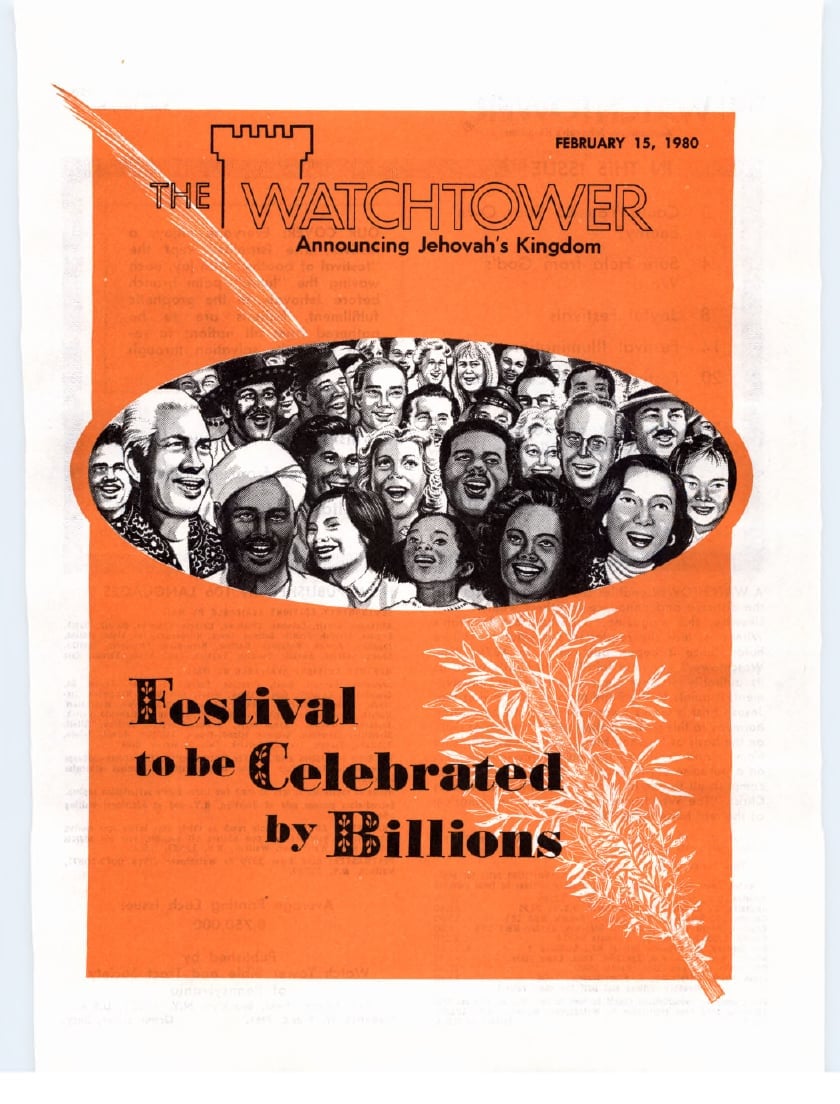
OUR COVER: Everyone enjoys a festival. The Israelites kept the "festival of booths" with joy, each waving the "lulab" palm branch before Jehovah. In the prophetic fulfillment, billions are to be gathered from all nations to rejoice in God's salvation through Christ
29 What Was "an Alabaster Case"?
30 Insight on the News
31 Questions from Readers
32 'Altar to an Unknown God'
A WATCHTOWER enables a person to look far into the distance and announce to others what is seen. Likewise, this magazine, published by Jehovah's Witnesses, aids the reader to see what the future holds. Since it began publication in 1879, "The Watchtower" has held faithfully to God's Word as its authority. It stays clear of all political involvement. It points to the Bible prophecies showing that Jesus Christ is God's means for restoring peace and harmony to this globe. It shows that this Son of God, on the basis of his shed blood, will release mankind from sin and death to enjoy eternal life in happiness on a paradise earth. Because Jehovah God will accomplish all this soon through his kingdom by Jesus Christ, "The Watchtower" announces that kingdom as the real hope for mankind.
Copyright © 1980 by Watch Tower Bible and Tract Society of Pennsylvania. All rights reserved.
Ten cents (U.S.) a copy
Yearly subscription rates for small
America, U.S., Watch Tower, Wallkill, N.Y. 12389
$2.50 Australia, 11 Boreen Road, Strathebald, N.S.W. 2135
$2.50 Canada, 150 Bridgeway Ave., Toronto, Ontario M6A 125
$3.00 England, Watch Tower House, The Ridgeway, London W7 1RN
$3.00 New Zealand, G-A Western Springs Rd., Ackland 3
N23.00 Nigeria, West Africa, P.O. Box 194, Yabua, Lagos State
N24.00 Philippines, P.O. Box 204, Akuana 2800
F17.50 South Africa, P.O. Box 143, Elandfontein, 3406
Remitances for subscription should be sent to the above rates.)
U.S.A. Printed in U.S.A.
NOW PUBLISHED IN 106 LANGUAGES
SEMIMENTUMLY EDITIONS AVAILABLE BY MAIL
Austria, Crown Court, Dublin, Dublin
Armenian, Beagil, Bicol, Criatian, Czech, Ehc, Ewr, Fijian, Gan,
Greenland, Gianjari, Gujarat, Gan, Hewind, Hindi, Hiru, Mato, Ganand,
Icelandic, Kannada, Khlonga, Khluga, Khluba, Lingala, Malayalam,
Malawi, New Guirae Ponga, Pampanga, Pangasian, Pagalene, Polish,
Pakistan, Punjab, Pakistan, Punjab, Pakistan, Punjab, Pakistan,
Sinhalese, Slovenian, Solomon Islands-Pidgin, Tahitian, Tamil, Telebi,
Tslibaia, Tsonga, Tswana, Tsurk, Twi, Uruda
The Bible translation used in "The Watchtower" is the modern-language "New World Translation of the Holy Scriptures," unless otherwise indicated.
Notice of expiration is sent at least two issues before subscription expires.
Second-class postage paid at Brooklyn, N.Y. and at additional mailing offices.
CHANGES OF ADDRESS should reach us thirty days before your moving date. Give us your old and new address (if possible, your old address label). Write Watchtower, Wallkill, N.Y. 12589, U.S.A.
POSTMASTER: Send Form 3579 to Watchtower (ISSN 0043-1087),
Waltkill, M.Y. 12589.
Average Printing Each Issue:
8,750,000
Published by
of Pennsylvania
117 Adams Street, Brooklyn, N.Y. 11201, U.S.A.
Frederick W. Franz, Pres.
Grant Suiter, Secy.
Could You Be Your Own Enemy?
"A calm heart is the life of the fleshy organism, but jealousy is rottenness to the bones."—Prov. 14:30.
A WOMAN began experiencing serious hearing problems. Her personal physician was unable to find anything that pointed to an organic cause. Why was she going deaf? Because of frequent loud arguments with her daughter, she simply had begun to tune out sounds. In this way, she apparently sought to defend herself against an unpleasant situation. Once she recognized the problem, her hearing returned to normal.
A 29-year-old man began feeling pain around his heart. For a period of 10 years the discomfort persisted and intensified. This occurred despite considerable medical care and extensive periods of rest. The health problem interfered with his work and deprived him of happiness.
Did he actually have heart trouble? No. At the age of 21, he had contracted a serious illness from which he had recovered completely. However, based on personal reading and the comments of others, he had become convinced that the illness had brought on a heart condition. As a result, although he had no organic disease, he suffered from the symptoms just described. Later, when he received professional help that came to grips with his emotional problem, the man's pain disappeared and he began leading a productive life.
As a member of a family in which back problems were common, a young woman
began experiencing backaches. She became deeply troubled about this but was afraid to go to a doctor, expecting the worst. The more she worried, the greater the pain became. Finally, she went to a physician, only to be told that he could not find any reason for the problem. What was wrong? The initial backache started when this woman received heavier responsibility in connection with her job. She became concerned about possible failure. Then the worry over the pain worsened the backache. After coming to realize the source of the difficulty, this woman stopped being anxious about it, and the pain ceased.
These are but a few of many examples illustrating that emotional factors can have a strong bearing on an individual's physical well-being. Without even realizing it, a person may be his own enemy. According to the Encyclopedia Americana (1977 edition, Vol. 22, p. 732), "an estimated 50\% of all medical patients have illnesses that can be classified as wholly or partly psychosomatic," that is, "precipitated or sustained by emotional factors." The heart seems to be especially susceptible to emotional stress.
Not until the 20th century have physicians come to accept the view that emotional problems may be at the root of many ailments. However, the Maker of man, Jehovah God, revealed this in his Word, the Bible.
For example, therein we read: "A calm heart is the life of the fleshy organism, but jealousy is rottenness to the bones." (Prov. 14:30) While a calm spirit has a wholesome effect on the heart, the
harboring of jealousy toward others can be destructive to a person's physical frame.
Since certain emotional factors can be injurious, we need to keep them in check. Acting in harmony with the Scriptures can help us. But how?
Sure Help From God's Word
off off off off off off off off off off off off off off off off off off off off off off off off off off off off off off off off off off off off off off off off off off off off off off off off off off off off off off off off off off off off off off off off off off off off off off off off off off off off off off off off off off off off off off off off off off off off off off off off off off off off
APERSON needs strong motivation to resist yielding to damaging emotions. The Bible does provide such motivation, aiding the individual to deal successfully with feelings of guilt, jealousy, anxieties over making a living and a host of other emotional factors that could be injurious to health.
DEALING WITH GUILT FEELINGS
Often, feelings of guilt cause or aggravate certain ailments. A person may have become involved in conduct that troubles his conscience. His experience may be like that of David, an Israelite king who lived about 3,000 years ago. Describing the effect of his guilt feelings, David
wrote: "My bones wore out through my groaning all day long. . . . My life's moisture has been changed as in the dry heat of summer." (Ps. 32:3, 4) These words suggest that David's efforts to suppress the naggings of a guilty conscience made him weary. Like a tree deprived of needed moisture during a drought or a very hot, dry summer, David was sapped of his strength or vitality. How did he gain relief?
He made complete confession of his sins to God and, in faith, accepted divine forgiveness. That is why David could write: "Happy is the one whose revolt is pardoned, whose sin is covered. Happy is the man to whose account Jehovah does not put error."—Ps. 32:1, 2.
The Bible reveals that anyone who turns to God in sincere repentance, on the basis of the sin-atoning sacrifice of Jesus Christ, can be forgiven his sins.
The Christian apostle John wrote: "If we confess our sins, he is faithful and righteous so as to forgive our sins and to cleanse us from all unrighteousness. . . [Jesus Christ] is a propitiatory sacrifice for our sins, yet not for ours only but also for the whole world's."—1 John 1:9; 2:2.
Of course, if a person does not believe that God has forgiven his sins, he will continue to experience the hurtful effects of a troubled conscience. Hence, it is vital that the individual strengthen his faith in God's willingness to forgive sins. This he can do by reviewing what the Bible says about divine forgiveness and the persons whose transgressions were pardoned.
For instance, the Israelites were told: "Though the sins of you people should prove to be as scarlet, they will be made white just like snow; though they should be red like crimson cloth, they will become even like wool." (Isa. 1:18) Since the Most High was willing to forgive the sordid acts of unfaithful Israelites, we can rest assured that he will grant similar pardon to sincerely repentant ones today. The Bible tells us: "I am Jehovah; I have not changed."—Mal. 3:6.
Consider another example. King Manaseh "did on a large scale what was bad in Jehovah's eyes, to offend him. And there was also innocent blood that Manasseh shed in very great quantity, until he had filled Jerusalem from end to end." (2 Ki. 21:6, 16) Later, he was taken captive to Babylon. This bitter experience brought Manaseh to the point of humbling himself before God. The Most High granted forgiveness to the repentant king and "restored him to Jerusalem to his kingship." (2 Chron. 33:11-13) Few persons have made as bad a record of sin as did Manaseh. Yet, because he was repentant, he
was forgiven. What encouragement this can give to individuals who are plagued with feelings of guilt!
Another case in point is that of the man who became the Christian apostle Paul. Before his conversion, he was "a blasphemer and a persecutor and an insolent man." (1 Tim. 1:13) "Nevertheless," Paul wrote, "the reason why I was shown mercy was that by means of me as the foremost case Christ Jesus might demonstrate all his long-suffering for a sample of those who are going to rest their faith on him for everlasting life." (1 Tim. 1:16) How faith-strengthening it is to contemplate what God, through Christ, did in connection with Paul! Though he had viciously persecuted Christ's followers, had acted in an arrogant manner against them and had blasphemed God unknowingly, Paul was forgiven when he repented. Thereafter he was used marvelously in aiding others to become Christians and in strengthening fellow believers. Moreover, he had the inestimable privilege of writing more of the inspired Christian Scriptures than any other man.
Individuals may at times feel condemned at heart, fearing that their sins are just too bad to be pardoned. Nevertheless, what the Bible states provides a firm basis for faith in God as the Forgiver of sins. This is forcefully expressed in the following statement of the apostle John: "We shall assure our hearts before him as regards whatever our hearts may condemn us in, because God is greater than our hearts and knows all things." (1 John 3:19, 20)
``` What fine relief from guilt feelings can confidence in these inspired words mean for us!
RESISTING JEALOUSY
Besides feelings of guilt, bitter jealousy toward others may cause or aggravate a physical affliction. Jealousy may prevent a person from sleeping, may cause certain muscles to be tense and painful, and may lead to digestive troubles or other health problems. As the Bible can help a person to be freed from destructive guilt feelings, it can also aid him to overcome jealousy or deep resentment. First, though, the individual must recognize that he does have a problem with harboring feelings of resentment.
According to the Bible, the quality of love is needed in order to triumph over jealousy. The Scriptures tell us that "love is not jealous." (1 Cor. 13:4) To overcome resentment, we need to accept and act in harmony with this Bible truth. We may find it helpful to put forth the effort to become better acquainted with those whom we may resent, striving to see their good qualities. Clearly, no individual can do everything, and all persons have faults. Hence, we wisely exercise care not to overrate our own abilities, appreciating that much can be done when, instead of just one person, many qualified people can give of their abilities and knowledge in doing worthwhile work.
The Bible makes it clear that we depend on others. Using the human body as an illustration of what should be true of the Christian congregation, the apostle Paul wrote: "For the body, indeed, is not one member, but many. If the foot should say: 'Because I am not a hand, I am no part of the body,' it is not for this reason no part of the body. And if the ear should say: 'Because I am not an eye, I am no part of the body,' it is not for this reason
no part of the body. If the whole body were an eye, where would the sense of hearing be? If it were all hearing, where would the smelling be? But now God has set the members in the body, each one of them, just as he pleased." (1 Cor. 12:14-18) In harmony with these words, we do well to think about what we can do to build up others instead of looking with envy upon their abilities, standing or accomplishments.
Individually, we have nothing over which to boast. We did not give ourselves the capacity for developing certain talents or abilities. The Scriptures set matters in a proper perspective, saying: "For who makes you to differ from another? Indeed, what do you have that you did not receive? If, now, you did indeed receive it, why do you boast as though you did not receive it?" (1 Cor. 4:7) Furthermore, what really counts is not our abilities but the kind of persons we are. Of what value are exceptional talents if the possessor of them is rude, selfish and hateful? So, rather than giving in to feelings of jealousy, we do well to follow the Bible's encouragement to pursue the way of love, proving ourselves to be persons who willingly and eagerly respond to the needs of fellowmen. (1 Cor. 14:1) It would surely be unwise to harbor jealousy, thereby jeopardizing our physical well-being and failing to be the kind of persons who could be a source of uplift and encouragement to others.
AVOIDING UPSETS OVER INJUSTICES
It is not easy to endure being made the victim of injustice or to be powerless when seeing fellow humans subjected to oppression or exploitation by corrupt men. This can cause damaging emotional upsets. Here, too, what the Bible says can be an aid in avoiding the inner upheavals that can be injurious to health.
The Scriptures make it plain that often there is little that we can do.
So many things are defective in the world that man simply cannot straighten out everything. The Bible is very realistic in telling us: "That which is made crooked cannot be made straight, and that which is wanting cannot possibly be counted." (Ecel. 1:15) A person's getting upset over the injustices that may be committed by others does nothing to alter the situation or relieve the problem for anyone. Of course, if we can further the cause of justice in a positive way, this would certainly be proper. We would not want to close our eyes callously to needless human suffering.
However, in the case of situations that must simply be accepted and endured, we can take comfort in the Bible promise that Jehovah God will set all matters straight. Regarding a future day of reckoning, the Scriptures tell us that 'God through Christ Jesus will judge the secret things of mankind.' (Rom. 2:16) Because there is a day of judgment, no injustice that we may experience in this world can result in permanent harm. When we have faith that the Creator will set all things straight, we spare ourselves many serious emotional upsets.
WORRIES ABOUT MAKING A LIVING
For many people, worry over making a living is a tremendous burden. This burden can be so great that it leads to serious health problems. In this regard, what helpful counsel does the Bible offer? "Never be anxious and say, 'What are we to eat?' or, 'What are we to drink?' or, 'What are we to put on?'" said Jesus Christ. "For all these are the things the nations are eagerly pursuing. For your heavenly Father knows you need all these things. Keep on, then, seeking first the kingdom and his righteousness, and all these other things will be added to you. So, never be anxious about the next day, for the next day will have
its own anxieties. Sufficient for each day is its own badness."—Matt. 6:31-34.
Surely, no amount of anxiety or worry will make it easier for us to make a living. Each day, as the Bible says, has "its own badness," its own problems. There are enough problems in one day without worrying about difficulties that might crop up the next day. Jehovah God will not let those loving him suffer needlessly or purposelessly, but he will respond to our requests for aid. If we continue to exercise faith in God as a Provider while doing our part in procuring the necessities of life through honest work, we will have what we need. Our experience will be like that of David, who wrote: "A young man I used to be, I have also grown old, and yet I have not seen anyone righteous left entirely, nor his offspring looking for bread." —Ps. 37:25.
TURN TO THE BIBLE
Regardless of what kind of pressure or stress you may face, there is information in the Bible that can aid you. Therefore, examine the Scriptures, making their superb guidelines a working part of your fund of knowledge. Then, by applying Bible principles in your daily life, you can continue to enjoy a good conscience and can resist yielding to emotions that could injure your health. More importantly, you will be walking in the way that leads to an eternal future. "He that does the will of God remains forever."—1 John 2:17.
Joyful Festivals
"You must become nothing but joyful."-Deut. 16:15.
WHO is there that does not enjoy a festival? Throughout the centuries the peoples of earth have enjoyed festivals. This was true of the people who got their national laws from man's Creator through his prophet Moses. But their festivals were different; they were prophetic of good things to come. Joyfulness
is likewise the portion of the modern-day counterpart of those ancient celebrators in the Middle East, for these enter into the fulfillment of those prophetic festivals. From the standpoint of the Sacred Bible, these present-day celebrators are spiritual Israelites, and they prove to be the happiest people on the face of the earth.
2 In the inspired books written by Moses, three festivals were provided for. In this fifth book, entitled Deuteronomy, chapter 16, verse 16, we read: "Three times in the year every male of yours should appear before Jehovah your God in the place that he will choose: in the festival of the unfermented cakes and the festival of weeks and the festival of booths, and none should appear before Jehovah empty-handed."
you." At the time those words were spoken, the Israelites were living in tents, on their way to the Promised Land of Canaan.
FESTIVAL OF UNFERMENTED CAKES
4 The first of the annual festivals, that of unfermented cakes, was held right after the observance of the Passover supper on
"Verse 17 says: "The gift of each one's hand should be in proportion to the blessing of Jehovah your God that he has given
Sheaf of firstfruits from the barley harvest pictures resurrected Jesus
Abib or Nisan 14. The festival of unleavened cakes was held for seven days, from Nisan 15 to and including Nisan 21. The first day of this festival was the Sabbath day that followed the keeping of the Passover supper.
On the second day of the festival, or Nisan 16, the Israelite high priest at Jehovah's temple in Jerusalem would offer to Him a sheaf from the newly ripened barley harvest.—Lev. 23:11-16.
3 There is a historic account of a 12-year-old male who was taken from Nazareth to Jerusalem to celebrate the Passover. The boy was Jesus, the son of Mary. Eighteen years later, in 29 C.E., that male Israelite, now the Lord Jesus Christ, be-
rowed at what seemed to them to be the permanent loss of their Leader. But on the next day, Sunday, Nisan 16, their sorrow was turned to a rejoicing that was not equaled by that of the Jews celebrating the festival.
Why so? Because their Leader, Jesus Christ, was resurrected from the dead by the almighty power of his heavenly Father, Jehovah. Interpreting what this meant, the Christian apostle Paul, when writing about
came the "Lamb of God," which was typified by the Passover lamb. (Luke 2:41-52; John 1:29-37) Three and a half years later he was actually sacrificed on a tree at Calvary, outside Jerusalem, on Friday,
the resurrection, said: "Now Christ has been raised up from the dead, the first-fruits of those who have fallen asleep in death." (1 Cor. 15:20) Thus the sheaf of firstfruits from the barley harvest that the
Jewish high priest at the temple waved before Jehovah on Sunday, Nisan 16, pictured an individual, the resurrected Lord Jesus Christ, the first to be resurrected out of death
Two symbolic loaves have Jehovah's recognition in heaven from Pentecost
Nisan 14, 33 C.E. That Friday night Nisan 15 began, and along with it the festival of
receded out of death completely to life eternal. So he alone was the one who could be called "the firstfruits of those who have fallen asleep in death." This miracle marked the second day of the festival.
7 During the seven days of the festival, no leaven was to be found in any quarters of the Jews, because
the unfermented cakes, but Jesus himself did not join in the rejoicing that marked such an occasion. He was dead and buried. Whereas the Jews in general at Jerusalem rejoiced at the start of their festival, the disciples of Jesus did not do so. They sor-
leaven represented that which is out of harmony with God, sin. This festival really memorialized that, because of having to leave Egypt in haste, the Israelites did not
have enough time to let their dough be leavened.
Hence, they had to eat unleavened bread, just as they had done on Passover day.—Ex. 12:11-34; Deut. 16:2-4.
8 Just as the festival of unfermented cakes followed the Passover and lasted for seven days, so the antitype of this festival must follow the sacrifice of the "Lamb of God," Jesus Christ, on Friday, Nisan 14, 33 C.E. Since the number of days of the festival, seven, pictures perfection, completeness, so the antitypical festival has continued on down through the centuries until now, and those Christians who are spiritual Israelites, Jews inwardly, are obligated to observe it. In 1 Corinthians 5:6-8, the apostle Paul refers to the antitypical festival as he writes:
9 "Do you not know that a little leaven ferments the whole lump? Clear away the old leaven, that you may be a new lump, according as you are free from ferment. For, indeed, Christ our passover has been sacrificed. Consequently let us keep the festival, not with old leaven, neither with leaven of badness and wickedness, but with unfermented cakes of sincerity and truth."
10 That was written about 55 C.E., or 22 years after Christ's sacrificial death. Today, the spiritual Israelites who read those words of the apostle Paul more than 19 centuries later are duty-bound to keep the antitypical festival, namely, with sincerity and truth. As the anointed remnant of spiritual Israelites do so, they can catch the spirit of the ancient typical festival and be "nothing but joyful." Why? Because the faithful observance of the antitypical festival makes for a clean, theocratic organization on which Jehovah can express his approval.
FESTIVAL OF WEEKS
11 The second of the obligatory festivals of ancient Israel was the festival of weeks. Why was it called so? For the reason that the Israelites were to count seven weeks from Nisan 16, the day that their high priest presented to Jehovah the sheaf of newly ripened grain as the firstfruits from the barley harvest. This count of time would run up to 49 days, and on the 50th day they were to celebrate the festival of weeks. In the Greek language into which a group of Jews translated their Bible, the word for 50th (day) is pentecoste'. Hence, the Greek-speaking Jews called the festival of weeks Pentecost. What was to be featured on this day?
12 In answer, Leviticus 23:15-21 says: "And you must count for yourselves from the day after the sabbath, from the day of your bringing the sheaf of the wave offering, seven sabbaths. They should prove to be complete. To the day after the seventh sabbath you should count, fifty days, and you must present a new grain offering to Jehovah. Out of your dwelling places you should bring two loaves as a wave offering. Of two tenths of an ephah of fine flour they should prove to be. . . And the priest must wave them to and fro along with the loaves of the first ripe fruits, as a wave offering before Jehovah, along with the two male lambs. They should serve as something holy to Jehovah for the priest. And you must make a proclamation on this very day; there will be a holy convention for yourselves. No sort of laborious work may you do. It is a statute to time indefinite in all your dwelling places for your generations.'"
13 This prophetic festival of weeks, or Pentecost, was fulfilled upon the congregation of Jesus' disciples at Jerusalem on the 50th day counted from his resurrection from the dead.
So the antypical festival of weeks, or Pentecost, began to go into effect on the sixth day of the third lunar month, that is, on Sivan 6, of the year 33 C.E. At that time the glorified Jesus Christ was in the Most Holy of Jehovah's great spiritual temple, namely, in the personal presence of Jehovah in heaven, to which he had ascended on the 40th day from his resurrection. While the Jews were celebrating the typical festival of weeks, or Pentecost, at Herod's temple in Jerusalem, about 120 disciples of the spiritual High Priest, Jesus Christ, were met together in an upper room in that city. Then, before the third hour of the day (9 a.m.), the Lord Jesus Christ poured down holy spirit from the Most Holy of Jehovah's spiritual temple. This resulted in their being spiritually begotten by their heavenly Father, Jehovah, and their being anointed with holy spirit by means of their High Priest, Jesus Christ. (Acts 2:1-36) Thus the two symbolic loaves of fine flour got Jehovah's recognition in heaven, in his Most Holy. —Heb. 9:24.
14 In the typical festival of weeks, or Pentecost, why were two loaves made of grain from the newly ripened wheat harvest presented to Jehovah? This typified that there would be more than one individual involved in the fulfillment. The two typical wheat loaves were baked with leaven. This indicates that those upon whom the fulfillment of the festival is realized are leavened with sin, by natural birth, which was the case with the 120 disciples of the sinless Jesus, waiting in Jerusalem on Sunday, Sivan 6, 33 C.E. There being two loaves may also indicate that those who become spirit-begotten, anointed disciples of the Messiah Jesus
would be taken from two groups on earth, first from the natural circumcised Jews and later from all the other nations of the world, the Gentiles. Together, the two groups would constitute one antitypical wave offering to Jehovah.—Eph. 2:13-18.
15 Looked at from the latter viewpoint, the first of the antitypical loaves, as meaning the circumcised Israelites, was presented by the High Priest Jesus to Jehovah God right on time, on Sivan 6, which was the same day when the Jewish high priest waved the two typical loaves before Jehovah in Herod's temple in Jerusalem. As those two wheat loaves were no longer necessary as a type, Jehovah did not recognize them, and so the Jews celebrating at Herod's temple did not receive the gift of the holy spirit. Those Jews who wanted to realize the fulfillment of Joel 2:28, 29 upon them had to come away from that typical temple and get in touch with the 120 disciples of Christ upon whom the prophecy had already come true. Thus about 3,000 of them became part of the antitypical wave loaf on that twofold day of Pentecost, 33 C.E.
10 The second symbolic loaf, as meaning the Gentiles, or non-Jews, began to be waved before Jehovah later with the admission of the believing Samaritans to the Christian congregation and afterward the admission of the uncircumcised Gentiles
or peoples of the nations in general.
This latter is understood to have taken place in autumn of 36 C.E. (Acts, chaps. 8 and 10). The two antitypical loaves have been undergoing completion during these past 19 centuries. The facts show that some have been added to be part of the "loaves" in recent times, these having been prefigured by Ruth the Moabitess and ancestress of Jesus Christ and by Queen Esther, the cousin of the Jew Mordecai who became the prime minister of the Persian Empire.—See the book Preservation, published in the year 1932 and reproducing the material in the series of articles appearing in the Watchtower issues of 1931 and 1932.
17 The completing of the membership of the two antitypical Pentecostal loaves during the now more than 1,900 years has been a cause for great rejoicing on the part of those spiritual Israelites celebrating the antitypical festival of weeks. Just as the two typical loaves represented the first-fruits in the harvest month of Sivan, so those making up the antitypical loaves are firstfruits to Jehovah God through Jesus Christ, since they take precedence over the rest of the world of mankind, getting a heavenly inheritance as the first benefits of the sacrifice of the "Lamb of God."—Jas. 1:18; Rev. 14:4.
FESTIVAL OF BOOTHS
18 The final great festival of the Jewish sacred year occurred in the seventh month, the month of Ethanim, or Tishri. (1 Ki. 8:2) It was outstanding in certain respects. Most frequently it was called the festival of booths, but two times it is called the festival of ingathering. (Ex. 23:16; 34:22) For instance, Exodus 23:16, 17 states:
"Also, the festival of harvest of the first ripe fruits of your labors, of what you sow in the field; and the festival of ingathering at the outgoing of the year, when you gather in your labors from the field. On three occasions in the year every male of yours will appear before the face of the true Lord, Jehovah." Also, Exodus 34:22 speaks of "the festival of ingathering at the turn of the year." Deuteronomy 16:13-15 mentions it as the festival of booths and says: "The festival of booths you should celebrate for yourself seven days when you make an ingathering from your threshing floor and your oil and winepress. And you must rejoice during your festival, you and your son and your daughter and your man slave and your slave girl and the Levite and the alien resident and the fatherless boy and the widow, who are inside your gates. Seven days you will cele-
brate the festival to Jehovah your God in the place that Jehovah will choose, because Jehovah your God will bless you in all your produce and in every deed of your hand, and you must become nothing but joyful."
19 For the most part, this festival is called "the festival of booths." During its seven days the Jews who were assembled at Jerusalem dwelt in booths or tabernacles, true to the name of the celebration. It began five days after the Day of Atonement, which took place annually on Tishri 10 and by which the nation of Israel was restored to peaceful relations with Jehovah God. So the festival of booths began at a most propitious time, and lasted from Tishri 15 to Tishri 21, a complete number of days.
20 It was without equal in the rejoicing that marked it. According to historical records, at daybreak of each festival day a priest would take a golden pitcher that could contain three log measures, or two pints, of liquid and he would descend from Jerusalem down to what came to be called the Pool of Siloam. Those of our readers who have visited today's Jerusalem will recall how, when they left the city by the Dung Gate at its southeast corner, they came down to what was called the Virgin's Well, or the Well of Gihon. From this well, King Hezekiah dug a tunnel during the threat of an Assyrian invasion. Stouthearted visitors will recall how, after feeling their way through the darkness of this tunnel for some time, they came out into the Pool of Siloam.
21 Not through Hezekiah's tunnel, but followed by a great procession, including a
band of musicians, the priest with the golden pitcher would go to the Pool of Siloam. After filling the pitcher with water, the priest would return to the city and would go to the courtyard where Jehovah's altar of sacrifice was situated. On the altar's southern side two basins had been installed, each with a hole at the bottom. The basin at the altar's southwest corner was for the water from the Pool of Siloam. When the priest poured in the water, it would flow through and fall at the altar base. On this occasion the observing Jews rejoiced greatly. This may have reminded the joyful celebrators of Isaiah, chapter 12, which describes the pleasure experienced by the Israelites on being released from exile in Babylon in 537 B.C.E. Isaiah 12:3 says: "With exultation you people will be certain to draw water out of the springs of salvation."
22 Jehovah God was the heavenly Source of their salvation. He was the One who delivered their forefathers from the 70 years of exile in pagan Babylon where they had thirsted for salvation to come after Babylon's overthrow in 539 B.C.E. (Isa. 44:28 through 45:7; Jer. 2:13) The remembrance of this deliverance was a cause for rejoicing during the festival of booths. An ancient Jewish proverb says: 'He who has never seen the rejoicing at the pouring out of the water of Siloam has never seen rejoicing in his life.'
Festival Illumination
THE festival of booths was an occasion for special illumination of "the city of the great King," Jehovah. (Matt. 5:35) Nightly in Herod's temple, in the Courtyard of the Women that lay to the east of the altar, there was an unusual display. Four giant candelabra were installed there. Each had four large basins. In order to fill the basins with combustible oil, ladders had to be used to reach them. Castaway garments of the priests were used as wicks for the basins of oil. The light cast by these 16 basins of burning oil was strong enough to illuminate all Jerusalem by night. Under this magnified illumination, the Israelite men in the Courtyard of the Women would dance or do acrobatics, while the womenfolk looked down upon the scene from their balcony. Singers entoned the 15 Psalms of Ascent to musical accompaniment by the Levites. This rejoicing kept on till daybreak.
2 Uncircumcised Gentiles attending the festival were restricted to the Courtyard of the Gentiles, separated from the Courtyard of Israel by the Stone Barrier and the Outer Courtyard.—Note Acts 21:28, 29, to illustrate restrictions on Gentiles at the temple.
3 In view of the prominent features that were added to the celebration of the festival of booths, we can appreciate some pertinent remarks of Jesus Christ at the festival. He celebrated this festival for the last time in the autumn of 32 C.E. Because Jews at Jerusalem were seeking to
kill him, Jesus left Galilee by himself and went up inconspicuously to the festival. About the middle of it, say, Tishri 18, he stood forth openly and began to teach the people, the throngs of celebrators in the temple.
4 The last day of the festival, Tishri 21, was called "the great day of the festival." On that day Jesus likely reminded the people of the pouring out of the water of Siloam when he said: "If anyone is thirsty, let him come to me and drink. He that puts faith in me, just as the Scripture has said, 'Out from his inmost part streams of living water will flow.'" On what Jesus there said, the apostle John makes this comment: "However, he said this concerning the spirit which those who put faith in him were about to receive; for as yet there was no spirit, because Jesus had not yet been glorified."—John 7:37-39.
Those marvelous words began to come true on the day of Pentecost of the following year, when about 120 disciples, assembled in an upper room in Jerusalem, received the outpouring of the holy spirit. From them, indeed, streams of living water began to flow forth when, in many miraculously given languages, they spoke "the magnificent things of God" to the astonished thousands of Jews that gathered together to witness the spectacle.—Acts 2:1-41.
On the seventh and last day of the festival of booths, Jesus made a further remark that may have reminded his disciples of the special illumination that featured the celebration, namely, that of the four tall candelabra in the temple's Courtyard of the Women.
Jesus said: "I am the light of the world. He that follows me will by no means walk in darkness, but will possess the light of life."—John 8:12.
7 Jesus' calling himself "the light of the world" was very appropriate at this festival of booths, inasmuch as the festival took on the characteristics of a world festival. How so? Because in God's law the "alien resident" within the gates of the Israelites was named as having the right to take part in the festival, with rejoicing along with God's chosen people. —Deut. 16:14.
8 According to Numbers 29:12-34, an unusual number of bulls were offered in sacrifice. On the first day 13 bulls were offered, and on the succeeding six days one less bull was offered each day, down to seven bulls offered on the seventh and last day, on which day Jesus said: "I am the light of the world." Thus by the last day of the festival 70 bulls had been offered up. The number 70 is a multiple of 7 and 10, both of these numbers representing completeness, perfection, 7 spiritual perfection and 10 secular completeness. On Tishri 10, the Day of Atonement, only one bull had been offered up as an atonement sacrifice. But during the seventy festival of booths, Tishri 15-21, 70 bulls were offered. As a type, these would provide enough blood for the cleansing and salvation of the whole world of mankind. This corresponds with what is set out in Genesis chapter 10. There the personal names of family heads and of nations are given, beginning with Noah and running down through his three sons to the names Mesha and Sephar. These amount to 70 designations, and they appear to cover
the world population of that post-Flood period.
So, at the suitable time, it was most fitting for Jesus Christ to announce, "I am the light of the world," not merely the light of his anointed footstep followers. As regards the benefit of light, we remember that it was after God said, "Let light come to be," and after he created the sun, the moon and the stars and made it possible for them to beam light down upon our earth, that he created animals and finally the perfect man and woman, to enjoy the light of life. Today, in this world bedarkened by sin and alienation from God, all persons stand to benefit from the light that streams forth from Jesus Christ, "the light of the world." All of them need "the light of life."—John 8:12; Gen. 1:3.
ANTITYPICAL FESTIVAL OF BOOTHS
10 Like the two preceding festivals ordained by God for his chosen people, the festival of booths should have an antitypical meaning for our times. Happily it does have an antitypical fulfillment. Well, then, when did this begin? How are we to determine this? By means of factors typical and antitypical, historical.
11 In Matthew, chapter 13, Jesus Christ gave us a parable in which the ingathering of the fruiture of the field was featured. This was the parable of the wheat and the weeds or tares (darnel). In explaining the features of the parable, Jesus said: "The harvest is a conclusion of a system of things." (Matt. 13:39) Bible prophecy and timetables, as well as historical events, establish that the conclusion of today's system of things began in 1914 C.E., in the autumn of which year "seven times" ended for Gentile domination of the earth without interference by God's Messianic kingdom.
(Dan. 4:23-25) Did the "harvest" or ingathering of the "wheat" class of true Christians begin in that year? No, because history shows that Jehovah's dedicated Christian worshipers were dispersed during World War I that began in 1914. Their worldwide organization was broken up by the enemies of Jehovah's Messianic kingdom, the heavenly kingdom that was zealously being proclaimed by those spirit-begotten, anointed disciples of Jesus Christ, the reigning King. The organizational breakup finally reached even the headquarters of Jehovah's dedicated people in Brooklyn, New York, U.S.A., in 1918.
12 In Jesus' prophecy on the "sign" of his presence and of the conclusion of this system of things, he said, in Matthew 24:31: "And he will send forth his angels with a great trumpet sound, and they will gather his chosen ones together from the four winds, from one extremity of the heavens to their other extremity." Those words foretold a gathering together of Christ's "chosen ones" from all the places to which they had been scattered or isolated. This gathering began taking place in the postwar year of 1919, immediately after members of the headquarters staff of the Brooklyn center were released, after suffering nine months of imprisonment in the federal penitentiary in Atlanta, Georgia, U.S.A., on March 25, 1919. Thus it was in that memorable year that the antitypical festival of ingathering, or of booths, started going into effect. This was marked by tremendous joy on the part of the anointed remnant of Christ's "chosen ones" world wide.
13 To confirm this, we must recall a number of weighty things. When Jesus said,
"The harvest is a conclusion of a system of things," about what was he talking? About the ingathering of "the sons of the kingdom," that is to say, the spirit-begotten heirs of the heavenly kingdom. That is a spiritual anointed class, symbolized by the wheat, and their ingathering did indeed start in the spring of 1919. In course of time more were gathered in besides those heirs of the Kingdom who were scattered by World War I events. In the period from 1919 onward thousands of others took their stand for God's established kingdom and dedicated themselves to Jehovah, got baptized, were begotten spiritually and were anointed with God's spirit, and these were added to the ranks of the original remnant. These newly added ones were, as a class, prefigured by outstanding characters in pre-Christian Bible dramas. These illustrious characters were Ruth the Moabitess, who became the loyal companion of the Jewess Naomi, her mother-in-law, and also Queen Esther, the cousin of the Jew Mordecai, who became the prime minister of the Persian Empire under Emperor Ahasuerus, or Xerxes.
14 Both Ruth and Esther became connected with the royal line of David and with its preservation down to the first coming of Jesus, the "son of David." (Matt. 1:1, 5; Ruth 4:18-22; Esther 4:13, 14) The gathering in of the Ruth and Esther class, along with the original anointed remnant, marks the opening of the antitypical feast of ingathering, or of booths.
13 Another thing: In pre-Christian times it was the natural Jews who celebrated the typical festival of booths. They were the ones commanded by Jehovah through Moses to celebrate it. So at the time of the autumn ingathering they flocked to Jerusalem and dwelt there in booths. Even
the permanent residents of Jerusalem did so.
This festival of booths was a reminder of something earlier. What? Leviticus 23: 42, 43 answers, saying: "It is in the booths you should dwell seven days. All the natives in Israel should dwell in the booths, in order that your generations may know that it was in the booths that I made the sons of Israel to dwell when I was bringing them out of the land of Egypt. I am Jehovah your God." Native Jews did so.
16 Of course, the "vast mixed company" of non-Israelites that threw in their lot with the Israelites and "went up with them" had to dwell in tents also on the way to the Promised Land. (Ex. 12:38) But the command to celebrate the festival of booths was not directed to the "vast mixed company" but was given to Israel. Neither was the Promised Land given to the "vast mixed company" to cultivate, but was divided up among the 12 non-Levitical tribes of Israel, and the law of the Jubilee restoration of land applied to the Israelites. So the festival of ingathering would be specially for the Israelites. Graciously the "alien resident" was allowed to join in. During the celebration in the days of Jesus Christ, the non-Jews, or Gentiles, were limited to the Courtyard of the Gentiles, the Stone Barrier and the Outer Courtyard dividing them off from the Courtyard of Israel. Their place was on the lowest level of the entire structure of Herod's temple.
THE CELEBRATORS WHO CARRIED THE BRANCHES
17 In the celebration itself it was the Israelites who carried the so-called "lulabs" and the ethrogs (citrons). To gain some idea of what it must have been like in
Jesus' day, we may read the description of the Jewish celebration as given in Nehemiah 8:14-18. The lulab was a cluster of branches from various trees and was carried in the hand of the Jewish celebrator. The idea of it is said to be drawn from Leviticus 23:40:
18 "And you must take for yourselves on the first day the fruit of splendid trees, the fronds of palm trees and the boughs of branchy trees and poplars of the torrent valley, and you must rejoice before Jehovah your God seven days."
19 The components of the lulab were (1) a shoot of the palm tree in its folded state, (2) three twigs of the myrtle with whorls of leaves in these, and (3) two willow-tree branches, the wood of which is reddish and the branches of which are long and entire. The Israelites carrying the lulabs waved them and disposed of them at the close of the festival. The lulab and the ethrog (a citrus fruit like a lemon but without the nipple that the lemon has at one end) were carried in procession around the altar in the Courtyard of Priests, with one circuit on each of the first six days and seven circuits on the seventh and last day. After that the ethrog, or citron, was eaten. Along with the procession, Psalm 118:25 would be chanted: "Ah, now, Jehovah, do save, please! Ah, now, Jehovah, do grant success, please!" Gentiles, in their own courtyard, could not share in all of this.
20 At the festival of booths in Nehemiah's day, he as governor said to the Israelites who had returned from exile in Babylon: "This day is holy to our Lord, and do not feel hurt, for the joy of Jehovah is your stronghold." (Neh. 8:10) The spiritual Israelites of today should have the same attitude as that since their being delivered from Babylon the Great in the year 1919 C.E.
21 It is evident that the fulfillment of the festival of booths began in that postwar year. In view of their earlier expectations before that year, the spiritual "sons of the kingdom" were somewhat puzzled on being ushered into the postwar epoch. But they rejoiced exceedingly when deliverance from Babylon the Great came in the spring of 1919. They at once addressed themselves to the work of ingathering that now lay ahead of them. At first they thought it would be merely a "gleaning work." Regarding this, see the Watch Tower of May 1, 1919, and its article "The Harvest Ended—What Shall Follow?," page 138, paragraph 1. However, instead of a gleaning work, it turned out to be a full-scale harvest.
22 The anointed remnant of harvesters lived, as it were, in "booths," for they were not setting their affections on earthly things. They were not looking forward to living in an earthly paradise for all time to come. They were looking forward to entering their heavenly inheritance with the glorified Lord, Jesus Christ. Hence, their view of things was like that set out in Hebrews 13:13, 14: "Let us, then, go forth to him outside the camp, bearing the reproach he bore, for we do not have here a city that continues, but we are earnestly seeking the one to come." In the face of that fact, they look upon themselves as being pilgrims, "aliens and temporary residents" amid this system of things, like Abraham, Isaac and Jacob.—1 Pet. 2:11; Gen. 47:9; Ex. 6:4; Heb. 11:13; Ps. 119:54. 23 For the anointed remnant who had
begun to enter into the modern antitype of the festival of booths, spiritual illumination from Jehovah's heavenly temple beamed forth. It was during the gathering in of the spiritual class prefigured by Ruth and Esther that Jesus' parable of the sheep and the goats, as recorded in Matthew 25:31-46, was given special illumination for the enlightenment of their understanding. At the 1923 general convention that was held in Los Angeles, California, U.S.A., the president of the Watch Tower Society, now free for four years from imprisonment in the Atlanta (Ga.) penitentiary, discussed the illustration of the sheep and the goats. It did not have to wait until the millennial reign of Jesus Christ for fulfillment to begin. The sheeplike class was already then forming. Members of it were already on the scene and were doing good to the remnant of the spiritual "brothers" of the glorified Jesus Christ. The public lecture theme "Millions Now Living Will Never Die" used to be applied to them. They belonged to the "other sheep" whom Jesus mentioned in John 10:16.
24 At the time of the explanation of the parable of Matthew 25:31-46, no special effort was made to gather in those "other sheep." But appreciation was expressed for the kindnesses that they were rendering to the remnant of Christ's spiritual "brothers." Further spiritual illumination during the antitypical festival of booths was awaiting the due time.
Festival to be Celebrated by Billions
Do the "other sheep" of the Good Shepherd, Jesus Christ, enter into the celebration of the antitypical festival of booths? The gladdening evidence is to the effect that they do at God's marked time for them. Festival illumination fell in 1931 upon Ezekiel's prophecy, chapter 9. It revealed that the aggrieved people whom the man clothed with linen and with the inkhorn at his side marks in the forehead are the same as the "sheep" in Jesus' parable at Matthew 25:31-46. Further festival illumination revealed in 1932 that this same "sheep" class had been prefigured by Jonadab the son of Rechab, who became the friend of Jehovah's executioner, King Jehu of Israel.—2 Ki. 10:15-28; Jer. 35:1-19.
2 Let us remember that Jesus gave the parable at Matthew 25:31-46 as being part of the "sign" that would denote his invisible "presence" and the "conclusion of the system of things." (Matt. 24:3) In this way Jesus foretold that there would be a gathering of others besides the "chosen ones" of Matthew 24:31 during this "conclusion of the system of things."
Such a gathering in of those doers of good to the "chosen ones" began in the spring of 1935. What gave tremendous impetus to the ingathering was the speech given on Friday, May 31, 1935, at the widely advertised convention of Jehovah's Witnesses held in Washington, D.C., to which the so-called Jonadab class was particularly invited.
a On that day the president of the Watch Tower Society spoke on the theme "The Great Multitude" and discussed the prophecy of Revelation 7:9-14, Authorized Version. He identified the "great multitude" as being the same as the "sheep" in Jesus' parable at Matthew 25:31-46. This explanation was hailed with joy by both those of the anointed remnant and those of the Jonadab class. The next day a baptism was held, and there were 840 that symbolized their dedication to Jehovah God by water immersion. The majority of these proved to be of the "sheep" who befriend the spiritual "brothers" of the King Jesus Christ. This now became part of the "sign" that proves the reigning Jesus Christ to be invisibly present and also that we are living in "the conclusion of the system of things."
4 This information was broadcast throughout the earth to all the sheeplike ones by its being published in the Watchtower issues of August 1 and 15, 1935. So then the ingathering of the Jonadab class went forward with authorization granted by Jehovah God.
5Despite all the impediments caused by World War II of 1939 to 1945 and the terrific persecution of Jehovah's Witnesses during those fiery times, the ingathering
of the "other sheep" has expanded to an activity in more than 200 lands and island groups. However, the ingathering of those of the "great crowd" did not stop the gathering of any further members of the Ruth and Esther class. No, but more "branches" worthy of becoming part of the Christ "vine" kept on being gathered. (John 15:1-8) More "branches" continued to be gathered for being "grafted" into the symbolic "garden olive tree," as described in Romans 11:17-24.*—Deut. 16: 13.
So from 1919 onward it has verily been an antitypical festival of ingathering, marked by a joyousness that was a special feature of the ancient festival of booths. Jehovah's words concerning the celebrators of the festival of booths became the order of the day: "You must become nothing but joyful." (Deut. 16:15) Here let us not forget that the festival of booths and the festival of ingathering are one festival, the one festival not starting after the other has already begun long before. The festival of ingathering ran concurrently with that of dwelling in booths. In the ancient type the festival of seven days during the seventh lunar month was given two designations simply because the dwelling in booths was to take place at the harvesttime of the seventh month, Tishri (Ethanim). Since, in the ancient type, the harvest was that of the Israelites, it was fitting for the fulfillment of the festival of ingathering to begin in 1919 with the harvesting of those who were typified by the natural Israelites, namely, a remnant of spiritual Israelites. Compare The Watchtower, July 15, 1967, pages 441, 442.
THE FUTURE PROSPECTS FOR THE FESTIVAL
What are the prospects for the antypical festival of booths, or of ingathering, into which we have already entered? Fine! Why? Because the oncoming "great tribulation" and the "war of the great day of God the Almighty" at Har-Magedon will not quiet down the joyousness of our festival. (Matt. 24:21; Rev. 16:14, 16) Bible prophecies show that the antypical festival will continue on unbroken into the New Order that Jehovah God will introduce by means of his victorious Warrior-King, Jesus Christ. The survivors of Jehovah's war at Har-Magedon, namely, the anointed remnant and the "great crowd" of the "other sheep," will continue the festival in the righteous New Order.*
For how long the anointed remnant will stay on earth in the functioning New Order as "temporary residents" until their glorification in the heavenly kingdom, they do not now know. But their present joyful outlook on celebrating the festival during their further residence on earth is well based on Jehovah's prophetic Word. For instance, in Zechariah 14:16-19 these celebrators of the antitypical festival of booths at the present time are multiplied:
"And it must occur that, as regards everyone who is left remaining out of all the nations that are coming against Jerusalem, they must also go up from year to year to bow down to the King, Jehovah of armies, and to celebrate the festival of the booths. And it must occur that, as regards anyone that does not come up out of the families of the earth to Jerusalem to bow down to the King, Jehovah of armies, even upon them no pouring rain will occur. And if the family of Egypt itself does not come up and does not actually enter, upon them also there shall be none. The scourge will occur with which Jehovah scourges the nations that do not come up to celebrate the festival of the booths. This itself will prove to be the punishment for the sin of Egypt and the sin of all the nations that do not come up to celebrate the festival of the booths."
10 Who, now, is the person described as "everyone who is left remaining out of all the nations that are coming against Jerusalem"? Neither the anointed remnant of spiritual Israelites, nor their associates, the "great crowd" that comes out of all the nations and takes up Jehovah's worship before the nations make their assault upon the antitypical Jerusalem. The remnant and the "great crowd" are the very ones who come under the combined attack made by the nations because they remain loyal to the "heavenly Jerusalem." (Heb. 12:22) The preceding verses (Zech. 14:1-15) describe how God wars against the attacking nations and how he confirms his kingship or sovereignty over our earth. Revelation 19:11-21 depicts how the nations will, without exception, attack those on earth who adhere to the "heavenly Jerusalem," and that no one of those nations will survive the "war of the great day of God the Almighty" at Har-Magedon. Not even will those, who, so to speak, stay at home but who give their backing to their armies at the front, survive, especially with total mobilization of the people.
11 From God's war at Har-Magedon all such enemies will suffer everlasting destruction, without provision for their resurrection. (Matt. 25:31, 32, 41-46; Isa. 66: 23, 24; Rom. 6:9; 1 Cor. 6:9, 10) Their corpses will be like bodies left on a battlefield as carrion food for scavenger birds to eat. (Rev. 19:17-21) After that, what?
12 Here now comes the opportunity of the one who is meant by "everyone who is left remaining out of all the nations that are coming against Jerusalem." (Zech. 14:16) Who now could that be? Scripturally, it would be "everyone" of the billions of human dead who died before the foretold "great tribulation" and its "war of the great day of God the Almighty" at Har-Magedon and for whom there is hope of an earthly resurrection.* Jesus Christ spoke of a time of resurrection for "all those in the memorial tombs." (John 5:28, 29; Rev. 20:12, 13) Unnumbered former Egyptians will be among those raised from the dead, but there will then be no land division called Egypt, nor any other national divisions of former times.
13 Under Christ's millennial kingdom all those resurrected on earth will be taught the one true religion. Will all conform to it? For anyone to gain eternal life he will have to come to Jehovah's spiritual temple that is associated with the "heavenly Jerusalem." He will have to celebrate the antitypical festival of the booths in the tem-
ple's earthly courtyard where the "great crowd" of Har-Magedon survivors already find themselves. (Rev. 7:9-15) He will have to recognize the "princes in all the earth" whom the King Jesus Christ will "appoint" to supervise earth's affairs. (Ps. 45:16) Above all, those resurrected on earth must recognize Jehovah as God and Universal Sovereign, as "king over all the earth" by means of Jesus Christ. (Zech. 14:9) Otherwise, the Great Rainmaker Jehovah will not pour down his blessings upon them through Christ. (Zech. 10:1) For such unblessed individuals this will be like existing in a drought-stricken area, this meaning eventual death.
14 There will also be at Jehovah's disposal the "scourge" similar to that with which he smote the nations that warred against his "heavenly Jerusalem." (Zech. 14:12-15) His smiting such stubborn opposers of true worship will spell death eternal for them, even if this occurs before the end of Christ's 1,000-year reign. Such scourged sinners will not make it to the end of Christ's millennial rule and thereafter have the opportunity to be justified by Jehovah God to endless life on a paradise earth. Their temporary residence under Christ's kingdom fails of its objective.
…