The Watchtower, November 1, 1973
Download: PDF — The Watchtower, November 1, 1973
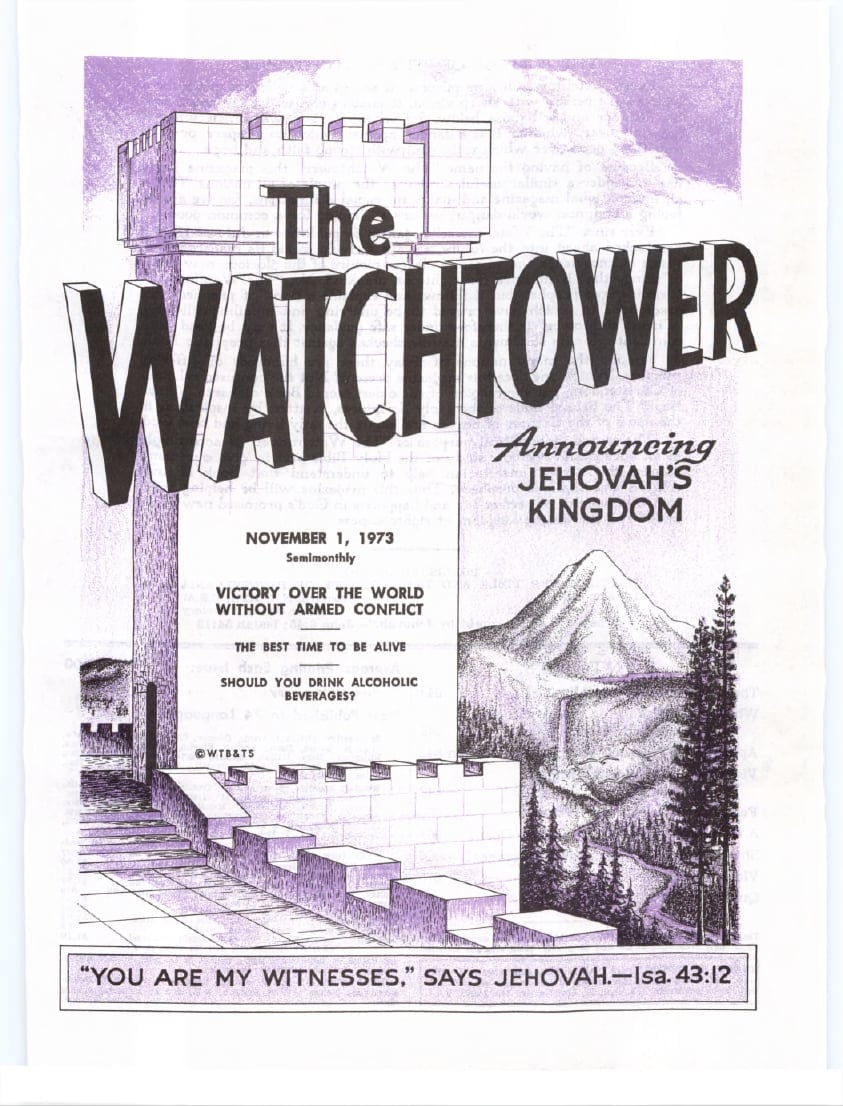
THE PURPOSE OF "THE WATCHTOWER"
Every watchtower has its purpose. It serves as an elevated place for a wide-awake person with sharp vision. It enables him to see far ahead into the distance and tell those below for whom he is a watchman what is drawing near, whether it is a danger against which to prepare or it is something good over which to be glad with strong faith and hope.
Because of having the name "The Watchtower" this magazine justly has to render a similar useful service to the people of all nations. This is an international magazine and makes no racial distinctions, for we are all facing a common world danger; we are all hoping for a common good.
Ever since "The Watchtower" began to be published in July of 1879 it has looked ahead into the future, always striving to aid its readers to advance in knowledge and to gain a clearer picture of the glorious new order of things that is in store for righteous mankind. No, "The Watchtower" is no inspired prophet, but it follows and explains a Book of prophecy the predictions in which have proved to be unerring and unfailing till now. "The Watchtower" is therefore under safe guidance. It may be read with confidence, for its statements may be checked against that prophetic Book.
Among the many nations of today there are hundreds of differing religions. Which one does this magazine present? Not the confused religions of Christendom, but the religion of the oldest sacred Book on earth. Which Book? The Sacred Bible of the Holy Scriptures, written by inspiration in the name of the Creator of heaven and earth, the only living and true God.
The sacred, nonpolitical purpose of "The Watchtower" is accordingly to encourage and promote study of the Holy Bible and to give our many readers the needed unsectarian help to understand that Book of true religion and infallible prophecy. Thus this magazine will be helping them to prove worthy of perfect life and happiness in God's promised new order under His everlasting kingdom of righteousness.
PUBLISHED BY THE
WATCH TOWER BIBLE AND TRACT SOCIETY OF PENNSYLVANIA
117 Adams Street
Brooklyn, N.Y. 11201, U.S.A.
N. H. KNORR, President
GRANT SUITER, Secretary
"They will all be taught by Jehovah."—John 6:45; Isaiah 54:13
CONTENTS
The Best Time to Be Alive 643
When the Kingdom of the World Was Entrusted to Christ 645
Appreciation Stressed at Gilead Graduation 647
Victory over the World Without Armed Conflict 648
Fellow Victors over the World 656
A Large Door Leading to Activity Opens 661
Should You Drink Alcoholic Beverages? 666
Victory over Alcohol 670
Questions from Readers 671
The Bible translation used in "The Wattewater" is the modern-language
"New World Translation of the Holy Scriptures," unless otherwise indicated.
Average Printing Each Issue: 7,875,000
Five cents a copy
Now Published in 74 Languages
Seminosthom. Arfkanae, Arabic, Cebuano, Chinese, Chishona, Cibemba, Chiyana, Danish, Dutch, English, Finnish, French, German, Greek, Japanese, Japanese, Japanese, Malagasy, Newgarian, Portuguese, Sewo, Spanish, Swahili, Swedish, Tagalog, Thai, Xhona, Yousha, Zulu.
Mosthiy; Armenian, Bengali, Bicol, Croatian, Ekk, Ekw, Filippa, Ghan, Gujarati, Hindi, Hokkaido, Malayalam, Maltese, Maldivian-Pididin, Moto, Pampango, Pangasian, Papalican, Polish, Rusian, Sasar-Leroy, Tsimane, Tsumane, Tundra, Turkic, Uzbek, Ukrainian, Vietnamese, Tawama, Tumwaka, Turkish, Tudik, Ukrainian, Uvetnamese.
Yearly subscription rates for semimonthly editions in local currency
in local
America, U.S. 12,17 Adams St., Bedford, N.Y. N12101 $11.00
Australia, 11.98 Edward St., Stainfield, N.W. N1236 $11.00
England, Watch Tower House, The Ridgeway, London NW17 INN $6p
New Zealand, 11.94 New Bedford St., Auckland 3 $11.00
Philippines, F.A. Gov. 2004 Machelle D-496 N1.04
South Africa, African Bank B. 2, F.A. Elandfontein, Transvaal N1.10
Remittances for subscriptions should be sent to the office in your country. Otherwise send your remittance to Brooklyn.
Notice of exfiltration is sent at least two issues before subscript expires.
Second-class postage paid at Brooklyn, N.Y., and at additional mailing offices.
Printed in U.S.A.
'OH! FOR THE GOOD OLD DAYS! How many times have you said this?
But would you actually have wanted to live in your grandfather's day? Think of World War I and perhaps even World War II, which you would have had to endure.
the Creator—not only on a promise, but upon the sure prophetic words of One who has already proved that he can do it, and who has also proved that he can foretell such a thing.
Or, suppose you had lived earlier, in the
"dark ages." Would you have had to undergo fewer hardships back then? Would you have had a better hope, if any at all?
The Bible counsels against longing for former days. It warns: "Do not say: 'Why has it happened that the former days proved to be better than these?' for it is not due to wisdom that you have asked about this.'"—Eccl. 7:10.
Why? Because we are nearer to the fulfillment of God's purpose toward the earth. We are near the peaceful thousand-year reign of God's kingdom, which will bring enduring blessings to mankind.
Really, NOW is the best time yet to be alive, in spite of the increased distress in the earth.
This is no false hope. It is not some kind of theoretical, wishful thinking. It is based on reality. It is based on the promise of
MANKIND'S BENEFIT IN MIND
The Almighty God chose to give a clear vision of that kingdom to the apostle John, who had been a faithful servant of the Lord Jesus
Christ for some sixty-five years. John was invited to look ahead, down the stream of time, to see that government actually administering all earth's affairs. John wrote down what he saw in the Bible book that is called Revelation or Apocalypse, which means, An Unveiling.
Because of John's continuing to proclaim the good news of Christ's coming kingdom he had been branded as a criminal by the Roman Empire—banished into exile on the island of Patmos in the Aegean Sea. No doubt this marvelous vision was a great comfort to him. It was a reward for his long years of faithful work, to be the first to see many details about that kingdom and to know that it will rule for a thousand years, resulting in earth's becoming a paradise. Such information can also be very comforting to us.—Rev. chaps.
20, 21.*
This kingdom will rule for the good of mankind. True, it will bring honor to God and will establish his sovereignty everlastingly over everything on the earth. It will bring this single rebellious planet into harmony with the rest of his universe. But the real beneficiaries will be humankind. Its King is the "seed" by means of whom "all nations of the earth will certainly bless themselves."—Gen. 22:18.
A DEMONSTRATION OF GOD'S TRUTHFULNESS AND POWER
But what about the sureness of hope in this beneficial rule—the reliability of the promise? Note what God did, demonstrating his ability to exercise rulership over men, and to foretell years ahead what he will do.
About twenty-five centuries ago a certain king, Nebuchadnezzar of Babylon, was the undisputed world ruler. Babylon had crushed the Second World Power, Assyria, and now became the great Third World Power of the Bible's historical record.
But its king, Nebuchadnezzar, made a serious mistake. In his pride and arrogance he overlooked the fact that the God of heaven had merely permitted him to be where he was. God had allowed him to take the Jewish nation, God's own people, into exile because of their disobedience, as a disciplinary punishment. It was not Nebuchadnezzar's strength that enabled him to take Jerusalem. To illustrate this for Nebuchadnezzar and for succeeding
generations, God sent a message to Nebuchadnezzar in a dream that greatly disturbed the king.
After conferring with his religious soothsayers and astrologers and getting no satisfactory explanation of the dream, Nebuchadnezzar called in a Jewish slave, the prophet Daniel.—Dan. chap. 4.
Daniel explained what the dream meant. It foretold for Nebuchadnezzar a humiliating seven-year discipline from God. Nevertheless, a year later, Nebuchadnezzar began to brag, glorying over his capital city Babylon. Hardly had he finished his boast when he heard a voice out of the invisible—out of heaven, saying:
"To you it is being said, O Nebuchadnezzar the king, 'The kingdom itself has gone away from you, and from mankind they are driving even you away, and with the beasts of the field your dwelling will be. Vegetation they will give even to you to eat just like bulls, and seven times themselves will pass over you, until you know that the Most High is Ruler in the kingdom of mankind, and that to the one whom he wants to he gives it.'"—Dan. 4:29-32.
What followed immediately? Exactly what God said would happen. It is in Daniel's account. Babylonian records that have been unearthed provide no account of the fact that Nebuchadnezzar was mad for seven literal years, as the Bible shows to be the case. But would we expect the supporters and servants of a dictator king to record his humiliation? We cannot imagine Hitler's historians recording Hitler's defeats if he had returned to power as did Nebuchadnezzar at the end of his seven years' madness. Other nations also have followed the policy of "whitewashing" their rulers and governments, as we can see in the annals of ancient Egypt, Assyria and many modern countries. But the Bible gives us the true, candid, unvarnished historical record.
When Nebuchadnezzar's sanity was restored by God, little did he realize that the "seven times" were to have a greater fulfillment of a year for each day of the seven prophetic years of 360 days each, a total of 2,520 (7 x 360) years.
Little did he realize that it was a prophecy revealing that, from the overthrow of God's representative kingdom when Jerusalem was desolated in 607 B.C.E., there would be no king of the line of David exercising ruling authority in the affairs of mankind for 2,520 years. During this time Jerusalem would be trampled on by the nations until the appointed times of the nations should be fulfilled'—that is, God would permit Gentile domination of the earth, with no king on the throne representing God. At the end of the 2,520-year period God's due time would arrive to set his Messiah upon the throne in the heavens. According to Bible chronology and world conditions fulfilling prophecy, these "times of the Gentiles" expired in 1914 C.E.—Luke 21:24, American Standard Version; Ezek. 21:27.
This would mean that we are now in the short period of time before the Messianic kingdom 'comes' against the present wicked system of things and ushers in the peaceful thousand-year reign.—Matt. 6:10.
CAN A BOOK WRITTEN BY MEN BE RELIABLE?
Some may be hesitant to rely on the Bible, since it was written by men. But often authors dictate their thoughts to others who act as mere secretaries. Similarly, historical and documentary works are not the ideas of their writers or compilers. While it is true that the Bible was written by men, it does not have to be the word of men. In its own pages the Bible claims to be the work of divine inspiration, and is written over the name of "the Most High himself, and the One living to time indefinite." After his humiliating experience, Nebuchadnezzar himself clearly saw and acknowledged that Daniel's words in interpretation of the dream were not merely Daniel's words. He admitted:
"At the end of the days I, Nebuchadnezar, lifted up to the heavens my eyes, and my own understanding began to return to me; and I blessed the Most High himself, and the One living to time indefinite I praised and glorified, because his rulership is a rulership to time indefinite and his kingdom is for generation after generation. And all the inhabitants of the earth are being considered as merely nothing, and he is doing according to his own will among the army of the heavens and the inhabitants
WHEN THE KINGDOM OF THE WORLD WAS ENTRUSTED TO CHRIST
Bible foretold God would give "the kingdom of the world" to Christ (Rev. 11:15)
When would this be? After seven symbolic "times" had passed (Dan. 4:10-17)
Immense tree representing kingdom power "cut down" when Jerusalem fell, 607 B.C.E. After "seven times" expired, "bands" would be removed; tree would grow
How long would the "seven times" prove to be? Far more than seven literal years
When on earth, Jesus indicated the symbolic "times" had not expired. (Luke 21:24) Revelation 12:6, 14 shows 1,260 days is equal to three and a half "times"
Each day of prophetic "times" stands for a year (Num. 14:34; Ezek. 4:6)
When did the seven symbolic "times" (2,520 years) begin?
In autumn of 607 B.C.E. when the territory of the typical kingdom of God in Judah was left desolate
When did the seven symbolic "times" end?
2,520 years brings us to autumn of 1914 C.E. (606¼ + 1913¾ = 2,520)
1914 C.E.—the marked year when "the kingdom of the world" was entrusted to Christ of the earth.
And there exists no one that can check his hand or that can say to him, 'What have you been doing?' "—Dan. 4:34. 35.
Really, the fact that men were used as secretaries in recording what God desired in the Bible does not lessen its authenticity or its impact upon mankind. The experiences of Job, David, Daniel and other men, their feelings, trials, their keeping integrity under test, give a reality and feeling of closeness that nothing else could give. Also, it encourages us as ordinary humans, for we can identify ourselves as undergoing many of the same things, and know that integrity can be maintained by humans if they continue to put trust in God. It gives the Bible a fine, comforting warmth and a stronger ring of truth than a book that claimed to be dropped coldly out of heaven could give.
Consider these facts: God could foretell with accuracy that Nebuchadnezzar would be mad for seven years and then be restored to his throne. Jesus Christ himself referred to the prophecy about the "times of the Gentiles" as authentic, and indicated that these were to come to their conclusion in a time long after his own day on earth. Then ask yourself: Would it not be possible, also, for God to foretell a thousand years of his Messiah's reign?
Certainly men cannot bring about a thousand years of peace. In fact, they cannot even bring about a thousand-year world rule. Hitler tried it, and lasted twelve years. And now, particularly, many serious students of government and of world conditions—statesmen, scientists and others—are saying that mankind will not even be able to survive to the year 2000 C.E. They base their outlook, not on the Bible, but on the hard facts of today and upon the now irreversible trend of things that involve all of us. The Bible tells of these hard times that we are experiencing as a sign of the nearness of
the end of this system.—2 Tim. 3:1-5. We can well believe the Bible on the nearness of this system's end. But we have no basis to believe the gloomy forecast of mankind's destruction, or the oftmouthed, age-old claims that politicians make, of world peace through continued domination by governments of men. We have no basis upon which to believe these promises. But we do have basis to believe the Creator, and we should welcome his predictions. These are not forecasts of gloom for the human race, but, rather, of a thousand-year rule that will bring mankind to perfection. God tells us that he will make this earth a jewel of beauty and its people harmonious. Furthermore, he promises everlasting continuance of life on earth, with happiness.
THE BEST TIME OF OPPORTUNITY
If we believe God, this is indeed the best time yet in which to be living. For we, of all generations of people, have the opportunity to see the destruction of wickedness, the cleansing of the earth, and the survival into a righteous new order. Do you believe that God has this fine purpose toward the earth? If so, take immediate steps to assure his favor when his Messianic king executes judgment upon this decadent system of things.
If you are one who tends to be skeptical, why not at least consider carefully what God says and compare it with what men offer? Is there any other hope to compare with God's promise? And is not what God promises in harmony with man's natural inborn desires? Is it not even more logical than what men promise? Take advantage of today's unparalleled opportunity to reason on what he says and to learn his purposes. Jehovah's witnesses will delight in assisting you, in your home, free of charge. Or you can attend meetings at their Kingdom Halls to hear these things discussed there.
APPRECIATION STRESSED AT GILEAD GRADUATION
"WHAT do you mean when you say, 'I appreciate it very much?' Is it just words or is it full of meaning?" With those remarks, N. H. Knorr, president of the Watchtower Bible School of Gilead, opened his address to the graduating students of the fifty-fifth class of this missionary school. It was September 10, 1973; the place, Jehavahh the Witnesses Assembly Hall in New York city, where a crowd of 1,975 had assembled. The fifty graduating students heard good counsel about the meaning of true appreciation.
The talk helped them to appreciate the value of knowledge and what Jehovah God is doing for us. "God appreciates us," Brother Knorr said, and quoted Jesus' words, "the very hairs of your head are all numbered." (Matt. 10: 29-31) The speaker stressed the need for the students to appreciate the value of their faith. —Gal. 5:6.
Brother Knorr, commenting on 1 Peter 1:7-12 (The New English Bible), said that 'trials come so that your faith may prove itself worthy of all praise, glory and honor when Jesus Christ is revealed. Then you will reap the harvest of your faith, that is, salvation for your souls.' Preachers brought these students the good news of salvation, and now they would be going out as missionaries to bring this good news to others. Brother Knorr closed his talk, telling them to 'appreciate their faith,' adding: "You must keep your faith strong, that it may never waver and never get weak. Jehovah God appreciates your faith because that brings honor and glory and praise to him."
With the conclusion of his talk, the graduating students from nine different countries filed past the Society's president to receive their diplomas and hear mention of their assignments to twenty-four lands, including Honduras, Indonesia, Hong Kong, Taiwan, Iceland, Liberia, Peru, Thailand, India, Korea, Japan, Chile, Brazil, Pakistan and South Vietnam.
Just prior to the main address, there was a series of brief talks. For example, school instructor U. V. Glass told the students that they had been tested in many respects. For instance, 40 percent of them got baptized while their parents were not believers in God's truth; further, half of these experienced family opposition. "This determination for God's truth," Glass counseled, "should stay with you"—because there were other areas in which they had
not been tried. New things would come up to test their faith. He warned against the danger of being a complainer and of tiring out when we are so near the end of the present system of things.
M. G. Henschel explained why the future missionaries needed a five-month course of special training—that they might be spiritually strong to face up to different things, including a new language, a new climate, and so forth. 'But others have done it, and you can too,' he said. 'And one thing that will help you to cope with annoyances,' Henschel added, 'is to keep a good sense of humor.'
F. W. Franz, vice-president of the Watchtower Society, encouraged the students to benefit by the example of a man who is seldom, if ever, spoken of as an example to imitate. This was a man of the tribe of Judah. What he did is mentioned in only two verses of the Bible. (1 Chron. 4:9, 10) His name was Jabez, and he became "more honorable than his brothers." How? Because he called on the God of Israel: "If you will without fail bless me and actually enlarge my territory and your hand really proves to be with me, and you really preserve me from calamity, that it may not hurt me,"—"
Jabez was not making a vow but was offering a heartfelt prayer. Was he seeking more territory at the expense of others? No, explained Franz, he was praying for the peaceful enlargement of his territory. According to ancient Jewish tradition, he said, Jabez wanted to establish a school and teach the worship of Jehovah God. He wanted to get disciples for God. Since his motive was good, the Bible says: "Accordingly God brought to pass what he had asked." So Jabez tried to cooperate with God, and Franz encouraged the graduating students to be like him, and, in effect, say: 'Oh, if you will without fail bless me and actually enlarge my territory,' enabling them to make more disciples of the Lord Jesus Christ!
In the evening the students put on a delightful musical program, which was followed by a thrilling Bible drama that presented the highlights of the career of the apostle Paul.
The entire program built up one's faith and helped Jehovah's people to appreciate that 'the tested quality of our faith is of much greater value than gold and is a cause for praise and glory and honor.'—1 Pet. 1:7.
VICTORY OVER
THE WORLD
</div>
Without Armed Conflict
</div>
VICTORY over the whole world of mankind without an armed conflict would certainly be a remarkable achievement. It seems impossible—especially with the world's being an armed camp, as it is today. World victory without a military conflict is not the idea of the political nations at present. They do not believe that any nation or any individual man could, by sheer peaceful political diplomacy, gain a world victory and thereafter dominate the world. The long-existing political governments are too smart with regard to the trickiness of international diplomacy to let such a thing be put over on them. Some few religious leaders of Christendom who try to interpret the prophecies of the Holy Bible predict a world dictatorship in the near future. By whom? By the one whom they call "the Antichrist," whom they also understand to be "the man of sin," "the son of perdition." (2 Thess. 2: 3-10, Authorized Version; 1 John 2:18) However, contrary to such a belief, there will be no individual antichrist that will
"In the world you will have trouble. But courage! The victory is mine; I have conquered the world."—John 16:33, The New English Bible.
gain the victory over the world without armed conflict.
2 The inspired Sacred Scriptures are very plain as to the matter of who comes off victorious over the world without taking up the violent weapons of blood-spilling warfare. According to these God-given Sacred Scriptures, we ourselves as God-fearing persons can win such a victory. The prize of such a victory is the gift of everlasting life in a happy, righteous new order of things, in which we shall not have this present wicked world to contend with. Such a prizeworthy victory is worth winning, is it not? A victory with such a matchless reward we should all desire to gain, should we not? Stupendous though it may seem, it can be done. We have a historic example to prove that it can be done. This encouraging example is that of a man who did it nineteen hundred years ago, a man whose name is not unknown to the whole world of mankind. That man was Jesus Christ. On his last day as a man on earth, he said, with a ring of triumph in his voice:
"I have spoken all this to you in order that in me you may have peace. In the world you have affliction. But keep up your courage: I have won the victory over the world."—John 16:33, The New Testament in Modern Speech, by R. F. Weymouth (1902).
*It is now the year 1973 of our Common Era, and yet the world has not been won over to belief in Jesus Christ. So in what way did Jesus Christ win the victory over the world? When he died like an accursed criminal just some hours after claiming victory over the world, he had not won over his own nation, the Jewish people, to an acceptance of him as their promised Messiah, as God's Anointed One. Fifty-one days after his disgraceful death, there were only about one hundred and twenty of the Jews in Jerusalem who held to him as the Messiah who fulfilled Bible prophecy. (Acts 1:15) How, then, was Jesus Christ justified in saying that he had won the victory over the world? In what possible way could his claimed victory be of benefit to us today? Let us see.
5 Look at him there on that Friday, Nisan 14, of the year 33 C.E., nailed to a stake in the way that the pagan Romans impaled condemned slaves, yes, and hanging there in between two notorious evil-doers! That situation branded him as a hated man, hated both by the Romans and by the Jews who had handed him over to the Romans to be executed in the most disgraceful manner. Even hours before his execution there at Calvary outside the city of Jerusalem, Jesus Christ admitted that he was a hated man. It is bad enough to be hated by someone else unjustly, but
by how many was Jesus Christ hated? To the eleven faithful ones who remained of his original twelve apostles Jesus Christ said: "If the world hates you, you know that it has hated me before it hated you. If you were part of the world, the world would be fond of what is its own. Now because you are no part of the world, but I have chosen you out of the world, on this account the world hates you."—John 15:18, 19.
Thus Jesus gave his apostles to understand that the world hated him, and likewise the world would hate them. What would they have to do about this? Well, when the whole world hates a person, a person has the whole world with which to contend and so a person has to gain a victory over the whole world. A person hated world wide must either defeat the world or else be defeated by it. How otherwise would a person prove that he is in the right, that he is true, that he is faithful?
WHY WORLD HATRED?
To understand how Jesus Christ gained a victory over the world, we have to understand why the world hated him. For being what or for doing what did he have to stand up against the whole world? He was not surprised at the world's hatred of him. He understood why it expressed hatred for him, and so he could take it, endure it. He pointed out the cause of the world's attitude toward him after about three years of his public activity in the land of Palestine. This happened in the latter half of the year 32 C.E., up in the Roman province of Galilee, where Jesus had been a carpenter at the city of Nazareth up until thirty years of age. He had a number of younger half-brothers, the sons of his mother Mary, and, unbidden, these half-brothers offered him some advice about his public career.
Even at that time the hostile Jews were waiting for the opportunity to kill him, out of their hatred for him. So the question was, Would he expose himself publicly to them at Jerusalem at the autumn festival of tabernacles that was drawing near? As a Jew under God's law through the prophet Moses, Jesus was obligated to be there. On his discussion with his half-brothers, we read:
8 "The Jews were seeking to kill him. However, the festival of the Jews, the festival of tabernacles, was near. Therefore his brothers said to him: 'Pass on over from here and go into Judea, in order that your disciples also may behold the works you do. For nobody does anything in secret while himself seeking to be known publicly. If you do these things, manifest yourself to the world.' His brothers were, in fact, not exercising faith in him. Therefore Jesus said to them: 'My due time is not yet present, but your due time is always at hand. The world has no reason to hate you, but it hates me, because I bear witness concerning it that its works are wicked.'"—John 7:1-7.
*Did Jesus Christ faithfully go up to Jerusalem, where those hating him would be flocking for the festival of tabernacles? Yes, he did so, but not in a foolhardy way. On this we read: "But when his brothers had gone up to the festival, then he also went up himself, not openly but as in secret." At the appropriate time, he spoke openly to the festival celebrators there in the temple. Orders were sent out by the Jewish authorities to arrest him, but these were not carried out by the police officers. (John 7:10, 32-48) Was that not a victory for Jesus Christ?
10 What reason did he give for the world's hatred of him? The reason, as stated to his half-brothers, was: "It hates me, because I bear witness concerning it that its works are wicked." (John 7:7) Well, now, if the works of the Jews to whom Jesus had confined his preaching were "wicked," what could be said about the works of the pagan world outside Jewry? They must have been no less wicked than those of the Jews hostile to Jesus Christ. Therefore, concerning the whole world of mankind, Jew and Gentile, the witness could be correctly given that its works were "wicked." Is that not enough to stir up hatred on the part of the world?
11 How, though, did Jesus bear witness to the world and show that its works were "wicked"? Both by word of mouth and by action. He himself had to be guiltless of wicked works. Who of his days on earth could truthfully accuse him of a single wicked work? Even Jewish unbelievers he challenged with the question: "Who of you convicts me of sin?" (John 8:46) When, toward the beginning of his public career, he went into the temple of Jerusalem and drove out the money changers and the merchandisers, saying: "Take these things away from here! Stop making the house of my Father a house of merchandise!" he was bearing witness to those profaners of the temple and to the Jewish authorities who allowed it that their works were "wicked."—John 2:13-17.
12 When, on the legal Jewish Sabbath Day, situations presented themselves for him to do good works of healing and he performed such healings despite the fact that he knew he was going to be criticized and condemned therefor, he bore witness that the deeds of his critics were "wicked."
(Matt. 12:9-16) When he cast out demons from obsessed persons and was accused of being in league with Beelzebub the ruler of the demons for doing so, Jesus made it manifest that the works of his opposers were wicked. (Matt. 12:22-37) When the unbelieving Jews asked for a sign from heaven in proof of his being the Messiah and he refused to dispel their unbelief by undue signs, he bore witness that their wicked works were those of a "wicked and adulterous generation." (Matt. 16:1-4; 12:38-45) Jesus' refusal to imitate this world and make himself like it or a part of it was a witness in itself that the works of the world were "wicked."
15 However, not just by letting his life speak for itself did Jesus bear witness against this world so as to call forth its hatred. He also did so directly by word of mouth. What does this mean?
14 Well, Jesus himself said to the Jewish ruler Nicodemus: "God sent forth his Son into the world, not for him to judge the world," that is to say, to judge it adversely or condemn it, sentencing the human race to destruction. (John 3:17) Even so, Jesus did not go around the land condemning everything that he saw, doing so all the time, proclaiming only the "day of vengeance on the part of our God." No, but he had a positive message that led to freedom from condemnation. This was the message of the Kingdom.—Isa. 61:1, 2; Luke 4:16-41.
witness concerning the world that its works were wicked? Yes! And this is shown in the way that the royal message was introduced. Matthew's account tells us how John the Baptist introduced the Kingdom message and then how Jesus Christ himself did so. After the imprisonment of John the Baptist, Jesus Christ took up John's message and enlarged upon it. Concerning this, Matthew 4:17 informs us: "From that time on Jesus commenced preaching and saying: 'Repent, you people, for the kingdom of the heavens has drawn near.'"
14 That very word of introduction of the message, "Repent," indicated that the works of the hearers of the Kingdom message were wicked. They needed to repent from such wicked works and turn around and prepare for the coming of the Kingdom. Why so? Because that divine government was not going to let its subjects practice wicked works. In fact, those who practiced wicked works were not going to be admitted into governmental offices in that kingdom. (1 Cor. 6:9, 10) That kingdom was to be a righteous government, and the fact that the God of the heavens saw the need to set up such a kingdom condemned all the kingdoms of this world as being wicked. It bore witness that those worldly systems of rulership were wicked and would one day, in God's appointed time, have to be destroyed. This was why those proclaiming and advocating the "kingdom of the heavens" could not consistently engage in the politics of the world, could not hold political office in any man-made government or take part in any armed conflict to maintain such worldly rulerships. As ambassadors and envoys of God's kingdom they abstain from unclean human politics.
17 Did the world hate Jesus for preaching the good news of the "kingdom of the heavens"?
The evidence shows that the world hated him on that account. The world rulers and their backers had their own ideas and plans on how the earth and its peoples should be ruled. They hated a message that held forth Jehovah God as having in mind to destroy their kingdoms and rulerships in His due time. They preferred a message that presented God as being behind their man-made governments, approving them and purposing to improve them and keep them in power. Consequently, a message that advertised a kingdom that would not cooperate with their systems of rulership and really work through them was something that the political elements of this world did not relish. They hated both it and the proclaimers of it. They hated the Anointed One whom God purposed to put in power in the "kingdom of the heavens."
OVERCOMING WORLD HATRED
18 Did Jesus deserve the world's hatred for preaching God's Messianic kingdom? Was he preaching thereby something that would be for the hurt of all mankind? No, but something for their everlasting good. Personal pride and selfishness were the things that induced the world to hate Jesus for proclaiming the Kingdom message that was really good news, Gospel, the Evangel. That the world's hatred of him was actually for no valid reason, Jesus plainly told his faithful apostles, saying:
15 "If I had not come and spoken to them, they would have no sin; but now they have no excuse for their sin. He that hates me hates also my Father. If I had not done among them the works that no one else did, they would have no sin; but now they have both seen and hated me as well as my Father. But it is that the word
written in their Law may be fulfilled,
'They hated me without cause.'"—John
15:22-25; Pss. 35:19; 69:4.
20 As showing that the world hated Jesus for preaching the righteous kingdom of his heavenly Father, Jesus' enemies resorted to a political trick to have him executed by the Romans who were not then interested in religious issues. They used Jesus' preaching of a perfect government for mankind as a tool for charging him with a political crime against the Roman Empire, the world power of that time. When the Roman governor of Judea, Pontius Pilate, wanted Jesus' accusers to treat the matter as a purely religious one involving their religious law and said to them: "Take him yourselves and judge him according to your law," they answered: "It is not lawful for us [under Caesar's law] to kill anyone." (John 18: 31) To give a political twist to what Jesus preached, his accusers said to Pilate: "This man we found subverting our nation and forbidding the paying of taxes to Caesar and saying he himself is Christ a king. . . He stirs up the people by teaching throughout all Judea, even starting out from Galilee to here." -Luke 23:1-5.
21 Then, finally, to make Governor Pilate feel personally involved in the matter, the accusers of Jesus said: "If you release this man, you are not a friend of Caesar. Every man making himself a king speaks against Caesar. . . . We have no king but Caesar."—John 19:12-15.
22 By thus forcing the pagan Romans to take a hand in doing away with this Preacher of the "kingdom of the heavens," the Jewish accusers obliged the Roman Empire to commit a hateful act against
Jesus did not let world hatred win the victory over him by stopping his miracles and good works. No, but within a few hours of his being sentenced to death he miraculously healed a man's ear after Peter had struck it off
Jesus. Before the Roman soldiers led him off to the place of execution at Calvary outside Jerusalem, they treated him scandalously like a criminal seditionist. That in this way Jesus was directly made an object of world hatred, his own disciples pointed out later on when offering prayer to God, saying:
"Sovereign Lord, you are the One who made the heaven and the earth and the sea and all the things in them, and who through holy spirit said by the mouth of our forefather David, your servant, 'Why did nations become tumultuous and peoples meditate upon empty things? The kings of the earth took their stand and the rulers massed together as one against Jehovah and against his anointed one.' Even so, both Herod and Pontius Pilate with men of nations and with peoples of Israel were in actuality gathered together in this city against your holy servant Jesus, whom you anointed, in order to do what things your hand and counsel had foreordained to occur."—Acts 4:24-28.
24 Nobody can call into question that Jesus Christ faced world hatred. But the vital question is, Did he let world hatred win the victory over him? Did he finally bow in defeat to it? Well, what was that world hatred trying to force Jesus Christ to do? It was stirred up by Satan the Devil to frighten him into submission. It was meant to induce him to stop doing his miraculous powerful works that testified to the fact that he was the promised Messiah sent by Jehovah God. It was designed to
persuade him against preaching the good news of God's Messianic kingdom any longer, to silence him as a Teacher and Preacher. It was meant to make him rebellious against Jehovah God who anointed him and commissioned him as the Messiah. Yes, this world hatred was roused up against Jesus Christ to make him get back at the people and hate them and break off from his self-sacrificing course of laying down his perfect human life that they might gain everlasting life under the promised Messianic kingdom of God. The world hatred was aimed at destroying him by making him seek to save his earthly human life, only to lose his soul, his hope of resurrection to life eternal.
25 Did world hatred succeed in accomplishing all these things with respect to Jesus Christ? Did he acknowledge defeat and stop performing miracles and good works that the promised Messiah was commissioned to perform?
No! Down to within a few hours of his being sentenced to death, he performed a miracle, to show that he was against any armed conflict. At the time of his being betrayed in the Garden of Gethsemane near Jerusalem, his apostle Peter drew a sword and struck off the ear of a man of the armed band that came out to arrest him under cover of darkness. But Jesus expressed disapproval of the use of the sword and then healed the man's ear, thereby giving a testimony to the high priest of the Jews, for this healed man, Malchus, was a servant of the high priest.—Matt. 26:48-54; Luke 22:47-51; John 18:10, 11.
28 Well, then, did the continuous world hatred beat Jesus Christ into submission and force him to keep his mouth shut and no longer preach the good news of the Kingdom? The testimony of eyewitnesses answers No! Leading off alone in the proclamation of the nearness of the Kingdom after the imprisonment of John the Baptist, Jesus gathered disciples to himself and chose twelve who should be with him all the time and whom he designated apostles. As the third Passover celebration during his public ministry drew near, he sent out these twelve apostles by twos, to preach the same message that he had continued preaching, for he said to them: "As you go, preach, saying, 'The kingdom of the heavens has drawn near.'" (Matt. 10:1-7) After the third celebration of the Jewish festival of tabernacles during his public ministry, Jesus sent out seventy other disciples as evangelizers, also by twos, and to them he said: "Whenever you enter into a city and they receive you, eat the things set before you, and cure the sick ones in it, and go on telling them, 'The kingdom of God has come near to you.'" (Luke 10:1-
9) This was during the last half year of his human life.
27 Now the fourth and last Passover of his public ministry drew near. A day of excitement that religiously rocked the city of Jerusalem arrived. This was on Sunday, Nisan 9, of the year 33 C.E., five days before his shocking death. That day Jesus brought his nationwide preaching of God's kingdom to a grand climax with a dramatic flourish. Upon the Mount of Olives to the east of Jerusalem, he seated himself upon an ass colt and rode like the Messianic King toward the royal city, not attended by an imposing body of cavalrymen armed with spears, not with a squadron of rattling war chariots or with a battalion of fully armored infantrymen, no, not with a mighty military force that would have caused the Roman soldiers to stream out from the soldier barracks in the Castle of Antonia at the northwest corner of the temple area, in order to resist the invasion of Jerusalem. No, but in fulfillment of the prophecy of Zechariah 9:9, he rode in a peaceful triumphal procession attended by a jubilant crowd of unarmed men, women and children, whom he let do the Kingdom proclaiming for him.
28 Among the cries that burst forth from the marching crowd were these: "Blessed is the coming kingdom of our father David!" "Blessed is the One coming as the King in Jehovah's name!" "Save, we pray you! Blessed is he that comes in Jehovah's name, even the king of Israel!" When the hate-filled enemies objected to these Messianic shouts of the people, Jesus insisted that the prophecy had to be fulfilled by saying: "I tell you, If these remained silent, the stones would cry out."—Matt. 21:6-16; Mark 11:4-11; Luke 19:32-40; John 12:12-16.
29 Thus not in vain had the prophecy of Zechariah 9:9 declared five hundred years earlier: "Rejoice heart and soul, daughter of Zion! Shout with gladness, daughter of Jerusalem! See now, your king comes to you; he is victorious, he is triumphant, humble and riding on a donkey, on a colt, the foal of a donkey." (Jerusalem Bible) "For see, your king is coming to you, his cause won, his victory gained, humble and mounted on an ass, on a foal, the young of a she-ass." (The New English Bible) Not as a piece of mere showmanship, but in obedience to God's unbreakable prophecy, Jesus courageously faced the hatred of the world and dramatically witnessed to God's Messianic kingdom. In this way he portrayed prophetically how after the end of the Gentile Times in 1914 C.E., and after the close of the war in heaven, he would ride triumphantly and present himself to Jehovah's theocratic organization as her rightful King. —Luke 21:24; Rev. 12:5-10.
A JUST CLAIM TO VICTORY OVER THE WORLD
30 World hatred stopped Jesus neither in performing miracles in proof of his Messiahship nor in his preaching of the good news of the Messianic kingdom of God. Neither did it cause him to imbibe its spirit and get filled with a malicious hatred of the human race whom he had come to ransom, nor did it pressure him into becoming rebellious against God and the divine will. At the temple, in an expression of his pity for the deceived, oppressed people, he openly denounced religious hypocrisy and said: "Woe to you, scribes and Pharisees, hypocrites! because you shut up the kingdom of the heavens before
men; for you yourselves do not go in, neither do you permit those on their way in to go in." (Matt. 23:1-13) Three days later, in no spirit of rebellion against God, Jesus celebrated the Jewish Passover at Jerusalem with his apostles. Immediately afterward he started a new observance, a new supper, as a memorial of his death as a human sacrifice.
31 When explaining the meaning of the cup of wine that was to be drunk at this memorial supper, Jesus said to his faithful apostles: "Drink out of it, all of you; for this means my 'blood of the covenant,' which is to be poured out in behalf of many for forgiveness of sins." (Matt. 26:26-28) No hatred of the human race was evident in those words, neither any rebelliousness against God's will for him that involved a sacrificial death. Then, in the course of the conversation afterward, Jesus said to the apostles: "You are the ones that have stuck with me in my trials; and I make a covenant with you, just as my Father has made a covenant with me, for a kingdom, that you may eat and drink at my table in my kingdom, and sit on thrones to judge the twelve tribes of Israel." (Luke 22:28-30) Later, at the close of his conversation and before offering a final prayer to God, Jesus said to them: "In the world you will have trouble. But take courage! The victory is mine; I have conquered the world."—John 16:33, NE.
32 At that hour of the night of Nisan 14, did Jesus have the right to claim victory over the whole world? In view of his faithful, loving course of life down till then, we can answer, Yes! Jesus was there making no idle boast of self-glorification.
His unswerving course of obedience to God in the hours that followed proved that. When standing before the highest local representative of Caesar of the Roman Empire, Jesus refused to deny that he was God's anointed King but said to Governor Pontius Pilate: "My kingdom is no part of this world. If my kingdom were part of this world, my attendants would have fought that I should not be delivered up to the Jews. But, as it is, my kingdom is not from this source. . . You yourself are saying that I am a king. For this I have been born, and for this I have come into the world, that I should bear witness to the truth." Although his Messianic kingship was a thing charged against him by his haters as a legal ground for the Romans to execute him, Jesus did not renounce God's kingdom.—John 18:36, 37.
33 Shortly afterward, as Jesus hung mailed to the torture stake at Calvary,
when his haters passed by and reviled him, he did not make himself like them and give them like for like. When, about three o'clock in the afternoon, Jesus said: "It has been accomplished!" and bowed his head and breathed his last, he had indeed gained the victory over the world, and that without armed conflict. (John 19:30; 1 Pet. 2:22-24) The world had killed him as a man, but he died undefeated. The hateful world got no satisfaction out of his death. It could not, and did not, prevent him from gaining the glorious prize for his world victory. Three days did not fully pass before Almighty God raised him from the dead in a stupendous victory over death and then exalted him to the right hand of his heavenly Father's throne, far beyond the reach of the hateful world down below on earth, God's mere footstool. (Phil. 2:5-11; 1 Pet. 3:22) Another kind of victory awaits him, and this one with his holy warrior angels at the coming "war of the great day of God the Almighty" at Har-Magedon. —Rev. 16:14, 16; 19:11-21.
JESUS' victory over the world without engaging in a conflict with it by the use of military arms stands as a pattern
for his disciples. His faithful apostles of the first century C.E. copied that pattern. All the world's hatred over decades of time failed to break their unswerving devotion to God's Messianic kingdom and to silence their preaching of it world wide. Just a few years before the end of that century the Christian apostle John, likely the last of the apostles to survive, wrote to fellow Christians and said: "I John, your brother and a sharer with you in the tribulation and kingdom and endurance in company with Jesus, came to be in the isle that is called Patmos for speaking about God and bearing witness to Jesus." (Rev. 1:9) Like those faithful apostles, the true disciples of Jesus are copying his pattern to gain victory over this twentieth-century world.
2 Although he is no longer on the earthly scene, Jesus Christ is an object of world hatred even today. This statement may be objected to by the nearly one thousand million church members of Christendom, who will insist, "We do not hate him!" And yet there is a test by which we can know whether we hate Jesus today. In a prophecy concerning what his disciples would undergo, Jesus said these words of advance warning to them: "You will be objects of hatred by all people on account of my name; but he that has endured to the end is the one that will be saved." "Then people will deliver you up to tribulation and will kill you, and you will be objects of hatred by all the nations on account of my name." (Matt. 10:22; 24:9) Logically, then, the hating of the disciples of Christ on account of his name means the hating of Christ himself at the same time.
There is no dodging the naked truth: the genuine disciples of Jesus Christ have to face and endure the world's hatred just the same as he did. So, for a disciple to remain such in a real sense, it means that he has to gain victory over the world. Not by means of any violence, but without armed conflict, as in Jesus' own case. The question for a disciple is, Will the world defeat him, or will he defeat it? If he suffers defeat, he must also suffer the sad consequences of defeat. If, however, he defeats the world, he will be rewarded with the grand prize of victory—at God's hand.
4 This being hated by all people and
nations on account of Christ's name, what does it mean? Does it signify being hated by people and nations just for being called a Christian? No, not today. Today there are hundreds of millions of religious people who are called "Christian" and who are in good standing with the rest of the world of mankind and in friendly relations with them. Who are these so-called Christians who enjoy world friendship and are not undergoing world hatred? According to all observations, these are the members of the religious sects of Christendom. They are not undergoing persecution as a class, are they? They are not banned or proscribed as a class and driven underground, are they? Oh, they do fight among themselves, not over being called Christian, but over belonging to different religious sects of Christendom. The issue of which religious authority they want to be ruled by is involved.
Jesus' expression "on account of my name" means on account of adhering to Jesus for what he officially is, the Messianic King appointed by Jehovah God. It means on account of our confessing and obeying him as a real Lord, our heavenly Lord whose commands we carry out as being ahead of those of any earthly ruler. It means sticking to the Messianic government that he represents and not dividing one's loyalties by mixing in the affairs of any earthly man-made government. It means viewing oneself and acting as the slave of Jesus Christ, a slave not belonging to oneself but owned by Jesus Christ at the cost of his own lifeblood. Yes, it also means being a witness of the God and Father of Jesus Christ, namely, Jehovah, the Source of the Messianic kingdom.
means far more than merely clean living. It requires one to identify oneself as not belonging to the worldwide system of things of which Christendom is the most prominent and powerful part, but as belonging to God's clean, new system that he has in reserve for earth's inhabitants. It places one in the position of being an alien resident, temporary dweller in this passing worldly system of things. (1 Pet. 2:11) This debars a true Christian from being one with the people of the world and conforming to their ways, being emotionally stirred and controlled by worldly nationalism, pride of earthly country. Concerning himself, Jesus said to nationalistic Jews: "You are from the realms below; I am from the realms above. You are from this world; I am not from this world." (John 8:23) Jesus thus made himself no part of this world with its selfish aspirations. Living up to his name obligates his disciple likewise to be no part of this world.—John 17:14, 16.
7 Does such a position stir up resentment or cause a flush of heat of indignation to rise up in the person friendly to this world? This hostile sentiment is a normal reaction toward the nonparticipation of the true disciple of Christ in the favorite affairs of this world. Worldlings are not fond of such a Christian stand. As Jesus told his apostles: "If you were part of the world, the world would be fond of what is its own. Now because you are no part of the world, but I have chosen you out of the world, on this account the world hates you." (John 15:19) Christ's name stands for separateness from this world. Being hated on account of Christ's name means being hated because one is no integrated part of this world, inasmuch as
Christ has chosen such one out of this world.
HATED BECAUSE OF WHAT IS PREACHED
8 Before Governor Pontius Pilate, Jesus said: "My kingdom is no part of this world. . . . But, as it is, my kingdom is not from this source." (John 18:36) How, then, could one who is a real Christian be a part of this world and at the same time be in favor of God's kingdom by Christ, which is no part of this world and does not have its source in this world? A true Christian could not do so, for Jesus said that Satan the Devil is the "ruler of this world." (John 12:31; 14:30; 16:11) For this reason the preaching of the non-worldly kingdom of Jesus the Messiah will bring the world's hatred upon the preacher; it will line up the world against the preacher. It did so in the case of Jesus himself; it has done so and will do so in the case of his true disciples.
9 And yet, after telling of the world hatred coming upon his disciples, Jesus said: "He that has endured to the end is the one that will be saved. And this good news of the kingdom will be preached in all the inhabited earth for a witness to all the nations." (Matt. 24:13, 14) The preaching of this kingdom, although it is good news, will incur the hatred of the world. Why so? Because God's Messianic kingdom and the political kingdoms of the world are enemies. For God's kingdom by Christ to take over the complete control of the earth, it requires the bringing of the man-made kingdoms of this world to their everlasting end. (Dan. 2:44) Here, then, is where the true-blue Christian must gain the victory over the world.
10 How so? Not by carrying a Bible in one hand and a sword, grenade or rapid-fire gun in the other! But by challenging the world's hatred and peacefully going forward, unarmed, in preaching "this good news of the kingdom" world wide for a witness to all nations with no exceptions, before the end of this system of things comes. The Kingdom preacher must not let the world's hatred, hostility and opposition defeat him. He is under the superior orders of the one who commissioned him to preach this good news, Jesus Christ, who is his Lord. He must be like his Lord and Master. This Jesus Christ was the greatest Preacher of good news from God ever on earth. Those called by his name do as he did; they must do as he both said and did. First when he had finished his Kingdom preaching despite world hatred and opposition did he say: "I have won the victory over the world." (John 16:33, Weymouth) In this he set the example for us.
11 There is yet preaching of "this good news of the kingdom" to be done world wide. From the postwar year of 1919, this good news has been preached by Jehovah's Christian witnesses uninterruptedly clear through World War II and down till now. They are under divine command through Christ not to stop this bearing of witness to God's Messianic kingdom world wide until the end of this system of things comes. Only when they have preached "this good news" to the finish and the victorious Kingdom has brought this worldly system to its complete end will they be able to say, each one for himself: "I have won the victory over the world."
world. The victory will be hard-won, but it can be won as Jesus' own victory proves to us. "Take courage," said Jesus. And the winning of the victory will take courage. It must be a courage born of faith in the Almighty God. On this the apostle John, who recorded the triumphant words of Jesus, said, shortly before his own victory at death: "To love God is to keep his commands; and they are not burdensome, because every child of God is victor over the godless world. The victory that defeats the world is our faith, for who is victor over the world but he who believes that Jesus is the Son of God?"—1 John 5:3-5, NE.
12 Such a victory is possible for us! Jesus Christ will have fellow victors over this
18 It is essential to have that spiritual quality of faith. As the Weymouth translation of 1902 renders John's words: "For every child of God overcomes the world; and the victorious principle which has overcome the world is our faith. Who but the man that believes that Jesus is the Son of God overcomes the world?" (1 John 5:4, 5) Such a victorious principle of faith is the inward force that moves Jehovah's Christian witnesses today and holds them true to the Son of God. They believe, not that he was a mere man begotten by a mere man wedded to a wife, but that he was born of a virgin Jewess to whose womb Almighty God transferred the life of his only-begotten Son from heaven, to be born as a human Son of God. They believe that immediately after his baptism in the Jordan River, he was begotten with God's holy spirit and anointed as the Messiah; but that on the third day of his sacrificial death he "with power was declared God's Son according to the spirit of holiness by means of resurrection from the dead."—Rom. 1:3, 4; Acts 13:32, 33.
14 Taking heed to the warnings by the apostle John concerning the antichrists that were to arise, Jehovah's Christian witnesses during this "conclusion of the system of things" do not let themselves be deceived and drawn after false Christs, antichrists that present themselves in Christendom or under the sponsorship of Christendom, like the United Nations for world peace and security.
They have identified the true Messiah, the true Christ, and they cleave to him and to the Godgiven Kingdom that he represents. They have the faith that this Messianic kingdom was established in the heavens in the year 1914 C.E., at the end of the Gentile Times. They therefore cannot accept and worship the symbolic "wild beast," that is, the Devil's worldwide system of political rulership, as the rightful government of the earth. Neither can they worship and pin their hopes to the political "image" of that "wild beast," namely, the United Nations that Christendom has sponsored for the perpetuation of imperfect human rulership over all mankind to time indefinite.
15 Never, no, never can they do such an idolatrous thing. With a faith victorious over the deceptions of this world, they take their stand with those pictured in the fifteenth chapter of the Revelation given to John, verses two through four, where the apostle John says: "I saw what seemed a sea of glass shot with fire, and beside the sea of glass, holding the harps which God had given them, were those who had won the victory over the beast and its image and the number of its name. They were singing the song of Moses, the servant of God, and the song of the Lamb, as they chanted: 'Great and marvellous are thy deeds, O Lord God, sovereign over all; just and true are thy ways, thou king of the ages. Who shall
not revere thee, Lord, and do homage to thy name? For thou alone art holy. All nations shall come and worship in thy presence, for thy just dealings stand revealed.'"—Rev. 15:2-4, NE; Weymouth; NW; Young.
By acting in harmony with their faith in Jehovah God the Almighty and in his Son Jesus Christ, the Christian witnesses of Jehovah have thus far "come off victorious from the wild beast and from its image and from the number of its name." (NW; An American Translation; Rotherham) This they have done even though this political "wild beast" has waged war upon them and temporarily conquered them during World War I. (Rev. 13:7) But victory over the Devil's worldwide political system of rulership and its political image (the United Nations) is not yet complete, as long as the Sovereign Lord God permits them to remain on earth. We shall come off victorious completely only when that political "wild beast" with the reproachful number 666 lies destroyed on the battlefield of Har-Magedon. (Rev. 13:18) If we desire to be fellow victors with Jesus Christ the Son of God over that enemy organization, we must continue to keep from being marked like a slave with the numerical name of the "wild beast" and not idolatrously worship its political image.
…