The Watchtower, June 1, 1929
Download: PDF — The Watchtower, June 1, 1929
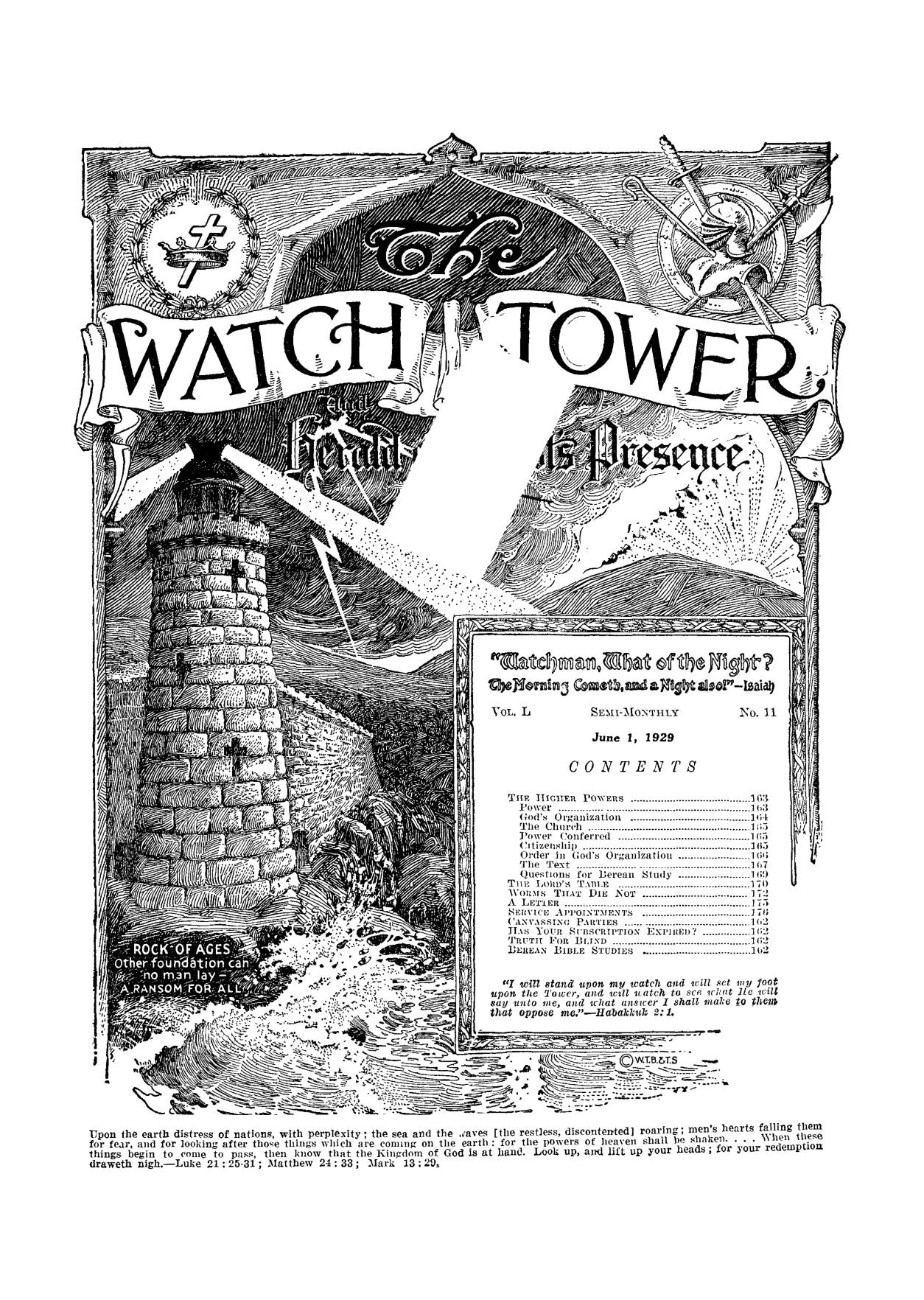
THE HIGHER POWERS
CANVASSING PARTIES
All canvassing parties and all individuals who canvass should mention the radio station in that vicinity that is broadcasting the truth. This often proves a means of opening the way to place the books into the hands of the people. Have in mind that the chief purpose of the radio is to call the people's attention to the truth and then furnish the opportunity for them to get a wider understanding of the truth by reading what is being printed.
Every one engaged in the house-to-house work in territory now served by broadcasts of the watchtower network program may have a share in telling the people that this unique service is available every Sunday. The “Radio Slip” Supplied by the Society, described more particularly in The Watch Tower for March 1, 1929 (page 66), is proving to be a convenient and effective method of giving public notice of this chain program.
HAS YOUR SUBSCRIPTION EXPIRED?
From time to time the subscription department receives an expression of surprise from a subscriber who discovers that his name has been ‘ ‘ dropped ’ ’ from the Watch Tower list. For the benefit of subscribers it is here repeated, by way of explanation, that discontinuance of an expired subscription is accomplished mechanically in every case. Machinery used to print address on label or wrapper is so constructed that the plate bearing address is automatically “dropped” from the list at expiration. A renewal blank (carrying also notice of expiration) is sent with the journal one month before the subscription is due to expire. On foreign subscriptions the expiration notice is sent with the journal two months in advance.
TRUTH FOR THE BLIND
Several of the Society’s books and The Watch Tower are published for the benefit of the blind. The Braille method is used. The books are loaned to the blind without charge. They are also sold at prices to cover the cost of manufacture. For further information address Watch Tower Bible & Tract Society, Branch for the Blind, Logansport, Indiana.
Vol. L | June 1, 1929 | No. 11
THE HIGHER POWERS
“Let every soul be subject unto the higher powers. For there is no power but of God: the powers that be are ordained of God.” — Rom. 13:1.
PART 1
JEHOVAH God gave his Word to his people for their reproof, correction, instruction, aid and comfort, to the end that such may be thoroughly furnished with knowledge that will enable them to do right and to accomplish good. (Rom. 15:4; 2 Tim. 3: 16, 17) That inflexible rule must always be kept in mind and followed in giving consideration to any Scriptural text. That means that the anointed must always be obedient to God’s law. A rule or law that commands a child of God to take any other course is wrong. The anointed of the Lord must do right; and God’s Word alone, and without a single exception, points out the right way.—Ps. 19: 7, 8.
2 The instruction of the thirteenth chapter of Romans has long been misapplied. The improper application has really been the basis for the false doctrine of the “divine right of kings” or rulers to rule and oppress the people. The instruction given therein by the apostle was not intended for mankind in general, but for the benefit of the church. If intended for any one outside of the church, then it must follow that God has been judging the people throughout the period of the Gentile times, whereas other scriptures show that God has appointed a special time for the judgment of mankind in general.—Acts 17: 31.
3 The apostle is, in substance, telling the members of the church that they should always be obedient to God, and that the motive for such obedience must be love for God and a delight in doing his will. Paul’s argument is also to the effect that if the laws of the land are in harmony with God’s law they should be obeyed, of course; not because such laws were enacted by the law-making body of the nation, but because they are in harmony with God’s law and for that reason are right; that if the law of a nation is not contrary to God’s law, then the law of the nation should be obeyed in order that the child of God might not needlessly cause offense; and, further, for the sake of his own conscience. The controlling point in his argument really is citizenship, or to what power the creature is to be in subjection.
POWER
4 The power of Jehovah is supreme. From him proceeds all rightful authority. He is the Creator of heaven and earth. (Isa. 42:5; Jer. 10:12) There is no limitation to his power, and there is no qualification to the statement that God is supreme. (Gen. 17: 1-3; 35:11) He is the Most High, and none can be above him. (Ps. 91:1; Eph. 4:10) In his argument the apostle says: “There is no power but of God: the powers that be are ordained of [arranged under] God.” Otherwise stated, all power that is rightfully exercised is that which is delegated by Jehovah to the creature exercising that power. It follows, then, that there is no creature or creatures that could rightfully make and execute laws or rules of action that are contrary to God’s law. When the apostle says, “Let every soul be subject unto the higher powers,” these words include the church now, and will later include all who come into harmony with God.
5 Many comments have been written of and concerning the thirteenth chapter of Romans to the effect that the Gentile powers or governments of this world are the “powers that be” and that such governments derive their powers from Jehovah God. At once it is seen that the foundation is laid for the doctrine of the “divine right of kings”, for the reason that the argument is that whatever power a nation has and exercises, that power is ordained of God, and that therefore the child of God must be obedient to that power. For many centuries the rulers and the nations called Christian nations have insisted that God has delegated to them the power to rule, and have used this to cause the people to pay them great respect and homage. Let this argument be followed to its logical conclusion, and where do we find ourselves?
6 In the United States it is unlawful for a citizen to be found in possession of or transporting, intoxicating liquor. In Canada, England, Germany and other countries, which also claim to be Christian, it is not unlawful to be found in possession of or (and) transporting intoxicating liquors. Has God delegated a different power or authority to these different nations ‘In the United States, in time of peace no citizen can, by law, be drafted and required to render military service. In Italy and other countries called Christian, even in time of peace all citizens are subject to military service, and refusing to render such service are subject to severe punishment. Which one of the nations is making and enforcing the military law in harmony with God's law, seeing that their laws are different?
7 In the United States, in time of war a law is made compelling persons within a certain age limit to engage in military service. Is the law of God different at different times and in different countries? The scripture answers: ‘God changes not.’ (Mal. 3:6) Of necessity God must be, and is, at all times consistent.
8 God says to his anointed sons: “Thou shalt not kill.” (Matt. 5:21, 22) He that kills is a murderer. Furthermore, it is written: “Whosoever hateth his brother is a murderer: and ye know that no murderer hath eternal life abiding in him.” (1 John 3:15) All the Gentile governments of the world in time of war compel their respective subjects or citizens to participate in war and to kill. Has God delegated the power to these governments to order men to kill each other, and are the anointed sons of God bound to obey the laws of the land which require killing, when at the same time God's own law commands that he shall not kill? If the child of God engages in war and deliberately kills, he precludes himself from entering the kingdom, according to God’s law.
9 If a worldly government can enact a law forbidding the use of certain drinks, that nation or government can also enact a law, and enforce it, forbidding the use of certain foods, even including bread. Jesus directed his followers to pray to God: “Give us this day our daily bread.” Would God delegate to a nation or government a power that would permit that nation to make and enforce a law forbidding the use of the very thing for which the children of God were directed to pray? If it is lawful to drink beer while eating cheese in Germany, and unlawful to drink beer while eating cheese in the United States, which one of these nations is exercising the power delegated by the Lord? If the answer be, Both, then the question is properly asked: Is God declaring that the doing of a certain act is right in one part of the earth and wrong in another part of the earth?
10 Russia and the United States are both powers of this world, otherwise called nations or governments; and both claim to be Christian nations, even though they are not. The fundamental law of the United States declares that a man may exercise his religion in any manner he may choose. Contrary to this fundamental law, some of the states enact a law that the gospel can not be preached in certain places or under certain conditions, and arrest and punish those who attempt thus to preach it. In Russia the law is that one can not preach the gospel at all without a permit from the government. God’s commandment to his sons, which commandment is given through Jesus Christ, is that his gospel shall be preached in all the nations as a witness. (Matt. 24:14) Shall the child of God be obedient to the law of the United States or of Russia, or to the law of God? Is it possible that God has delegated to these various nations the'right and authority to make and enforce laws that are inconsistent with and in derogation of his own expressed will?
11 Is it not therefore clear that there has been a decidedly improper application of the words of the Apostle Paul when applied to the governments of this world? When he says, “The powers that be are ordained of God,” does he have any reference whatsoever to the Gentile nations of the earth? Is it not more reasonable that he directs his words exclusively to the powers possessed and exercised in God’s organization, and not to those that arc exercised in Satan’s organization ?
GOD’S ORGANIZATION
12 Aside from Jehovah himself his organization consists of Jesus Christ, his holy angels, cherubim, the resurrected members of the body of Christ, and those who have been brought into the church and anointed of the spirit and who are diligently putting forth their best endeavors to be obedient to God. At the Joi’dan, at the time of his consecration, Jesus was anointed to the high office of “priest for ever after the order of Melchizedek”. He was then and there clothed with certain powers as the man Christ Jesus on earth. Speaking to his disciples Jesus said that “the Son of man hath power on earth to forgive sins”. (Mark 2:10) After Jesus had been raised from the dead he said to his disciples: “All power is given unto me in heaven and in earth.” (Matt. 28: 18) That power he received from Jehovah. Manifestly God permitted Jesus to grant some power to his servants or disciples, because Jesus said: “For the Son of man is as a man taking a far journey, who left his house, and gave authority to his servants, and to every man his work, and commanded the porter to watch.”— Mark 13: 34.
13 The word “power’’ is translated from the Greek exousia; and Paul's argument set forth in the text and context shows that the power there mentioned has reference to the authority that is possessed and exercised in God's organization. It is the institution which Jehovah himself employs to carry out his purposes. The foregoing scriptures are in point, as well as those that follow: “For by him were all things created, that are in heaven, and that are in earth, visible and invisible, whether they be thrones, or dominions, or principalities, or powers: all things were created by him, and for him.” (Col. 1:16) “Thou hast given him power over all flesh, that he should give eternal life to as many as thou hast given him. ’ ’ (John 17:2) “The Father judgeth no man, but hath committed all judgment unto the Son: and hath given him authority to execute judgment also, because he is the Son of man.” (John 5: 22, 27) These scriptures prove that Christ Jesus is the “higher power” and that Jehovah is the highest or supreme power. “The higher powers” may therefore be applied to both Jehovah and Jesus, because Christ Jesus always carries out the order of his Father.
14 Concerning the Lord Jesus Christ the apostle wrote: “Who is gone into heaven, and is on the right hand of God; angels and authorities and powers being made subject unto him.” (1 Pet. 3: 22) Manifestly this text does not include the Gentile nations, powers and authorities of the earth, for the reason that at that time it was not God’s due time to make the enemy organization the footstool of the Lord. (Ps. 110:1) The words of the apostle must therefore mean that every creature in God’s organization must be subject to Christ Jesus, the Prince, or Ruler, or Head over God’s organization. In support of this conclusion Jesus stated that the power of judgment had been committed unto him, with the authority to execute the judgment. That judgment has particular reference to the organization of Jehovah, as it is written: “For we must all appear before the judgment seat of Christ; that every one may receive the things done in his body, according to that he hath done, whether it be good or bad.” (2 Cor. 5:10) “For the time is come that judgment must begin at the house of God; and if it first begin at us, what shall the end be of them that obey not the gospel of God?” (1 Pet. 4:17) These scriptures show that Jesus Christ is the higher power, which power is always exercised in harmony with Jehovah, the Supreme One.
THE CHURCH
15 The church, made up of the members of the body of Christ, is of God’s organization, with Christ Jesus as the Head thereof. “And he is the head of the body, the church: who is the beginning, the firstborn from the dead; that in all things he might have the preeminence.” (Col. 1: 18) Furthermore, the apostle, relative to Christ Jesus, says, “And what is the exceeding greatness of his power to usward who believe, according to the working of his mighty power, which he wrought in Christ, when he raised him from the dead, and set him at his own right hand in the heavenly places, far above all principality, and power, and might, and dominion, and every name that is named, not only in this world, but also in that which is to come: and hath put all things under his feet, and gave him to be the head over all things to the church, which is his body, the fulness of him that filleth all in all.” —Eph. 1:19-23,
16 Christ Jesus, acting under the authority granted to him, organized the church. (Matt. 16:18) Since all things are from the Father, and all things are by the Son, we must understand that Jesus Christ is the executive officer of Jehovah in all things. Then says the apostle: “God hath set the members every one in the body as it hath pleased him.” The proof is therefore conclusive that the church is of God’s organization. (1 Cor. 1:2; 11:22; 2 Cor. 1:1) The church is composed of many members, assigned to different positions in the church. It is through Christ, the Head of the church, that the members thereof have access to the Father. The organization is one building of God, with the apostles of Jesus Christ holding important positions therein under Christ Jesus the Head thereof.— Eph. 2: 19-22.
POWER CONFERRED
17 That Christ Jesus conferred power upon his apostles, there can not be the slightest doubt. Unto Peter he said: “And I will give unto thee the keys of the kingdom of heaven: and whatsoever thou shalt bind on earth shall be bound in heaven: and whatsoever thou shalt loose on earth shall be loosed in heaven.” (Matt. 16:19) After his resurrection Jesus said to his disciples: “Peace be unto you: as my Father hath sent me, even so send I you. And when he had said this, he breathed on them, and saith unto them, Receive ye the holy spirit: whose soever sins ye remit, they are remitted unto them; and whose soever sins ye retain, they arc retained.”—John 20: 21-23.
18 Furthermore, the Scriptures show that the apostle exercised power conferred upon him by the Lord and in so doing he had the Lord’s approval when he pronounced judgment upon Ananias and Sapphira. (Acts 5:11, 12) Others committed offenses in the church, and Paul, although absent, exercised his power and authority in judging the offenders. (1 Cor. 5: 1-5) That the ecclesia shall properly take action in judging certain offenders is proven by the words of Jesus.—Matt. 18:15-18.
CITIZENSHIP
19 A man is subject to the laws of the nation of which he is a citizen. He is therefore the subject of that nation. A citizen of the United States is subject, to the laws of the United States. If that citizen of the United States is in Italy he is still subject to the laws of the United States, the land of his citizenship. Since the scripture under consideration is addressed to the anointed sons of God, the inquiry is pertinent: Where is the citizenship of the son of God? The Apostle Pau: answers that question and plainly declares that tl.e members of the body of Christ on earth have their citizenship in heaven. “For our citizenship is in heaven; whence also we wait for a Saviour, the Lord Jesus Christ.”—Phil. 3:20, R. V.
20 It appearing that Paul (Rom. 13) is addressing his words to the new creation, and the citizenship of such being in heaven, then, by all known processes of proper reasoning, his words must mean that these members of the new creation are subjects of God and must be obedient to the laws of God. Whether or not the thirteenth chapter of Romans has any reference to the laws of the nations of earth, without any question of doubt the apostle’s words there do apply to God’s organization, because addressed to members of that organization. In this and a subsequent issue of The Watch Tower consideration is given to the scripture in question as applying to God’s organization and the higher powers thereof and what relation (if any) it has to the powers exercised by the Gentile nations or governments of the world.
ORDER IN GOD’S ORGANIZATION
21 The organization of Jehovah is of far greater importance than any other organization. It is to his organization that the words of the apostle are addressed. Everything in God’s organization must be orderly; because he is the God of order, and not of confusion. The same rule applies to his church: “For God is not the author of confusion, but of peace, as in all churches of the saints.”—1 Cor. 14: 33.
22 By his prophet God gave a word-picture of his organization. Four living creatures appeared in a vision given to his prophet, and it is written that “every one had four faces, and every one had four wings. . . . they turned not when they went; they went every one straight forward’’. The vision then discloses a wheel beside each one of the living creatures. The description in the vision proceeds as follows: “The appearance of the wheels and their work was like unto the colour of a beryl; and they four had one likeness: and their appearance and their work was as it were a wheel in the middle of a wheel. When they went, they went upon their four sides: and they turned not when they went. And when the living creatures went, the wheels went by them: and when the living creatures were lifted up from the earth, the wheels were lifted up. When those went, these went; and when those stood, these stood; and when those were lifted up from the earth, the wheels were lifted up over against them: for the spirit of the living creature was in the wheels. And under the firmament were their wings straight, the one toward the other: every one had two, which covered on this side, and every one had two, which covered on that side, their bodies. And when they went, I heard the noise of their wings, like the noise of great waters, as the voice of the Almighty, the voice of speech, as the noise of an host: when they stood, they let down their wings.”—Ezek. 1: 16, 17, 19, 21, 23, 24.
23 The vision thus gives a description of God’s organization under the firmament. Then it proceeds with the further description, to wit: “And above the firmament that was over their heads was the likeness of a throne, as the appearance of a sapphire stone: and upon the likeness of the throne was the likeness as the appearance of a man above upon it. And I saw as the colour of amber, as the appearance of fire round about within it, from the appearance of his loins even upward, and from the appearance of his loins even downward, I saw as it were the appearance of fire, and it had brightness round about.”—Ezek. 1: 26, 27.
24 This is a marvelous picture of God’s organization: made up of Jesus Christ in glory, the risen members of his body in glory, the legions of holy angels, and on earth the faithful remnant; and above all is the Almighty God. The prophetic picture discloses that everything in God’s organization must move exactly in order, and therefore in harmony with the supreme power, which is Jehovah, and in harmony with the higher power, which is Christ. That which governs the entire organization is God’s perfect law.—Ezek. 1: 5-28.
25 The Lord having come to his temple, and Zion being assembled and given a specific work to do, there must be exact harmony and unity of his organization. The members of Zion on the other side of the vail are perfect. The small number of those who are on this side are imperfect in their organism, but must be perfect in their devotion to Jehovah and his organization; which means that each one must be perfect in heart. That part of Zion on earth is a unit of the organization of Jehovah. Every soul that is a member of Zion must be in harmony with the Head, and therefore subject to the Head and to Jehovah, “the higher powers.” What then constitutes Zion on earth? The right appreciation of the correct answer to this question will enable the anointed to keep in harmony with the Lord’s way. The correct answer is this: All of God’s anointed on earth.
26 There is on the earth a company claiming to be the “servant of the Most High” and often spoken of as “the Society”. What is the “Society”, as generally understood by Watch Tower readers? The answer is, All of God’s anointed children on earth who are working harmoniously together to the glory of God and of Christ Jesus. If one is anointed by the spirit of Jehovah he is now a member of Zion, and if he would maintain his standing in Zion he must be in exact harmony with the course of action Zion is taking.
27 Christ Jesus is the great Head of Zion and is directing the work on earth, and he makes no mistakes. But how about those who hold positions of responsibility in the “Society”, and through whom direction concerning the work on earth is given? Do any of these make mistakes? Yes, to be sure they do, because they are all imperfect. How then may others of the Society know whether or not the direction for the work of God’s organization on earth is being given according to God's law? They could not know except by faith and by the fruits of those who are actually engaged in the work of the Lord. Jesus said: "Wherefore by their fruits ye shall know them. Not every one that saith unto me, Lord, Lord, shall enter into the kingdom of heaven; but he that doeth the will of my Father which is in heaven."—Matt. 7: 20, 21.
28 If, therefore, we find one who is devoted to the Lord and is bending his efforts to do what the Lord has assigned him to do, and is faithful and true to the Lord and not compromising with the enemy, and who has the Lord's manifest blessings upon his efforts, then his fruits are being manifested and such is proof that he is pleasing to the Lord and going in the right way. (John 15: 8) If one is being used of the Lord in harmony with his Word, that is the evidence that his course of action is pleasing to the Lord. Being imperfect, such will make mistakes, but each one who has faith in the Lord will leave it to the Lord to do the chastening and the correction and to rectify the mistakes. (Heb. 12: 6; Rom. 8: 33) This same rule, because it is the Lord's rule, must apply to all who are in the "Society". If the "Society" is pursuing the wrong course or policy, then all of God's people must depend upon the Lord to correct that policy and change it into the right one. It is not the prerogative of any individual to set himself up as the judge to take action and oppose the work of the Lord. "Who art thou that judgest another man's servant? to his own master he standeth or falleth. Yea, he shall be holden up: for God is able to make him stand."—Rom. 14: 4.
29 If Romans the thirteenth chapter applies to the church, does that mean that the elders and deacons have authority to do judging and to determine the course or policy of the church? No, certainly not. The elders are the advisers or counselors in the ecclesia and have no jurisdiction to act except within the scope of the authority conferred upon them by the Scriptures. The deacons are servants in the church and possess no authority other than that conferred by the Scriptures. The Scriptures do not confer authority upon elders or deacons to judge or determine the course of action of the ecclesia. If there is disorder in the church the ecclesia, composed of those who are God's children, may take certain action. The Lord himself laid down the code of procedure.—Matt. 18: 15-18.
30 The church as a body has jurisdiction to hear and determine matters relating to those who are members of the body; but no individual has been clothed with such power or authority, aside from the twelve apostles, who were clothed with special authority from the Lord. If Romans thirteen has any application to the powers in the world, with much stronger reasoning must it apply to the church, because it is addressed to those who are in God's family. Consider now the apostle's instructions verse by verse.
THE TEXT
31 "Let every soul be subject unto the higher powers. For there is no power but of God: the powers that be are ordained of God." (Verse 1) At once the question arises, To what shall God's people be subject? It is written: "And when all things shall be subdued unto him, then shall the Son also himself be subject unto him that put all things under him, that God may be all in all." (1 Cor. 15: 28) This scripture really answers the question. This proves that the higher powers are Christ Jesus and Jehovah and that the supreme power is Jehovah God. The apostle uses the husband and wife to picture Christ and the church, and by his argument he shows that the church is subject to Christ: "For the husband is the head of the wife, even as Christ is the head of the church: and he is the saviour of the body. Therefore as the church is subject unto Christ, so let the wives be to their own husbands in every thing." (Eph. 5: 23, 24) The inspired testimony of James supports this conclusion: "Submit yourselves therefore to God. Resist the devil, and he will flee from you. Draw nigh to God, and he will draw nigh to you. Cleanse your hands, ye sinners; and purify your hearts, ye double minded." (Jas. 4: 7, 8) These scriptures show beyond a doubt that the anointed can be pleasing to God only by an undivided and complete devotion to him. The apostle could not mean that the "higher powers" are the Gentile powers. It is not possible that these are higher than and have control over God's arrangement of his own people.
32 The apostle says: "The powers that be are ordained of [arranged under, Diaglott] God." Can this be properly applied to the Gentile powers on earth and not applied to the church? The words of the apostle are in answer to that question: "But now hath God set the members every one of them in the body, as it hath pleased him. And God hath set some in the church; first, apostles; secondarily, prophets; thirdly, teachers; after that, miracles; then gifts of healings, helps, governments, diversities of tongues." (1 Cor. 12: 18, 28) Those who have insisted that the apostle referred exclusively to the Gentile powers when he said, "The powers that be are ordained of God," cite in support thereof the words of Peter, to wit: "Submit yourselves to every ordinance of man [human creation, Greek] for the Lord's sake; whether it be to the king, as supreme; or unto governors, as unto them that are sent by him for the punishment of evildoers, and for the praise of them that do well." A careful examination of this text shows that it does not apply to the powers exercised by the Gentile governments.
33 The phrase "ordinance of man" in the above text means "human creation". How then could it be said that any ordinance of the church is of human creation? When the man Christ Jesus appointed the apostles and sent them forth as leaders and governors in the church, were they not all of human creation, within the meaning of this text? It was the man Jesus that did it, and it was men that were sent forth; and this is none the less true even though it was done in obedience to God's command.
34 When the church by a vote makes a rule governing the ecclesia, or by vote elects leaders, is not such of human creation? When the apostles announced a rule or rules relating to the church, were not these of human creation? In support of this conclusion, note the words written: "Remember them which have the rule over you [your leaders, Diaglott] ... Obey them that have the rule over you, and submit yourselves: for they watch for your souls, as they that must give account, that they may do it with joy, and not with grief: for that is unprofitable for you."—Heb. 13: 7, 17.
35 Peter's words addressed to the church seem clearly to mean this: Where the church acts under the authority of the Scriptures and creates an arrangement for its government or course of action, each member of the ecclesia should submit to such arrangement and not try to overthrow it. If that which is of human creation, such as regulations, rules or leaders, become useless or the leaders become unfaithful, the church may take action to judge or rule or put out the unfaithful ones. No individual, however, has authority to take such action. The chief lesson is that it is the Lord's arrangement or organization and he has designated the manner in which it shall be governed and judged.
36 What, then, did Peter mean when he said, "whether it be to the king, as supreme"? Undoubtedly he referred to Jesus, because Jesus is the King or Lord to the church, and is supreme over the church because he always acts in exact harmony with Jehovah, the Supreme One. But how could it be said that Jesus the King is of human creation, as those words appear in the text? The apostle did not say that Jesus is an ordinance of man. When Jesus was on earth he laid down certain rules which must be followed by the church; and these rules, being promulgated by the man Christ Jesus, were of human creation. But even that is not what is here meant by Peter's argument. Paraphrased, his words are these: 'For the Lord's sake submit yourselves to every ordinance of man [in the church], for that ordinance relates to the King, the Christ, the Head of the church. To be sure you will submit to that, because he is the Head of the church; or whether it relates to the governors of the church, who are sent by the Lord Jesus Christ.' The apostles were appointed as governors in the church. (1 Cor. 12: 28) They laid down rules relating to the church. Whether those rules were directly inspired and directed from Jehovah or the Lord Jesus, or were made by the apostles, the members of the church may not have known; but they were admonished to be submissive thereto for the Lord's sake and to let the Lord determine whether or not the rules were right. Not always did the apostles speak by commandment. Paul said on one occasion: "I speak by permission, and not of commandment."—1 Cor. 7: 6.
37 The argument of Peter (1 Pet. 2: 13, 14) was for unity and harmony in the church. In support of this, note his further words: "Be respectful to all; love the brotherhood; fear God; honor the King." (1 Pet. 2: 17, Diaglott) It is manifest here, when he commands the church to be respectful to all, to love their brethren and to fear God, and then speaks of the King, that he does not mean the kings of earth over which Satan is the god. To determine to whom he speaks, it is but necessary to notice the opening words of the epistle, which he addresses to the new creation.
38 As further proof that Peter's words have reference to the government in the church, and that when he speaks with reference to the King he has reference to Christ, he says: "Or to governors, as sent by him for the punishment of evil-doers, and the praise of well-doers." (Diaglott) Can it be said that God has sent the governors of the various nations to punish evil-doers in the church and to praise well-doers therein? Whoever heard of the governor or ruler of any Gentile nation giving praise to those because of their full and absolute obedience and faithfulness unto the Lord God and to the Lord Jesus Christ? The Lord Jesus Christ did send the apostles as governors in the church; and the apostles, as governors in the church, did punish evil-doers. (Acts 5: 1-10; 1 Cor. 5: 1-5) They also gave praise to those who did well in the church. (Phil. 1: 3; 2 Cor. 9: 1, 2; Col. 4: 9, 12, 14) There is therefore no support to the argument that the Apostle Peter (1 Pet. 2: 13-17) had any reference whatsoever to the laws or governments of the Gentile powers.
39 Jehovah conferred all power upon Christ Jesus, and in turn Jesus Christ delegated to his disciples certain powers in the church. (John 17: 2) After he had been raised from the dead Jesus said to his faithful disciples: "Receive ye the holy spirit [power]: whose soever sins ye remit, they are remitted unto them; and whose soever sins ye retain, they are retained." (John 20: 22, 23) That the apostles had and exercised such power, note the words of Paul: "For though I should boast somewhat more of our authority [power], which the Lord hath given us for edification, and not for your destruction, I should not be ashamed." (2 Cor. 10: 8) "Therefore I write these things being absent, lest being present I should use sharpness, according to the power which the Lord hath given me to edification, and not to destruction."—2 Cor. 13: 10.
40 Addressing the Ephesians, Paul wrote: "Whereof I was made a minister, according to the gift of the grace of God given unto me by the effectual working of his power. And to make all men see what is the fellowship of the mystery, which from the beginning of the world hath been hid in God, who created all things by Jesus Christ: to the intent that now unto the principalities and powers in heavenly places might be known by the church the manifold wisdom of God."—Eph. 3: 7, 9, 10.
41 These words of the apostle could hardly be construed to mean that "by the church" on earth the wisdom of God is being made known to the princely, angelic powers in the literal heavens. The context shows that this is the meaning of the apostle's words, to wit: That by the divine arrangement God was using Paul as his minister to make known these truths to the principalities and powers throughout the church, the members of which are 'seated with Christ in heavenly places'. (Eph. 2: 6) It was Paul who was given the privilege to disclose to others, the apostles and leaders, the mystery of God. The Scriptures therefore show that the apostles, and particularly Paul, occupied important positions as governors in the church; and this must be taken into consideration in determining the meaning of their words.
42 There are no successors to the apostles. There has long been in the world an organization called the "Christian church", or "Christianity". Because men in that organization have assumed to be successors to the apostles and individually to direct the affairs of the church and of the world, there has been much confusion of mind of those who have studied the Word of God. The apostle's words have been wofully misconstrued. It should always be kept in mind that Christ is the Head of the church, and that the apostles held special positions therein and that no men since the apostles' day have filled their places. They exercised certain governing powers in the church. The Lord Jesus, and the apostles, under his direction, laid down certain rules for the governing of the church; and the ecclesia, as a body, is clothed with certain power and authority to act, and every individual member of the church should be subject to that arrangement.—Eph. 2: 18-21.
43 Seeing, then, that the Society is made up or composed of God's anointed yet on earth, and that this body or company of Christians is diligently endeavoring to carry out the Lord's commandments, and knowing that the Lord Jesus is the Head thereof, even every member should diligently seek to be in harmony with the policy, course of action and work of such Society. If any are of the opinion that the Society is not pursuing the proper course, then commit the matter to the Lord and wait upon him to do the judging and to determine what is the proper course to be taken. Every member of Zion on earth is in the covenant with the Lord, and every one must be in harmony with the Lord; and, that being true, every one must be subject to the higher powers.
(To be continued)
QUESTIONS FOR BEREAN STUDY
¶ 1. State Jehovah's purpose in giving his Word to his people. Where only, then, will the child of God find true guidance?
¶ 2. Where did we get the doctrine of the "divine right of kings"? For whom was Romans 13 intended? Give scripture proving that it was not intended for any one else.
¶ 3. Give the substance of the apostle's statement, as recorded in our text. How should the laws of the land be regarded?
¶ 4. Show that all true power and authority come from Jehovah. How may we know whether a given law is right?
¶ 5-7. Prove, by illustration, that the governments of this world are not the "powers that be".
¶ 8. Quote scripture and show whether a child of God may engage in war.
¶ 9. What conclusion is logically reached as to the propriety of laws that vary in different countries and in different localities?
¶ 10, 11. Show by illustration whether the various man-made laws and ordinances imposing restraint or compulsion are proper. To what power, therefore, does the apostle here refer?
¶ 12-14. Of whom does God's organization consist? What do the Scriptures say as to delegation of power to the members thereof? To what does the power here mentioned refer? Prove the identity of "the higher power" and of "the higher powers".
¶ 15, 16. What does the Apostle Paul say concerning Christ and his relationship to the church?
¶ 17, 18. What evidence have we that Christ Jesus conferred power upon his apostles, and that they exercised such power?
¶ 19, 20. How does the rule of citizenship come into consideration here? What is the citizenship of the body of Christ, and where, therefore, do the members thereof owe their allegiance?
¶ 21-24. Describe what is pictured in Ezekiel's prophetic vision of God's organization. Point out the lesson contained therein and in 1 Corinthians 14: 33.
¶ 25. Explain how the anointed on earth, being imperfect, can be a part of God's holy organization Zion.
¶ 26. What arrangement has the Lord been using to represent him in the earth in this time of his second presence? Of whom does this company consist? How is this "servant" class related to Zion?
¶ 27. Explain whether infallibility is to be expected of those in positions of responsibility in the "Society" and through whom direction concerning the work is given. Then how may others of the "Society" know whether the work is properly directed?
¶ 28. How may it be known whether the course of action of any individual in the organization is pleasing to the Lord? How does the Lord deal with any mistakes made by individuals in his organization?
¶ 29, 30. What is the status of elders and of deacons in the ecclesia? What provision has the Lord made for correcting disorder in the church?
¶ 31. Clearly, then, what did the Apostle Paul mean when he said, "Let every soul be subject unto the higher powers"?
¶ 32. Quote 1 Corinthians 12: 18, 28, and identify the "powers that be".
¶ 33, 34. What is meant by "ordinance of man", referred to in 1 Peter 2: 13? How do the words of Paul (Heb. 7: 17) and of Peter (1 Pet. 2: 13, 14) show that the "human creation" referred to is the ordinance of the church?
¶ 35, 36. Explain Peter's words referred to in verse 13, above cited.
¶ 37, 38. What was Peter's argument, as indicated in 1 Peter 2: 17? Quote scripture to prove to whom he was speaking. Prove, with scriptures, the correct application of Peter's words in verse 14, here under consideration.
¶ 39, 40. Prove that the apostles were vested with authority in the church, and that they exercised that authority.
¶ 41. What was the purpose of Paul's reference to himself, as recorded in Ephesians 3: 1-9, and what is the application of verse 10?
¶ 42. Describe the position of the apostles in the church, in relation to Jesus, the Head of the church, and to the ecclesia, as a body.
¶ 43. Seeing who compose the Society, and its relationship to the Lord and his work in the earth, what is clearly the privilege and duty of every member thereof? Should any one differ with the Society as to the course it is pursuing, what is the proper procedure for such one? Being a member of Zion, where does each one owe his full allegiance?
THE LORD’S TABLE AND THE TABLE OF DEVILS
[Fifteen-minute radio lecture]
ADDRESSING his letter to the "sanctified in Christ Jesus", the Apostle Paul wrote: "Ye cannot drink the cup of the Lord, and the cup of devils: ye cannot be partakers of the Lord's table, and of the table of devils." (1 Cor. 10: 21, 22) Since these words are addressed to Christians, it behooves every true Christian to know just what they mean. To have no desire to investigate would classify one as not being a Christian and as having no interest in the Lord's table.
The apostle draws attention to two tables, one called "the Lord's table" and the other 'the devils' table', and tells us that a Christian can not eat of both at the same time. This statement is entirely in harmony with the words of Jesus, who said: "No man can serve two masters: for either he will hate the one, and love the other; or else he will hold to the one, and despise the other." (Matt. 6: 24) These words assure us that every one who claims to be a Christian is serving either the Lord or the Devil. There are only two masters.
To serve the Lord, of course, would mean to be interested in his Word to the extent of studying it in order to know just what the Lord would have us do. Without such an interest and study and effort to please the Lord no one could even claim to be serving the Lord.
To serve the Devil one will be doing the Devil's will and work, or at least be indifferent to the Lord's will and work. There are many millions of people who think they are on the Lord's side, but who take no interest in either his Word or his work. They are indifferent to what the Lord would have them do. Such people are serving Satan, even though they are doing it unwittingly.
But what is meant by "the Lord's table" and "the devils' table"? In ancient times it was customary for kings to invite those whom they desired to specially honor to a great feast, prepared especially for them. The table was laden with all the bounties at the king's command; hospitality was unlimited, and every need supplied. This was the king's method of showing favor to his guest, of honoring him and bestowing his approval upon him. To decline such an invitation would mark one as an enemy of the king, and to accept instead an invitation extended by another would be a positive insult.
The apostle was using this illustration. He was showing that Jehovah God is the greatest king in the universe; that he has invited certain ones to be his guests, so to speak; that he has specially prepared a table for them. On this table are all the bounties which God has to give to his creatures. These bounties consist of all the promises made to them; all the joys; all the privileges of service; all the hopes; all the doctrines and truths found in his Word; and all the blessings of his favor, approval and love. It is an honor to be invited to a feast by the great Jehovah. To refuse to accept such an invitation would mark such a person as God's enemy, and to sit down at the table of the Devil instead would be a gross insult to the God of the universe.
These things being true and self-evident, it becomes an important matter to every one who claims to be a Christian to take time to investigate and see whether he is sitting at the Lord's table or at the table of devils. If we are sitting at the latter table we are enemies of God, despising his grace and favor, and treating him with contempt. The prophet, speaking of those who despise the Lord's table, says: "Ye say, The table of the Lord is contemptible. . . . My name shall be great among the heathen, . . . saith the Lord of hosts. But ye have profaned it, in that ye say, The table of the Lord is polluted; and the fruit thereof, even his meat, is contemptible."—Mal. 1: 7, 11, 12.
But what is meant by the table of devils?
The table of devils refers to all those lies against Jehovah God and his Word of truth, of which Satan is the father; it includes also all those false doctrines which are not found in the Bible but which Satan has persuaded the people to believe are taught therein. Speaking of these false doctrines, Paul says: "Now the spirit speaketh expressly, that in the latter times some shall depart from the faith, giving heed to seducing spirits, and doctrines of devils."—1 Tim. 4: 1.
The table of devils is filled with slanders against God and against his truth; it is spread with messages that have no comfort in them, that contain no hope of blessings to come and that are not a source of joy or peace or pleasure. Chief among the slanders against God is the doctrine of eternal torment of the wicked; that God has created a lake of fire and brimstone and also a wicked creature called the Devil, and appointed him to the task of tormenting some of the race forever. Those who feast at the Lord’s table are well aware that no such dish as eternal torment is served up to them by their gracious, loving heavenly Father. This food is found only on the Devil’s table, and those who are feasting on it and dealing it out to others are sitting at the table of devils. Another article of food which is not found on the Lord’s table is the doctrine of “trinity”. It belittles Jehovah God by teaching that instead of his being the one and only true God, he must share this honor with two other persons.
The teaching that the wicked, corrupt governments of earth, filled with oppression, graft and corruption, and that the divided condition of the religious denominations of our day, with varied and contradictory creeds and innumerable money-begging schemes, and their modern tendency to deny that the Bible is inspired and to declare that man was not created by an intelligent God but is the creature of a blind force called evolution, all these teachings are found on the table of devils and not on the table of the Lord.
Jehovah God chose the one nation of Israel. He prepared a special table for them. He made a special covenant with them, which covenant he did not make with the other nations of earth. He gave them special promises, set a special hope before them, and promised them a special reward if they would keep their covenant faithfully. They were his own peculiar people. The word of God, given to Moses, is: “If ye will obey my voice indeed, and keep my covenant, then ye shall be a peculiar treasure unto me above all people: for all the earth is mine: and ye shall be unto me a kingdom of priests, and an holy nation. These are the words which thou shalt speak unto the children of Israel.”—Ex. 19: 5, 6.
All the hopes, promises and blessings mentioned in that covenant were the food on their table. No other nation on earth had any right to eat thereof. But this special favor of Jehovah God puffed them up, and they felt and claimed to be superior to other people; and in their pride and self-conceit they broke their covenant. As the prophet stated it, they “went a whoring after other gods”, and established an “altar to Baal under every green tree”. They deserted Jehovah God and sat down at the table of devils. They worshiped Baal, and were served at their table by Baal-zebub the prince of devils, that is, by the Devil himself. Speaking of their pride and their fall from favor, David says: “Let their table become a snare before them; and that which should have been for their welfare, let it become a trap.” Paul quotes this text and applies it to Israel. See Romans 11: 9.
The rich man, who was clothed in purple and fine linen and fared sumptuously every day (mentioned in the parable in Luke 16: 19-31), is the nation of Israel seated at the table specially provided by the Lord. The beggar, who was full of sores and lay at the rich man’s gate, represents those believing Gentiles, like Naaman the Syrian, the widow of Zarepta, and the Syro-phenician woman, all of whom begged for crumbs of favor (food, blessings) which were on the rich man’s table. When the woman of Canaan begged Jesus for the healing of her daughter, Jesus said to her: “I am not sent but to the lost sheep of the house of Israel.” This plainly shows that this blessing of healing belonged especially to Israelites. It was promised to them in their covenant, but their pride and unbelief kept them from enjoying the blessing. To this woman Jesus said: “It is not meet to take the children’s bread, and to cast it to dogs.” (Matt. 15: 26) Now note her answer. She said: “Truth, Lord: yet the dogs eat of the crumbs which fall from their masters’ table.” Here was a Gentile “dog” begging for a crumb which fell from the table of Israel. This explanation entirely explodes the idea of eternal torment which has been built up on this parable.
At the first advent of the Lord he found the great religious leaders claiming to be worshipers of Jehovah God but really sitting at the table of devils. In blistering language and with a biting sarcasm Jesus reproved those hypocrites, saying, “Ye are of your father the devil, and the lusts of your father ye will do.”—John 8: 44.
In a most beautiful parable beginning in Matthew 22: 2 Jehovah God is pictured as “a certain king, which made a marriage for his son, and sent forth his servants to call them that were bidden to the wedding; and they would not come. Again, he sent forth other servants, saying, Tell them which are bidden, Behold, I have prepared my dinner; my oxen and my fatlings are killed, and all things are ready”. What does this parable mean? It means that during this Christian era, since the death of Jesus, Jehovah God has invited 144,000 persons to be the bride of the Lamb. He has made a covenant with them; given them special promises; set before them a special hope; promised them his special care and supervision of their every interest, so that all things shall work together for their good. He has promised them a special reward of ‘glory, honor and immortality’ if they are faithful even unto death. He has promised them a share in the first resurrection; that they shall be like the Lord and see him as he is, and that they shall live and reign with him a thousand years. These promises and hopes and blessings are called their “table”. The food on this table is for them and for nobody else. These promises are for an elect little flock; they are for the overcomers; they are only for those who are faithful unto death.
Speaking of this elect class, David says: “Thou preparest a table before me in the presence of mine enemies.” (Ps. 23: 5) To this special class of faithful ones Jesus made a special promise. He said: “I appoint unto you a kingdom, as my Father hath appointed unto me; that ye may eat and drink at my table in my kingdom and sit on thrones judging the twelve tribes of Israel." What a stupendous promise! Thus we can see that faithfulness in partaking of the Lord's table now will entitle us to feast with him in the kingdom, which means that we shall share in all the blessings and work of the kingdom. All other tables are described by the Prophet Isaiah (chapter 28, verse 8), as follows: "All tables are full of vomit and filthiness, so that there is no place clean."
The vomit and filthiness on the Devil's table consists of false and slanderous doctrines, blasphemies against Jehovah God and denials of the inspiration and accuracy of his Word.
WORMS THAT DIE NOT AND FIRE THAT IS NOT QUENCHED
[Thirty-minute radio lecture]
IN MARK 9:47 we read: "If thine eye offend thee, pluck it out: it is better for thee to enter into the kingdom of God with one eye, than, having two eyes, to be cast into hell fire; where their worm dieth not, and the fire is not quenched."
Jesus spoke these words to his disciples, and not to the multitude. They are a warning to those who have entered into a covenant with the Lord, that there is a danger of their missing the kingdom of God.
To understand these words it is quite necessary that we grasp the thought that the Bible was not written to or for sinners, but was written for the consecrated child of God, the true church. The Apostle Paul calls attention to this fact, saying, "All scripture is given by inspiration of God, and is profitable . . . that the man of God may be perfect." (2 Tim. 3:16, 17) When Jesus spoke in the presence of the multitude he always spoke in parables, and it is written that "without a parable spake he not unto them". (Matt. 13:34) The disciples asked Jesus why he spoke unto the multitudes in parables. His answer was, "Because it is given unto you to know the mysteries of the kingdom of heaven, but to them it is not given."--Matt. 13:10, 11.
Because there is danger of missing the kingdom of heaven and of being cast into a hell-fire which will never be quenched, and where worms will never die, those who love the Lord and are trying to do his will should be anxious to know the meaning of this text.
Those people who believe in eternal torment have misunderstood this text to apply to a literal lake of fire and brimstone where wicked people are tormented for ever. Indeed it is often used as one of the texts to prove eternal torment to be true. It is strange how a false doctrine will become so rooted in the mind that one will cling to it tenaciously no matter how unreasonable it is. For instance, it never seems to occur to believers in eternal torment that if this were a real lake of fire and brimstone, worms could not live for a single moment in it. Likewise, it never seems to occur to them that if these were literal worms which could never die, then these worms would be immortal, for immortality means that which can not die, that which is deathproof.
It is impossible for any one to have a sensible understanding of this text as long as he believes in eternal torment. Another thing that helps to hide the real meaning of the text is the mistranslation of one word, namely, the Greek word translated "hell fire". The word does not mean hell-fire, and should never have been so translated. In the Greek the word is gehenna, which, correctly translated, means "the valley of the son of Hinnom". The Hebrew word sheol, in the Old Testament, and the Greek word hades, in the New Testament, are properly translated "hell", because the word "hell" means "the grave". But this word gehenna is not found in the Old Testament at all, and is found only eleven times in the New Testament. It is wrongly translated "hell" and "hell fire".
The translators believed in eternal torment, and were desirous of finding something to support their unscriptural theory, and so made this mistranslation, probably hoping that people would never find out the fact that they had been duped. There is no excuse for the mistranslation, for every commentator on earth who understands the Greek knows full well that gehenna means "the valley of the son of Hinnom".
This means that a man by the name of Mr. Hinnom lived in or near Jerusalem and owned a valley just outside of the walls of the city. Mr. Hinnom had a son whose name is not known. Mr. Hinnom died and left an estate to this son, and the estate included this valley. Thereafter the valley was called "the valley of the son of Hinnom". It is impossible for any one, by any hook or crook, to make gehenna mean eternal torment, or lake of fire and brimstone, or suffering or anguish, or anything akin to these.
Now let us read the verse in its correct translation. "It is better for thee to enter into the kingdom of God with one eye, than, having two eyes, to be cast into the valley of the son of Hinnom; where their worm dieth not, and the fire is not quenched." To grasp the thought which Jesus had in mind when he uttered these words, it is necessary to know what this valley was used for.
History records that it was used for the purpose of burning up or destroying all the offal and rubbish of the city of Jerusalem. It was a deep valley with a high and precipitous cliff on the Jerusalem side. Not only was all waste and rubbish burned here, but also the carcasses of dead animals, such as cats, dogs, horses, etc., were thrown into this valley, to be destroyed. The city ordinance was that nothing that had life should be cast into the valley. Thus we can see that it could not possibly represent eternal torment, because nothing that had life was ever cast into it. History also tells us that the dead bodies of the worst criminals were denied a proper burial and were likewise thrown into this valley and there completely destroyed.
To destroy this rubbish and these carcasses, a fire was always kept burning there. Many cities in the United States have just such places for the destruction of the rubbish of the city at the present time. The speaker has seen several of them, and each one has always been a valley or some depression. The dead carcasses and other waste matter thrown into these valleys would breed pestilence, and so it was customary to sprinkle brimstone over these, which not only served as a disinfectant but also hastened the complete destruction of the carcasses, since brimstone will burn more destructively than any other known substance.
This fire was not permitted to be quenched. To quench a fire means to forcibly put it out. When a fire burns up everything and goes out for the reason that there is nothing more to burn, that fire is not a quenched fire. Let it be noted, then, that when Jesus spoke of "the fire that is never quenched", he did not mean that the fire would never go out, but he did mean that nobody would be permitted to put it out, to quench it. Thus, we can see that this fire pictures the complete destruction of that which was put into the fire, and thus becomes the best possible picture of the "everlasting destruction" of all those wilful sinners who are to be destroyed in the second death.
This fire that is never quenched is identically the same thing as the lake of fire and brimstone mentioned several times in Revelation. And in most positive language the lake of fire and brimstone is declared to be "the second death".—Rev. 20:14; 21:8.
Now note the fact that sheol, of the Old Testament, and hades, of the New Testament, both correctly translated "hell" and "grave", refer to the Adamic death, while gehenna, of the New Testament, is a picture or illustration of the second death, which means everlasting destruction or annihilation.
What is the particular difference between Adamic and second death? The answer is that Adamic death is temporary destruction, likened to sleep, because a sleeping person generally awakens. Many texts speak of the Adamic death as sleep. The second death is never called sleep, for the reason that there is no awakening from the second death, and not even a promise or any hope of a resurrection for those who go into it. They are completely and for ever destroyed, and the apostle speaks of this as everlasting destruction. On the other hand, all who die the Adamic death, and go into sheol or hades, will be awakened.
…