The Watchtower, May 15, 1929
Download: PDF — The Watchtower, May 15, 1929
SPECIAL SERVICE WEEKS
Designating certain weeks during the year for special service to the Lord in advertising his kingdom has had the Lord’s blessing. This is the best evidence that we should continue this practice. Where a definite time is set and notice given ahead, the anointed remnant can prepare and arrange their affairs so as to devote the time to special field service.
For the year 1929 two separate weeks have been selected. The first will be the week beginning May 19 and ending May 26. This will include two Sundays. Notice is now given that the anointed in every part of the earth may have ample time to prepare the British Empire is now the great world power. Within its domains there are a number of the Lord’s anointed. It will be their privilege to give the witness in these countries, to the glory of the Lord’s kingdom. likewise in the United States, the anointed will have the same opportunity.
The second drive or field service week will begin August 25 and will include two Sundays and one holiday, to wit, September 2, Labor Day in the United States.
Regional service directors and local service directors everywhere will please take notice and prepare the organization for united action during these two service weeks.
VACATION
The vacation date for the Bethel Family office and factory force at Brooklyn is fixed for the two weeks beginning August 18 and ending September 2, 1929. This gives two full weeks. During that period of time there will be no general convention, and therefore all who take advantage of this period for vacation may arrange for special field service wherever they spend their vacation.
As to all other countries, it will be desirable to have the vacation in the same period if convenient. If not convenient, the local managers will fix the vacations in the countries respectively which best suit the convenience of the majority of the brethren.
The classes will please have these dates in mind and send in any orders so that they can be filled prior to August 18, as no orders to the office will be filled during the time above mentioned, the period of vacation. During the period of vacation the Bethel Home will be closed.
OPPORTUNITY FOR SERVICE
It seems likely that we shall find it necessary to Increase our factory force at Brooklyn from time to time to care for the increasing work. Any unencumbered brothers desiring to participate in this branch of the service will be sent questionnaires. When returned to us they will be filed for call when required.
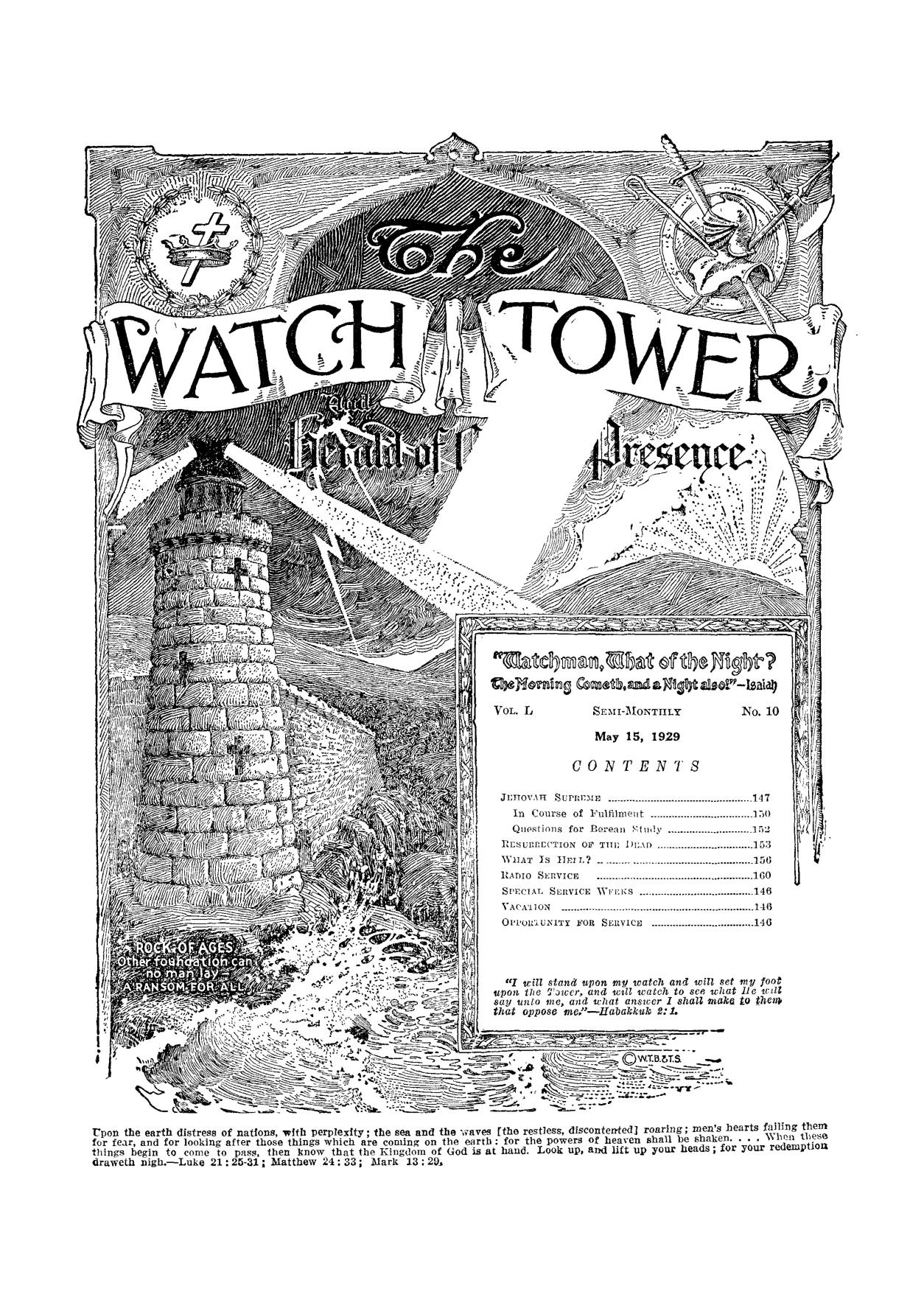
Vol. L May 15, 1929 No. 10
JEHOVAH SUPREME
“Behold, the Lord’s hand is not shortened, that it cannot save; neither his ear heavy, that it cannot hear.” — Isa. 59:1.
JEHOVAH is long-suffering and merciful. His mercy is great unto the heavens, and his lovingkindness is for ever extended to them that know and obey him. He takes no pleasure in the death of the wicked; but when his creatures continue in the way of wickedness and with no attempt at reformation, their destruction becomes a necessity for their own good. Every act of Jehovah is therefore unselfish. God is love.
2 Pride and vainglory cause some to disregard the mercy and loving-kindness of Jehovah God. Seeing those in danger who have made a covenant with him, God sends them a warning. Those who are still in possession of some meekness will hear the warning and change their course of action. Those who are proud and impressed with their own importance will not heed, but will harden their hearts toward God and his work. When the attempt is made to aid such to see the way of the Lord, the effort is repulsed and the proud assume that, because of the effort being made, they are needed by the Lord. Believing that they have developed such an approved character that the salvation of man and the operation of the universe requires them, they go on in their own selfish way.
3 The Prophet Isaiah (fifty-eighth chapter) is caused to sound a warning to those who have made a covenant with God and who have transgressed in violation of that covenant. The prophecy indicates that there are many who have taken their own selfish way in utter disregard of their covenant and God’s Word, although they have been offered the opportunity to serve God. The same prophet (fifty-ninth chapter) utters the sequel to the preceding prophecy. In both chapters the prophet who speaks is the anointed and approved prophet of Jehovah God, and therefore represents the class on earth today who are faithful and true to the Lord as witnesses. To such the Lord has committed his kingdom interests represented by his goods. As the instrument of Jehovah, the servant class takes its stand before those who refuse to heed the prophet’s warning and says to them: “Behold, the Lord’s hand is not shortened, that it cannot save.’’ The inference must be drawn that the disobedient have assumed an attitude that God can not get on without them. The prophet then tells them in substance that Jehovah is supreme and needs no one to help him. Regardless of what the creature may do, Jehovah’s prepared plan of salvation for man will be worked out exactly according to his will and exactly in due time. Everything that Jehovah does for man is for man’s own good.4 The purpose of the warning is a manifestation of mercy and loving-kindness on the part of Jehovah extended to those who have become lukewarm and indifferent to their covenant privileges. The words of the prophet are addressed to those who have spurned the warning. Those who continue in that attitude separate themselves from God. Even though a man has made a solemn covenant with the Lord, if he gets into a bad way, God does not save him from that condition until the creature admits his error and calls upon God for help. To such the Lord had already said that if they would turn away from their wrongful course and cry unto him he would hear and help. “Thou shalt cry, and he shall say, Here I am.’’ (Isa. 58: 9) But the prophet shows that some do not repent and cry unto the Lord. On the contrary, they continue in their way of iniquity. Then says the prophet of the Lord to them: ‘God’s ear is not heavy, that he can not hear.’ The cries of those who are repentant and desirous of service to God, he will hear, and he will lead them and help them.
5 Then the prophet addresses those who continue to oppose God, and says: “But your iniquities have separated between you and your God, and your sins have hid his face from you, that he will not hear.’’ (Verse 2) The marginal reading is, “sins have made him hide his face from you.” That means that God’s favor is withdrawn from them. If the lawless ones have separated themselves from God, what good could result from calling attention thereto? Manifestly the purpose is to awaken some of the weaker ones who are in danger and to rescue them from the influence of the stronger, self-willed ones who continue in the wrong way. It is a part of the warning which God commanded his servant to give, as set forth in the fifty-eighth chapter. To be sure, God would not have the warning sounded forth for his own good. It is an act of loving-kindness on his part toward those who have consecrated themselves to do God’s will. It is a warning for them to break away from the sinister influence of men and delight themselves in the Lord.
6 That the danger might be realized for their own good, the prophet of God then proceeds to set forth the terrible condition of those men who deliberately oppose the way of the Lord God. It would be a waste of time and effort to appeal to such as have, by reason of their iniquities, persisted in a course that has caused God to hide his face from them. If, however, there are those who are being held under the influence of the workers of iniquity and who can be made to see their danger and their opportunities to escape therefrom, then the warning and the recounting of the deeds of the iniquitous persons might result in good to those who will hear and obey.
7 God through his prophet makes it plain that it is not a lack on God’s part that causes such consideration, but is the lawless course taken by proud and unrepentant ones that has separated themselves from the Lord. It is their sins which have ‘made him to hide his face from them’. Then the dreadful situation of such is made known by the words of the prophet, to wit:
8 “For your hands are defiled with blood, and your fingers with iniquity; your lips have spoken lies, your tongue hath muttered perverseness. ” (Versed) Doubtless the course of iniquity by such workers was begun by evil surmisings and evil words spoken against their brethren. The tongue is a great enemy. Concerning it it is written: “And the tongue is a fire, the world of wickedness; thus is that tongue rendered among our members, which defiles the whole body, and sets on fire the wheel of nature, and is set on fire by gehenna. . . . but the tongue of men no one is able to subdue, an irrestrainable evil, full of death-producing poison.” — Jas. 3:6, 8, Diaglott.
9 An effort is made to hinder the work of the Lord by evil speakers using their power against it. Their desire is to kill the Lord’s work, and thereby they defile their hands with blood, which is a symbol of death. Their fingers, representing even their smallest efforts, are defiled with lawlessness. By their unlawful course these have corrupted themselves. It seems qui1e certain that the evil class here mentioned includes those clergymen or leaders in the denominational church systems who claim to represent God and yet who deliberately persecute those who they know are striving to serve God. Furthermore, the iniquitous ones embrace those who have been favored with the truth of God’s plan and who by reason of their perverseness have joined with the clergy in opposition to the work of the Lord. All such opposers are of the antichrist.
10 If the clergy were just, they would surely say: ‘Let the Bible Students tell what they know about God’s Word, and let the people judge as to whether or not they are right.’ On the contrary, they say to the people: ‘Don’t hear anything the Bible Students tell you. Burn their books and read nothing they bring you.’ Those who have been in the truth and then turn against the work of the Lord have entered into a combination with the clergy to accomplish an evil purpose against the Lord’s people. Whether they know it or not, they are working to the same end. They know that the clergy arc doing injustice to those who are striving to be witnesses for God, and yet they join with the clergy in seeing that the Bible Students should say nothing against the Devil’s organization. Once in the truth and then turning from it, and thus separating themselves from God, no more do they plead for justice and truth, but they speak against justice and truth. They trust in their own vanity and speak lies. Therefore the prophet of God, continuing to speak of and concerning them, says:
11 “None calleth for justice, nor any pleadeth for truth: they trust in vanity, and speak lies; they conceive mischief, and bring forth iniquity. They hatch cockatrice’ eggs, and weave the spider’s web: he that eateth of their eggs dieth, and that which is crushed breaketh out into a viper.” (Verses 4, 5) These opposers are in combination against the work God has commanded his anointed to do. They are working to the same end, to wit, the destruction of the work of God's anointed. They weave webs like the spider to ensnare the gullible. As food for such they provide that which is likened by the Lord unto cockatrice’ eggs, which results in death to those who feed upon that food. They resort to lies to accomplish their unlawful purposes, and when these arc crushed or exposed to others they break forth like vipers to destroy everything in their way. Continuing the prophet says:
12 “Their webs shall not become garments, neither shall they cover themselves with their works: their works are works of iniquity, and the act of violence is in their hands.” (Verse 6) The proud and vain workers of iniquity deceive themselves and try to cover up their evil course by an outward appearance; but the Lord declares that these webs they weave shall not be a garment to cover them. They do not deceive the Lord’s elect by their works, and of course they do not deceive the Lord. They do deceive some who follow their advice, but the Lord through his prophet says that their works of iniquity shall be uncovered; and without a doubt this is done for the benefit of the ones who have been put under the yoke of the workers of iniquity. God offers the opportunity for the breaking of that yoke, that the less guilty may escape. Continuing to describe the evil done by those who are opposing the message of God’s kingdom, the prophet says:
13 ‘‘Their feet run to evil, and they make haste to shed innocent blood: their thoughts are thoughts of iniquity; wasting and destruction are in their paths. The way of peace they know not; and there is no judgment in their goings: they have made them crooked paths: whosoever goeth therein shall not know peace.” (Verses 7, 8) The Apostle Paul, addressing the Jews, emphasizes the fact that man can not by his own efforts make himself righteous; that this can be done only by faith in the blood of Jesus Christ, and then by following in the footsteps of Christ Jesus in doing God’s will. He shows that the praise of men or the approval of men could result in no benefit, but that God alone must approve. (Rom. 2:29) He then quotes the above words from the Prophet Isaiah to show the condition of those alienated from God. But the context, both of the words of the apostle and of those of the Prophet Isaiah, shows that they are applicable to the people who have known the way of God and who by their perverse heart and course of action have separated themselves from God. (Rom. 3:1-22) Therefore the words of the prophet would mean that those thus described as having taken the evil course have been brought down to the lowest level of iniquitous humanity. These words show that the clergy and those who have held positions of confidence and trust among the people of God, such as elders and leaders, and who have turned away from God, are the most reprehensible of all creatures aside from Satan himself. Such are the same as those described by the psalmist. “Thou sittest and speakest against thy brother; thou slander- est thine own mother’s son.”—Ps. 50: 20.
14 These concoct schemes of evil against those who were once their brethren because brought forth by the same covenant. The student of God’s Word is reminded of a terrible condition that existed at a former time amongst men. (Jer. 6:5) The prophet of God, in the eighth verse above quoted, says that these workers of iniquity have made crooked paths for their feet. They have made common cause with Satan’s organization by turning from the Lord and persecuting his people, and therefore the way of peace is not known to them. Jude describes those who “speak evil of those things which they know not”. Then he describes them as those who like Cain would murder their brother. He that hates his brother is a murderer. Again Jude describes them as those who, like Balaam, preached for reward or approval of men; and again, as those who, like Core, refused to hold the head and therefore refused to follow Christ as head of God’s organization. The fact that record is made of such shows that this class is amongst the people of God. Then Jude says to them: “These are spots in your feasts of charity, when they feast with you, feeding themselves without fear: clouds they are without water, carried about of winds; trees whose fruit withereth, without fruit, twice dead, plucked up by the roots; raging waves of the sea foaming out their own shame; wandering stars, to whom is reserved the blackness of darkness for ever.” (Jude 12, 13) Whosoever therefore follows where such men lead will find themselves hopelessly involved in the way of evil; and continuing therein, their end will be destruction. The warning of the prophet is, doubtless, to recover the ones that are being influenced by the evil class described by Jude.
15 Those who have proudly walked in the way of evil have deceived themselves and others. (2 Tim. 3: 13) They have become bold and brazen. They have once known the Lord and turned away from him and have then come to realize that they have no light but that they walk on in the darkness. Then God, by and through his prophet, makes such speak against themselves. Be it noted that in their speech there is not the slightest expression of regret for their terrible condition. The prophet records them as speaking of themselves thus:
16 “Therefore is judgment far from us, neither doth justice overtake us; we wait for light, but behold obscurity; for brightness, but we walk in darkness. We grope for the wall like the blind, and we grope as if we had no eyes: we stumble at noonday as in the night; we are in desolate places as dead men. We roar all like bears, and mourn sore like doves: we look for judgment, but there is none; for salvation, but it is far off from us. For our transgressions are multiplied before thee, and our sins testify against us; for our transgressions are with us; and as for our iniquities, we know them; in transgressing and lying against the Lord, and departing away from our God, speaking oppression and revolt, conceiving and uttering from the heart words of falsehood.”—Verses 9-13.
17 The words of the prophet here seem to say that such workers of iniquity come to know how dreadful their course has been and is. They know that they have taken a lying course against Jehovah and have spoken in revolt of his Word and in repression of his service. These workers of iniquity are not satisfied to be steeped in evil themselves, but if they see one trying to depart from evil and take the right course in serving the Lord, they make that person a prey. Then God speaks by and through his prophet concerning the result of the evil course of the workers of iniquity and says:
18 “And judgment is turned away backward, and justice standeth afar off: for truth is fallen in the street, and equity cannot enter. Yea, truth faileth; and he that departeth from evil maketh himself a prey; and the Lord saw it, and it displeased him that there was no judgment.” (Verses 14, 15) With those who have taken the course of evil against the Lord and his work, truth is fallen in the street or by the wayside, and equity and righteousness can no more be with them. So far as they are concerned, the truth has failed. Once knowing the truth, there was no excuse for them to fail to see that God would have his anointed ones testify to his name and his works while he proceeds to set up his government for the benefit of man. They had no reason to refrain from calling attention to the enemy’s organization, its blinding influence and effect, and great oppression of mankind. There was no excuse to refuse to tell the people that God with his strong arm would dash to pieces the enemy organization and deliver mankind. They revolted against the truth and joined with the oppressors. The Lord saw it, and it displeased him that there was no proper conclusion reached by them that work against the cause.
IN COURSE OF FULFILMENT
19 The facts show that the prophecy here under consideration is in course of fulfilment, and that must mean that God intends for his anointed now to have some understanding thereof. It was in the year 1918 that the Lord came to his temple, and there judgment came upon those who claimed to be followers of Christ Jesus. (1 Pet. 4:17) It was about that time that the nominal church systems, under the leadership of their clergy, rejected in toto the Lord’s plan and adopted the Devil’s plan of salvation. It was about that time that great distress came upon the anointed of the Lord, and many who had professed to be walking according to present truth turned back and began the persecution of their brethren. Such thereby joined the enemy. Since that time both the nominal church clergymen and those who departed from the truth have been working to the same end, whether by actual agreement or not. Their object has been the overthrow and destruction of the Lord’s work on the earth. Both classes of these opponents should have been active in honoring the name of Jehovah by declaring his name and plan of salvation for the people instead of following their own selfish devices. Proud and arrogant, they have exalted themselves and followed their own selfish course. They induce themselves to believe that they have the work of salvation in their own hands, and they would do it in their own way. Displeased with the course of action God’s anointed take in obedience to his commandments, the opposers have persecuted the remnant of the Lord. God announced his displeasure with these workers of iniquity, and through his prophet says: ‘The hand of the Lord is not shortened, that he can not save. ’
20 The Lord has no need of any other. Surely he needs not those who work iniquity. Then says the prophet: ‘Neither is his ear heavy, that he can not hear. ’ God hears those who cry unto him in sincerity and in truth and grants his favor unto them. This terrible condition having obtained, and seeing that the workers of iniquity were dragging others with them, God directs his servant class to ‘cry out aloud, and lift up the voice like a trumpet, that his people may see their transgressions’. This he does that they might turn away from the transgression and no longer be deceived by the proud, self-centered and lawless ones. That message is given forth by the true lovers of God and of his righteous cause. The workers of iniquity who profess to be of the Lord, whether in the truth or out of it, God now declares to be against him and therefore proves they are false. The goodness of God hardens the heart of such, even though they still call themselves by his name. Among these workers of iniquity there is no one who will make a move toward repentance or make an intercession with God. Therefore says God through his prophet:
21 “And he saw that there was no man, and wondered that there was no intercessor: therefore his arm brought salvation unto him; and his righteousness, it sustained him.” (Verse 16) The due time arrives for God to act. He sends forth the faithful servant class to represent him. These are under the direct supervision of Christ Jesus, the great right Arm of Jehovah God. These faithful servants are in partnership with God and with Christ, because they walk in the light and rejoice to do the will of God. (1 John 1: 7) Armed in the holy cause of God, in righteousness the servant class comes forth. God himself is in supreme command thereof; and his beloved Son, as the Head of Zion, and all who are of Zion, go forth in complete harmony to represent the Lord. The prophet of God, then speaking concerning the faithful servant class of Jehovah, Christ and his body members, says:
22 “For he put on righteousness as a breastplate, and an helmet of salvation upon his head; and he put on the garments of vengeance for clothing, and was clad with zeal as a cloke.” (Verse 17) The battle is Jehovah’s and the time has come for him to get himself the victory. The prophet here speaks also concerning the servant class which is now, in obedience to God’s commands, clothed in the armor of the Lord. These “put on righteousness as a breastplate”, because their heart devotion to God is whole and complete. They put on the “helmet of salvation” as the servant class of the Lord, because they are all of one mind and that is the mind of Christ, the Head of Zion. They intelligently and obediently follow the Lord. The servant class furthermore ‘put on the garments of vengeance for clothing’ because they are identified as the ones commissioned by Jehovah to declare the “day of vengeance of our God” and they do it. (Isa. 61:2) The servant class is “clad with zeal as a cloke”, because these have the approval of God and possess the burning zeal peculiar to his house. Such is the armor of Almighty God, and is so described by the Apostle Paul. (Eph. 6:10-18) All who are in harmony with Jehovah must be thus clothed. Clad in the accoutrements of warfare and in the capacity of an avenger, God and his entire organization move on to the scattering and punishment of the enemy and to the complete vindication of Jehovah’s name. God remembers the degree of iniquity of the evil class, and he deals with them accordingly. Concerning such, through his prophet he says:
23 “According to their deeds, accordingly he will repay, fury to his adversaries, recompence to his enemies; to the islands he will repay recompence.’’ (Verse 18) God will show his fury against those who have deliberately opposed his work of righteousness and will recompense those who have stood on the side of the enemy. There are those amongst God’s people who have faith in God but who are looking to the time when they may enter into his glorious realm. Concerning his commandments to sing forth his praises they are negligent and indifferent. They are content to meditate upon the Word of God and do nothing. But they do not rely upon the restless world. They do not put their trust in the power of restless humanity. Such are of God’s organization, and are described as Jerusalem which shall be taken in the battle. (Zech. 14:2) They are otherwise called the great multitude. (Rev. 7:9) They come in for a just recompense in the great tribulation that will mark the complete overthrow of the enemy’s organization. In another part of the prophecy of Isaiah the prophet mentions the faithful servant class as speaking to the same class, thus: “Listen, 0 isles, unto me; and hearken, ye people, from far.’’ (Isa. 49:1) In the prophecy here under consideration (Isa. 59:18) the prophet of the Lord says: “To the islands he will repay recompence.” The prophecy therefore must mean that when God’s fury is expressed against the adversary those of the great company class will receive a just recompense due them.
24 The prophet represents the faithful servant class as a part of God’s organization participating in the battle against the enemy. It is the battle of Almighty God, however, and Jehovah does the real fighting by and through Christ Jesus, his beloved Son and chief executive officer. The remnant class is counted in as participating in the battle, because these sing forth the praises of Jehovah and at the same time give notice of his purpose of avenging and vindicating his name. As the forces of righteousness move on in battle those who hear and heed the warning are represented as looking up from the west toward the rising sun which marks the beginning of the manifestations of God’s almighty power. As these take note they will begin to fear the name of the Lord God and to observe his glory and manifestation of his power. Concerning such, the prophet further says:
25 “So shall they fear the name of the Lord from the west, and his glory from the rising of the sun. When the enemy shall come in like a flood, the spirit of the Lord shall lift up a standard against him.” (Verse 19) In this verse the Authorized Version reppresents the enemy as coming in like a flood. The Revised Version renders that part of the text thus: “For he shall come as a rushing stream which the breath of the Lord driveth.” Whichever rendering is accepted as correct, we know from this and other scriptures that Satan will assault the people of God like a rushing flood and that God will drive the enemy and his forces asunder and completely wreck his organization. For the encouragement and comfort of those who have a hearing ear, the prophet then says:
26 “And the Redeemer shall come to Zion, and unto them that turn from transgression in Jacob, saith the Lord.” (Verse 20) God thus declares his purpose to fully protect and save Zion by the hand of his beloved Son, the Head of Zion. The words of the prophet here also show the reason for God’s causing this prophecy to be recorded concerning those who become desperately wicked. That purpose is shown to be as a warning to all of the house of Jacob who still possess some love for God. The great Deliverer comes also “unto them that turn from transgression in Jacob”. Again God shows his mercy and loving- kindness to those who do not harden their hearts but who turn to him and joyfully obey him. In corroboration of this prophecy, by another prophet God shows that some will harden their hearts.—Ps. 95: 8-11.
27 In harmony with this prophecy of Isaiah, Jesus declared that he would send forth his angels and would ‘gather out of his kingdom all things that offend, and all that do lawlessly’, and that then the righteous should shine forth as the sun. (Matt. 13: 41-43) That day of shaking and separating of the false from the true is at hand. Let all who are of God’s organization take warning. Let no one of the household of God be influenced or guided by any human being on earth. God declares that ‘no flesh shall glory in his presence’. (1 Cor. 1:29) It could not therefore be pleasing to God for any one to glory in the learning, ability or acquisition of a fleshly being. Let all the followers of Christ take full warning of this. There may be in an ecclesia some elder; who has long been held in high esteem and confidence by the members of that ecclesia, and to whom many have looked for advice. If that elder opposes the Lord’s work, particularly the giving of testimony now to the name of Jehovah and the declaring of God’s vengeance against the enemy’s organization and of God’s purpose to set up his kingdom of righteousness, do not heed the advice or follow the course of that elder. Look to the Lord and his Word for guidance. The things which he has heretofore caused to be written were written for the encouragement and comfort of those now on the earth. (Rom. 15: 4) No man’s advice, regardless of who he is or what position he holds, should be taken when that advice or course of action is contrary to God’s Word.
28 God commissions his anointed to declare the day of his vengeance against his enemy and to tell of his great works and the establishment of his kingdom of righteousness. (Isa. 61:1-3; 43:10-12; 12:1-6) Any man or woman who advises against any or all of the anointed’s participating in giving this witness is giving such advice contrary to the Word of God. The advice of no such opposer should be taken by any one who is consecrated to the Lord.
29 Each consecrated one has a responsibility before God to know his Word and to obey it. God has made it so plain in his Word that he has called out a people for his name to give testimony concerning his name and plan that there is no excuse for any of his children now to err as to the will of God. If one who loves God supremely, who seeks his counsel and is guided thereby, follows that righteous course, he will be fully protected from the blinding influence of the enemy. Those who take a contrary course shall suffer that which God, through his Prophet Isaiah, in the prophecy here under consideration, points out.
30 The Lord draws a contrast between those who trust him fully and those who turn aside unto their crooked ways: “They that trust in the Lord shall be as mount Zion, which cannot be removed, but abideth for ever. As the mountains are round about Jerusalem, so the Lord is round about his people from henceforth even for ever. For the rod of the wicked shall not rest upon the lot of the righteous; lest the righteous put forth their hands unto iniquity. Do good, O Lord, unto those that be good, and to them that are upright in their hearts. As for such as turn aside unto their crooked ways, the Lord shall lead them forth with the workers of iniquity; but peace shall be upon Israel.”—Ps. 125:1-5.
31 Without a doubt the warning is given for the benefit of those who have an honest desire to be pleasing to the Lord and who are in some measure wrongfully influenced in taking a course that they are now taking. If such as are the Lord’s people heed his warning and ‘turn from their transgressions’, they have the promise of God’s blessing. Concerning such the prophet says: “As for me, this is my covenant with them, saith the Lord: My spirit that is upon thee, and my words which I have put in thy mouth, shall not depart out of thy mouth, nor out of the mouth of thy seed, nor out of the mouth of thy seed’s seed, saith the Lord, from henceforth and for ever.” —Isa. 59:21.
32 Jehovah delights in blessing those who delight themselves in him. He will have his family be a joyful and glorious one. To the wicked and erring ones he extends his mercy and loving-kindness that they may return to him and receive the blessings which he has in store for those that truly love him. Let the remnant be not at all discouraged by the harsh criticism leveled against them by the opposers of the truth. Let the lukewarm ones of the Lord’s people arouse themselves and put on the zeal peculiar to the Lord’s house. Let all take courage and press on in the keeping of God’s commandments. Let all who are God’s anointed ones henceforth and for evermore sing the praises of our God.
QUESTIONS FOR BEREAN STUDY
In what are Jehovah’s long-suffering and mercy manifest? To whom are his warnings given? Describe the circumstances necessitating the Lord’s bringing his words of warning to the attention of his people. Point out the purpose of such counsel, and how differently two classes receive it. 1-4.
Seeing that the lawless ones have separated themselves from God, justify calling attention thereto. 5-7.
In the light of the apostle’s statement (Jas. 3:6, 8), how, doubtless, have the iniquitous and sinful come into their condition of defilement? What are the facts supporting this conclusion? 8, 9.
Show how those who have separated themselves from present truth are really in combination with the clergy against the Lord’s people and his message of truth. Quote the Lord’s judgment against these, as recorded in verses 4 and 5, and show the application thereof. 10, 11.
Show that the iniquitous attempt to conceal their works, and whether they will succeed therein. Give the words of the Prophet Isaiah, describing the condition of those alienated from God. The application is to what class, as shown by context? What does the apostle say as to the means by winch a person is justified? How do the psalmist, the Prophet Jeremiah, and the Apostle Jude refer to these? What in the words of each indicates that these workers of iniquity are amongst the people of God? Then how timely is the Lord’s warning to his people now? If 12-14.
In the prophet’s words respecting those who have once known the Lord and have turned away from him, what admission do these themselves make concerning their present condition and their attitude toward those who would face about and take the right course? Then how should even neglect and indifference, as a beginning of iniquity, be regarded by God’s people? 15-18.
Explain why since 1918 many have turned away from present truth and have joined the enemy. Describe the position now taken by that class. 19.
For what purpose, then, does God direct his servant class to ‘cry aloud, and lift up the voice like a trumpet’? Under what arrangement and supervision will the servant class go forth to carry out their commission? Describe their armor and their peculiar zeal. 20-22.
Identify the “adversaries”, the “enemies”, and the “islands”, referred to in verse 18. How will God deal with each of these classes? 23.
What is the part of the remnant class in the battle of Almighty God? 24.
What, activity on the part of the enemy is suggested in verse 19, and what results? 25.
Apply, “The Redeemer shall come (a) to Zion, and (b) unto them that turn from transgression in Jacob.” 26.
Locate the day referred to in Matthew 13: 41-43. By what standard only must all counsel, whether of elders or of others, be weighed? What should be the attitude of every one of the Lord’s people toward any indifference or opposition to engaging heartily in the witness work now to be done? Point out the personal responsibility of each of the anointed in this respect. 27-29.
The psalmist draws what contrast between the faithful and those who turn aside? State the promise given to those who heed the warning and “turn from their transgressions”. Clearly, then, what is the proper procedure for the faithful remnant at this time? 30-32.
RESURRECTION OF THE DEAD: WHY NECESSARY?
[Thirty-minute radio lecture]
THE great majority of people are taught that when a person dies he is more alive than ever.
This belief is common among Christian people and is shared by heathen people as well. It is quite common, on funeral occasions, to hear expressions like this: ‘There is no death; what seems so is merely a transition from one scene of activity and life to another. Your loved one is not dead: he is present with us today and fully aware of what is taking place on this occasion.’
The foundation for such belief is found in the age- old doctrine that every man possesses an immortal soul that can not die. This doctrine is held alike by both heathen and Christian. It is supposed that every person has somewhere in his body something that is called a soul, and that at the moment of death this soul escapes from its prison and lives on in either a more happy or a less happy environment, depending on whether or not the individual has repented of his sins and received forgiveness. If a proper repentance has occurred and a proper forgiveness received, the individual is supposed to live on in glory, as a spirit being, happy beyond the power of words to describe. If, however, such a forgiveness has not been given, it is supposed that the individual will continue to live on either in an intermediate state called “purgatory”, or in a horrible place called “hell” to be tormented by the Devil and a horde of imps throughout all eternity.
Those who believe that dead people are more alive than ever find themselves in groat difficulty when considering the Bible doctrine of a resurrection of the dead. Their belief makes confusion in their minds on this subject of the resurrection; for if a man who dies is more alive than ever, then how can he be resurrected? And if he is alive and happy, and has shaken off this old mortal coil, as the body of flesh is often called; if he has escaped from the prison of the flesh, and is free from its limitations, why should a resurrection be necessary or even be desired?
In an effort to avoid this confusion, they are driven to the necessity of claiming that it is the body that is resurrected, at some most distant date, and will be united with the soul again. As a result they have a man-made “Apostles’ Creed” that none of the apostles ever saw, which has a sentence in it as follows: “I believe in the resurrection of the body.” The claim that it is the body that dies and will be resurrected adds more confusion to that already existing in their minds, for the Scriptures tell us in most emphatic language that it is the soul that dies, and that the body will not be resurrected.
Let me quote some of the proofs. In Ezekiel 18; 4, 20 we read: “The soul that sinneth, it shall die.” Also, in 1 Corinthians 15:37, 38, we read: “Thou so west not that body that shall be, . . . but God giveth it a body as it hath pleased him.” Thus do the Scriptures deny the teaching of the creeds. Moreover, every one knows that our present bodies are not desirable. They are full of wounds and bruises and putrefying sores; pains and aches, disease and death. If it is true, as claimed by the creeds, that when a man dies he has escaped out of the prison-house of his old body, why want to come back into the prison? If one has thus escaped into a larger life and is beyond the limitations of the flesh, and enjoying bliss unspeakable, then, to resurrect the body and reunite it with the soul would mean to fetter the soul with all the handicaps that it formerly had. Thus we see that the theory, that it is the body that dies and is resurrected, only intensifies the confusion on this subject and places it in violent conflict with the teachings of the Scriptures.
The resurrection of the dead is one of the most important doctrines found in the Bible. Every Christian should have a proper understanding of it, and should not be content until he has such an understanding. To reach this understanding, it is of the utmost importance that he discard the teachings of the creeds and go directly to the Bible for his instruction. To the reverent and honest student the Bible furnishes a most complete and satisfactory explanation of two important questions, namely, What is meant by the word “resurrection”? and, Why is a resurrection necessary?
The word “resurrection” means to restore to life again. It means that a being has formerly had life, and for some reason has lost the same, and will receive back again the life that had been lost. This, which is the Bible explanation, is very simple. Even a child can understand it. But if one is handicapped by the creeds, he has been taught that a person who dies has not lost anything, but, on the contrary, has gained something, because he now lives on a higher plane, in a better environment, and enjoys a larger liberty than he did before he passed through what the creeds call the gate of death. In the creeds, death is pictured as a door or gate into higher life; but the Bible never pictures it thus. In the Bible, death always means to pass out of existence; it means the very opposite of life.
Over and over the Bible confirms this thought. In Ecclesiastes 9:5 we are plainly told that “the dead know not any thing”. Again, in Psalm 146:4 we are told that a dead man “returneth to his earth; in that very day his thoughts perish”. If, as the Bible teaches, a man who is dead knows nothing, if even his thoughts are perished, then it becomes an easy matter to discern what a resurrection means and why a resurrection is necessary.
A question that must be considered in the discussion of this subject is, How did man become subject to death? Why is death necessary, and why does God permit it? The Bible clearly answers all these questions; but the creeds are silent on them for the reason that the creeds assume that there is no death.
According to the Bible, God created this earth with the benevolent intention of making it the home of a happy and sinless race of human beings. With this purpose in view, he started the race in Eden and commissioned Adam and Eve to multiply and increase and fill the earth with their posterity. But God also purposed that no one could have everlasting life on earth unless he should first prove himself loyal to God and obedient to his law.
Hence God placed the first man under certain tests, in order that he might prove his worthiness to live for ever on the earth. Under this test, the divine arrangement was that if the man proved disloyal and disobedient, he was to die. This meant that he would forfeit and lose his life and his right to live. God did not tell Adam that he would go to eternal torment; he did not tell him that death would be simply a doorway into a higher and belter life; but he did tell him that death would be the punishment for disobedience. Paul says that “the wages of sin is death”. (Rom. 6:23) God told Adam that he would return to the dust as he was. Let us get this thought in all its significance; namely, Death is a penalty for disobedience, and is not a reward for obedience.
After Adam had sinned he was driven out of his beautiful Edenic home and left alone to die. He had forfeited his right to his home and his right to live. God deserted him; or more properly speaking, he had deserted God. After 930 years of struggle against the death penalty which had been pronounced against him; after trying in every way to keep himself alive, by eating the fruits of his own labor, he finally succumbed to the inevitable and passed into death.
This means that he passed out of existence, and that if he ever has life again it must be a gift from God in the nature of a resurrection and a restoration to his former condition. His posterity were born under this same condemnation and, like Adam, have gone down into death, have returned to the dust as they were, which means that they have ceased to exist. They are dead, sleeping in the dust of the earth, and awaiting a resurrection which God has promised all through his Word.
God has promised just such a resurrection and restoration, by all the prophets and apostles who have written the Bible. He has purposed that Jesus, the second Adam (1 Cor. 15:45, 47), shall first ransom the first Adam and all his posterity from the power of the grave, as recorded in Psalm 49:15 and Hosea 13:14, and that then the second Adam shall recover for the first Adam and his posterity just what the latter lost for himself and them, namely, the right to go on trial, to pass other tests intended to prove their loyalty and obedience, and give them, if obedient, just what was promised Adam if he had obeyed in the first trial in Eden, namely, eternal life.
This is why Jesus could say: “I am the resurrection, and the life.” (John 11:25) Again, Jesus said: “The Son of man is come to seek and to save that which was lost.” (Luke 19:10) Now an excellent question is, What was lost? And the Bible tells us in most unequivocal terms that Adam lost the right to live on earth. This is what he will receive again, and his posterity will receive, at the hands of the second Adam.
What a glorious prospect lies just ahead of the present time for the human family! How grand it will be when the graves begin to open and the dead begin to come forth again, not to sickness, pain, disease and death, but to be restored to the perfection of being that Adam lost in Eden!
This great work is to be accomplished by Jesus, who, as the second Adam, the great agent of Jehovah God, will reign a thousand years. During the thousand years he will bind the Devil and restrain every evil work and every person that would do iniquity, and will write the law of God on every human heart. Then for the first time those children of Adam who are called ‘ ‘ heathen ’ ’ will learn why they had to die: that it was for the disobedience of the one man. They will also learn for the first time about the loving plan of God for their ransom from the curse of death, and their deliverance into the glorious liberty of the sons of God. They will learn that Christ died for their sins and made a resurrection possible for them. They will have their first opportunity to prove their loyalty and obedience to God.
During the thousand years all those who have died in infancy will come forth from the tomb, and for the first time will learn of the love of God and of Jesus and will have an opportunity to prove their loyalty and obedience and their right to live eternally on the earth. During this same thousand years all those people who have been blinded by the creeds, who profess to be Christian and yet do not know the truth, will come forth from the tomb and have an opportunity to honor their heavenly Father by believing the truth; and this will be the first time they will ever have fully understood and appreciated the same. They will then unlearn the creeds which have so blinded them in the past.
Who is to blame for these creeds, which have hidden the truth for centuries? The answer is that, primarily, Satan is to blame. He is the great adversary of God. He delights to misrepresent God and the Bible. It serves his purpose so to do. He is a wily creature, and realizes full well that if he can make creeds that misrepresent God and the Bible and get the people to believe the creeds, they will, of course, believe that the Bible supports the creeds. Satan has also taught the people that the creeds summarize the teachings of the Bible, and, therefore, that if they know the creed it is not necessary to study the Bible; hence we find that most people think that Bible study is unnecessary. In fact, many people believe that it is dangerous to study the Bible, and say: ‘If you pry into God’s secrets too much you will go crazy.’ Such remarks arc of Satan and are designed to keep people from investigating the Bible; for he is well aware that if people study the Bible they will shortly repudiate the creeds.
Bible study is delightful as well as instructive. It reveals God’s plans and purposes to his amazed creatures. It clarifies the truth. On the contrary, the creeds confuse, perplex, frighten and discourage the people. Many people who believe the creeds inwardly hope they are not true, and some with more liberty than others openly express this hope. The Devil has the people so in bondage to the creeds that if any one doubts or denies them he is immediately branded as an infidel or a heretic; and the Devil has made people believe that it is a great disgrace to be called an infidel or a heretic. This feeling, that they will be disgraced, only increases the bondage.
But how could Satan succeed in this work of blinding and deceiving the people? The answer is that he has worked through human dupes. He finds among the human family some men and women who are ambitious; who like to shine among men; who like to be leaders of thought, leaders in some important movement. They like to have a following and to have their names emblazoned on the front page of the newspapers, or to have their names go down in history. These people like to draw attention to themselves. Having selfishness enthroned in their hearts, they are unfit for the service of the Lord; and so the Devil, who is the very embodiment of selfishness, uses them to further his selfish purposes. Selfish people are not particular whom they slander or misrepresent if they can accomplish their ends. So Satan uses such people to start some creed. Then he uses other selfish people to popularize it. He can find plenty of people who will, for a money consideration, print and circulate the same, and write up news items extolling the virtues of the said creed. Soon it has a following. Innocent and guileless people are duped into believing that it is supported by the Scriptures.
Again, Satan uses another class of superstitious people, a class who love the occult, the mysterious; who love to delve in mesmerism, hypnotism, black art or healing of disease. He panders to their ambitions, and uses them to foist on the race false ideas of divine healing, of communication with those who have died, and makes them believe they are heaven’s favorites by giving them what seem to be miraculous powers by which they can do secret and occult things. This appeals to certain ones and soon crystallizes into a creed. Thus many more are deceived.
These creeds, of which there are hundreds in the earth, are contradictory one of another, as well as contradictory of the Bible. Nevertheless, great colleges and theological schools are built to educate others in the creeds and send them out to poison other minds and blind them to the beauties of Jehovah’s plans and purposes. In this way Satan has perpetuated the creeds and fastened them with viselike grip on the minds and consciences of millions of people. It is an undisputed fact that it is the clergy of our day who are teaching these creeds to the people and urging them to worship and venerate these more than the Bible. Thus the clergy become the tools of Satan, some of them ignorantly so, and others wilfully and maliciously so.
The doctrine of the resurrection is a most beautiful doctrine. Nothing could be more comforting, and surely nothing could be a greater honor to Jehovah God, nor prove his love and power more. Why should any one refuse to believe the plain and beautiful teachings of God’s Word? There are several answers to this question. Some men esteem themselves too highly and therefore put their own views ahead of the teachings of God’s Word. Others esteem some other man or men too highly and put the sayings or teachings of these men ahead of the Word of God. Others are so extremely selfish and dishonest that they allow their love of money, position or power to swerve them from honoring Jehovah God. Still others have not taken the time to investigate and are conscientiously believing and teaching the error. Being conscientious in their beliefs, they oppose those who advocate the truth.
The Bible calls attention to two resurrections, a first resurrection and an afterward resurrection. Why the two resurrections? we ask; and the answer is just as beautiful and harmonious as one could wish. When Jesus was on earth, at his first advent, he was continually pointing forward to a coming kingdom. He taught his followers to pray for that kingdom. Other Scriptures show that that kingdom is a thousand years long; that it is right here on the earth; and that during that kingdom Satan is to be bound in order that he may deceive the nations no more.
Now comes a most wonderful fact, namely, that Jesus invited 144,000 men and women to deny themselves, take up their cross, and follow in his footsteps. He told these to “search the Scriptures”; to “preach the word”; and that if they were faithful they would have all manner of evil said about them falsely; that they would be persecuted, reviled, and that some of them would be killed. This would be a test of their loyalty and obedience; and if they faithfully stood the test these would come up in the first resurrection and reign with him during that thousand years. Their reward would be glory, honor and immortality, and they would get this reward in the first resurrection.
Speaking of the first resurrection, of this 144,000, Jesus said: “Blessed and holy is he that hath part in the first resurrection; . . . they shall be priests of God and of Christ, and shall reign with him a thousand years.” (Rev. 20:6) Jesus also said of them: “I appoint unto you a kingdom, as my Father hath appointed unto me.”
This explains why there is a first and an afterward resurrection. The first resurrection is for this elect, special class, who will faithfully follow in Jesus’ footsteps now and prove their loyalty and obedience to Jehovah God now. They are to share in the kingdom work with Jesus. These will assist Jesus in the work of awakening all the rest of the dead and bringing them to a knowledge of the truth. Their reward will be a heavenly one, for it is written that they ‘shall be like the Lord and see him as he is’.
The rest of the race will be awakened to life on the earth again and have an opportunity to prove faithful and loyal during the thousand years, under the special help and ministration of Christ and the faithful elect church.
Other scriptures show that some will carry their selfishness and ambition to the length of refusing to come into harmony with God and that such ones will be destroyed in the second death. The Bible repeatedly refers to the second death; but the creeds are silent about it because, if the creeds were true, that a man, when he dies, is more alive than ever, how would a second death be possible?
The Bible teaching of a second death for the wilfully wicked is a point-blank denial of the creeds.
Answering the question, then, Why is a resurrection necessary? The Scriptures clearly indicate that it is necessary in order that people may have life. Without a resurrection death would end all. People would remain for ever dead. There would be no hope for the race, as Paul most emphatically states. He says: “If there be no resurrection of the dead, then is Christ not risen; and if Christ be not risen, then- is our preaching vain, and your faith is also vain.” (1 Cor. 15:13, 14) Ah, yes! If there be no resurrection, there can be no hope for any member of the race; and it would be useless to try to preach the gospel, for the reason that there would be no gospel to preach: no hope to set before the race and no basis for a proper faith.
The resurrection of the dead is the logical result of the death and resurrection of Jesus; and for any one to teach that the dead are more alive than ever completely nullifies the beautiful, harmonious and consistent doctrine of the resurrection of the dead as taught in the Bible.
WHAT IS HELL?
[Thirty-minute radio lecture]
THE word “hell” is a Bible word. Among professing Christian people it is generally supposed to be a place where sinners are everlastingly tormented in a literal lake of fire and brimstone, at the hands of a wicked creature, called the Devil, who is aided in this work by a host of lesser devils. It is claimed to be, and taught to be, a place of indescribable cruelty and suffering. Parents, who love their children, have been guilty of threatening them with this everlasting torture for some slight offense against parental authority or for some mischievous act; and children who have been taught this cruel doctrine have suffered untold agony and spent many sleepless hours, fearing that the Devil or some of his imps would come to carry them to this place of torment.
Mothers and fathers have likewise suffered in anguish of heart, believing that a loved son or daughter who died without having joined some church was suffering in this place of fiery torment, never to be released. Many Christian people honestly believe that infants dying without being baptized must always suffer this same torment because their parents neglected to have the rite performed.
It is also generally believed that all those liars, thieves, murderers, adulterers, bribers, grafters, profiteers and those who indulge in other forms of sin, who die without being converted must spend eternity in this torment. It is further claimed that those fortunate ones who succeed in getting into heaven can look over the battlements of heaven and see their loved ones writhing in torment and still be serene and happy themselves because they are convinced that their loved ones deserve this cruel fate. It is further believed that the unfortunate ones who are suffering in this torment will be able to see their loved ones in heaven, and will beg for a drop of water to alleviate their anguish, only to find that those in heaven are so happy and contented with their lot that they will turn a deaf ear to their cry.
It is claimed that God is the author of this doctrine, and that in some indescribable way it will redound to his glory. Men and women who believe and teach this doctrine try to convince themselves that God can still be a God of wisdom, justice and love, and condemn sinners to this awful punishment.
The heart of every good man and woman on earth rebels at the thought of eternal torment, and in their inmost heart they hope that it is not true. No honest person would thus torment a dog; and if a brute beast were thus tormented, the laws of men would send the tormentor to prison. Love recoils at the thought, reason rejects it, and justice forbids it. It would be impossible to conceive of anything more wicked, cruel and unjust than the doctrine that God has created a lake of fire and brimstone for the purpose of tormenting any of his creatures and has also created a being called the Devil to do the tormenting. This doctrine is not true. It is not taught in the Bible, and its author is the Devil himself.
Satan’s object in leading the people to believe in eternal torment is to cast a reproach upon the name of Jehovah God and his Word, so that otherwise good and loving people would reject the Bible because they think it teaches these horrible doctrines. Millions of people have rejected the Bible because they have thought it teaches this theory; and those people who have taught it, however unwittingly they may have done it, are guilty before God of having misrepresented him and his Word and also of having injured their fellow men. These must give an account of the same before the judgment bar of Jehovah God.
The Bible teaches very clearly that there is a "hell”; but the description just given is not the description of the Bible hell; it is a description of the theological hell, the hell of the creeds, which originated in the dark ages.
…