Golden Age, February 20, 1929
Download: PDF — Golden Age, February 20, 1929
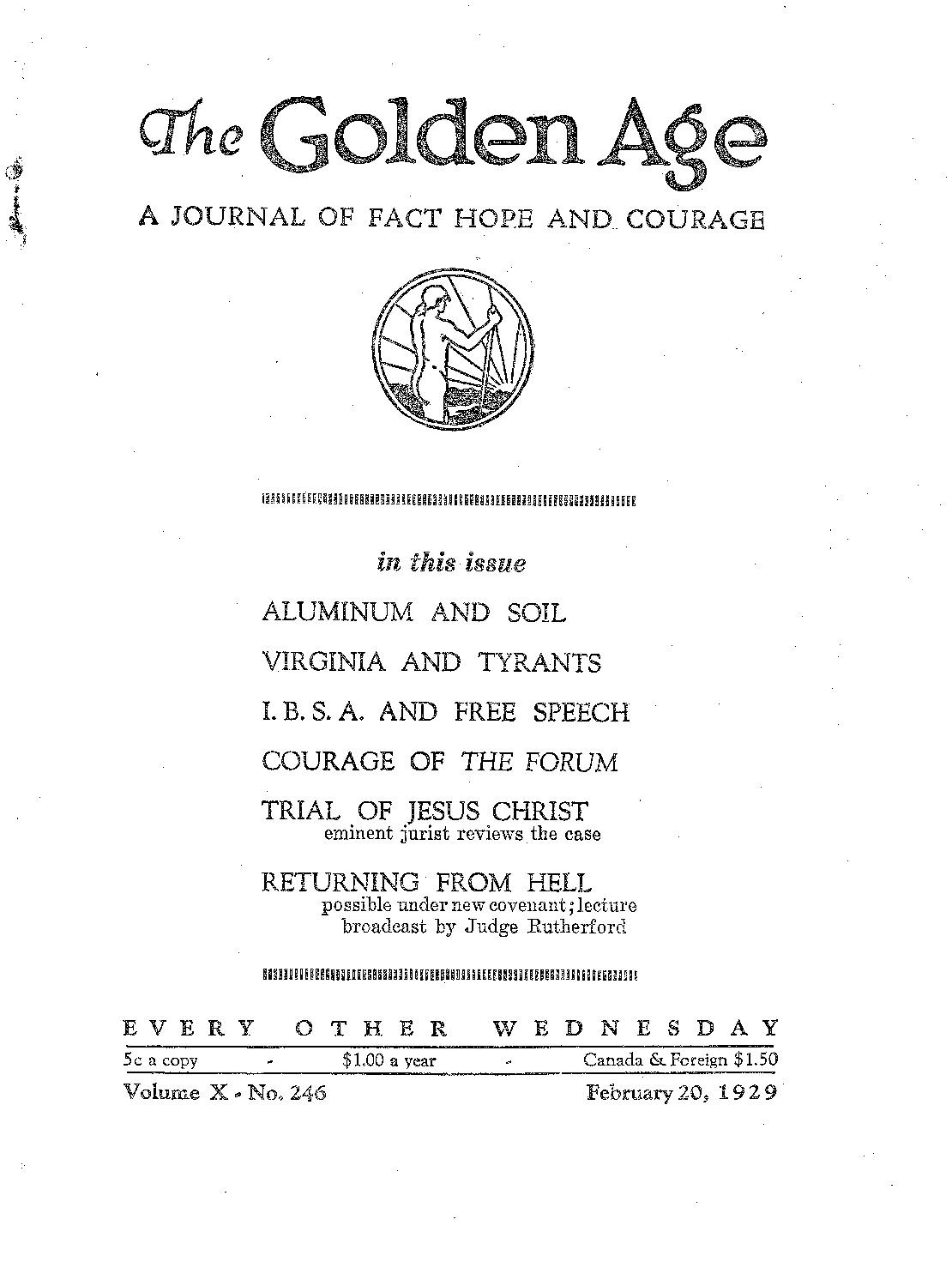
Golden Age
A JOURNAL OF FACT HOPE AND. COURAGE
igimgmmmomiimHmsHmimmimsmmmmimimni
in this issue
ALUMINUM AND SOIL
VIRGINIA AND TYRANTS
LB. S.A. AND FREE SPEECH
COURAGE OF THE FORUM
TRIAL OF JESUS CHRIST eminent jurist reviews the case
RETURNING FROM HELL possible under new covenant; lecture broadcast by Judge Rutherford
immmmtimmmmmmiimsmEESHmiiimmmmimm
EVERY OTHER WEDNESDAY 5c a copy - $1.00 a year - Canada &. Foreign $ 1.50
Volume X <• No. 246 February 20, 192 9
Contents
......,-■......;,.—■?......- -:---------_^_Kv
Social and Educational
Nothing Much . ......... .......... 327
Twenty Types of Men ................ 330
The Courage of THE FOHVaI .............. 341
Finance—Commerce—Transportation
The First Ship Without Rivets ............. 327
Spain May Tunnel Under Gibe;'her ........... 328
Immense Power Tunnel in Korea ............ 32!)
Giants Cause the Wars ................ 32!)
India’s Great Canal Opened .............. 340
Political—Domestic and P'oueion
180,000 Cry Peace, Peace ............... 327
World Radio Telephony ................ 328
Mosul Oil to Be Piped to Haifa
Welcoming m Peach Ambassador ............ 330
I.B.S.A. and Free Speech .....
Agriculture and Husbandry -Goat Culture in British Columbia . .
Science and Invention
Chemistry, the Newest of the Old Arts .......... 331
. Home and Health
Aluminum in Soil, Vegetation, Animals and Humans ..... 323
Interior Aluminum Plating Not So Good
Virginia and Sic Semper Tyrannis
Eelicion and Philosophy
The Golden Age . . ..........
Waking Up Slowly But Si.bei.y .....
A Badly Tangled Branch .....
The Trial oh Jesus Chidst ............... 343
Religion and Prohibition in Illinois .....
“The Hell of Tins Bible’’
Returning From Hell ......
Bible Questions and Answers .............. 350
Prayers fob Repose of Souls .............. 350
The Children’s Own Radio Stogy ............ 351
Published every other Wednesday at 117 Adams Street. Brooklyn, N. Y., U. S. A., by WOODWORTH, KNORR & MARTIN
Copartners and Proprietors Address: 117 Adcuas Street, Brooklyn, N. P., V. S. A. CLAYTON J. WOODWORTH.. Editor ROBERT J. MARTIN .. Business Manager NATHAN H. KNORR.. Secretary and Treasurer
Jiva Cents a Copy—$1.00 A Year Make Remittances to THE GOLDEN A.GB Notice to Subscribers: We do not, as a rule, send an acknowledgment of a’renewal or a new subscription. A renewal blank (carrying notice of expiration) is sent with the journal one month before the subscription expires. Change of address, when rc<iuestedf may be expected to appear on address label within on® month.
Foreign Offices
British . . , s , s , 34 Craven Terrace, London, W, 2, England Canadian 40 Irwin Avenue, Toronto 5, Ontario, Canada
Australasian ..... 4S5 Collins Street, Melbourne, Australia South African ..... 6 Lelie Street, Cape Town, South Africa
Entered as second-class matter at Brooklyn, N, X.t under the Act of March 3, 1879.
al™ Golden Age
Volume X Brooklyn, N. Y., Wednesday, February 20, 1929 Number 246
Aluminum in Soil, Vegetation, Animals, Humans
By Dr. 0. T. Betts
"Cursed is the ground for thy sake."—Gen. 3:17.
FARMERS throughout the nation have for many years seen their lands become less and less productive. Many of them have become discouraged and have abandoned their farms. These people, who number many thousands, left beautiful and health-giving surroundings in the country districts, to seek employment in the cities, where a more profitable income could be secured.
With the greatly increased cost of food and farm products there has been a constant call for farmers and more farmers, yet the migration has continued to flow city-ward in spite of the price of living steadily climbing higher and higher.
In the past the young man on the farm has had a poor future staring him in the face. This has been on account of the dwindling returns from the soil on which he has labored, and the discouraging fact that many crops are so poor that they do not pay. There has been a steady depletion of farmer boys on our farms. Practically only those who are unable to leave or are too old to secure positions in factories remain and man the farms.
This condition may now be revolutionized. Scientists some fifty years ago began intensive research upon the cause of poor (sick) soil. Very little progress was made by various agronomists in their work, yet they plodded on in the hope that some day it might be revealed how this could all be changed and crops again be produced in such abundance and of good healthy stock, on poor soil, that it would pay the boy, financially and in the keeping of good health, to remain on the farm and thus make life worth living. This is now possible.
Facts have recently been extensively published in numerous papers that examiners have
' . 823
learned what causes poor soil, that this condition is produced by aluminum—too much aluminum—in the soil, that this metal makes it sour, acidic and unproductive. Following is a copy of an editorial published in The Plain Dealer (Cleveland, Ohio), November 28, 1928.
Why Soil is Sour
The fact that soil becomes sour and unproductive has generally been accepted as an inexplicable fact. Theories have not been lacking to account for the distressing phenomenon, but they have been abstruse and have never been proved. To kill the acidity, limo has been used. Lime, being an alkali, can destroy any acidity, no matter what the cause.
Now, after fifty years of intensive research, the University of Wisconsin announces that it has discovered the cause of sour soil. This is the formation of aluminum silicate. It is purely a chemical process, and has nothing whatever to do with the theories of absorption and of unknown electrical phenomena which have hitherto been propounded.
With the cause definitely ascertained the chemical remedy will be comparatively simple and inexpensive, and vast areas of unproductive land may be restored to fertility.
It is a discovery of incalculable importance. Credit goes to Prof. Emil Truog, who conducted the ultimate researches based on the work of many preceding agronomists, some of whom are dead. Modestly and undoubtedly justly Prof. Truog shares the praise with these predecessors and with his present associates. It is not too much to predict that the Wisconsin discovery will revolutionize the science of agriculture.
The Dictator of Italy has organized an “antiurban campaign” known in America as a “back to the land” movement. This has been done to compel the youth of Italy to remain on the farm. Now that the cause of “poor, sour soil” is known and the. remedy for this condition available, the
young men of Italy may be happy t remain on their farms, if they also receive the information which is now being given to the American public.
Governmental scientists of our Agricultural Department have been very busy and have made extensive investigation of plant life. They have placed experimental stations throughout the nation, where these matters may be under constant observation. This has been done for the express purpose of being of assistance to the farmer in producing more abundant and greater-valued crops.
The question of corn sickness has recently been of particular interest to members of our Agricultural Department, such as George Hopper and John F. Trost. These men have been investigating the various causes of the diseases common to corn.
Many of our fields throughout the nation have become unproductive. Corn has what is commonly termed soot or mold. The stalks become very weak and unable to stand the ordinary winds and have a tendency to break over and fall to the earth.
This reached such a stage in recent years that it was almost impossible to secure corn for canning purposes without having’ an unsatisfactory product. The corn canners of America made considerable complaint and they made demand that further investigation should be conducted to learn why this condition exists.
The two men above named have spent years of their time in extensive investigation, to determine the cause of this condition. The January, 1928, issue of The Country Gentleman magazine contains a report of their findings upon this question, under the title “Men Who Make New Land from Old”.
They give to the farmer the information that they have discovered and proven, by actual tests, how sick corn can be made well and crop 'disease prevented. There are photographs of plants, showing how the diseased corn looks, also how fields of corn look which have been poisoned by aluminum.
They have found that this condition is produced by the earth’s being starved for phosphate and having too much aluminum. It was discovered that the ash, after burning the stalks in the poor fields, contained as high as five percent of pure aluminum, twice as much as that contained in the healthy corn in other fields close by.
The following quotation is taken from the above-mentioned magazine, and it is a marvelous revelation regarding the damaging or evil effects of too much aluminum in the plants.
It was in down corn—big corn but corn with rotted roots and chaffy ears—that he had come upon the iron; and now in the stunted, leaf-fired corn of acid fields he found aluminum—too much aluminum— and of course everybody knows that this metal, aluminum, is the chemical cousin of iron. From the fields near LaFayette, Hopper brought stunted corn plants with curiously discolored leaves to the chemist Carr.
From the Battle Ground in Tippecanoe, Hopper brought such plants, and the ash of those plants held five percent of aluminum—twice as much as the ash of healthy ones close by. Hopper rose now to the height of the first line experimenters: he clinched his hun’eh-es, guesses, observations by an ingenious trick. He planted a field of corn on rich soil where it would show never a sign of sickness.
The com shot up straight and strong. ■
Then into the bottom of those good living cornstalks, just above the first joints, Hopper bored little holes with a sharp cork borer, right into the soft pith of those joints he bored. Then into the hole he poked—it was a nice tight fit—the open end of a little glass tube, swelled out to a bulb at the opposite end.
Each one of those tubes he tied carefully to the stalk of its corn plant. . . . He poured solutions of the salts of iron, aluminum, a dozen other chemicals into those bulbs—for the living plants to drink gradually out of those bulbs.
It was magic. Less than one three-thousandth of an ounce of aluminum gradually killed strong plants, fired the leaves just exactly as they would discolor in a bad acid soil, killed the leaves between the veins. And the iron? Small bits of it turned the cornstalk joints brown, wrecked those joints exactly as they were wrecked by the root rot.
But what was he going to do about it? The brutal fact was that this was only a start of the fight against corn sicknesses.
There must be some way; somehow he must get the corn plant to stop sucking up that poisonous iron, and aluminum, out of the ground. If only he could do that, then those Gibberellas, those Fusariums, could go hang 1
What to do? Work to do, fumbling, trying; trying this, experimenting with that.
From now on Hopper had the priceless help of the lean John Trost.
Together they found out about the original experiments of Bert Hartwell, of Rhode Island, and of his coworker, Pember, who had proved that when certain plants went to pot in acid soil, it wasn’t the acid, but aluminum that made them sick.
And those Rhode Islanders had held out hopes, had.added lime and phosphates to soil, and the lime and phosphate had knocked out the poisonous effect of the aluminum.
“We’ll keep aluminum from poisoning our corn, too,” vowed Hopper and John Trost, and that winter Trost toiled in the dank greenhouses at LaFayette.
Then they went out and dug up poor soils, bad corn soils, soils famous for root rot, from Pike and Daviess counties to the south, and from Bartholomew, Hancock, Shelby counties southeast of Tippecanoe. Into pots they put those weak soils, tucked in good healthy seed of maize—then treated the pots, some with lime, others with phosphate; and into some pots they put the deadly chloride of aluminum.
Trost nursed and tended the seedlings that struggled up in the kind heat of the steamy greenhouse. At the end of ten weeks he harvested the young maize.
That test turned out just as it ought to.
Oh, there was no doubt that phosphate was fine—in the phosphate soil the young plants stood green and sturdy. In the check-pots—with no phosphate or lime— the rots were already beginning at the roots. But in the aluminum soil? The seedlings hardly poked their shoots out of the ground before they blighted, died.
Aluminum and phosphate are present in all kinds of soil butthey must be properly balanced in order to produce good healthy herbs or food for animals. It has been found by Prof. E. L. Mosely, Sandusky, Ohio, that when this drug (aluminum phosphate), contained in herbs such as white snakeroot or the rayless goldenrod, is consumed by animals, they become sick and show a palsied condition commonly known to the medical profession as “trembles”.
Cows eating this drug contained in the abovementioned plants contract a disease known as “milk sickness”. Cats, rabbits and human beings consuming milk from cows having this sickness also contract “trembles”. Aluminum was found in the milk of cows which ate the above-named herbs.
Professors Edwin 0. Jordan and N. M. Harris, of the University of Chicago, wrote an article which appeared in the Journal of the American Medical Association, May 23,1908, entitled “The Cause of Milk Sickness and Trembles”. Prof. Moseley compares the statements of the abovenamed professors with those of Arthur E. Cushny, Ph.D. The writer gives Cushny’s statements as found in his book Pharmacology, third edition, page Z01, partially quoted by Prof. Moseley :
Aluminum has a very remarkable general action when it obtains access to the blood. In Siem’s experiments on animals, the sodium-aluminum lactate or tartrate induced a very slow intoxication, mammals never dying from the effects sooner than one or tw® weeks after the intravenous injection of the salts. In frogs the symptoms were those of a descending paralysis of the central nervous system, the heart and the peripheral nerves and muscles being little affected.
In mammals, the first symptoms appeared only after three to five days, and consisted in constipation, rapid loss of weight, weakness, torpor, vomiting; marked abnormalities in movement and sensation were observed later, such as tremor, jerking movements, clonic convulsions, paresis of the hind legs, anesthesia of the mouth and throat and lessened sensation all over the body.
Before death, diarrhea often set in and albuminuria was generally present. The mucous membrane of the stomach and bowel was found swollen and congested, the kidney and liver had often undergone fatty degeneration, and hemorrhages were found in the renal cortex. Albuminum was found in the urine.
Like the other members of the heavy metal series, aluminum therefore acts on the bowel and kidney in general poisoning, while many of the symptoms point to a direct action on the brain Dollken has recently confirmed Siem’s results, and showed that the nerve cells and fibres of the cord and medulla undergo degeneration, particularly those of the lower cranial nerves.
Following is Prof. Moseley’s discussion of the above findings of Cushny, found in Prof. Moseley’s brochure, The. Cause of Trembles and Milk Sickness, republished in The Medical Record, May 15,1909. .
Now, these effects of the injection of aluminum, remarkable as they are, are the same as the effects of milk sickness and trembles. The “constipation, weakness, torpor and vomiting” are familiar to all who have seen persons or carnivorous animals affected with the disease. The “tremor, clonic convulsions, and paresis of the hind legs” are striking features of the “trembles” in animals.
As to “loss of weight”, Mr. Louis Quinn, who has lost more than a thousand dollars’ worth of stock from trembles, says: “The hide of a cow that has been sick for two weeks with trembles will not weigh within forty percent of a normal cowhide.” Concerning anesthesia, he says: ‘ ‘ Salt placed on the nostrils of a cow calls forth no response.” “Cattle in which trembles proves fatal live on an average hardly, a week after they are first seen to be affected, but the time differs considerably; a few live about two weeks.” Sheep live less than four days after the disease is first noticed. Siem’s experiments •"ere with eats, dogs, and rabbits.
For our knowledge of the pathological anatomy and histology in “trembles” we are indebted to the article by Jordan and Harris, referred to above. Not only did they find all the lesions which Cushny mentions on Siem’s authority, but many others which are mentioned in Siem’s pamphlet on the action of aluminum.
In 1913 the writer found that his various ailments quickly disappeared directly after discarding aluminum kitchen utensils in his home. Investigation at that time proved that aluminum dissolved from his aluminum cooking utensils, and this was the apparent cause of his broken health. Within the twelve-year period before this matter of aluminum poisoning became generally known by the public, hundreds of his patients also received health benefits by discontinuing eating the poison which was ingested with their foods from aluminum cooking utensils which they used in their homes.
The following quotation is taken from “The Story of the Human Aura”, by Dr. George Starr White, M.D., Ph.D., LL.D., F.R.S.A. (London), of Los Angeles, Calif. Many reports of clinical cases of aluminum poisoning are noted in the Doctor’s books, but the following citation will suffice for this article: .
'Aluminum Ulcer of the Stomach
The man who came from Minnesota with the one referred to in No. 7, was to have been operated on for ulcer of the stomach, but he did not like the idea; so he came out here to have me diagnose his case. It just happened that I diagnosed him the same day as the man who came with him. I diagnosed this man as ulcer of the stomach and aluminum poisoning. Hence, I concluded that the ulcer was caused by the aluminum poison.
I treated him practically as I did the other man, and this man was entirely free from stomach pains in about 8 months. It was a very bad case and perforation would surely have taken place soon, had he not gotten relief.
You see the surgeons are not taught to look for near-by causes for such troubles, but think only of the knife.
Many can use aluminum for years without any outward signs of being poisoned by the aluminum compounds, caused by the food cooked in it, but others linger on with all manner of unhealth until they die of “heart trouble”. As aluminum is such a terrible heart depressant, it kills, no doubt, thousands that way.
It is apparent from the above various quotations and statements that aluminum, in either the organic or the inorganic form, produces poisoning to the soil, poisoning to the vegetation, poisoning to the animals eating such vegetation, and poisoning to human beings consuming the drug.
The writer believes that, since men like Dr. 'James B. Murphy, of the Rockefeller Institute (a cancer research organization), New York, and Dr. James Ewing, of Cornell University, New York, claim that cancer is induced by metal irritants or what is known to the medical profession as “chemical ferments”, it behooves us to investigate the matter of aluminum poisoning upon a greater scale than ever before, so that the facts pertaining to the evil or deleterious effects of this drug upon humanity may be available to all.
Interior Aluminum Plating Not So Good By I. M. Moll
SEVERAL months back, in an issue of The Golden Age, you had an article on “Aluminum Poison by Way of the Kitchen”. The article interested us so much that we decided then and there to discard all of ours, and did so, with amazing results.
Right here allow me to congratulate The 'Golden Age that through divine providence they saw fit to print that article, whereby I have, been restored to normal health. This was after three doctors had tried, but with no result other than to leave me in an almost helpless condition.
In reading the article I was much impressed with the fact that I had often found the bowel region to seem sore, so much so that, personally, I thought it was ulcerated. The doctors said I was suffering from intestinal indigestion; but I was so sore internally day and night that I hardly knew what to do.
In less than two weeks after we had discarded our aluminum all soreness disappeared and I have regained normal health.
Nothing Much
The First Ship Without Rivets
HE first ship to be built without rivets has been launched recently in South Brooklyn. The plates of the ship were all joined by welding. It is stated that the job seems to be a perfect one, no signs of strain being evident.
If Billy Sunday Were God
illy Sunday says that if he were God fifteen minutes certain of his political opponents
would not be this side of hell. This gives us all two tilings to be thankful for. The first is that Billy Sunday is not God, and the second is that we are not Billy Sunday,
Thomas Hardy’s Poem
Hardy, at Christmas time, 1924, produced the following poem:
"Peace upon earth!” was said. We sing it, And pay a million priests to bring it.
After twTo thousand years of mass
We’ve got as far as poison gas.
Chinese Eggs in Britain
T N THE face of the knowledge that there are -'L twenty millions of human beings starving in China it makes one feel odd to read that a single ship recently brought forty million Chinese eggs into the British market, and that no ready sale awaited the arrival of the cargo.
600 Periodicals in Palestine
T THE press exhibit recently held in the new Jewish city of Tel Aviv, there were
Pacifism in Mexico
resident Gil of Mexico has declared that his government will combat not only war but the thoughts of war; and to that end he will give special attention to make sure that the history taught in the schools of Mexico is taught from a pacifist viewpoint,
Wolves West of Los Angeles
WESTERNERS as well as Easterners were doubtless surprised to find that three deputy sheriffs west of Los Angeles were recently attacked by a pack of wolves. It seems almost incredible, but the wolves were slain and bounty paid.
Getting Ready for Flying
HE business men of America are now getting ready for flying and are going about
it in dead earnest. All cities will be so marked that licensed aviators will be able to identify them immediately from the air and to know how far it is, and which way, to the nearest air port. Scientific landing stations approximately 1,500 by 2,500 feet may be built in the centers of America’s greatest cities, and hundreds of feet above the ground.
Britain Building an Invisible Plane
HE British government is building an airplane of a material transparent in appear
shown six hundred periodicals, many of them in ancient Hebrew; surely an imposing figure in a Jewish population of only 165,000 people. Their Arab neighbors refer to the Jews as "The People of the Book”. In fact, this name was conferred upon them by Mohammed himself.
180,000 Cry Peace, Peace
0 A petition asking that the Kellogg Peace Pact be promptly ratified by the Senate,
180,182 persons have appended their names. The petition which was handed to President Coolidge was presented by Bishop McCowell and Doctors Gulick and Darby in behalf of the Federal Council of Churches of Christ. No doubt the great cry of "Peace and safety” is now about to go up over the land, with Armageddon to follow in its wake, if we interpret Scripture correctly.
ance, but unbreakable, and not affected by rot or rust. The material is called plass. It is believed that this plane will be practically invisible in flight and could not be brought down by anti-aircraft guns. Bullets may be imbedded in plass without hurting it, and repairs in the material may be so made as to remove all traces of the injury inflicted upon it by bullets or splinters.
Burning Books in County Galway, Ireland
HE archbishop of Tuam, officially appointed censor to the Libraries Committee, has
now completed the burning of books in the Galway Library (Ireland), of which he, the archbishop, does not approve. The people of county Galway will now be privileged to think as the archbishop thinks. If they think any differently, they will confess it. The books burned included those of Victor Hugo. .What is the archbishop afraid of, anyway?
Shaw’s Opinion of Bolshevism
SEED his opinion of Bolshevism, George Bernard Shaw said: “The Bolsheviki teach common honesty to the children of Russia, while all the capitalist states are teaching them that their highest destiny is to become rich idlers. If Russia sticks to that she will lick creation.”
350,000 Criminals in America
IN AN address at the Hotel Astor, United States Attorney Tuttle made the statement that there are 350,000 criminals in the United States, and that there is more crime and fraud in America than in any other country. It is actually safer in the interior of China or Africa than in America.
The Wastage of Food
JT SEEMS too bad that in one California harbor, and that not a large one, sometimes 200 tons of fish are thrown away in a single day. Those who are interested in profits are determined that prices shall not come down, and so they keep the surplus fish away from the markets.
World Radio Telephony
THE British government is now planning" a J- radio telephony network that will place the entire earth in one vast telephone system. If the plan works out as planned, anybody any-vdiere in the British Empire can call anybody else anywhere in the same empire and converse with him by telephone. -
Surprises as to Figs
WE HAVE just had two surprises in regard to figs. One is that figs may be bought in the fig orchards for as low as twenty-five cents a bushel, and sometimes for even less; and the other is that when you buy three of the same figs at a high-priced restaurant in New York they cost you eighty cents.
Nicaragua Goes Liberal
THE United States backed a conservative for president of Nicaragua, entailing a private, unauthorized war which has cost several hundred lives. Now the Nicaraguans have had their election and elected a Liberal president after all, showing that the war was as unpopular there as it. was here. •
The Junkers Flying Hotel
rpiIE Junkers flying hotel, accommodating fifty persons, is now nearing completion. The structure is a two-story affair, the lower floor being devoted entirely to freight and mail. The passengers are carried in the wings, which are fitted with windows for observation purposes.
Mennonites in Trouble
STRANGELY enough, the Mennonites who went to Paraguay by thousands two years ago, in the effort to be rid of fears of war for all time, are directly in the zone of conflict between Bolivia and the country where they are now making their home. The world is still a bad place for anybody who loves peace.
Westernizing Turkey and China
THE westernizing of Turkey and China is in full swing. Turkey is sitting up nights wrestling with the Roman alphabet, the only legal alphabet in the country since November 30; while China is trying to figure out how to do business with a solar calendar when all her life long she has been using a lunar calendar.
Spain May Tunnel Under Gibraltar
PAIN is making wonderful progress of late. M Just now a commission of technical experts is studying the problem of constructing a tunnel to Africa, beneath the straits of Gibraltar. ■ The tunnel must be at least eight and one-half miles long and must descend nearly thirteen hundred feet below sea level. If built it will cost $40,000, 000 and will be connected with through routes to Central and South Africa now building or in contemplation.
The Teletypesetter
THE Teletypesetter, tried out at Rochester, December 6, 1928, proved that an operator in New York, running an electric typewriter, may control thousands of typesetting machines located in Chicago, New Orleans, San Francisco or any other place on the continent. It is even hoped to make this device operable by radio. It seems to presage loss of employment for thousands of typesetters, but it is a step ahead in the progress of the world. Ticker tapes receive the messages and transmit them to the typesetting machines.
Vatican Falling to Pieces
IT SEEMS that the old Vatican was dishonestly built and is now falling to pieces. The ceilings of two cellar rooms have fallen down, carrying with them the floors of two large rooms on the ground floor. The military guard which usually occupies these rooms was out at the time of the collapse.
Italian Peasants Must Remain Peasants
nPHE latest in Italy is that people may not move from the country into the city without consent of the Fascisti authority, and the same authority may compel those now living in cities to move back to the country. City employers are required to refuse work to peasants, so as to keep them in the country.
Debates in the League
Qi^N eager the nations must be to disarm!
One hundred and eleven resolutions on armament have been adopted and these have been debated in 120 sessions; yet year after year there is no disarmament, but on the other hand armaments are steadily increasing. Nothing ever frightened these nations that are so eager to disarm, as much as Russia’s offer to disband its army, demolish its forts and destroy all its other means of making war.
Labor Arbitration in Germany
ERM ANN’S labor arbitrator recently awarded a ten percent increase to the 225,000
workers in its iron and steel industries. As soon as the notice was served upon the financiers controlling the enterprises they at once closed their doors, throwing every one of the 225,000 men out of work. The government, promptly voted a $5,000,000 relief fund for the workers, and after holding out for five v/eeks against the combined opinions and powers of the government, the workers and the public, the financiers capitulated.
Captain Coll a Brave Man and True American abiaix E. P. Coll, Hoquiam, Washington, member of the American Legion, is a brave
man. In a public letter to his fellow Legionnaires he says in part: “The I. AV. V/. in Centralia, Washington, who fired upon the men that were attempting to raid the I. W. AV. headquarters were fully justified in their act. As in the famous Dreyfus case in France, so in the state of Washington, a great wrong has been done, and the innocent party has suffered.” Everybody knows that Captain Coll is telling the truth, and that these innocent men are kept in Walla Walla prison for the same reasons that Sacco and Vanzetti were murdered in Boston. Captain Coll is a true American, not a uniformed sissy.
Immense Power Tunnel in Korea
THE Mitsubishi Company of Tokio has just completed a seventeen-mile power tunnel through the mountains of Korea. Through a succession of dams and power plants a river with a daily average flow of 660 cubic feet of wrnter per second is given a fall of 3,326 feet. The power will be used for the manufacture of nitrogen for fertilizer purposes.
Giants Cause the Wars
HE people are beginning to find, out things.
In its issue of December 14, 1928, The
Graphic says: “It is Big Business that controls the destinies of the people of today. It is behind activities of the statesmen, and if this omnipotent power wants war, we will have it.” The mask is being pulled farther and farther from the Devil's organization every day,
Shows in the Stores
EW YORK’S largest department stores are running free shows, with the object of at
tracting customers, and the plan is declared to be a financial success. One good feature of it is that it provides employment for actors and others. Free shows as a means for selling goods are as old as the hills; but their employment in modern department stores is something new.
Cadman the Impossible
adman the Impossible gives three answers to questions. They are published in the
same paper. The first is advice to a woman to beat up her hubby with a rolling pin vigorously exercised; the second advice is to pay no attention to ranting zealots who invoke fire, brimstone, etc., on other people; and the third one refers to a portion of God’s AA7ord in this language: “Under no circumstances, at least of all such sad ones as yours, should the book of Ecclesiastes be consulted for light upon the hereafter.”
Eloquence in St. Louin
AST. LOUIS pastor preaching on the flag on Armistice Day made the surprising statement that “Old Glory is the glory of God shining in the face of the people”. We find no such glorification of human battle-flags anywhere in the Bible, but one woman was so carried away with the pastor’s eloquence.that she fainted away and had to be carried out.
Pacifism in Rumania
ONE of the things that led to the downfall of the old regime in Rumania and the setting up of a peasant’s government was the act of imprisoning 250 workmen who refused to collect funds for an air fleet to uphold the old order of things. Three of these men were so bra-tally treated -while in prison that they committed suicide.
Tremendous Storms in Europe
EUROPE has been having storms of unprecedented severity. Vessels held in port, vessels unable to make port, demolished houses by the hundred, trees blown across railway tracks, and forty persons killed, are among the items. In one instance a channel vessel that usually makes its trips in one and one-half hours required ten and a half hours to make the crossing.
No Connection with Bolshevism
THERE is no connection whatever between The Golden Age and Bolshevism, wdiich latter form of government we consider one of the most tyrannical in the urn rid today; yet by an odd coincidence, only three days after the leading article in our paper denounced the whole Christmas idea as unscriptural, the Bolshevists announced that no more Christmas celebrations wrnuld be allowed in Russia.
Largest Shoes Ever Made
npIIE largest shoes ever made to be worn by a human being have just been completed for
Robert Wadlow, of Alton, Illinois. Robert is eleven years old, six feet nine inches tall, weighs 217 pounds and is growing like a weed. His new pair of shoes is size 25 Double A. They are eighteen inches long and five inches wide. Robert’s pituitary gland is working overtime, and if he lives he is morally sure to be above nine feet in height.
Mosul Oil to Be Piped to Haifa
TJ AIFA, one of the new cities of Palestine, is about to become one of the oil centers of the world. It is settled that the oil from the Mosul regions will be piped to Haifa for export, and ground for the storage tanks has already been purchased by the great oil companies involved. This will help in the development of the old and yet new land of Abraham. A thoroughly first-class modern hotel will be built shortly in Jerusalem.
Twenty Types of Men
TpOREMEN now recognize, and are taught to recognize, twenty types of men, and to divide them into three distinct classes.
In the Number One, or desirable class, are put the types that are classified as pleasant, conscientious, honest, cooperative and ambitious. .
In the Number Two, or usable class, are put the types that are classified as grouchy, dissatisfied, narrow-minded, contentious, sickly, crippled, temperamental and jocular.
In the Number Three class are put the types that are classified as shirkers, careless, agitators, indifferent, lazy and sobbers.
It will be noted that the foregoing classification makes no reference to the habits of speech or conduct such as profanity, smoking, chewing drinking, immorality, etc., but that it does want honesty.
No Winter Storms in Florida
Charles L. Mitchell, w’eather forecaster at the Washington office, has written and compiled a detailed history of hurricanes on the Atlantic and Gulf coasts, covering a period of fifty years. The record shows that in Florida these storms have occurred only in the months of June, July, August, September, and October.
While it is to be deplored that some sections of Florida have suffered severely from storms in recent years, there may be some consolation in the statement by Dr. Harvey Kellogg, of the Battle Creek Sanitarium, that “for every life lost in Florida by storm, at least a thousand years are added by Florida sunshine to the lives of the multitudes flocking to the state from all over the world”.
Chemistry, the Newest of the Old Arts
in glandular function. These chemicals, all of which can be found in the dust beneath our feet, are estimated as worth collectively about $1.04.
Every time a man inhales, the chemists tell us, he draws into his lungs some 3,000,000,
THE word “chemistry” is supposed to be derived from Khem, an ancient name of Egypt, the early home of alchemy. The alchemists of the eighteenth century were objects of ridicule. Light came slowly. Carbon dioxide was discovered in 1756, hydrogen in 1765, and oxygen in 1774. AU progress in chemistry is since then. As a science, it has just begun to show itself.
An element is a substance which can not be decomposed into different kinds of matter by any means at present employed. In scientific usage, an atom is the smallest particle of matter that can enter into combination: one of the elementary constituents of a molecule. A molecule is a group of atoms so united and combined, by chemical affinity that they form a complete, integrated whole, being the smallest portion of any particular compound that can exist in a free state; as, a molecule of water consists of two atoms of hydrogen and one atom of oxygen.
Drink a glass of water and it is calculated that you have swallowed about 1,865.000,000,000, 000,000,000,000 molecules. Please do not try to check up on this by counting them as they go down! A molecule is to a drop of rain as a pea is to the size of the earth. Two million kinds of molecules are theoretically possible, and about one-fourth that number of combinations have been worked out. The one fundamental fact of chemistry is that matter can undergo apparent transformation of kind, one substance being converted into another. Thus iron is changed to rust.
Man a Chemical Engine
A one-hundred-pound boy or girl consists of sixty-five pounds of oxygen, eighteen pounds of carbon, ten of hydrogen, three of nitrogen, two of calcium, one of phosphorus, five and a half ounces of potassium, four of sulphur and two and a quarter each of chlorine and sodium, nearly an ounce of magnesium, a very small quantity of iron and a minute quantity of fluorine, silicon and iodine.
The oxygen and hydrogen are in the body fluids; the carbon, calcium and magnesium in the bones; the nitrogen, potassium and phosphorus in the bones, blood and muscles; the chlorine and sodium, chiefly in the blood; the iron in the red corpuscles of the blood; the sulphur, all over; the fluorine and silicon chiefly in the enamel of the teeth, and the iodine aiding ' • 331
000,000,000,000,000 little particles of air, a jostling, pushing crowd of oxygen and nitrogen particles so crowded that each one bumps his neighbors and is bumped back 5,000,000,000 times every second, each trying to rush 1,500 feet in that time.
When the same man exhales, 120,000,000,000, 000,000,000 of the oxygen particles that went in do not come out, while their places are taken by carbon dioxide and water. Every breathing animal loses weight with every breath. That is one of the reasons we have to eat and drink in order to live.
Some of ike Other Elements
Aside from the elements of which our bodies are composed, most of us have some acquaintance with aluminum, antimony, arsenic, bromine, copper, gold, helium, lead, manganese, mercury, nickel, platinum, radium, silver, tin, vanadium and zinc.
There are ninety-two known elements altogether. Of some of these the layman never hears, and the rarest of them have been seen by only a few persons. There are actinium, argon, barium, bismuth, boron, cadmium, caesium, cerium, chromium, cobalt, columbium, dysprosium, erbium, europium, gadolinium, gallium, germanium, glucinum, holmium, indium, ionium, iridium, krypton, lanthanum, lithium, lutecium, molybdenum, neodymium, neon, niton, osmium., palladium, polonium, praseodymium, rhenium, rhodium, rubidium, ruthenium, samarium, scandium, selenium, strontium, tantalum, tellurium, terbium, thallium, thorium, thulium, titanium, uranium, xenon, ytterbium, yttrium and zirconium.
Some years ago tungsten was supposed to be an element, but its atoms were broken down and changed into helium by artificial lightning developed by the late Dr. Charles P. Steinmetz, electrical expert of the General Electric Company. Many other supposed elements have also been broken up in recent years.
It is believed that ultimately a way may be found to break up all the elements, and to release atomic energy. Should this tim® ever come,
the problems of heal, light, power and food will be solved for all time.
Oxygen and nitrogen are not the only elements of the air. In addition there are also the rare gases, argon, helium, neon, krypton, and xenon. Much searching was done to find helium, the existence of which, in the sun, was established in 1868. It was finally found in 1895. Every device known to science has been tried to make helium combine with other known chemical elements, but all to no purpose. This is a property which it shares with some of the other rare gases just mentioned, discovered about the same time.
Some of the elements come into their own very slowly. Thus vanadium has been known since 1801, but it was only recently that it was found that four pounds of vanadium added to a ton of steel results in an increase of forty-five percent in its strength. Ninety-five percent of all the known vanadium ore is found in the Peruvian Andes.
Radium, Rhenium and Illinium
Radium was discovered in 1898, and the world has not yet recovered from the shock; nor has it found out how to handle this element without danger. It is in common use for luminous paint and other purposes, but at the cost of the life of the users.
Radium is supposed to have a life of 1,590 years, at the end of which time it will have reduced itself to lead, uranium, thorium, and helium. Weight for weight it gives off 330,000 times as much heat as could be obtained by burning coal. It is always a little hotter than its surroundings, regardless of what those surroundings may be. Nothing that can be done to it alters its habits.
Somebody has jokingly said that radium would be ideal for a house furnace if it were not for a few things. Two hundred pounds of radium would heat the house all winter with a loss of only one and a half ounces of radium, but when summer time came there would be no way of shutting off the heat. Moreover, it would be impossible to go near the furnace at any time, on account of the emanations from it. A third objection noticed is that two hundred pounds of radium would cost something like $9,000,000,000, and that is too much.
Rhenium has been obtained in pure form to the extent of seven hundred-thousandths of an ounce. It is described as a black powder of high melting point that unites readily with a number of other elements. Its uses are not known. In an atmosphere of pure oxygen it ignites, forming a white oxide.
Illinium, chemical element Number 61, the first to be 'horn” on American soil, has been discovered in Illinois. Twenty years were spent in separating one-half ounce of this material from four hundred pounds of monazite, the rare earth used in the manufacture of gas mantles.
Mining the Air
“Mining the air” is a term first used by Sir William Crookes, when it became apparent that man is to recover billions from that source. Every square mile of air over the earth’s surface carries 20,000,000 tons of nitrogen, or enough to last the entire world twelve years.
Nitrogen is indispensable to man. Originally mined from the air for military reasons, the mining continues after the World War, and at a greater rate than during the war itself.
At Oppau, Germany, an immense nitrate plant, constructed at a cost of $50,000,000, and employing 6,000 men a day in the making of nitrogen in the form of ammonia, blew up, completely demolishing the town in which it was located. This disaster occurred in September, 1921.
The Coal Tar Bases
One of the fields in which the chemist delights to roam is that of coal tar, which shows how different he is from the rest of us. Most of us, when we get into tar, like to get out of it and stay out of it; but the chemist finds it a never-failing source of interest.
Coal tar first began to yield its treasures in 1856, when William Henry Perkin, an eighteen-year-old chemistry student, while experimenting in a laboratory in London, seeking a way to produce quinine artificially, obtained a dark precipitate which, washed in alcohol, proved to be the dye now known as mauve. A German named Hoffman sensed its possibilites, obtained the secret, and set out post haste for Berlin, since then, and because of that, the chemical center of the world.
Some of the things that come from coal and coal tar, and in nearly all of which the chemists have had a hand, are the solvent carbon disul-phid, illuminating gas, fuel gas, ammonia for the making of artificial ice, ammonium sulphate for fertilizers, electrodes for electric furnaces, coke for steel works and smelting plants, lamp-black for paints, crude carbolic for sheep dips and medicinal use, photo developers for movies, explosives, dyestuffs, flotation oils for solvents, cresols for wood preservations and disinfectants, tar for paints and pipe covering, roofing and paving material, naphthalin, mothballs, synthetic tanning materials, indigo, lubricants, waterproofing, shingles, insulation, powdered fuel, pitch, briquets, targets, perfumes, drugs and countless other items.
The Chemistry of Life
This is too great a subject for us to say much about; yet we are all interested in it, because every one of us is a chemical factory where complicated changes are continously taking place, and of which we know as yet but little.
During the World War the chemists occupied the front rank in designing ways to kill their fellow men; but they are no less potent in times of peace. Every farmer is a chemist on a huge scale, converting the elements of the soil into food for man and beast.
All life is dependent on what is called Keule’s ring, named in honor of the man who discovered it. The ring consists of six carbon atoms, linked to form the main loop, each of them holding also a single hydrogen atom. Without this there is no life. Carbon is exhaled by every animal and inhaled by every plant, aiding it in building starch and sugar.
The chemists are hopeful that as they have evolved drugs that have exerted evil influences on humanity, such as alcohol, opium and cocaine, they may yet prepare compounds that will stimulate virtues instead of vices. We have our doubts about this.
Chemists have had much to do with tampering with human foods, to their injury, and also with the detection of those who have thus tampered. They have much work as insurers of the quality of foods. They are often called to assist physicians in diagnoses and autopsies.
Understanding the chemistry of bacteria it is possible to cause bacteria to enter into combinations with chemical compounds, thereby causing their death. This is believed to be of advantage to man also. It may be. We have our doubts, but incline to the belief that there is some truth in it.
Chemistry and Power
Dr. Edwin E. Slosson, a famous chemist, said: “Chemistry is the science of power. All the energy of man and beast and all the energy of machinery, except that furnished by windmills and water wheels, is chemical energy, and nearly all of that is derived from two simple and similar chemical reactions, the oxidation of hydrogen to form water and of carbon to form carbon dioxide.”
Chemists were the first to notice that the combustible gas in the average auto exhaust amounts to thirty percent of the total heat in a gallon of gasoline, and it was their insistence that improved the carbureters of gas engines Until they reached their present point of efficiency.
Chemists are doing away with rust in machinery, a loss which, when fully corrected, will save 29,000.000 tons of steel every year. Paints and protective coverings are being replaced by changes in the metals themselves. Chemists have devised new methods of removing sulphur from coke, thus better adapting it for household fuel and for work in the steel furnaces.
At a large cotton textile plant, some years ago, engineers had introduced an air-conveying system so that prepared fiber might be quickly and cheaply transferred from one part of the immense plant to another. When cold weather came the plant did not work well, and an expense of $30,000 was contemplated for steam-heating the conveyor. The chemist recommended that the fibers be conveyed in cold air drawn in from outside the building. The engineers predicted that it would not work; but it did, perfectly.
Recent Chemical Achievements
In the year 1926 the Germans suddenly surprised New York and the world by dumping a shipload of wood alcohol in New York at a profit and yet at a price far below cost of production in the United States. Methanol is the name of the product, produced in Germany at twenty cents a gallon.
A system has been devised in Germany for arresting decay in poles, posts and other wood products by injecting special chemicals into them, under pressure. Aluminum alloys are now made as strong as steel. All-metal airplanes have for years been made of duraluminum, a strong, tough, artificial metal.
American chunists thought Japan was charging too much for her camphor, so now we are making it at home from turpentine. The chemical eye for seeing invisible light was worked out at Johns Hopkins University. Synthetic . leather is better than the real thing, from which it can hardly be distinguished. Synthesized perfumes are a matter of daily life.
Dry ice, which does not leave any liquid as it evaporates, is being used in refrigeration cars from coast to coast. Liquid ice, which can be poured on any hard surface and makes a good skating surface, and yet will not melt with less than 200 degrees Fahrenheit, are chemical achievements.
Better and cheaper soaps and glass, chemical bleaching instead of waiting for sun and dew, vast improvements in metallurgy, lactic acid from corncobs, secret inks, developments in the art of cookery, are all recent triumphs of the chemist’s art.
The Uses of Catalysts
A catalyst is defined as a body that changes the velocity of a reaction without itself being changed by the process. Coal burns quickly; iron oxidizes slowly. A catalyst might be found that would cause the iron to oxidize as rapidly as the coal.
When water-gas (made by passing steam over red-hot coal or coke) is treated catalytically it may be made to produce a dozen different alcohols and useful acids. Even grain alcohol may be made in this manner, without any grain being used.
The chemists themselves do not understand the nature of catalysis, and are quite unwilling to set any limits to its possibilities, in 'view of the wonderful results they are obtaining.
Catalysis is responsible for some of the new and wonderful materials of all kinds that are finding their1 way into market. It is believed that by this means many combinations can be effected which are not found in nature at all.
Chemistry as a Profession
Chemistry as a profession has its drawbacks. The fumes incident to it are not too beneficial. Dr. Emil Fromme, discoverer of many of the deadliest gases used in the .World War, died at sixty-three years. The gases affected his constitution and brought on a heart attack. Before • the World War most American chemists made a living running a drug store. Even now the wages are not commensurate with the risks and responsibilities.
The total annual chemical production of the United States is now around $3,000,000,000. The country is now very nearly self-sufficient in chemicals. It is the largest consumer of chemical and related products.
Chemists have constructed a scale of odors similar to the musical scale. The bass notes are represented by heavy odors, such as vanilla and patchouli, while the treble notes are represented by the sharp odors, such as peppermint and citronella. Chemists are close observers and students of nature’s methods of solving problems. They have to be such in order to be successful in their work.
One of the outstanding achievements of American chemists is that of Dr. George W. Carver, a negro professor at Tuskegee Institute, and son of an ex-slave. He has produced 165 products from the peanut and 100 useful products from the sweet potato, the latter including rubber, coffee, candy, dyes, paste, paint, starch, vinegar, ink, shoe-blacking and molasses.
The Chemist’s View of the Future
The chemist sees the clothing of the future made of the synthetic wool which he is already producing in his laboratory. He says it will be pasted together, because stitching is an unnecessary expense.
He sees the furniture of the home made of a beautiful combination of carbolic acid and formaldehyde. The home itself will be of rustless alloy steel, around which cement has been poured. The glass in the windows and on the sideboard will be of pollakite, transparent, in-. soluble in water and unbreakable.
Draperies, rugs, bed linen and table linen will be tissues of synthetic fibers. Dishwashing and the washing of clothing will have ceased. Man will eat three pellets a day instead of three meals. Streets will be paved with synthetic rubber.
Sleep will be abolished. Light will be heatless. Solar heat will be kept in storage. Fuel will be very cheap. Life will be greatly prolonged and mental and physical vigor will abound, Office furniture will all be made of light and strong aluminum alloys. Street and subway cars, locomotives and railway cars will be made largely of the same. Atomic force will be at man’s command. The Dead Sea will be yielding its 600,000, 000 tons of chemical treasures. And necessarily there will be vast additions to the chemist’s dictionary, which already contains 250,000 names of recent origin.
Chemical Man and His Chemical Male
We conclude this little sketch by two quotations from contemporaries. The first is from The North American. The second is from the Ladies Home Journal. As to the man:
What has chemistry to do with me? asks the average man in the street. From the moment the chemically-made. spring of the unwelcome alarm clock rouses him at sunup until he disposes himself between chemically-whitened sheets at night, he is surrounded by and dependent on its products and processes. The shoes he puts on are tanned by a chemical process, and chemical dyes have colored his wearing apparel. The very buttons on his coat probably are of chemical origin; so also the glass in his spectacles, the windshield of his automobile, the windows through which he looks at the chemical coloring of the flag afloat on a nearby office building. He writes with a pencil or ink born of chemistry, in a notebook bound in chemical imitation leather or on a sheet of paper chemically sponsored. The bread he eats at luncheon is leavened by a chemical process, and many of the foods spread before him are dependent on the science of chemistry for proper growth, preservation and preparation. If he feels ill, he consults a physician who prescribes some chemical product. If he chooses recreation, he follows a chemically produced golf ball or enjoys a movie or stage spectacle in which chemical processes play an important part in the -matter of photography, light effects and otherwise; plays chess or checkers with “men” of chemical composition; lights his pipe or cigar with a chemical match. The “silk” cravat he wears is vegetable fiber, chemically treated.. The handsome handle on his walking stick or umbrella may be a chemical by-product of milk. Indeed, in nearly all he does he constantly comes in close touch with this miraculous agency which is daily adding new laurels to its achievements in human welfare and convenience.
As to the maid:
Dressing for a dinner party, she slips on her dainty undergarments made of cornstalks. Her sheer and silken stockings are of wood pulp, and her shoes are fashioned in the latest vogue from artificial skins. Her pretty frock was once part of a forest tree, and the gayly colored buttons with which it is trimmed were at some not far distant date the milk of contented cows. That afternoon the hairdresser had touched her curls with a synthetic sheen, and on her face she dabs a bit of the product of a dyestuff company. The rings on her fingers gleam with synthetic stones; her bracelets found their rich color in a chemist’s crucible. In a car painted with cotton she rides to her friends’ home, and in a dining-room whose walls are made of sugar cane the dinner begins with a grapefruit ripened by ethylene gas and ends with ice cream kept cold since early morning by the dry ice of carbonic acid gas. No wonder a British chemist has dubbed the modern girl the “patron saint of chemistry”.
Goat Culture in British Columbia By Lucy Ruesch
WHEN I read in the farming papers that the cows have tuberculosis, I feel glad that I have goat’s milk to drink, instead of cow’s milk. The reason we prefer goats to a cow is that we can keep eight goats for what it would cost to keep a cow; and we have the same amount of milk, and more than most cows would give, and so much richer and cleaner, and more strengthening and healthful.
We could not keep a cow here in the summer, as there is no pasture for a cow and hay is thirty 'dollars a ton. The goats do well on this brush. They thrive on devil’s club, thimble leaves, cedar, etc., -which would be untouched by a cow.
Nevertheless, a goat is extremely fastidious in its food. It will not eat peelings if they have been accidently dropped enroute. Only yesterday I offered them some peelings, of which they are usually very fond; but I had been handling meat, and they turned their heads away, unwilling to eat. them.
I believe that in the Millennium people will make much more use of goats than they do at present. If only people knew the value of goat’s milk, they would be sure to keep goats now. Next to mother’s milk there is no food so good for a baby as goat’s milk. .
The reconstruction of the human race, and the restoration of man to perfection, is a tremendous task. Only 'divine power could accomplish it. This task will be accomplished in God’s due time, and that time is now about to begin.
. Reconstruction means making over again; that is, making anew. Restoration of man means the act of bringing man back to the original strength and beauty of perfect manhood. One of the primary purposes of the new heaven and new earth, which constitute the new world, is that man might be "reconstructed and restored and righteousness for ever established amongst men. The sacrificial death and resurrection of Christ Jesus made available the great ransom price, whereby is removed the legal disability " which prevents man from coming back to God.
The overthrow of Satan’s empire and the restraining of the enemy will remove the powers that were actively hindering man from making progress in righteousness.
Can not man then, unaided, bring himself back into harmony with God? He can not. It must be borne in mind that for more than six thousand years the human race has been traveling the broad road of unrighteousness that leads to degradation and destruction. After such a long period of sin and debauchery the race is wicked and depraved. Visit the slums of the great cities and gain some idea of the vice, immorality, corruption. and wickedness that is practised there. Observe the filth and muck and poverty-stricken conditions. Note those afflicted with loathsome disease, the weak of mind, the wretched, the lame, the halt and the blind, all herded together in a small ill-ventilated hovel, and no proper food or clothing. They have nothing elevating upon which to feed the mind. Many of them appear to have reached almost a state of total depravity. This is the result of the work of the Devil.
…