The Watchtower, September 1, 1926
Download: PDF — The Watchtower, September 1, 1926
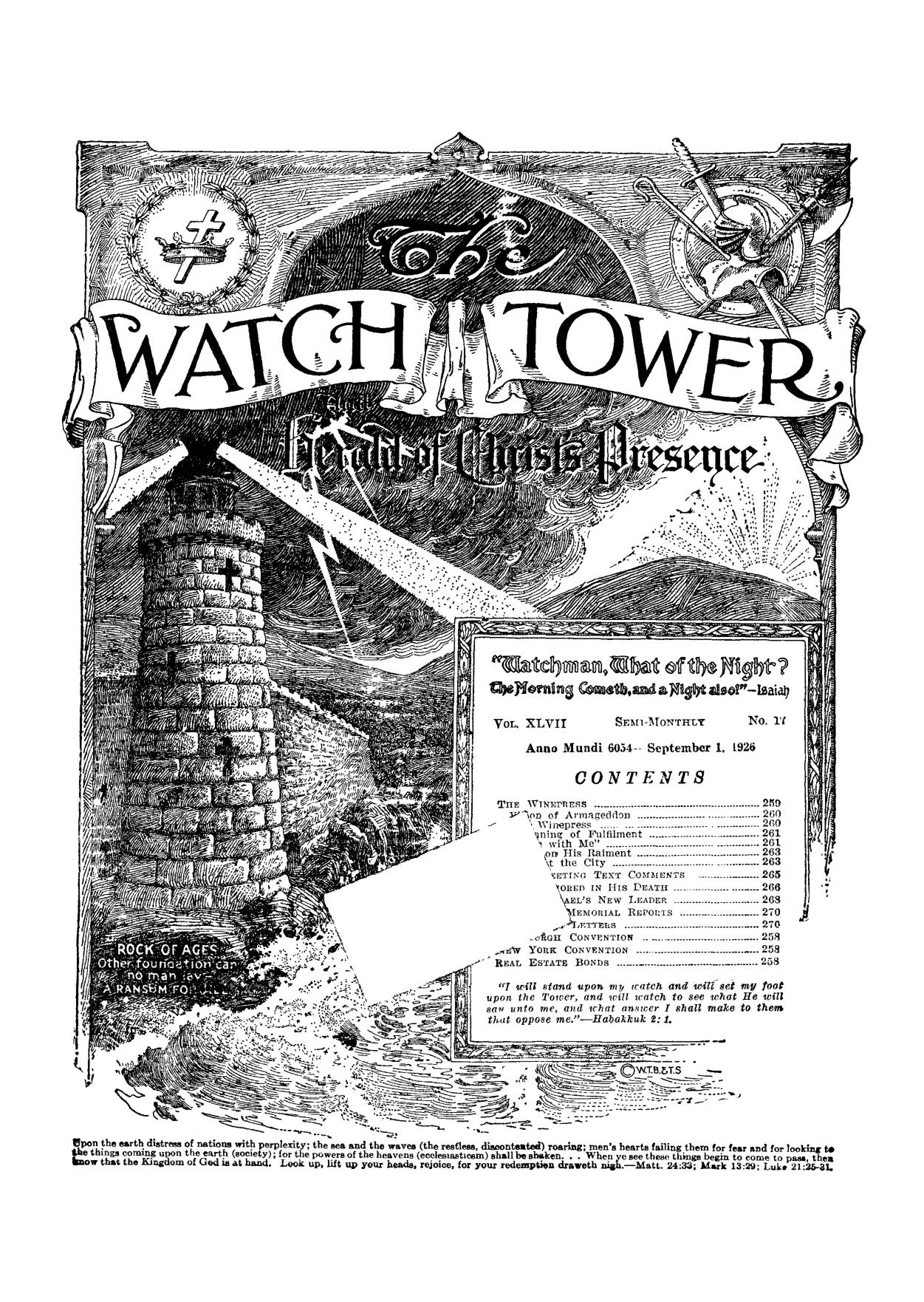
No. 17
SS°Jk*he esrt11. distress of nations with perplexity; the sea and the waves (the restless, discontented) roaring; men’s hearts failing them for fear and for looking to J®® 4Uj°n (society); for the powers of the heavens (ecelesiasticem) shall be shaken. . . When ye see these things begin to come to pass, then
■now that the Kingdom of God is at hand. Look up, lift up your heads, rejoice, for your redemption draveth nigh.—Matt. 24:33; Mark 13:29; Luke 21:25-31,
Vol. XLVII
Semi-Monthly
Anno Mundi 6054- September 1, 1926
CONTENTS
j - ROCK OF AGFC Othe< foLrfad+ion no rran -f,'A RANSbM rO
The Winepress ............................
J^'Ann of Armageddon ................
\ Winepress ...... ...................
^ning of Fulfilment ............
*» with Me” ...............-.........
kon His Raiment ................
\t the City ........................
Feting Text Comments
Xored in His Death .... Xael's New Leader .... Memorial Reports .. ^•’•’I./ETTEICS ....................
,.J1gh Convention .............
York Convention .................
Real Estate Bonds .......-..............
... 259
... 2G0
... 260
... 261
... 261 ... 263 ... 263
... 265 ... 266 ... 268
... 270 ... 270 -.258
... 258 .. 258
“I will stand upon my watch and wilt set my foot upon the Tower, and will watch to see what He will san unto me, and what answer I shall make to them that oppose me.”—Habakkuk 8: 1,
©WT.B.5T.S
THIS JOURNAL AND ITS SACRED MISSION
THIS Journal ona of the prime factors or instruments in the system of Bible instruction, or "Seminary Extension”, now being
presented in all parts of the civilized world by the Watch Tower Bible & Tract Society, chartered A. D. 1884, "For the Promotion of Christian Knowledge”. It not only serves as a class room where Bible students may meet in the study of the divine Word but also as a channel of communication through Which they may be reached with announcements of the Society’s conventions and of the coming of its traveling representatives, styled "Pilgrims”, and refreshed with reports of its conventions.
Our “Berean Lessons” are topical rehearsals or reviews of our Society’s published Studies most entertainingly arranged, and very helpful to all who would merit the only honorary degree which-the Society accords, via., Verbi Dei Minister (V. D. M.), which translated into English is Minister of God’s Word. Our treatment of the International Sunday School Lessons is specially for the older Bible students and teachers. By some this feature is considered indispensable.
This journal stands firmly for the defease of the only true foundation of the Christian’s hope now being so generally repudiated .—redemption through the precious blood of “the man Christ Jesus, who gave himself a ransom [a corresponding price, a substitute] fo« all”. (1 Peter 1:19; 1 Timothy 2:6) Building up on this sure foundation the gold, silver and precious stones (1 Corinthians 3: Ills; 2 Peter 1:5-11) of the Word of God, its further mission is to "make all see what is the fellowship of the mystery which. . .has been hid in God, . . < to the intent that now might be made known by the church the manifold wisdom of God”—“which In other ages was not made known unto the sons of men as it is now revealed”.—Ephesians 3:5-9,10.
It stands free from all parties, sects and creeds of men. while it seeks more and more to bring its every utterance Into fullest subjection to the will of God in Christ, as expressed in the holy Scriptures. It is thus free to declare boldly whatsoever the Lord hath spoken—according to the divine wisdom granted unto us to understand his utterances. Its attitude is not dogmatic, but confident; for we know whereof we affirm, treading with implicit faith upon the sure promises of God. It is held as a trust, to be used only in his service; hence our decisions relative to what may and what may not appear in its columns must be according to our judgment of hla good pleasure, the teaching of his Word, for the upbuilding of his people in grace and knowledge. And we not only invite but urge oug readers to prove all its utterances by the Infallible Word to which reference is constantly made to facilitate such testing,
TO US THE SCRIPTURES CLEARLY TEACH
That the church Is “the temple of the living God”, peculiarly “his workmanship”; that its construction has been in progress throughout the gospel age—ever since Christ became the world’s Redeemer and the Chief Corner Stone of his temple, through which, when finished, God’s blessing shall come “to ail people”, and they find access to him.—1 Corinthians 3:16, 17; Ephesians 2:20-22 ; Genesis 28 ; 14 ; Galatians 3 :29.
That meantime the chiseling, shaping, and polishing of consecrated believers in Christ’s atonement for sin, progresses; and when tho last of these “living stones”, “elect and precious,” shall have been made ready, the great Master Workman will bring all togethea in the first resurrection; and the temple shall be filled with his glory, and be the meeting place between God and men throughout the Millennium.—Revelation 15 : 5-8.
That the basis of hope, for the church and the world, lies In the fact that “Jesus Christ, by the grace of God, tasted death for every man,” “a ransom for all,” and will be “the true light which lighteth every man that cometh into the world", "In due time”.— Hebrews 2:9; John 1: 9 ; 1 Timothy 2:5, 6.
That the hope of the church is that she may be like her Lord, "see him as he Is,” be “partakers of the divine nature’,’ and share his glory as his joint-heir.—1 John 3:2; John 17:24; Romans 8:17; 2 Peter 1:4.
That the present mission ef the church is the perfecting of the saints for the future work of service: to develop in herself every grace; to be God’s witness to the world; and to prepare to be kings and priests in the next age.—Ephesians 4:12; Matthew 24 : 14; Revelation 1:6; 20:6.
That the hope for the world lies in the blessings of knowledge and opportunity to be brought to all by Christ’s Millennial kingdom, the restitution of all that was lost in Adam, to all the willing and obedient, at the hands of their Redeemer and his glorified church, when all the wilfully wicked will be destroyed.—Acts 3:19-23 ; Isaiah 35.
published ay
WATCH TOWER. BIBLE &■ TRACT SOCIETY 18 CONCORD STREET n n BROOKLYN, NX, U S A-FOREIGN OFFICES: British: 34 Craven Terrace, Lancaster pate, London W. 2 ; Canadian: 38-40 Irwin Avenue, Toronto, Ontario; Australasian: 495 Collins St., Melbourne, Australia; South African: 6 Lelie St., Cape Town, South Africa.
Pleasb Address the Society in Every Case
YEARLY SUBSCRIPTION PRICE : United States, $1.00 ; Canada and Miscellaneous Foreign, $1.50; Great Britain, Australasia, and South Africa, 7s. American remittances should be made by Express or Postal Money Orders, or by Bank Draft. Canadian, British, South African, and Australasian remittances should be made to branch offices only. Remittances from scattered foreign territory may be made to the Brooklyn office, but by International Postal Money Orders only. (Foreign translations of this journal appear in several languages.)
EDITORIAL COMMITTEE : This journal is published under the supervision of an editorial committee, at least three of whom have read and approved as truth each and every article appearing in these columns. The names of the editorial committee are: J. F. Rutherford, W. E. Van Amburgh, J. Hemery, R. H. Barber, E. J. Coward. TERMS TO THE LORD’S POOR: All liible Students who,-by reason of old age or other infirmity or adversity, are unable to pay for this journal, will be supplied free if they send a postal card each May stating their case and requesting such provision. We are not only willing, but anxious, that all such be on our list continually and in touch with the Berean studies.
Notice toSubscribers: We do not, as a rule, send a card of acknowledgment for a renewal or for a new subscription. A renewal blank (carrying notice of expiration) will ba sent with the journal one month before the subscrintion expires. Change of address, when requested, may be expected to appear on address label within one month.
Entered as Seeond Class Matter at Brooklyn, N. Y. Postoffice. Act of March Srd. 1879,
PITTSBURGH CONVENTION
A convention of Bible Students will be held at Pittsburgh, October 29th to 31st Following this will be the annual meeting on Monday, November 1st. Speakers who will serve at this convention will be announced later. AU communications with reference to rooms and other information about the convention may be addressed to Charles H. Stewart, 317 Grace St., Mt. Washington Station, Pittsburgh, Pa., secretary Pittsburgh Ecclesia.
NEW YORK CONVENTION
The principal convention to be held by the Society In America this year wiU be that at New York City, October 15th to 18th inclusive. Most of the meetings wiU be held in the Manhattan Opera House, West 34th Street. The public meeting will be at the New Madison Square Garden and will be addressed by the president of the Society. The New Madison Square Garden is New York’s greatest assembly place, and there is probably none equal to it on earth for a closed-in building. Its seating capacity exceeds twenty thousand. It is absolutely fireproof and is equipped with all modem conveniences, including voice amplifiers which will make it easy for everyone to hear.
We remind the brethren that this is their convention; and Brooklyn headquarters will appreciate full cooperation to make this the greatest public witness ever held. Further details wiU appear from time to time in The Watch Tower. All communications concerning the convention should be addressed Watch Tower Bible and Tract Society, Convention Committee, 18 Concord St., Brooklyn, N. Y. Requests for rooms should be made on separate sheet, and no one should count on less than $1.50 or §1.75 per day per person with two in a room.
REAL ESTATE BONDS
The Society has sent out a supplement concerning bonds. This is not a solicitation for money, but offering the brethren an opportunity of taking the Society’s bonds for building rather than the Society selling them to some worldly institution. The bonds will be payable on or before ten years after date, and bear at five percent interest annually. They will be registered at the Socscrr’a office, and the holder can sell his bond or bonds at any time and the transfer will be made at the Society’s office. The bonds will be guaranteed by the Society, which puts all the Society’s property back of the bonds. See supplement August 1st Watch Tower for further information.
e,WATCH TOWER
AND HERALD OF CHRIST'S PRESENCE
Vol. XLVII Septembeb 1, 1926 No. 11
THE WINEPRESS
“1 have trodden the winepress alone; and of the people there was none with me; for 1 will tread them in mint anger, and trample them in my fury; and their blood shall be sprinkled upon my garments, and 1 will stain all my raiment. For the day of vengeance is in mine heart, and the year of my redeemed
is come."—Isaiah 63: 3,4.
THIS prophecy has not been fulfilled, but its fulfilment is beginning. Guessing at the meaning of prophecy is not beneficial. We may guess right or we may not. The physical facts showing the fulfilment, or that the prophecy is in course of fulfilment, furnish the key to interpretation. When a prophecy begins to be fulfilled, then those who are in the temple class should begin to have some understanding of it.
2 This prophecy could not even begin to be fulfilled until after 1918 and, of course, could not be understood until after that time. The argument hereinafter submitted is believed to strongly support this view. No one is to be criticized because the prophecy was not understood prior to 1918, and no one is entitled to any credit for calling attention to its fulfilment after that date nor at any other time. The Lord is his own interpreter, and he will make known his truth to his church in his own good way and time.
3 It is remarkable and wonderfully encouraging to note how many prophecies have had fulfilment since 1918. There is a reason for this. The reason is that it was in 1918 that the Lord came to his temple. (See Z 1926, pages 229-232) Agreeable to the promise of the Lord, there the temple was opened, followed by flashes of light upon the divine plan serving as encouragement and consolation to those privileged to be of the temple class.—Revelation 11:19.
* As a prelude to the examination of the sixty-third chapter of Isaiah, reference is made to the words of the same prophet as follows: “I have set watchmen upon thy walls, 0 Jerusalem; they shall never hold their peace day nor night: ye that are the Lord’s remembrancers, take ye no rest, and give him no rest, till he establish, and till he make Jerusalem a praise in the earth.”-—Isaiah 62: 6, R. V.
6 The watchmen here are those who are wholly devoted to the Lord and who have the heart set upon the establishment of his kingdom. These are not particular about daily formalities, not believing that these prepare them for the kingdom. They are not spending time in meditating upon how they can “develop a
character” that will make them more sanctimonioui than others. They are not performing eye service that they might shine before men or have the approval and compliments of men. They are not so much concerned about wearing clothes of a certain cut or pattern. They are not particular to seat themselves in the pulpit before the congregation and assume a sanctimonious attitude by bowing the head to be seen of men.
6 The true watchmen appreciate the fact that the things above mentioned belong to ecclesiasticism and not to the true and honest sendee of God. “As the servants of Christ, [they are] doing the will of God from the heart; with good will doing service, as to the Lord, and not to men.” (Ephesians 6: 6, 7) They are concerned about the kingdom, and are earnest and diligent in performing their part of the covenant entered into with God, that they might please him and receive his approval.
7 Jerusalem represents God’s organization, and in that organization there is a faithful “remnant” class which are called watchmen. These are the ones whom the Lord has set on watch. The negligent and indifferent ones of that antitypical city will be of the great company class. When the temple of God was opened, and those of the remnant had a vision of its meaning, the heart of each one burned with zeal for the Lord. These began to have an appreciation of what the kingdom really means, to wit, that it will bring the downfall of the wicked organization built up by the Devil; that it will release the great company class from the prisons wherein they are held by the ecclesiastical wing of the Devil’s organization; that it will relieve the people from their oppressors; that it will bring the complete union of the members of the church with her glorious Head; and that above all, it will be a complete vindication of the name of Jehovah, the Most High.
3 Being thrilled with this vision, the watchmen keep continually before the Lord their prayers in behalf of the kingdom. (Psalm 83:11-18) These watchmen see that the Lord must destroy Satan’s organization before the name of the Most High can be vindicated and before restoration of the peoples of earth can begin. The
watchmen see that they have a part in the great work How in progress, and that there must be no cessation of their efforts. Like an army on the march, following the General in whom they have absolute confidence, they are pressing on to certain victory.
9 As Gideon pursued the enemy when he fled, even so these faithful ones see that the fight must be pressed to a successful conclusion. As the prayers of Cornelius went up before the Lord and were placed on file until God’s due time to consider them, even now the prayers of the remnant of Jerusalem, watching upon the walls, ascend before God continually for the complete estab' lishment of his government upon earth, which will lift the veil of ignorance and break the shackles from the arms of oppressed humanity. As these faithful watchmen pray and work, the command from the Lord comes to them: “Go through, go through the gates; prepare ye the way of the people; cast up, cast up the highway; gather out the stones; lift up a standard for the people.”—Isaiah 62:10.
VISION OF ARMAGEDDON
10 Then opens the sixty-third chapter of Isaiah’s prophecy. These watchmen catch a glimpse of what is about to transpire. They see that the groat God has set his King upon his throne. There are many kings and lords on earth, but now Christ Jesus has become King of kings and Lord of lords; and all are commanded to render obedience to him. They will refuse, however, to obey; and dire results shall follow. (Psalm, 2:1-10) The watchmen have a vision of the Mighty One marching in the greatness of his strength. He is faithful and true, and in righteousness he comes to make war and judge. He is clothed with complete authority and power and is now beginning to exercise it. (Revelation 19: 11,12; Psalm 110:2) Onward in his majesty and greatness he marches. It is a prelude to Armageddon.
11 The first verse of the prophecy (Isaiah 63) is in the nature of a colloquy. The first speaker is the prophet. His words constitute a declaration by the Lord for the encouragement and comfort of his people. The second speaker is “The Servant” of Jehovah. The first speaker says: “Who is this that cometh from Edom, with dyed garments from Bozrah? this that is glorious in his apparel, travelling in the greatness of his strength?” The second speaker answers: “I that speak in righteousness, mighty to save.” The first speaker inquires further: ‘^Wherefore art thou red in thine apparel, and thy garments like him that treadeth in the winefat ?” To this “The Servant”, the mighty Executor of the divine plan, replies: “I have trodden the winepress alone; and of the people there was none with me; for I will tread them in mine anger, and trample them In my fury; and their blood shall be sprinkled upon my garments, and I will stain all my raiment For the day of vengeance is in mine heart, and the year of my redeemed is come.”—Isaiah 63: 3,4.
DEFINITIONS
13 Some of the words of this prophecy have a symbolic meaning. It is important to ascertain if possible the correct meaning. The one “marching in greatness and strength” is pictured as coming from Edom and Bozrah.
13 EDOM: The name Edom represents that which is opposed to the Lord. (Obadiah 1:1) It has the same meaning as Esau, and therefore refers to the organization of Satan, the most reprehensible element of which is ecclesiasticism.—Genesis 36:1-8; Psalm 137:7,8.
™ IDUMEA: Idumea has the same meaning as Edom, and really is Edom. (Isaiah 34: 5) The wrath of God is especially against Idumea. (Ezekiel 35: 15) It refers to the same wicked system that is described in Revelation 19:19, 20.
16 BOZRAH: Bozrah was the chief city of Edom. Therefore Bozrah would represent that which is the center or most important part of the Devil’s organization; to wit, the ruling factor. The ruling factors of the Devil’s organization visible consist of the commercial, political and ecclesiastical powers, the latter of which is the most reprehensible, because claiming to represent God. Satan’s organization has many supporters, but the ruling factors form the chief part thereof.
16 WINEFAT: The word winefat, used in the Scriptures, means a vat to hold the grapes while pressing them, or a receptacle in which the pomace is held when pressed.
17 WINEPRESS: A winepress is an instrument or arrangement employed to crush or break up the fruit.
18 THE VINE: The vine produces the fruit, the grapes. The true vine is Christ, and his faithful body members are branches thereof. (John 15:1-3) These produce the fruit of the spirit, which fruit is unselfish devotion to Jehovah God and is used to bless the people. The true vine therefore is the official part of God’s organization.
'19 VINE OF THE EARTH: “The vine of the earth” (Revelation 14:18,19) produces the grapes or fruit of the earth. The earth represents the Devil’s organization visible to man. The vine of the earth is the very antithesis of the true vine and is therefore the official part of the Devil’s visible organization. The vine of tha earth produces the fruit of wickedness by which the Devil has held the people in subjection to himself. This false vine of the earth and its fruit must be destroyed.
THE WINEPRESS
20 In addition to the prophecy here considered, tha winepress is mentioned in Revelation, chapters fourteen and nineteen. It seems clear that the same winepress is referred to in each instance. Since tha winepress is the instrument employed by the husbandman to crush the grapes, and since Jehovah is the husbandman (John 15:1), it follows that the winepress is the means oi instrument employed by Jehovah to destroy the Devil’s organization. This is both reasonable and Scriptural* Having its proper definition we should therefore have no difficulty in locating the winepress.
21 Zion is God’s organization; and it is opposed by the enemy Satan’s organization, which controls the nations of the earth. The prophet says: “The Lord shall send forth the rod [sceptre of authority] of thy strength out of Zion.” (Psalm 110:2) Christ, the anointed King, is the One sent forth with authority. Why is he sent forth? The prophet answers: “To rule among his enemies.” Then the prophet shows that the One sent forth is the great antitypical Priest after the order of Melchizedek who is, to wit, the Executive Officer of Jehovah God. The winepress therefore must mean God’s organization, of which Christ Jesus is the head, and which Jehovah employs to destroy Satan’s organization.
22 The treading of the winepress is another picture of the great battle of God Almighty against the Devil. It pictures the complete destruction of the enemy’s entire organization, and not merely the humiliation of the false religious systems. It is apparent that the members of the church could not see the meaning of this prophecy until first they had a vision of Satan’s organization. That vision was not given to the church until after 1918. It follows that the understanding of the prophecy could not be had until after 1918.
BEGINNING OF FULFILMENT
23 All prophecy relating to the treading of the winepress shows that the treading takes place during the time of the wrath of God. “I will tread them in mine anger, and trample them in my fury. . . . For the day of vengeance is in mine heart, and the year of my redeemed is come.” (Isaiah 63": 3, 4) In harmony with this the Revelator says: “And the angel thrust in his sickle into the earth, and gathered the vine of the earth, and cast it into the great winepress of the wrath of God.” (Revelation 14:19) “And he treadeth the winepress of the fierceness and wrath of Almighty God.”— Revelation 19:15.
24 The end of the Gentile times came in 1914, evidenced by the World War and what followed immediately. Prior to that time the great Executive Officer of God had remained inactive against Satan. (Psalm 110: 1; Hebrews 10: 12,13) It was in 1914 that the nations became angry, and it was after 1918 that God’s wrath against the nations began. The Lord came to his temple in 1918, as heretofore shown in this journal. He came for the purpose of judgment. (Psalm 11:4; Malachi 3:1-3) That judgment must begin at the house of God. (1 Peter 4: 17) After that the judgment against the nations forming the visible part of Satan’s organization begins.
25 As long as the ecclesiastical systems had any favor whatsoever from Jehovah this prophecy could not have had a fulfilment. The World War brought before the ecclesiastical leaders the conclusive proof that the world had ended and that God’s kingdom is at hand. Acknowledgment of this proof is made by them. Ten representative clergymen in the spring of 1918 issued from London, the very “seat of the beast”, that memory able manifesto declaring their belief in the nearness of the kingdom of God. Thereafter these men and their allies openly repudiated this proof by opposing the truth concerning the divine plan. The year following, namely, January 1919, the Federation of Churches, officially representing the ecclesiastical systems of the world, openly repudiated the Lord’s kingdom and adopted the League of Nations compact as a substitute therefor. From that time forward all the ecclesiastical systems ceased in every sense to be spiritual Israelites. They completely allied themselves with tho rulers of the world under the supervision of her god, the Devil.
26 It is here worthy of note that the Herods, who were the last rulers of Palestine, were not Jews but Idumeans. Then the Pharisees (the ecclesiastics), the Herods (the politicians), and the Romans (the great commercial power of the earth) united against Jesus. Herod tried to kill Jesus; the Pharisees set the tr.ip for his death; and the Romans actually put him to death; but the Devil was the prime mover of the foul crime. The fate of that first unholy triple alliance following the first advent, which was complete destruction, foreshadows the fate of the later unholy alliance at tho present time.
2T The time comes to begin the work against the vino of the earth, and the Lord in the prophecy here under consideration says: “And I looked, and there was nona to help; and I wondered that there was none to uphold: therefore mine own arm brought salvation unto me; and my fury, it upheld me.” (Isaiah 63:5) Of necessity this observation by the Lord must take place before the beginning of the treading of the winepress, that is to say, “The Servant” of God, who is Jehovah’s Executive Officer, must first observe that there is none to help him in the work of destroying Satan’s organization; and hence he proceeds to do the work himself.
2S Since it was in the year 1919 that the religious systems, claiming to represent the Lord, openly repudiated him, it follows that the fulfilment of this prophecy must take place after that date. Now we are in the close of 1926; and it is apparent to those in the temple that the forces are gathering for the great battle of God Almighty, at which time the winepress shall crash out the grapes of the vine of the earth. The fulfilment of the prophecy has begun, and therefore tha Lord’s people may have some understanding of it.
“NONE WITH ME"
29 The second speaker, “The Servant” and Executive Officer of Jehovah, says: “I have trodden the winepress alone; and of the people there was none with me.” These words prove that no church system on the earth will be supporting the Lord in his battle to overthrow the Devil’s organization, because the church systems are now a part of that enemy organization. Does it mean then that no one will be with tha Lord? Does this mean that the Lord Jesus will be supported by none? Many prophecies show that the Lord counts the loyal and faithful members of his body as a part of himself, therefore when he uses the pronoun “me” he includes all such loyal ones. A few scriptures are submitted here in proof of this point, which will establish conclusively that the faithful remnant class are counted in as a part of the Lord, participating in this great battle of God Almighty.
30 In Psalm 69: 5, which undoubtedly refers to the Lord, he speaks of himself thus: “Thou knowest my foolishness; and my sins are not hid from thee.” This could not refer to the Lord Jesus himself, because he was not foolish nor did he have any sins. It clearly then refers to the body members, who are imperfect yet loyally devoted to God.
31 Psalm 110:3 says, “Thy people shall be willing [volunteers] in the day of thy power.” Thus the prophet locates the faithful followers of Christ Jesus, who are counted in as a part of himself and participate in the fight.
32 In Revelation 19:14 it is recorded: "And the armies which were in heaven followed him upon white horses, clothed in fine linen, white and clean.” The faithful members of his body constitute the army and therefore are counted as a part of himself. The great fight is that of the beast, which is the Devil’s organization under the leadership of the Devil, against the Lamb, the Lord of lords and King of kings; and his chosen and faithful are with him in the fight because they are part of him.—Revelation 17:14.
33 It is recorded in Psalm 149: 5-9: "Let the saints be joyful in glory: let them sing aloud upon their beds. Let the high praises of God be in their mouth, and a two edged sword in their hand; to execute vengeance upon the nations, and punishments upon the people; to bind their kings with chains, and their nobles with fetters of iron; to execute upon them the judgment written: this honour have all his saints." (Psalm 149: 5-9) This without question has referenoe to the faithful members of the body of Christ, who participate in the battle because they are part of him.
34 The prophecy shows that the Lord goes into the winefat, and with his feet treads out the grapes of the vine of the earth. The last members of the body of Christ on earth who continue faithful unto the end are designated “the feet of him”, therefore a part of him. (Isaiah 52:7) Again it is written: “Behold my servant, whom I uphold; mine elect, in whom my soul delighteth; I have put my spirit upon him: he shall bring forth judgment to the Gentiles.” (Isaiah 42:1) "My servant” here undoubtedly refers to Christ Jesus and the faithful members of his body; because these are part of him and he counts them as such. Many other scriptures corroborate this, proving that the “faithful Unto death” are counted in as a part of the Christ.
•’When the Lord says: “Of the people there was none with me,” he means that of all the peoples of earth who profess to be followers of Christ none are in fact with him, except those whom he counts as a part of himself because of their faithfulness. It therefore conclusively follows that no one now on earth, regardless of what he may have heretofore done in the name of the Ixjrd, can be counted in as a part of the Lord, the Christ, unless he is with the Lord, actively supporting him in the fight against the Devil’s organization. It could not include any of those in present truth or other professed Christians who in any wise compromise with the Devil’s organization or sympathize with it. Nor can there be among such who form a part of him “any calm or tempered steel”, because the Lord says that he does this work in his fury. There must now be a boldness on the part of the saints in this day of judgment, because only such show that they love the Lord; and none others does he approve.-—1 John 4:17,18.
36 The proclamation of the truth must be given before many peoples, nations and kings (Revelation 10:11); and this must be given with a zeal for the Lord and without fear. There can be no slacking of the hand now. A withdrawal from joyful and active service of the Lord, or a refusal or neglect to have a part in the service as opportunity affords, will spell disaster to such, depriving them of membership in the kingdom. The saints should bear in mind that God is not merely preparing them for heaven that he might use them there. He is offering to them an opportunity to prove their faithfulness and devotion to him; and those who are faithful and true even unto death shall receive the heavenly reward, and none other have the promise of such. (Revelation 2:10) These scriptures show that the Lord Jesus Christ and the members of his body, both on the other side and on this side the vail, shall have a part in the great battle of Armageddon which shall crush “the vine of the earth” and its fruitage, and that none others will have a part therein.
OUR PART
31 The host" are marching toward Armageddon now. Are you in the ranks? If so, on which side? Armageddon shall mark the use of the winepress which shall completely crush out the vine and the fruit of the earth. In just what manner the Lord will bring about this destruction the prophecy does not reveal, but it is certain that the Lord himself will do the crushing.
33 What part then in that great work is to be performed by the faithful members of the body, the remnant class, yet on earth? The Scriptures make it clear that their part is to declare the day of the vengeance of our God (Isaiah 61:2); to be witnesses that he is God (Isaiah 43:10,12); to sing the praises of him who hath called them out of darkness into his marvelous light (1 Peter 2:9); to be unreservedly and wholeheartedly on the side of the Lord (1 John 4:17,18); and to hold forth his standard for the people, that they may know which way to go. (Isaiah 62:10) This they do by constantly participating in the sendee of the Lord as opportunity is offered. Their part is really to sing.
88 A vivid illustration of this is given in 2 Chronicles the twentieth chapter. There the peoples of Moab, Ammon and Mount Seir, the descendants of Esau, all fitly representing the Devil’s organization as it now appears, entered into a conspiracy to destroy the Israelites. To the Israelites God said: “Be not afraid nor dismayed by reason of this great multitude; for the battle is not yours, but God’s. ... Ye shall not need to fight in this battle: set yourselves, stand ye still, and see the salvation of the Lord with you, 0 Judah and Jerusalem: fear not, nor be dismayed; tomorrow go out against them; for the Lord will be with you." (2 Chronicles 20:15,17) Then the Lord commanded that as they went to battle they should put the singers in the van of the marching hosts of Israel and that these should sing the praises of Jehovah and extol the beauty of his holiness. This is what they did, and the Lord destroyed the enemy’s army.
40 In harmony with this the prophet, in describing the part to be performed by the saints on earth, says: “Let the saints be joyful in glory: let them sing aloud upon their beds. Let the high praises of God be in their mouth, and a two edged sword in their hand." (Psalm 149: 5, 6) These are the instruments they use in participating in the great battle. They are the witnesses of the Lord, proclaiming his message, announcing his kingdom, and testifying what he is about to do.
BLOOD ON HIS RAIMENT
81 In Isaiah’s prophecy the Lord is recorded as saying: “And their blood shall be sprinkled upon my garments, and I will stain all my raiment.” (Isaiah 63:8) The stain upon all his raiment is a testimony that all of the saints, both on the other side and on this side, shall participate in the battle in the crushing out of the vine of the earth.
42 In this same connection, in this chapter, the prophet refers to the time when Moses as an instrument of the Lord overthrew Egypt and delivered the people. God sent Aaron with Moses to Egypt to act as a mouthpiece for Moses. It was Aaron’s business to talk. Soon thereafter Egypt was overthrown, that God might make for himself an everlasting name. (Isaiah 63:12) Now in the end of the world God will overthrow Satan and his organization, of which Egypt and her ruler were types; and this he does that he might make for himself an everlasting name. His saints are to be witnesses concerning this fact and give the testimony in the earth. —Isaiah 43:10-12.
43 Now he sends the antitypical Moses to do this great work; and with the antitypical Moses he sends the members of his body who axe on earth, pictured by Aaron, and who are therefore to be the spokesmen to declare the message of the Lord to the peoples of the earth. This is another proof of what part the saints on earth have in the treading of the winepress. They must tell the people who is God, what he Is about to do, and that his kingdom will relieve them from thebe afflictions. The Lord will require faithfulness on the part of these.—1 Corinthians 4:2.
“When Egypt was overthrown it could be properly claimed that the blood of her hosts was upon the garments of Moses and Aaron, because they were the instruments used by the Lord to overthrow that nation. When the life-blood of Satan’s organization is crushed out, as pictured by the treading of the winepress, the blood of those who shall perish may properly be said to be upon the raiment of the Lord and the faithful members of his body; for such is the instrument which Jehovah uses to accomplish this purpose.
FEAR NOT
41 The treading of the winepress is near at hand; because the day of God’s wrath has come. It will be a time of tribulation such as mankind has never before known. (Matthew 24: 21, 22; Jeremiah 25: 30-35) But the true and faithful remnant will have no fear, neither will they slack their zeal in the proclamation of the message of the Lord. In that terrible day now pending Jehovah will be a crown of glory and a diadem of beauty unto this remnant of his people.—Isaiah 28: 5, 6.
48 To this class the Lord, the Most High, says: “Fear not; for I have redeemed thee, I have called thee by thy name; thou art mine. When thou passest through the waters, I will be with thee; and through the rivers, they shall not overflow thee: when thou walkest through the fire, thou shalt not be burned; neither shall the flame kindle upon thee. For I am the Lord thy God, the Holy One of Israel, thy Saviour: I gave Egypt for thy ransom, Ethiopia and Seba for thee. Since thou wast precious in my sight, thou has been honourable, and I have loved thee: therefore will I give men for thee, and people for thy life."—Isaiah 43:1-4.
WITHOUT THE CITY
4T Referring to the winepress the Revelator says: “The winepress was trodden without the city.” (Revelation 14:20) The city undoubtedly refers to the city of Jerusalem, which is a symbol of God’s organized people. The word “without” here means "outside of”. Therefore it shows that the great destruction and trouble is outside of the city, or away from God’s people.
"Another picture is given in Zechariah’s prophecy, (Zechariah 14:1-3) There the Devil’s organization ia shown engaged in battle against Jerusalem, God’s organized people. “The city shall be taken, and the housea rifled, and the women ravished,” and a part of the city goes into captivity, which clearly represents the great company class. But the residue or “remnant" of God’a people, representing the faithful ones, shall not be cut off from the city.
48 “Then shall the Lord go forth, and fight against those nations, as when he fought in the day of battle.’* (Zechariah 14: 3) In this fight shall the Lord, outaidi of the city, crush the life-blood out of the Devil’s organisation. The far-reaching scope of this terrible trouble is described by the Prophet Jeremiah when he says: “And the slain of the Lord shall be at that day from one end of the earth even unto the other end of the earth: they shall not be lamented, neither gathered, nor buried; they shall be dung upon the ground.”—Jeremiah 25: 33.
60 Blood poured out always represents death. Therefore when the Revelator says, “Blood came out of the winepress,” it indicates death or destruction to those constituting the Devil’s organization. And Jeremiah definitely locates who the chief ones in this organiz-tion are, when he says: “And the shepherds shall have no way to flee, nor the prinaipal of the flock to escape.” (Jeremiah 25:35) This trouble will be world-wide because against the god of this world and all of his force. Upon one side shall be arrayed the Devil and his powerful organization. Upon the other side the Lamb of God, the Executor of the divine plan; and with him, proclaiming his praises and his victory and extolling the name of Jehovah, will be the called, the chosen and the faithful saints, including those faithful ones now on this side who thus continue faithful until the very end.
51 The destruction of Sodom and Gomorrah was an illustration of the destruction of Satan’s organization. The winepress is another picture of its complete destruction. The annihilation of the wicked system is described again by the Prophet Isaiah in these words: “For my sword shall be bathed in heaven: behold, it shall come down upon Idumea, and upon the people of my curse, to judgment. The sword of the Lord is filled with blood; it is made fat with fatness, and with the blood of lambs and goats, with the fat of the kidneys of rams: for the Lord hath a sacrifice in Bozrah, and a great slaughter in the land of Idumea. . . . For it is the day of the Lord’s vengeance, and the year of recom-pences for the controversy of Zion. And the streams thereof shall be turned into pitch, and the dust thereof into brimstone, and the land thereof shall become burning pitch.”—Isaiah 34: 5, 6, 8, 9.
52 The land of pitch and brimstone above mentioned illustrates complete destruction, and corresponds exactly with the picture of the same thing given in Revelation 19:19, 20. In the latter picture the Devil’s organization, and especially the false religious system which forms a part thereof, is cast into the lake of fire and burning brimstone. All of this is done in the closing hours of God’s wrath expressed against a wicked system, an organization that has blasphemed his holy name and oppressed humankind for ages past.
63 The vine of the earth is the wicked organization of which the Devil is the head. It produces the grapes of the earth, the fruits of wickedness. The vine of God, which is the vine of righteousness, is Christ the Head and the faithful members of hia body. The winepress of God is the instrument or means which he uses to crush the life-blood out of the grapes of the earth, which instrument is his beloved Son, willingly and joyfully supported by the faithful members of his body. Jehovah brings this terrible trouble upon all creatures of earth, particularly those outside of his own people (pictured by the city of Jerusalem), in order that he might establish amongst all creatures his everlasting name.
54 Of course no one this side the vail can see every detail of the operation of the winepress. The earnest watchmen of the temple class, however, can see that it means the instrument Jehovah will employ to annihilate that wicked system that has long defamed his name and oppressed the human race. Seeing the wonderful results that will follow, these are thrilled with joy, because they know that the day of deliverance for themselves and for mankind in general is at hand. These faithful watchmen have entered into the joy of the Lord and these keenly appreciate the fact that the joy of the Lord is their strength. With joy and yet with keen and earnest watchfulness they continue to pray: “Save now, I beseech thee, 0 Lord: 0 Lord, I beseech thee, send now prosperity.”—Psalm 118: 25.
QUESTIONS FOR BEREAN STUDY
What constitutes the key to prophetic interpretation? When did Isaiah 63:3,4 begin to be fulfilled? Who are the watchmen mentioned in the preceding chapter? V 1-6.
Who are “the remnant”, and what does the kingdom mean to this class? How does Isaiah 62:10 apply?
Who are the speakers of Isaiah 63:1-4? 8 7-11.
Define Edom, Idumea and Bozrah. 8 12-15.
What is meant by “winefat” and “winepress”? What constitutes “the vine” of John 15:1-3 and “the vine of the earth” of Revelation 14:18,19? 816-19,53.
Do the winepress of Isaiah’s prophecy and that of Revelation 14 and 18 refer to the same thing? What is illustrated thereby? 8 20-22.
When does the prophecy show that the treading of the winepress takes place, and why? What are the physical facts which show the necessity for the treading work? 8 23-25, 28.
What three elements desired and plotted the death of Jesus? Whom did they foreshadow? Who helps “the servant” tread the winepress? 8 26-29,35.
How may we know that the church shares with the Lord Jesus Christ in the work of treading the winepress? What if we should now withdraw from active service? 8 30-34,36.
What is respectively the Lord’s part and our part In this work? 8 37-40.
W’hat is meant by “their blood shall be sprinkled upon my garments”? 8 41, 44.
How is the present work of the saints pictured in Aaron? 8 42, 43.
What special comfort may we derive from Isaiah 28: 5, 6 and 43:1-4? 8 45, 46.
What is “the city” of Revelation 14:20? Is it the same city mentioned in Zechariah 14:1-8? 8 47-49.
What is signified by blood coming out of the winepress? Mention other forceful pictures of the destruction of Satan’s organization as given in the Scriptures. 8 50-52. What effect should these things have upon the temple class?
8 54.
PRAYER-MEETING TEXT COMMENTS
TEXT FOR OCTOBER 6
"God will establish it for ever."—Psalm 48:8.
THE context shows that the beginning of the fulfilment of this prophecy is when the Lord comes to his temple. He there begins the exercise of his power as King of kings. God calls upon the rulers and lords of earth to render allegiance to his great King. Christ offers himself as King and is rejected by the rulers of earth. Although rejected, Jehovah declares that he will establish his glorious organization for ever. His due time has come to establish it.
Those of the temple class recognize Zion as God’s organization and know that if they abide there they are in the place of complete refuge. It is the faithful who say: Aly God hath clothed me with the garments of salvation, and covered me with the robe of righteousness.” They appreciate their divinely-given privilege of now being witnesses for Jehovah, and they delight to send forth his praises out of Zion. This is the reason why they are zealous in telling others concerning God’s great plan of redemption and salvation. They know that Zion will overthrow the enemy organization and bring to the people that for which they have long waited.
The establishment of Zion will continue for ever being a blessing to the human race and a monument of praise to its great Builder, Jehovah.
TEXT FOR OCTOBER 13
"With my Father in his throne."—Revelation 3:21.
THRONE is a symbol of rulership and judgment.
He who sits upon the throne rules and judges those within his jurisdiction. Jehovah is the great ruler and judge. He has appointed his beloved Son to be ruler over the earth and to exercise this ruling power with him in heaven.
When Jesus arose from the dead there was given to him all power in heaven and earth, but he did not at once begin the exercise of that power against the enemy of God. He must wait until God’s due time for him to act. That time came when Jesus began the exercise of his power by expelling the enemy from heaven. Later the Lord comes to his temple; and to those whom he finds faithful he says: “You have been faithful over a few things; I will make you ruler over many things.” That implies that their faithfulness must continue even unto death, and that then in the resurrection they shall be granted rulership with the Lord.
All who reign with the Lord must be overcomers. They must overcome the same temptations that were placed before Jesus by the enemy. (Matthew 4:1-4) Only those who do overcome receive the reward and are made to sit down in the throne with the Lord Jesus, even as he reigns with his Father. Only those who are prompted by love, and who continue in joy as witnesses for God at this time, can hope to be overcomers.
TEXT FOR OCTOBER 20
"A pillar in the temple of my God."—Revelation 3:12.
THIS promise is to those who overcome the influence of the enemy and his organization and who are found always faithfully and joyfully supporting the cause of the Lord. As each one is begotten and anointed of the holy spirit some interests of the kingdom are committed to him. When the Lord came to his temple, all such servants were required to give an account of their stewardship concerning these interests of the kingdom. He found some who were loyal and unselfishly supporting him. Those who were approved and were brought under the robe of righteousness began to have a realization of the great privilege of being a part of God’s organization. The temple opened; their vision became clearer. They refused to have any part with the enemy’s organization. On the contrary they joyfully supported the Lord and his organization. They are the willing ones mentioned by the prophet in the day of the Lord’s power.—Psa. 110: 2.
A pillar is a symbol of a support as well as a standard held forth as a witness. These now are witnesses for the Lord God, and thus continuing faithful to the end, they shall there be a pillar or monument to the glory of the Lord in his holy temple.
To be an overcomer now means that one must joyfully support the Lord’s cause. Increased knowledge brings increased responsibility. The enemy likewise makes the test greater; but the Lord provides grace sufficient for every one of the temple class to be a complete overcomer if they unselfishly devote themselves to him. Their work in so doing necessarily causes them to delight in sounding forth his praises. In all the ages to come these overcomers will be the recipients of the exceeding riches of God’s grace.—Ephesians 2:7.
TEXT FOR OCTOBER 27
"Gather together all things in Christ.”—Eph. 1:10.
THE plan of God, as revealed to man, is that God has appointed his beloved Son to be King; that he has made him the chief corner and foundation of his organization, Zion; that in due time he is presented as earth’s rightful King; that although rejected by all, God completely establishes his organization, which brings righteousness to the earth; that when the work of restoration of man is completed, every creature who is obedient unto God will be granted everlasting life and will be joyfully supporting and rendering homage to the great king. Then to him every knee shall bow and every tongue shall confess that he is the Christ, the anointed King of Jehovah, and his great Executive Officer. Then God’s organization, Zion, will be the joy of the whole earth, because it is God’s means of delivering and blessing the people.
When all creatures in heaven and in earth are gathered together under one head Christ Jesus, and all through him subject to the Father, all things will be to the glory of God, Jehovah would have this message made known to the people now. He has therefore appointed a« his witnesses those of the temple class, and gives command to them to lift high his standard. Those who are of Zion will delight so to do.
MOSES HONORED IN HIS DEATH
—October 17—Deuteronomy 32:45-52; 34:5-8—
"Precwus in, the sight of Jehovah is the death of his saints."—Psalm 116:15.
THE Scriptures give no record of Israel’s wanderings in the Sinaitic peninsula, except a bare statement of the places where they stayed. The reason is obvious. The people were treated as cast off from God, and there was but little more reason for recording what happened to them than for giving a detailed account of the current Egyptian or Assyrian happenings.
2 On two occasions now God had threatened to destroy Israel, and had offered to Moses to make another nation through him. God, on Mt. Horeb, heard Moses’ first plea for mercy for the people, when he offered himself as a substitute for them that they might be reinstated to divine favor. On the second occasion, at Kadesh, Moses rather sharply answered God, but pleaded that God would honor himself by showing mercy to the people who were so rebellious; and, lest the people be cast off immediately and utterly, he reminded God that he had promised to spread their punishment over three or four generations.—Numbers 14:17,18.
2 God heard him, but only to the extent that he would not cut Israel off altogether. But so serious was the occasion that God registered an oath that his purposes should not fail: “As truly as I live, all the earth shall be filled with the glory of the Lord.”—Numbers 14: 21.
4 What murmurings there were, and what trials Moses had to bear during the long years of wandering, are not related. We know that the people degenerated. As they did not keep the law of circumcision, which means that they had little or no respect for the covenant it represented, we may properly suppose that they would not keep the covenant into which they entered at Sinai. There is no record of any observance of the day of atonement sacrifices, but this in part may be because their laws were really intended for their life in Canaan. Whatever the reason, the picture presented is that of a people who were covenanted to Jehovah but who had loosed themselves from their obligations, and who were covered from their transgressions by the sin-offering sacrifices provided therefor.
* It is a saddening picture—a people who had been delivered from a terrible bondage and the hardest affliction, who had seen God destroy a mighty nation in order to give them their freedom, who had heard the voice of God speaking from heaven, and who were fed day by day with food which fell from heaven, yet who were so ungrateful as to rebel against God and bring upon themselves the loss of all things.—Deuteronomy 4: 34.
• If we look for the root cause of this condition it will be found in the fact that in Egypt the people had given themselves up to idolatry and to such pleasures as Egypt could give them, having forgotten that they were a chosen people to God; and that they had never really left the pleasures of Egypt in spirit. In Egypt they cried out because of hardships, but not to God.
' Before Israel were turned into that terrible wilderness wandering, two attacks made upon Moses served to make his position as God’s representative more definitely sure. One was made by his sister and his brother, apparently instigated by Miriam; the other by the sons of Korah. Miriam, supported by Aaron, claimed that Moses had no right to be leader of Israel, because he had married an Ethiopian woman. She professed a wish to have Israel’s ministry pure; but that which really troubled her and Aaron was jealousy over Moses.
• In any case the matter was between Moses and tha Lord; for if the Lord chose to use Moses why should they assume to be first guardians of Israel’s purity? Besides, God had called Moses to his service notwithstanding that he was already married to an alien. (There is no reason for thinking, as some have, that Moses at that busy time had married again.) They were judging God’s management. Further, if they were right, then the standing of two of the leading tribes of Israel must be questioned; for Ephraim and Manasseh were children of an Egyptian mother.
* These two, Aaron and Miriam, were in opposition to God while making profession to be seeing to the Lord’s interests. To such extent does jealousy blind its victim 1 The other rebellion against Moses was of a like cause, but professed to have a different motive. Korah and certain others made out that Moses was treating the people as if he had a right to order all their affairs; and they claimed that all the people were the Lord’s people, and that nene should have such preeminence.
12 Just before this, Moses, tried by the murmurings of the people, had somewhat complainingly said to God that he was not able to bear the burden of all these people. (Numbers 11:14,15) God told him to take seventy of the elders of Israel and set them apart. Sixty-eight went to the tabernacle court; and there God took of the spirit of Moses, the spirit of loyal devotion to God and of service to the people, and put it upon them. The two others who were not present, for an unexplained cause, were also similarly endowed; evidently there was neither sullenness nor rebellion in them.
11 Thus the suggestion of Jethro, Moses’ alien fatherin-law, was brought into effect. Perhaps the critics, Korah and others, thought Moses was acting on advice from outside, and they professed to be desirous of correcting such influence. But in a special way God indicated that Moses was his servant; the offenders were cut off from Israel, and the affairs of Israel were so settled as to fix them for the thirty-eight years of wandering in the desert. (Numbers 16:1-3) There they removed from place to place, apparently only as occasion demanded.
12 As the years of wandering drew to an end, the Israelites come again into the picture. Miriam died, evidently in the first month of the fortieth year. Then Israel moved to a place where again there was no water. Now the people gathered together and openly chode with the aged Moses, and said, “Would God that we had died when our brethren died before the Lord” (Numbers 20:3); as if they would say that they had no respect for the Lord, that better they had died smitten of God than suffer thirst in the wilderness. The people were strong in their denunciation; a spirit of rebellion was abroad. Finally the glory of God appeared, and the Lord instructed Moses and Aaron to speak to a certain rock, which should bring forth water before their eyes.
13 Moses now fell into a grievous fault. He and Aaron made a mistake, so serious as to result in a sentence which seemed like a cutting-off from the promise of Israel. He called the Lord’s people rebels, and said, “Must we fetch you water out of this rock ?” Then, instead of speaking to the rock as instructed, he smote it twice. It was not a mere slip of the tongue or a precipitous act; God spoke of it as definite rebellion against him. (Numbers 20: 24) Evidently there was some opposition to the will of God; it appears as if they were not willing to give the people water, even at God’s command. The Psalmist says that Moses spake unadvisedly with his lips. (Psalm 106: 33) There -was also some unbelief; for God says: “Because ye believed me not, to sanctify me in the eyes of the children of Israel, therefore ye shall not bring this congregation into the land which I have given them.”—Numbers 20:12.
14 The people were rebels, and God would not have them despise his servants; but neither would he have Moses take too much upon himself. It was the one time when before the people he failed to give God the glory due to his name; it was not a simple mistake but a sin of rebellion, and must not go unpunished.
15 After these things God directed Moses concerning Aaron’s death and the passing on of the priesthood to his son Eleazar. (Numbers 20:23-25) Also, directed by Jehovah, Moses appointed Joshua to be his successor as leader in Israel. A month before the end of his life Moses began that account of Jehovah’s dealings with his people, and the reiteration of the law, which is so well known to us as Deuteronomy. The higher critie finds for himself very satisfactory reasons for saying that Moses knew nothing of this book. But the spirit of truth is not in them, and the Bible student knows no reason why he should accept the critic’s statement. It is one of the great books of the Bible, full of tha spirit of truth and of instruction for spiritual Israel.
16 It took about a month to close the life work of this man of God; then with no further farewell to the people than that of his grandest song, his prophetic blessing on Israel (Deuteronomy 32, 33), with his eye undimmed and his natural force unabated, in full vigor of body and mind, Moses went at God’s command on a lonely climb up Mount Pisgah. With wistful eyes he saw Mt. Lebanon, Mt. Gilead, the hills of Canaan, the Jordan valley, and all the goodly lands of the south. Then with that land imprinted on his eyes they were closed in death by the loving God he had so faithfully served. “So Moses the servant of the Lord died there in the land of Moab, according to the word of the Lord. And he buried him in a valley in the land of Moab, over against Beth-peor: but no man knoweth of his sepulchre unto this day.”—Deuteronomy 34:5,6.
17 Moses stands preeminent among men. For sincerity of purpose and ability and length of service he has no compeer excepting the Apostle Paul. God’s record of him is that he was faithful in all God’s house, worthy to be a type of Jesus himself. (See Hebrews 3:2) And the Scripture record is that he was the meekest of men. Evidently he died a poor man; he had not sought anything but the welfare of God’s people. That he did not seek to have his office continued in his family is clear; for he requested Jehovah to set apart one who could be trained to the service of the people.—Numbers 27:16,17.
18 In his service, and by the appointment of God, Moses is made a type of a greater than he (Deuteronomy 18:15), of Jesus, who has been to his disciples a Leader building a house of sons, and who is to be the Leader of that great human family for whose deliverance the Father sent his Son into the world.
…