The Watchtower, March 1, 1921
Download: PDF — The Watchtower, March 1, 1921
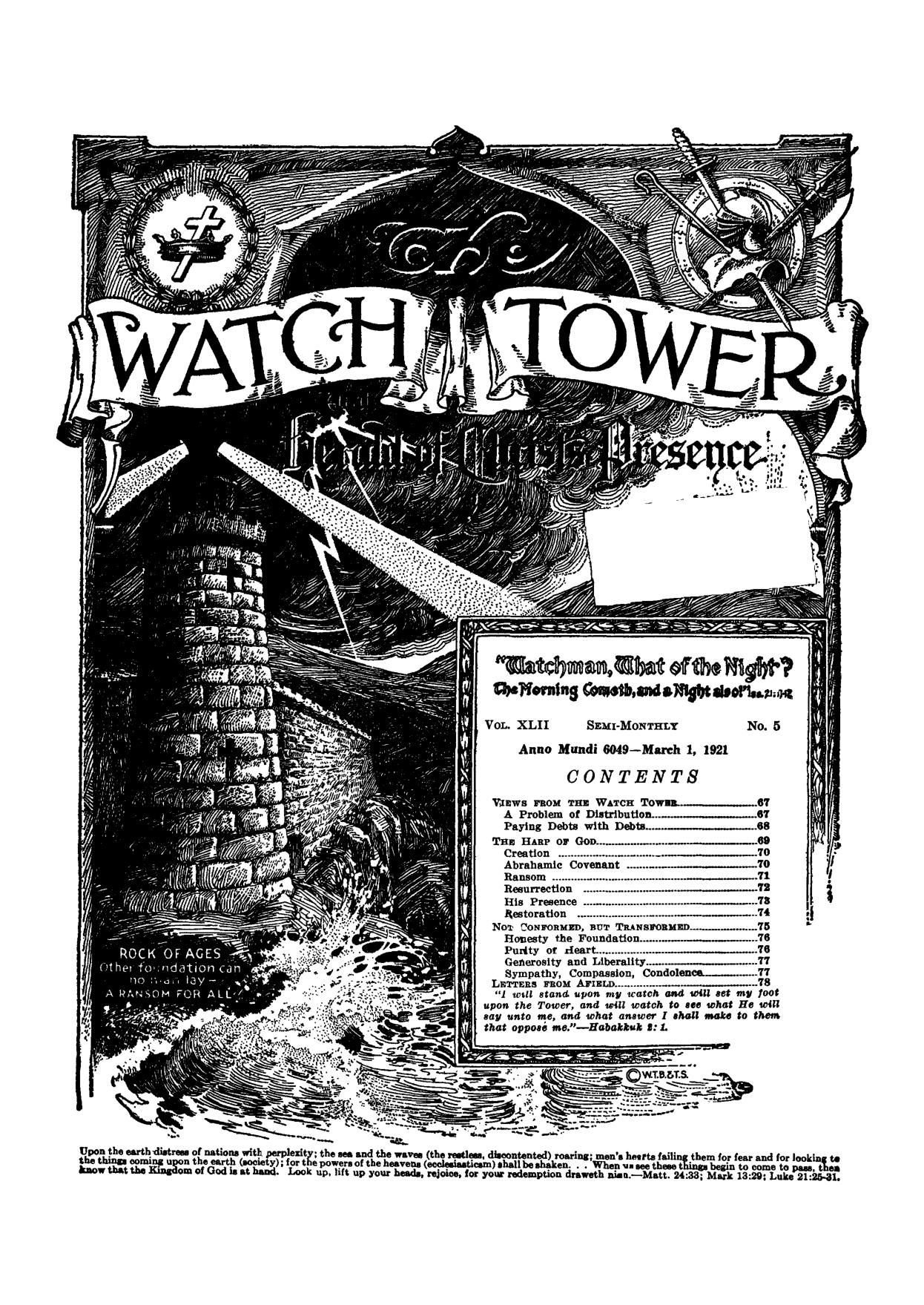
ROCK OF AGES
Other fo'.ndation can
no :■ a n lay - •
JhP°n.J?e earth-distress of nations with perplexity; the sea and the waves (the restless, discontented) roaring; men's hearts failing them for fear and for lookins to ; f,°r t,.e P0”*” of the heavens (ecclesiaaticsm) shall be shaken. . . When v. see theee things begin to come to pass'tlea know that the Kingdom of God u at hand. Look up, lift up your heads, rejoice, for your redemption draweth nine.—Matt. 24:33; Mark 13:29; Luke 21-2501
A RANSOM FOR ALL"
Vol. XLII
Semi-Monthly
No. 5
Anno Mundi 6049—March 1, 1921
CONTENTS
Views from the Watch Towbb___
A Problem of Distribution_______
Paying Debts with Debts_______
The Harp of God._________________________
Creation ...................................
Abrahamlc Covenant ----------------
Ransom ............................................
Resurrection ______________________________
His Presence .......... —
Restoration ...................................
Not Conformed, but Transformed_____
Honesty the Foundation_____________
Purity ot Heart.........................
Generosity and Liberality________
Sympathy, Compassion, Condolence..
Letters from Afield......................
...67 —67 ...68 ...68
...70
-.70
-.71
-.72 ...78 —74 ...7B ...76 ...76 ...77
—77
—78
“I will stand, upon mp watch and will set mp foot upon the Tower, and will watch to see what He will sap unto me, and what answer I shall make to them that oppose me.”—Hahakkuk 1:1.
THIS JOURNAL AND ITS SACRED MISSION
THIS journal is one of the prime factors or instruments in the system of Bible instruction, or “Seminary Extension”, now beln?
presented in all parts of the civilized world by the Watch Tower Bible & Tract Society, chartered A. D. 1884, “For the Promotion of Christian Knowledge”. It not only serves as a class room where Bible students may meet in the study of the divine Word but also as a channel of communication through which they may be reached with announcements of the Society’s conventions and of the coming of its traveling representatives, styled “Pilgrims”, and refreshed with reports of its conventions.
Our “Berean Lessons” are topical rehearsals or reviews of our Society’s published Studies most entertainingly arranged, and very helpful to all who would merit the only honorary degree which the Society accords, viz., Verbi Dei Minister (V. D. M.), which translated into English is Minister of God's Word. Our treatment of the International Sunday School Lessons is specially for the older Bible students and teachers. By some this feature is considered indispensable.
This journal stands firmly for the defense of the only true foundation of the Christian’s hope now being so generally repudiated —redemption through the precious blood of “the man Christ Jesus, who gave himself a ransom [a corresponding price, a substitute] for all”. (1 Peter 1:19; 1 Timothy 2:6) Building up on this sure foundation the gold, silver and precious stones (1 Corinthians 3: Ills; 2 Peter 1:5-11) of the Word of God, its further mission is to “make all see what is the fellowship of the mystery which. . .has been hid in God, ... to the intent that now might be made known by the church the manifold wisdom of God”—“which in other ages was not made known unto the sons of men as it is now revealed”.—Ephesians 3 : 5-9,10.
It stands free from all parties, sects and creeds of men. while it seeks more and more to bring its every utterance into fullest subjection to the will of God in Christ, as expressed in the holy Scriptures. It is thus free to declare boldly whatsoever the Lord hath spoken—according to the divine wisdom granted unto us to understand his utterances. Its attitude is not dogmatic, but confident; for we know whereof we affirm, treading with implicit faith upon the sure promises of God. It is held as a trust, to be used only in his service; hence our decisions relative to what maj and what may not appear in its columns must be according to our judgment of his good pleasure, the teaching of his Word, for the upbuilding of his people in grace and knowledge. And we not only invite but urge our readers to prove all its utterances by the infallible Word to which reference is constantly made to facilitate such testing.
TO US THE SCRIPTURES CLEARLY TEACH
That the church is “the temple of the living God”, peculiarly “his workmanship” ; that its construction has been in progress throughout the gospel age—ever since Christ became the world's Redeemer and the Chief Corner Stone of his temple, through which, when finished, God's blessing shall come “to all people”, and they find access to him.—1 Corinthians 3:16, 17; Ephesians 2:20-22; Genesis 28:14; Galatians 3 : 29.
That meantime the chiseling, shaping, and polishing of consecrated believers in Christ’s atonement for sin, progresses ; and when the last of these “living stones”, “elect and precious,” shall have been made ready, the great Master Workman will bring all together in the first resurrection ; and the temple shall be filled with his glory, and be the meeting place between God and men throughout the Millennium.—Revelation 15 : 5-8.
That the basis of hope, for the church and the world, lies in the fact that “Jesus Christ, by the grace of God, tasted death for every man,” “a ransom for all,” and will be “the true light which lighteth every man that cometh into the world”, “in due time”.—• Hebrews 2:9; John 1 : 9 ; 1 Timothy 2:5, 6.
That the hope of the church is that she may be like her Lord, “see him as he is,” be “partakers of the divine nature’,’ and share his glory as his joint-heir.—1 John 3:2; John 1< : 24 ; Romans 8:17; 2 Peter 1:4.
That the present mission of the church is the perfecting of the saints for the future work of service: to develop in herself every giace; to be God’s witness to the world; and to prepare to be kings and priests in the next age.—Ephesians 4:12; Matthew 24: 14 ; Revelation 1:6; 20 : 6.
That the hope for the world lies in the blessings of knowledge and opportunity to be brought to all by Christ's Millennial kingdom, the restitution of all that was lost in Adam, to all the willing and obedient, at the hands of their Redeemer and his glorified church, v. him all the wilfully wicked will be destroyed—Acts 3:19-23: Isaiah 35.
Published oy
WATCH TOWER. BIBLE TRACT SOCIETY
124 COLUMBIA HEIGHTS a o BROOKLYN, NY., USA
Foreign Offices: British: 34 Craven Terrace, Lancaster Gate, London W. 2; Canadian: 270 Dundas St., W., Toronto, Ontario; Australasian: 495 Collins St., Melbourne, Australia; South African: 123 Plein St., Cape Town, South Africa.
Please Address the Society in Every Case.,
YEARLY SUBSCRIPTION PRICE. United States. $1.00; Canada and Miscellaneous Foreign, $1.50; Great Britain, Ai stralasia, and South Africa, 8s. American remittances should be made by Express or Postal Money Orders, or by Bank Draft. Canadian, British, South African, and Australasian remittances should be made to branch offices only. Remittances from scattered foreign territory may be made to the Brooklyn office, but by International Postal Money Orders only.
(Foreign translations of this journal appear in several languages)
Editorial Committee: This journal is published under the supervision of an editorial committee, at least three of whom have read and approved as truth each and every article appearing in these columns. The names of the editorial committee are: J. F Rutherford, W. E. Van Amburgh, F, II. Robison, G. II. Fisher, E. W. Brenisen. Terms to the Lord's Poors AH Bible students who, by reason of old age or other infirmity or adversity, are unable to pay for this journal, will be supplied free if they send • postal card each May stating their case and requesting such provision. We are not only willing, but anxious, that all such be on our list continually and in touch with the Berean studies.
/a .QmAsaw • Wo do not. as a rule, send a card of acknowledgment for a renewal or WOliCetOBUO8Cnoere. for a new subscription. Receipt and -ntry of -enewal are indicated within a month by change In expiration date, aa shown on wrapper label.
Entered ae Second Close Matter at Erooklvn, N. Y., Poatofiee under the Aet of March 3rd, 1879.
BROOKLYN CONVENTION
Arrangements are being made for a four-day convention to be held In Brooklyn May 19-22, inclusive. An auditorium with a capacity of 2,500 will be used for the entire convention. It is expected that many will attend from different parts of the United States, but it will particularly furnish an opportunity for friends in the Eastern and New England States to have a season of fellowshipping together and of the study of God’s Word. We make this brief announcement now so that the friends may be making their plans to attend. A more detailed statement will appear later.
HYMNS FOR MAY
Sunday ..........
15 114
22 333
29 137
Monday __________
16 256
23 154
30 186
Tuesday ..........
IO
17 261
24 165
31 244
Wednesday ....
18 104
25 164
Thursday ......
19 267
26 224
Friday ............
20 179
27 281
Saturday ______
21 49
28 98
STUDIES IN THE SCRIPTURES
These Studies are recommended to students as veritable Bible keys, discussing topically every vital doctrine of the Bible. More than eleven million copies are in circulation, in nineteen languages. Two sizes are issued (in English only) : the regular maroon cloth, gold stamped edition on dull finish paper (size 5"x7£"), and the maroon cloth pocket edition on thin paper (size 4"x6§") ; both sizes are printed from the same plates, the difference being in the margins; both sizes are provided with an appendix of catechistic questions for convenient class use. Both editions uniform in price.
Series I, “The Divine Plan of the Ages,” giving outline of the divine plan revealed in the Bible, relating to man’s redemption and restitution: 350 pages, plus indexes and appendixes, 75c. Magazine edition 20c. Also procurable in Arabic, Armenian, Dano-Norwegian, Finnish, French, German, Greek, ITollandish, Hungarian, Italian, Polish, Roumanian, Slovak, Spanish, Swedish, and Ukrainian; regular cloth style, price uniform with English.
Series II, “The Time is at Hand,” treats of the manner and time of the Lord’s second coming, considering the Bible testimony on this subject: 333 pages, 75c. Obtainable in Dano-Norwegian, Finnish, German, Polish, and Swedish.
Series III, “Thy Kingdom Come,” considers prophecies which mark events connected with “the time of the end”, the glorification of the church and the establishment of the Millennial kingdom ; it also contains a chapter on the Great Pyramid of Egypt, showing its corroboration of certain Bible teachings : 380 pages, 75c. Furnished also in Dano-Norwegian, Finnish, German, Polish, and Swedish.
Series IV, “The Battle of Armageddon,” shows that the dissolution of the present order of tilings is in progress and that all of the human panaceas offered are valueless to avert the end predicted in the Bible. It contains a special and extended treatise on our Lord’s great prophecy of Matthew 24 and also that of Zechariah 14 :1 - 9 : 656 pages, 85c. Also in Dano-Norwegian, Finnish, Greek, German, and Swedish.
Series V, “The Atonement Between God and Man,” treats an all important subject, the center around which all features of divine grace revolve. This topic deserves the most careful consideration on the part of all true Christians: 618 pages, 85c. Procurable likewise in Dano-Norwegian, Finnish, German, Greek, and Swedish.
Series VI, “The New Creation,” deals with the creative week (Genesis 1, 2), and with the church, God's new creation. It examines the personnel, organization, rites, ceremonies, obligations, and hopes appertaining to those called and accepted as members of the body of Christ: 730 pages, 85c. Supplied also in Dano-Norwegian, Finnish, German, and Swedish.
Series VII, “The Finished Mystery,” consists of a verse-by-verse explanation of the Bible books of Revelation, Song of Solomon, and Ezekiel: 608 pages, illustrated, $1.00 in cloth, 20c in magazine edition—latter treats Revelation and Ezekiel eaiy.
AI ARCH 1, 1921
Vol. XLII
No. 5
VIEWS FROM THE WATCH TOWER
AIiKCk’XT cable dispatch Trout Geneva. Switzerland, the seat of the League of Nations, says:
L "From every part of Europe, from old countries ami new, ami men from Asia, reports arrive of unrest ami disturbance, of Commercial crises, unemploy ment ami inability io sell products, together with the greatest need of such products."
WeaUow ourselves to indulge in the remark that if Gw Loagim o Nations is ‘the pohtieal expre.^on ol Christ's kingdom on earth this described conditionjs a very poor recommendatimi or Chrtrt s ktngdom. 1 he Prenner ol Great Britain, Lloyd George tn a public address recently described some phases of the world situation as follows ;
“I got figures from the Board of Trade this afternoon of what we sold to Europe before the war. We sold from this country, most of it our own products, but we got a profit on even what passed through—we sold 2 111 millions' worth of goods. At present prices, I am told, that would be about 600 millions, probably more.
“Where is that trade now? Our customers tire impoverished. bankrupt. I am not sure about borrowing. The printing press may save you for a time, but you cannot always carry a sack of paper on your backs. That is what is happening in Europe. They cannot get on without it, and when they buy they cannot pay. Have you ever seen the spectacle of a man in rags, down at heels, standing in front of a shop window looking at clothes and boots of the latest fashions? And you say: Why does he not buy, he is in rags, lie needs them, why does he not go in the shop? He cannot pay.
“Europe is standing in front of our shop window’s, stocked with the best goods (hat any land can turn out. It is in rags and wants to buy. But its pockets are full of paper. It cannot buy. And until a customer is in a condition to trade with pm we must admit it. Ho not let us work up pretended causes; let us get at realities. Britain has got to work its way buck to a full purse, and until it does that, nothing that Governments can do, nothing that federations can do. and nothing that newspaper articles can do can help us.”
A PROBLEM OF DISTRIBUTION
Tn another press report in the London Daily New* it is mentioned that £1)0.000,000 worth of the finest Australian and New Zealand wool is piled up in Great Britain as a surplus over their normal demands It us a sad commentary on human incapacity for righteous government to know that these vast stores of clothing material, as well as vast stores of foodstuffs in this land, are lytng id e .when thousands are actual y dying m Europe and Asia from ack of food and clothing. From Unxty and Justice, of Winston-Salem (N.C.), we take the fallowing:
“(’ertainly Ilie cause of industrial stagnation is not under-production on the part of the worker. Right now the i'e:,iilers' .shelves aie idled with goods ihal ihey cannot sell, the w liolesa let s nre heavily stocked with goods that they cannot sell: Ilie inaiiufacturer.s have filled their storage houses with goods they cannot sell. 'The American farmer lias just harvested a record-breaking crop. There are plenty ol goods.
"With the invention of the steam engine, the gas engine, the dynamo, the loom, die linotype, the self-binder and the automalie and semi-automatic machinery that does every operation m every branch of industry, the workers are enabled to produce ten. a hundred and even a thousand fold, more than they could in the old days of hand tools. The piobleni of production is solved.
■■’The problem of distribution is not solved and herein lies the cause of ‘liaril limes' Unit are periodically occurring.
“Trude is inactive not because the people do not wish to buy; there is scarcely a home in all the country that does not need new' furniture and furnishings, nor a family that does not desire better clothes, a great variety of food, books, magazines, etc.
“Everything that the manufacturers are making and the dealers are so anxious to sell, the people are just as eager to buy, but they cannot; they haven’t the money with which to buy.
“The workers are not only the producers, they are the consumers as well. The amount that is paid them in wages for the goods they produce is much less than the retail price of the goods when they go to buy. Consequently, for every' dollar's worth of goods they are able to buy on the market they put four or live dollars’ worth of goods on the market that they are unable to buy. Naturally the markets are glutted and business becomes stagnated. The manufacturer finds it necessary to 'lay off’ his employes; and they walk the streets in idleness while their families go hungry, ill clad and cold because they have produced an abundance of food, clothing and fuel and all the other things that make life worth living.”
MUCH FABRIC, MORE RAGS
The Manchester (Eng.) Daily News sees the situa-aiion a little differently, because the British situation is difTerent. But much of what it says is applicable to general world conditions.
"What is the meaning of the heavy fall in prices which has taken place in the last two months? It would be a fact to rejoice in if it meant that the production of the world was beginning to overtake the demand ; but it does not mean that. It has a much more sinister meaning than that: it means that production and demand are divorced. It means that the external trade by which we have mainly lived in the past and by' which .'done this great industrial system can live in the future has ceased ; that our manufacturers have piled up vast stocks of commodities for consumption and that having no customers abroad they are compelled to unload them on the home consumer at any price they can get.
•T
“Europe is in rags, but New Zealand is choked with wool it cannot sell. In a very real sense the fall in prices is one of the most ominous signs of the time! it is the reminder that the ruin which the peace has wrought in Europe is beginning to react on ourselves. It has killed the goose that laid our golden egg, and because Europe is in rags and cannot buy, the streets of our industrial towns and of London as well are paraded by processions of unemployed, and the prices of stocks and shares in every kind of undertaking are failing to levels that threaten an unprecedented catastrophe.”
“There can be no pause in the drift to catastrophe until we relate cause and effect, until we see that what we are doing in Russia, in Mesopotamia, in Ireland and elsewhere is responsible for the long faces in the City, for the intolerable demands of the tax collector, for the high cost of living and for the gathering cloud of unemployment. The connection is obvious enough, but public opinion, chloroformed by the Press, is blind to it.”
The world needs Messiah’s kingdom; and it is going to get it just when it needs it most. The Prophet Isaiah says: “Thou hast been a strength ... to the needy in his distress". (Isaiah 25: 14) All the world is needy, but all men do not recognize their needs. Among those who recognize their needs not all are willing to acknowledge them. Only those who recognize their need, acknowledge it, and come to Jehovah in the appointed way through Christ Jesus are helped and strengthened. AU in Christendom have not yet been humbled to the point where they are willing to accept the Lord's help in the Lord’s way. There is hardly a more notable phenomenon in all human experience than man’s stubbornness and unresponsiveness to divine goodness. No one can accuse Jehovah of acting hastily in letting the time of trouble come to a head. He has been long-suffering for more than six thousand years, but he will not keep his anger for ever.
PAYING DEBTS WITH DEBTS
The New York Sun and Herald makes some illuminating statements concerning one prominent cause for financial straitness in this country. Doubtless similar conditions exist elsewhere.
“Representative Fess says there can’t be any chance for a reduction of Federal taxes so long as the Government continues its high operating expenses, an expression which simply means so long as the Government continues to overspend ils income by billions of dollars a year.
“Rut Representative Fess might go further with his plain statement of fact and serve tin' nation a good turn. He might remind the American people, he might remind the United States Government in general, he might remind in particular the United States Congress, of which he is a member, that s(l long as the United States Treasury goes on giving the banks its 1 < > I ”s by 1 lie bi 11 ions of dollars to ‘pay debts with debts’, there must be a terrific and back-breaking strain on the country's banking credits.
“So long as the United States Treasury forces the banks to print 'money' by the ton so as to supply the Government with funds—I O ft inflation funds—to pay daily bills that can’t be paid out of the Government’s income, there is going to lie inordinate and dangerous inflation.
“So long as the United States Government creates such inflation there is going to be a merciless high cost of living, causing the American consumer such copious financial hemorrhages as to make him think lie is bleeding to death.
“It is not merely the burden of billions of taxes, huge as this burden is, which the Government loads upon the public. Greater and worse is the burden of more billions in grossly swollen prices of commodities due to the Government's preponderant share in the money inflation which cuts the purchasing power of the American buyer’s dollar to 75 cents in some instances, in others to only 50 cents. This makes it the more difficult for all, well nigh Impossible for many, to scrape up the spare pennies with which to pay those very taxes.
"In this country of economic waste, financial squander and living cost excesses flic United States Government's waste is the most colossal waste of all; the United States Government’s squander is the most costly squander of all; the United States Government’s responsibility for the bread and butter burdens of the American people is the most direct and the most insufferable of all."
One cannot read this without being reminded of the statement in Brother Russell's last preface to Volume IV in which he says:
"This spells bankruptcy—as soon as the war shall end and the issuing of bonds shall cease to provide money for the payment of the interest on other bonds. The nations are thus falling into the chasm of bankruptcy.”
Public channels of information have several times stated that the current expenses for the United States Government during the past year were about nine billion dollars and the total possible income was six billion dollars. The deficit of three billion dollars had to come from somewhere. It could only come from those who had money or securities to furnish. It goes without explanation that a debtor is obligated to his creditor and it is rarely indeed the case that this obligation stops with financial matters. It nearly always reaches over into other realms and the obligation becomes partly moral. A heavy debtor rarely has the moral courage or even the desire to oppose the wishes of his creditor. Since the obligations of the Government are so enormous. it would not be surprising to find no inconsiderable amount of moral obligation given in return for the financial aid furnished. It is in these ways that a strongly centralized government becomes less and less representative of the people at large and more and more representative of the favored few.
FEAR AND ANXIETY
Concerning the mental ills which are attendant upon complex modern life, a medical expert is reported by the Chicago Daily Nevs as saying:
"Four ami anxiely, twin demons that make miserable so many lives. have their origin in inward conflict and <•.111 only be conquered by tracing the trouble to ils source's, says Ur. Frnnkvtood E. Williams, associate medical director of the national committee for mental hygiene, in the current number of Mental Hianene.
“Complex- community life brings about innumerable necessities for adjustment in the individual, and failure to make these adjustments with a measurable degree of success is often responsible for so called mental or nervous ills, technically termed psychoses or neuroses, according to I>r. Williams, who uses illustrations from the recent war to make this point clear.
“The measure of a man's success in handling life's problems, according to the article, lies in his skill in adjusting himself to the complicated life of modern society. Some fail completely, developing psychoses of a more or less serious nature, others are partly successful, but the diffl-culties of adjustment set up nervous disturbances that render them neurotic, while the majority succeed in making their adjustments without too great difficulty.”
Without attempting to enter into the technicalities of this question, there are points in it well worthy of observance by the Lord’s people. Our Lord promises us that our experiences shall work in such a way as to contribute to our highest welfare. (Romans 8: 28) Much of our spiritual lives is spent in experiences calculated to prove the truthfulness of this statement. Much of our spiritual energy, we fear, is needlessly expended on fear and worry. Either the Lord meant what he said or he did not mean it. If he did not mean it, then all of his promises are independable and we have no basis for any confidence whatever—an idea which is entirely untenable. If he did mean what he said in this connection we can depend on it absolutely; for he is omnipotent.
One of the most blessed and productive of lessons in the Christian way is to learn to be happy in spite of conditions and surroundings, rather than merely because of them. If our happiness and peace of mind is dependent upon conditions solely, then we are not living the life of faith at all. If we have become familiar with certain conditions and have accustomed ourselves to them and the Lord’s providence points to the need of a move or a change and our hearts are filled with dread and uncertainty as to the outcome of that change, we are not leaning very strongly upon the everlasting arms. Fear is but another way of telling the Lord that we think our judgment is better than his. We know (?) what we need, but we are not at all convinced whether Jie is as able to understand us as we ourselves do. Fear is an insult to God’s almighty power; anxiety an offense against his boundless love. “Perfect love casteth out fear.”—1 John 4:18.
Albert J. Beveridge, sometime Senator from Indiana, was recently quoted by the Indianapolis News as asserting in an address that the reason for decline in church attendance all over the country was the failure of the ministers to preach the gospel. We quote:
“Let them preach Jesus Christ and him crucified and they will have no trouble in filling their churches. But no, instead, they lecture on hygiene and on every movement that comes before the public, and try to regulate the affairs of the nation instead of preaching the gospel of Jesus Christ.”
THE HARP OF GOD
"And them that had gotten the victory over the beast, and his image, and over the number of his name, stand on the sea of glass, haring the harps of the Lord God and singing the song of Moses, the servant of God, and
the song of the Lamb."—Revelation 15:2,3.
IT seems quite certain that the harp is used to symbolize the divine plan concerning man, as revealed in God's Word, the Bible. No one can understand the great plan except by divine aid; and no one can appreciate that plan except him who has the spirit of the Lord. When Jehovah favors one with an understanding and an appreciation of his plan necessarily the heart of such an one is filled with joy and singing. Therefore the harp fitly symbolizes the divine arrangement and the joy it brings to those in harmony with it. When all the strings are seen and appreciated by the child of God, and are used in harmony with the divine will, the harp yields a music of surpassing sweetness such as the natural man never heard.
The first mention of the harp in the Bible is in Genesis 4:21. and Jubal is the one named as its inventor. With Israel, the chosen people of God, it was an instrument consecrated to joy and exultation. David, who typified the Messiah, was an expert in the use of the harp and employed it in the praise of Jehovah. According to the records, the Jews were accustomed to use this instrument on occasions of joy, such as jubilees and festivals. Josephus is authority for the statement that the harp usually had ten strings, but that at times it was smaller and had only eight strings, being played then with the fingers. The number ten is used in the Scriptures to symbolize that which is perfect or complete as pertaining to man. The use of the harp with eight strings, then, would seem to indicate that, antitypically, for a time two of the strings would be lacking and unappreciated by Israel after the spirit; and we find this thought in harmony with the facts.
The first one to understand the divine plan was Jesus. In the fifth chapter of Revelation Jehovah is pictured as being seated upon his throne, having in his right hand (solely vithin his power and keeping) his great plan. The picture then shows one asking the question: “Who is worthy to open the book and to loose the seals thereof?” None of the angels of heaven were granted that favor, even though they had much desired to look into God’s secret arrangement. No one of earth was granted the great privilege. Jacob on his deathbed had prophesied that this great favor would be granted by Jehovah to his beloved Son. The picture then discloses the Son, the express image of the Father and the very center of his plan, appearing as a lamb slain, now endowed with perfect power and wisdom, as breaking the seals—understanding and making known the beauty ami harmony of this plan to the glory of the heavenly Father. Here, then, was the first time that the mystery of God, hid for ages and generations, was made known to any creature.
The harp is used to symbolize the grandeur and beauty, exquisite harmony and majestic sweetness, of the divine arrangement. The Old and the Nqw Testaments contain the revealed purposes of God concerning man, his redemption, deliverance and blessing with life everlasting; hence the great fundamental doctrines or truths therein stated would constitute the strings upon the harp of God. These great fundamental truths were spoken by Jehovah through the law and the prophets and the testimony of Jesus and his apostles. Seeing that David is a type of the church and that he used a harp of ten strings, we are justified in concluding that the ten fundamental truths testified to in the Scriptures harmoniously disclose the divine purposes concerning man. We, therefore, venture the suggestion that the following is a proper division of these ten truths or doctrines symbolized by the ten strings; viz.,
(1) creation
(2) justice manifested
(3) Abrahamic promise
(4) birth of Jesus
(5) ransom
(6) resurrection
(7) mystery revealed
(8) the Lord’s presence
(9) glorification
(10) restitution;
and understanding and harmonizing these great truths brings joy to the heart and fills the soul with music.
CREATION
Before the creation of man God prepared a place for his habitation. “1 have made the earth, and created man upon it. ... For thus saith the Lord that created the. heavens; God himself that formed the earth and made it; he hath established it, he created it not in vain, he formed it to be inhabited.” (Isaiah 45 : 12, 18) Jehovah’s active agent in the creation of all things was the Logos, later called Jesus. In the Scriptures he is designated as ‘•the bright and morning star”. (Revelation 22:1G) He was the joy and delight of the heavenly Father, in whose name he created all things. There was in heaven another star, clothed in beauty and glory and endowed with power and authority, whose name was Lucifer. With these in heaven was a host of angelic sons of God. When God began the creation as pertaining to man by laying the foundation of the earth, these great stars of heaven sang together the song of gladness, and the angelic sons of God shouted for joy. (Job 38:7) All of the heavenly host watched the development of creation step by step, in an orderly and progressive manner, culminating with the creation of man in the image and likeness of Jehovah.
This was the first string hung upon the harp of God and afterward made manifest to his creature, man. Up to that time, so far as revealed, there had been nothing to mar the beauty, glory, and sweetness of all this creation.
JUSTICE MANIFESTED
One of the primary divine attributes is justice. (Psalm 89 :14) It was the attribute of wisdom that originated and developed the divine plan. Justice must perform its part in harmony with the other divine attributes. God’s law as made and declared was and is unchangeable. The prerogative of justice is to see that the law is enforced. The violation of the law of God was the occasion for justice being made manifest. Without its manifestation the great ransom sacrifice would have been an impossibility. Good and evil were set before man, who as a free moral agent was granted the liberty of choosing one or the other. He deliberately chose the evil course. God pronounced his judgment against man in these words: “In the sweat of thy face shalt thou eat bread, till thou return unto the ground; for out of it wast thou taken: for dust thou art, and unto dust shalt thou return”. (Genesis 3:19) But how could it be said that justice manifested is one of the strings of the harp of God? In all music there is to be found a minor key or tone, which seems to be necessary to produce perfect harmony. At any rate, in all the music of man there exists the minor key. The manifestation of strict justice was essential to sustain the dignity of the great Jehovah and to make it possible for other parts of his plan to be made manifest. It seems to be the string producing the minor key in all of man's music.
Job seems to be a picture of the world of mankind under condemnation ; and thus he speaks: “My harp also is turned to mourning”. (Job 30: 31) 'Ilie joy which filL the heart of the perfect man was turned into mourning when he realized his loss. Divine justice took away from man the right to Eden and all of its incident blessings, as well as life, and the world has been in a state of mourning from then until now. But it is the new creature that sees and appreciates the harp of God, not man that is under condemnation. The anoint -d of the Lord are not to mourn when they see divine justice made manifest. This is clearly shown in God’s dealings with the two sons of Aaron who offered strange fire and who were stricken dead. “And as Aaron and the two remaining sons were forbidden to make lamentation for their brethren who were thus cut off, this signifies that all the faithful of the priests will recognize the justice of the divine decisions, and will bow to them in humble submission, saying. ‘Just and true are thy ways, thou King of saints’.”—T. 10.
The world cannot appreciate that man is justly under condemnation. Indeed none but those who have been regenerated by the merit of Christ, made right or justified by Jehovah, can appreciate this divine attribute; and these appreciating it can truly sing the song as described in our text, declaring the justice and majesty of Jehovah and his works.
ABRAHAMIC COVENANT
The word covenant is the solemn term expressing a contract or promise to do a certain thing. With Jehovah a covenant or a contract is sacred and inviolate because he changes not. (Malachi 3: 6) There can be no change in his justice or judgment. Once entered, that judgment must be enforced. He could, however, consistently make and did make provision for the satisfaction of justice and the granting to every one of the human race a trial or opportunity for life. In the exercise of his loving-kindness and to carry out his purposes, ho chose the man Abram, whose name was afterward changed by him to Abraham, and to him he made the unconditional promise that “in thy seed shall all the families of the earth be blessed”. In addition to his unchangeable word, it pleased Jehovah to bind this promise later with his oath, and by these two immutable things, to-wit, his word and his oath, the new creation would be doubly assured of his carrying out all of his promises, and restored man will ultimately come to the same conclusion.
Jehovah did not put any conditions or any limitations to the promise. There was no need for him so to do. It announces his benevolent purpose toward mankind. The promise or covenant does not even say that the blessing of the people will be upon condition that they will all seek him, nor does the blessing promised mean that every one will be given life everlasting whether or not he wants it; but it does mean that provision is made that etery one shall have an opportunity, and that knowledge shall be brought to all, in order that all may enjoy the opportunity of conforming to the divine arrangement and thereby live. It means that assistance will be given to every one to this end; and after a full and fair opportunity and test and proof of loyalty, the Lord will grant to all such life everlasting.
'Ibis unconditional and oatbbound covenant made by Jehovah is one of the great truths which constitutes a string upon the bar]) of God and which sounds hi harmony with the other strings, bringing joy to the heart of those v ho lemn to appreciate lus arrangement. The Psalmi-t, in one of the songs of degrees, referring to this lunwiviil opportunity coming to the people of all nations for sahatnm. was moved io sing with gladness: “Our mouth [was | filled with laughter, and our tongue with singing | for the nations |. The Lord hath done great thing.- for them.”—Psalm 126:2.
BIRTH OF JESUS
Two thousand years had elapsed since God had given his oatbbound coionant to Abraham, during which time his holy prophets frequently prophesied to Israel that he who would be born according to the promise would be the blesser of the world, the Messiah. Every good mother of Israel regarded it as the greatest honor to give birth to the promised one; and for this reason a barren woman was a reproach among the Israelites. When the announcement was made to Mary that she was to give birth to a son and that his name should be called Jesus, the Son of the Highest, who would be a King without end, Mary said: “My soul doth magnify the Lord, and my spirit hath rejoiced in God my Savior. For he hath regarded the low estate of his handmaiden: for, behold, from henceforth all generations shall call me blessed.”—Luke 1: 4G - 48.
The day for the birth of the babe arrived and all the host of heaven was awake to the importance of the hour. On earth the place selected for this momentous event was Bethlehem, where the boy David had been anointed to be king over Israel, and had foreshadowed the coming of the King now to be born. The earthly witnesses chosen were the meek and lowly shepherds, who were watching their flocks in the field where the beautiful Ruth had gleaned. At the appointed time, “the angel of the Lord came upon them, and the glory of the Lord shone around them;.. . and the angel said unto them, Fear not: for, behold, I bring you good tidings of great joy, which shall be to all people; for unto you is born this day in the city of David a Savior, which is Christ the Lord.”—Luke 2: 9 -11.
And then it was as if attendant angels, awaiting a given signal, when the heavenly messenger had finished his speech to the astonished shepherds, stood forth as a great heavenly host and sang the good tidings of great joy. Their song was but the reflex of what had been announced. These sweet singers told in words of praise what had taken place and what would be the blessed sequel. It was the song of glory from heaven, and earth echoed the message of peace and good will toward men; and down through the age the sweet anthem has resounded: “Glory to God in the highest, and on earth peace, good will toward men”.
Nearly two thousand years more have passed and through the corridors of the age the sweet anthem has resounded, and ever and anon it has brought gladness to some heart that has joyfully turned away from the world upon learning of the birth of the Redeemer and the work he subsequently did and is doing; and this message has grown in sweetness to the one who has learned to recognize this and other strings upon the great harp of God.
Now we are entering the age of restitution, the time when the peoples of earth will learn that the birth of Je.'iis is one of the mighty and important events in the plan of Jehovah, and that there is no other name given among men whereby they can be saved and granted life everlasting except the name of Jesus of Nazareth, the Babe of Bethlehem, the Savior of the world.
RANSOM
'rhe great ransom sacrifice must take its place as one of the important strings upon the harp of God. In due time its benefits shall result to the whole human family.
A perfect man had sinned and lost life, liberty, and happiness for himself; and the sequel to his act was that all of his offspring were born in sin and shapen in iniquity. Justice must take its course. The judgment of God could not be set aside. Justice demanded the life of a perfect man and received that in the death of Adam. 'Therefore nothing short of the life of a perfect man could operate as a redemptive price which would be accepted for the release of Adam and his offspring. The knowledge of the ransom sacrifice has brought joy to every person who up to this time has understood and appreciated it. A knowledge of this ransom must ultimately be brought to all. The appreciative one cannot keep back the singing when he learns that here is a guarantee that he shall live. Gladly does he exclaim : “'Thanks be unto God for his unspeakable gift!” It was Jehovah’s love that prompted this great gift: “For God so loved the world, that he gave his only begotten Son, that whosoever believeth in him should not perish, but have everlasting life”.—John 3:16.
With delight to do the Father’s will, the rich Logos laid aside his heavenly glory and majesty and was made flesh, in the likeness of sinful men. He dwelt among men and was subjected to the sorrows incident to humankind. He became poor, that fallen humanity might through his poverty enjoy the great riches of life, liberty, and happiness. The opportunity to possess these riches must in God’s due time come to all men, because Jesus “by the grace of God [tasted] death for every man”. (Hebrews 2:9) The ransom price was provided at the cross. The cross of Christ is the great pivotal truth of the divine arrangement, from which radiate the hopes of humankind. The poet has beautifully expressed it thus:
“In the cross of Christ I glory, Tow’ring o’er the wrecks of time;
All the light of sacred story Gathers round its head sublime.”
The inspired writer in the divine Word tells that it was the will of God that all men shall be saved from death by this ransom price and brought to an accurate knowledge of the truth, and that in due time this testimony will be given to every one of Adam’s race. When the grand finale is sung and all the harpers of heaven and earth unite in beautiful harmony, blending with the voices of all the creatures perfected and happy, the great ransom sacrifice will be one of the strings of the harp of God that will yield sweet music to every ear.
RESURRECTION
The sabbath day immediately following the crucifixion of the Lord was indeed a sad one to those who devotedly loved and followed him. Rudely had he been snatched from them, unjustly tried, brutally condemned and then subjected to the most ignominious death known to man. How terrible was this shock to those who loved the Master! The Scripture merely records the fact that they saw where he was laid and then rested on the sabbath day. The rest must have been one merely of cessation from labor, with the great sorrow bearing down upon them; they could have had little rest or peace of mind.
The sabbath day was ended, and before the sun lighting the first day of the week had dispelled the darkness of the early morning, Mary Magdalene and other faithful women hastened to the Savior’s tomb. Jesus was not there. A messenger of the Lord appeared unto them and said: “Ye seek Jesus, which was crucified.... lie is risen.” The news sounded too good to be true. They were dazed and bewildered. Hurriedly these faithful women ran away to tell others of their company. What unspeakable joy filled their hearts when they learned that the beloved One lived! Yea, what joy must have filled the courts of heaven when the watching angels beheld that Jesus had triumphed over death and the grave!
The resurrection of Jesus was vitally essential, that he might ascend on high, bearing the merit of his perfect human sacrifice and there present it to divine justice that man might receive the benefit of that sacrifice. For nineteen centuries the benefits of the merit of this sacrifice thus presented by him at his resurrection have been ministered unto those who have made a full consecration to do the will of God; and to such there has resulted at the hands of Jehovah justification and spirit-begetting; and these consecrated ones have been made acceptable in the beloved One, anointed to the high position of joint-heirship with Christ Jesus and membership in the royal family of heaven. Throughout the age these faithful followers have sung the praises of the risen Lord.
St. Paul declares that the resurrection of Jesus is a guarantee that every man in due time shall have one fair and impartial opportunity for life, and that God has appointed a day in which this opportunity shall be given to all. (Acts 17: 31) That day is at hand, and the Lord is present, preparing to judge the quick and then the dead; and men of the world are beginning to learn something of the importance of the death and resurrection of Christ Jesus. When all mankind know of God’s great plan, when they learn that the resurrection of Jesus is a complete guarantee that every man shall have an opportunity to live and enjoy liberty and happiness, then they will sing his praises, and in their mouth his name shall be blessed forever; and this great truth will take its place in their minds as one of the beautiful strings upon the great harp of God.
MYSTERY REVEALED
Not all of the divine plan has been revealed at one time. In fact, the seed of promise through which the blessing must come to all the families of earth was a great mystery hidden from all ages and generations and made known to man for the first time at the giving of the holy spirit at Pentecost; and as yet none can understand this mystery except those who have entered into the favor of God through consecration, justification, and spirit-begetting. The hiding of this mystery was illustrated by Jehovah in the construction of the Tabernacle in the wilderness and its furnishings. Its gold-covered walls, the golden candlestick, the beautifully engraved furniture, its veil of curious work, its incense altar, the ark of the covenant, were so completely covered and hidden from view that none of the people could see them.
As God thus hid these things which were typical of greater things, so he has hid the glories and beauties of spiritual things, seen only by those who have become members of the priestly class. As the high priest alone was in the holy and the most holy on the day of atonement, even so none but the priestly order occupy this position during the antitypical day of atonement. Of these beauties and glories of God’s arrangement and the sweet music that comes to them from his harp by reason of this relationship the world knows not and cannot know until the due time of Jehovah to permit them to know something about it. To the world those of the priestly order seem mean and are despised because the world knows them not.
“Why do they, then, appear so mean?
And why so much despised?
Because of their rich robes, unseen, The world is not apprized.”
The holy prophets foretold of the Christ as the seed of promise, but they did not understand. In the language of one of the prophets, they “heard, but understood not”. The holy angels of heaven were not admitted to the secrets of this great mystery, because it pleased God to conceal the same and in his due time to reveal it to those who are begotten and anointed of the holy spirit. This is why Jesus said to his disciples: “When he, the spirit of truth, is come, he will guide you into all truth;... he will show you things to come”. (John 16: 13) It was impossible for the disciples to understand the mystery until the Pentecostal blessing, and not even then did they immediately understand and appreciate it; but gradually this great mystery began to be revealed to them and was understood and appreciated by them. This is clearly in line with God’s promise: “The path of the just is as the shining light that shineth more and more unto the perfect day”.
So it has been with Christians through the age, and particularly in the harvest period of the age. More and more the light has revealed to the saints the beauty of God’s arrangements, especially a clearer understanding of the mystery class, the royal family of heaven. Clear and clearer has the vision grown to the faithful followers, in striking contrast to the darkness that has come to those who have yielded to the influence of the antichrist. As the saints have appreciated and yet appreciate more and more the beauty revealed in the mystery, their mouths have been filled with singing and they have exclaimed: “The Lord hath done great things for us; whereof we are glad”. (Psalm 126:3) These feed upon the precious promises and with joyful anticipation look forward to the time when the Bridegroom shall be fully revealed in all his glory and beauty, and when the bride, the church, shall appear with him in glory.
The mystery of God involves an understanding and appreciation of the great fundamental truths of consecration, justification, spirit-begetting, and sanctification. As the saints mark the contrast between the Christ, the mystery of God, and the antichrist, the mystery of iniquity, more hideous to them appears the mystery of iniquity and more glorious the mystery of God. And with their clearer vision, consecration, justification, and sanctification shine forth in their respective places with greater brightness than ever before. It was of these things the Apostle said: “The natural man receiveth not the things of the spirit of God:... neither can he know them, because they are spiritually discerned; but God hath revealed them unto us [members of the mystery class’] by his spirit; for the spirit searcheth all things, yea, the deep things of God”. (1 Corinthians 2:10,14) When these great truths were made known to the Apostle Paul and he was telling others about them, in ecstacy he exclaimed: “0 the depth of the riches both of the wisdom and knowledge of God!”— Romans 11: 33.
HIS PRESENCE
Christ Jesus is the Bridegroom and the church is the bride. (John 3:29; Revelation 21:9) For more than nineteen centuries she has been waiting for his return because he promised to come again and receive her unto himself. (John 14: 3) In faith and patience she has looked forward to that time with great expectation. He has kept his promise faithfully and now has returned and is gathering unto himself those who have made a covenant with the Lord by sacrifice and have kept that covenant. The bride loves the Bridegroom and therefore loves his appearing, and for such he has a crown of righteousness. (2 Timothy 4:8) Anticipating this happy time, St. Paul wrote: “Rejoice in the Lord alway: and again I say, Rejoice. . . . The Lord is at hand.”—Philippians 4:4, 5.
The second coming of the Lord Jesus is one of the great fundamental doctrines of the holy Scriptures, but the time, manner, and purpose of his coming have been little understood by those who have professed Christianity. Those ignorant of the true meaning of his coming have looked forward with dread to that time. But those truly illuminated by the holy spirit have appreciated the light and its increasing brilliancy, and in that proportion their joy has increased. Such see that the time of his coming is at the time of the end; i.e., the end of the present evil order. The evidence now is cumulative and overwhelming that he is here and that the old order is rapidly passing away. The members of the bride class see that his coming is not in the flesh, marked by the nailprints received at Calvary, but that he appears in a glorious body, invisible to human eyes. These appreciate the fact, according to his promise, that as the sun rises quietly in the east and gradually sheds its illuminating rays upon the earth, so is the appearance of our Lord, and his appearance gradually becomes more marked to the watchers. As a thief conies in the night time, when all except the faithful watchers are asleep, so the Lord has come in the great night time of this present evil world, when all except his faithful watchers are asleep and no others observe his presence.
The faithful watchers see that the purpose of his coming is, according to his promise, to take unto himself his bride, to make up his jewels, to assume his great position of power and to reign, to destroy the wicked works of Satan, to enthrone truth and righteousness for ever, and to bless for ever all those who love righteousness and hate iniquity. These greatly appreciate the privilege of declaring his presence, and God’s holy prophet pictures them as standing aloof from the kingdoms of earth, publishing the glad tidings and lifting up their voices together with singing. (Isaiah 52: 7, 8) These faithful watchers, pure of heart and wise by the grace of God, are now going forth joyfully crying: “Behold the bridegroom! Go ye out to meet him.” And this string of the harp of God yields to the hearts of the bride class a music of ever increasing sweetness and to this accompaniment they sing to each other:
“Behold, behold the Bridegroom, And all may enter in,
Whose lamps are trimmed and burning, Whose robes are white and clean.”
GLORIFICATION
The Bridegroom is the fairest of ten thousand and altogether lovely. To be glorified means to be made in the likeness of his character and with a similar beautiful organism. The prospect of poor, imperfect creatures being transformed and made into the image and likeness of this blessed One is too stupendous for the mind to fully grasp and appreciate; but we know it is true because the Master said: “I will come again, and receive you unto myself; that where I am, there ye may be also”. (John 14: 3) No one could be with him and not be like him. “It doth not yet appear what we shall be: but we know that, when he shall appear, we shall be like him; for we shall see him as he is.”—1 John 3 :2.
It is written of the King of glory: “Thou lovest righteousness, and hatest wickedness: therefore God, thy God, hath anointed thee with the oil of gladness above thy fellows. All thy garments smell of myrrh, and aloes, and cassia, out of the ivory palaces, whereby they have made thee glad.” (Psalm 45: 7, 8) The church, which is the bride of Christ, is described as standing at the right hand of the wonderful Bridegroom, and because she has joyfully submitted to the transforming work and proven herself faithful unto her Lord, her beauty is greatly desired by him. A little glimpse of her beauty is given in the phrase of the Psalmist: “The king’s daughter is all glorious within: her clothing is of wrought gold. She shall be brought unto the king in raiment of needlework.”—Psalm 45: 13,14.
This wonderful Savior and Bridegroom will present the church, his bride, faultless before the presence of Jehovah's glory with exceeding joy. (Jude 24) Her beauty will be that of holiness, like unto her glorious Bridegroom. This abundant entrance of the church into heavenly glory will be the occasion of great rejoicing. It will mark the hour of her triumph in the works of Jehovah’s hands. In heaven the cherubim and seraphim and hosts of holy angels will rejoice and give praise to Jehovah and his beloved Son; and in this glory the church will share because she is the bride of Christ. By faith the church now has some foregleams of that hour of triumph; and even now with joy she is singing. This great truth of the divine arrangement for the glorification of the church is one of the strings of the harp of God making glad the hearts of the faithful before participating in the general assembly of the church of the firstborn.
RESTORATION
The tenth string of the harp of God may be designated as restoration or restitution. It was the theme of all the holy prophets. This great truth and that of the oathbound promise to Abraham seem to have been lost sight of by many Christians during the gospel age, and to such the harp was minus two of its strings. But when the Lord returned and found watching a faithful servant, he enlightened him upon these great truths; and by the Lord’s grace that servant has been greatly blessed by being used of the Lord to bring forth meat in due season for the household of faith—things new and old from the great storehouse. As the light of the Lord’s presence increased, a clearer vision of the divine plan was had by that faithful and wise servant. He, by the grace of the Lord, brought clearly to the minds of the consecrated the scope and meaning of the Abra-hamic promise, the philosophy of the great ransom sacrifice, and showed how the presentation in the heavenly courts of the merit of this sacrifice is a guarantee that in God’s due time every man shall have a fair and full opportunity for life, and that God has appointed a day certain for that trial, and that while the trial is in progress the earth itself will be gradually made like unto the garden of Eden, as a fit habitation for perfected man.
As the vision of this faithful and wise servant grew brighter, he swept the harp of God with his consecrated life and from the string of restoration resounded these beautiful words of song and praise which have made glad thousands of hearts:
“The first num (who was a sample of what the race will he when perfect) was of the earth, earthy; ami his ]>oster-ity. with the exception of the gospel church, will in the resurrection still he earthy, human, adapted to the earth. (1 Corinthians l.DUS, 44) David declares that man was made only a little lower than the angels, am! crowned with glory, honor, dominion, etc. (I’salm S :-I - S I And Peter, our Lord, and all the prophets since the world Itegan, declare that the human race is to be restored to that glorious perfection, and is again to hate dominion over enrth, as its representative, Adam, had.—Acts 3:10-21.
“It is this portion that God has elected to give to the human race. And what a glorious portion! Close your eyes for a moment to the scenes of misery and woe, degradation and sorrow that yet prexail on account of sin, and picture before your mental vision the glory of the jterfect earth. Not a stain of sin mars the harmony ami peace of a perfect society; not a bitter thought, not an unkind look or word; love, welling up from every heart, meets a kindred response m every other heart, and benevolence marks every act. There sickness shall be no more : not an ache nor a pain, nor any evidence of decay—not even the fear of such tilings. Think of all the pictures of comparative health and beauty of human form and feature that you have ever seen, and know that perfect humanity will be of still surpassing loveliness. The inward purity and mental and moral perfection will stamp and glorify every radiant countenance. Such will earth's society be; and weeping bereaved ones will have their tears all wiped away, when thus they realize the resurrection work complete.—Revelation 21 : 4.”
Soon the peoples of earth will see this day; and as they see these things actually taking place in the earth, the appreciative ones will begin to say: “0 come, let us sing unto the Lord: let us make a joyful noise to the rock of our salvation”. “O sing unto the Lord a new song: sing unto the Lord, all the earth. Say among the heathen that the Lord reigneth: the world also shall be established that it shall not be moved.” “Sing unto the Lord with the harp; with the harp, and the voice of a psalm.” (Psalm 95 :1; 96: 1,10; 98 : 5) And as one nation after another comes up to worship the Lord, they will learn to say to the others: “Make a joyful noise unto the Lord, all ye lands. Serve the Lord with gladness: come before his presence with singing.”—Psalm 100:1,2.
…