Pay attention to Danielss prophecy (2006 printing) (1999)
Download: PDF — Pay attention to Danielss prophecy (2006 printing) (1999)
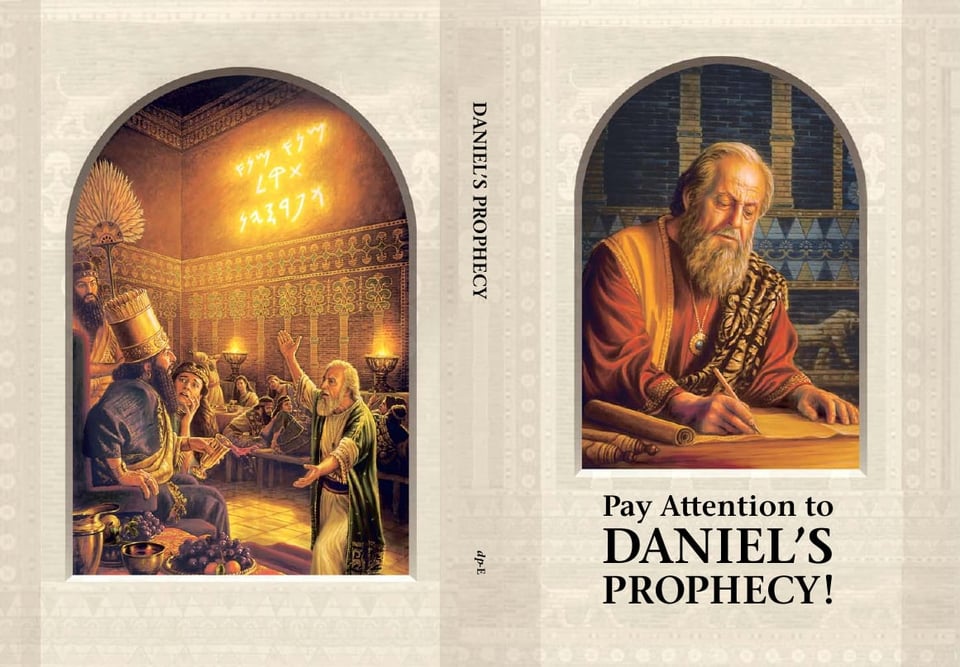
DANIEL'S PROPHECY
Pay Attention to DANIEL'S PROPHECY!
Pay Attention to DANIEL'S PROPHECY!
Photo Credits: Pages 20-2: Background. From the book The Coloured Ornament of All Historical Styles Pages 20-1: All images. Photograph taken by courtesy of the British Museum. Page 22: Left. Copyright British Museum, right. Photograph taken by courtesy of the British Museum; bottom left. Reproduction from Algerie-Geographie in Einzelstellen-Dritten-Brück: Geschichte Babylonien und Asyriens, 1885. Page 128 The Conquenaries, by Pierre Fritel. From the book The Library of Historic Characters and Famous Events, Vol. III, 1895. Page 151 Charles & Josette Lenaris/Corbs. Page 153 Maurel Capitolini, Roma. Page 154 Culver Images. Page 158 The Walters Art Gallery, Washington. Page 160 The Metropolitan Museum of Washington: Painting by Gilbert Stuart/Dictionary of American Portraits/Dover, Woodrow Wilson: Courtesy New York Historical Society/Dictionary of American Portraits/Dover, David Lloyd-George: Archive Photos, Woolen Church; The Trustees of the Imperial War Museum (MH 26392); Franklin D. Roosevelt: Franklin D. Roosevelt Library. Page 197 Sopprentendenza Archeologica di Ostia. Page 215 Copyright British Museum; bottom right. Photograph by Israel Museum/David Harris. Israel Antiquities Authority; bottom right. Copyright British Museum. Page 218 Copyright British Museum. Page 228 Ptolemy II, Antichus II, and Ptolemy VI. Copyright British Museum; iddu, Eugene. A. Bolesta/H, Armstrong Roberts; Seleucus I. Per gentile concessione della Sopprentendenza Archeologica delle Province di Napoli e Caserta. Page 230 Center for the Study of Ancient Civilizations, University of New York; top
© 1999 Watch Tower Bible and Tract Society of Pennsylvania All Rights Reserved
PUBLISHERS Watchtower Bible and Tract Society of New York, Inc. Brooklyn, New York, U.S.A.
2006 Printing This publication is provided as part of a worldwide Bible educational work supported by voluntary donations.
Unless otherwise indicated, Scripture quotations are from the modern-language New World Translation of the Holy Scriptures—With References
Pay Attention to Daniel's Prophecy! English (dp-E) Made in the United States of America CONTENTS
CHAPTER PAGE
1 The Book of Daniel and You 4
2 Daniel-A Book on Trial 12
3 Tested-But True to Jehovah! 30
4 The Rise and Fall of an Immense Image 46
5 Their Faith Survived the Crucible 68
6 Unraveling the Mystery of the Great Tree 82
7 Four Words That Changed the World 98
8 Rescued From the Jaws of Lions! 114
9 Who Will Rule the World? 128
10 Who Can Stand Against the Prince of Princes? 164
11 The Time of Messiah's Coming Revealed 180
12 Strengthened by a Messenger From God 198
13 Two Kings in Conflict 210
14 The Two Kings Change Identities 230
15 The Rival Kings Enter the 20th Century 256
16 The Contending Kings Near Their End 270
17 Identifying True Worshipers in the Time of the End 286
18 Jehovah Promises Daniel a Wonderful Reward 306
THE BOOK OF DANIEL AND YOU
A POWERFUL king threatens to execute his wise men because they are not able to reveal and interpret his puzzling dream. Three young men who refuse to worship a towering image are thrown into a superheated furnace, yet they survive. In the midst of a festive celebration, hundreds behold a hand that is writing mysterious words on a palace wall. Evil conspirators have an elderly man thrown into a pit of lions, but he emerges without a scratch. A prophet of God sees four beasts in a vision, and their significance stretches millenniums into the future.
2 These are just some of the accounts found in the Bible book of Daniel. Do they merit serious consideration? What possible relevance could this age-old book have for our day? Why should we be concerned about events that occurred some 2,600 years ago?
DANIEL-AN ANCIENT BOOK FOR MODERN TIMES
3 Much of the book of Daniel focuses on the theme of world rulership, a subject that is of paramount concern today. Almost everyone will agree that we live in difficult times. On a daily basis, news reports bombard us with grim reminders that human society is sinking into a quagmire of perplexing problems—and this despite remarkable achievements in science and technology.
4 Consider this: Man has walked on the moon, but in many places he cannot stroll on the streets of his own planet without fear. He can furnish a home with all sorts of modern conveniences, but he cannot stem the tide of broken families. And he can bring about the information age, but he cannot teach people to live together peacefully. Hugh Thomas, a professor of history, once wrote: "The spread of knowledge and education has taught mankind little in the way of self-control and less in the art of living with other men."
5 In an attempt to establish a measure of order in society, men have organized themselves under a wide variety of governments. None of them, though, have been exempt from the truthfulness of King Solomon's observation: "Man has dominated man to his injury." (Ecclesiastes 4:1; 8:9) Of course, some rulers have had noble ideals. Nevertheless, no king, president, or dictator can eradicate sickness and death. No human can restore our earth to the Paradise that God purposed it to be.
Yet, the Creator is both willing and able to do such things. He does not need the permission of human governments to accomplish his purpose, for to him "the nations are as a drop from a bucket; and as the film of dust on the scales they have been accounted." (Isaiah 40:15) Yes, Jehovah is Sovereign Ruler of the universe. As such, he has authority far above that of human governments. It is God's Kingdom that will replace all human rulerships, to mankind's eternal blessing. Perhaps no where is this made clearer than in the Bible book of Daniel.
DANIEL-GREATLY BELOVED BY GOD
7 Jehovah God had great affection for Daniel, who served as his prophet for many years. Indeed, God's angel described Daniel as "someone very desirable." (Daniel 9:23) The original Hebrew term translated "someone very desirable" can mean "greatly beloved," "highly esteemed," even "a favorite." Daniel was especially precious in God's sight.
8 Let us briefly consider the unique circumstances of this beloved prophet. In 618 B.C.E., Babylonian King Nebuchadnezzar besieged Jerusalem. (Daniel 1:1) Shortly thereafter, certain well-educated Jewish youths were forcibly taken into exile in Babylon. Daniel was forcibly them. At the time, he was probably in his teens.
9 Daniel and his companions Hananiah, Mishael, and Azariah were among the Hebrews selected to receive three years of training in "the writing and the tongue of the Chaldeans." (Daniel 1:3, 4) Some scholars note that this was likely more than just a language course. For instance, Professor C. F. Keil states: "Daniel and his companions were to be educated in the wisdom of the Chaldean priests and learned men, which was taught in the schools of Babylon." So Daniel and his companions were being specially trained for government service.
10 What a drastic change of circumstance this was for Daniel and his associates! In Judah they had lived among worshipers of Jehovah.
Now they were surrounded by a people who worshiped mythological gods and goddesses. Nevertheless, young Daniel, Hananiah, Mishael, and Azariah were not intimidated. They were determined—despite this faith-challenging situation—to hold fast to true worship.
11 This would not be easy, King Nebuchadnezzar was a zealous devotee of Marduk, the chief deity of Babylon. The king's demands were at times totally unacceptable to a worshiper of Jehovah. (For example, see Daniel 3:1-7.) Yet, Daniel and his companions had Jehovah's unfailing guidance. During their three years of training, they were blessed by God with "knowledge and insight in all writing and wisdom." In addition, Daniel was given the ability to understand the meaning of visions and dreams. Later when the king made an examination of these four young men, he found them to be "ten times better than all the magic-practicing priests and the conjurers that were in all his royal realm."—Daniel 1:17, 20.
PROCLAIMING GOD'S MESSAGES
12 Throughout the many years he spent in Babylon, Daniel served as God's messenger to such men as Kings Nebuchadnezzar and Belshazzar. Daniel's assignment was a crucial one. Jehovah had allowed Nebuchadnezzar to destroy Jerusalem, using him as His instrument. In time, Babylon too would be destroyed. Truly, the book of Daniel magnifies Jehovah God as the Most High and as Ruler in "the kingdom of mankind." —Daniel 4:17.
13 Daniel continued in court service some seven decades, until the fall of Babylon. He lived to see many Jews returning to their homeland in 537 B.C.E., though the Bible does not state that he accompanied them.
He was very active until at least the third year of the reign of King Cyrus, the founder of the Persian Empire. By that time, Daniel must have been close to 100 years of age!
14 After the fall of Babylon, Daniel put the most significant events of his life down in writing. His document is now a remarkable part of the Holy Bible and is known as the book of Daniel. But why should we pay attention to this ancient book?
TWO THREADS, ONE MESSAGE
15 The unique book of Daniel contains two very different threads—one is narrative, the other is prophetic. Both aspects of Daniel's book can build our faith. How? The narrative portions—among the most vivid in the Bible—show us that Jehovah God will bless and care for those who keep their integrity to him. Daniel and his three companions remained steadfast in the face of life-threatening trials. Today, all who want to remain loyal to Jehovah will be strengthened by a close consideration of their example.
16 The prophetic portions of Daniel build faith by showing that Jehovah knows the course of history centuries—even millenniums—in advance. For example, Daniel provides details concerning the rise and fall of world powers from the time of ancient Babylon right down to "the time of the end." (Daniel 12:4) Daniel directs our attention to the Kingdom of God in the hands of His appointed King and associate "holy ones," pointing to it as the government that will endure forever. This government will fully accomplish Jehovah's purpose for our earth and will result in the blessing of all those who want to serve God.-Daniel 2:44; 7:13, 14, 22.
17 Thankfully, Jehovah does not keep knowledge of future events to himself. Rather, he is the "Revealer of secrets." (Daniel 2:28) As we consider the fulfillment of the prophecies recorded in the book of Daniel, our faith in God's promises will be strengthened. We will come to feel ever more sure that God will accomplish his purpose at the exact time and in the precise manner that he chooses.
18 All who study the Bible book of Daniel with a receptive heart will grow in faith. Before embarking on an in-depth examination of this book, however, we need to consider evidence as to whether this book is truly authentic. Some critics have attacked the book of Daniel, saying that its prophecies were actually written after their fulfillment. Are the claims of skeptics justified? The next chapter will address this matter.
17, 18. (a) How will our faith be strengthened by a close examination of the book of Daniel? (b) What matter needs to be addressed before we embark on a study of this prophetic Bible book?
WHAT DID YOU DISCERN?
Why is Daniel a book for modern times?
How did Daniel and his companions come to enter Babylonian governmental service?
What was Daniel's special assignment in Babylon?
Why should we pay attention to Daniel's prophecy?
DANIEL-A BOOK ON TRIAL
IMAGINE yourself in a court of law, attending an important trial. A man stands accused of fraud. The prosecuting attorney insists that the man is guilty. Yet, the accused has a long-standing reputation for integrity. Would you not be interested in hearing the evidence for the defense?
2 You are in a similar situation when it comes to the Bible book of Daniel. Its writer was a man renowned for integrity. The book that bears his name has been highly regarded for thousands of years. It presents itself as authentic history, written by Daniel, a Hebrew prophet who lived during the seventh and sixth centuries B.C.E. Accurate Biblical chronology shows that his book covers the period extending from about 618 to 536 B.C.E. and was completed by the latter date. But the book stands accused. Some encyclopedias and other reference works imply or assert outright that it is a fraud.
3 For example, The New Encyclopedia Britannica acknowledges that the book of Daniel was once "generally considered to be true history, containing genuine prophecy." The Britannica claims that in reality, however, Daniel "was written in a later time of national crisis—when the Jews were suffering severe persecution under [Syrian King] Antiochus IV Epiphanes." The encyclopedia dates the book between 167 and 164 B.C.E. This same work asserts that the writer of the book of Daniel does not prophesy the future but simply presents "events that are past history to him as prophecies of future happenings."
4 Where do such ideas originate? Criticism of the book of Daniel is not new. It started back in the third century C.E. with a philosopher named Porphyry. Like many in the Roman Empire, he felt threatened by the influence of Christianity. He wrote 15 books to undermine this "new" religion. The 12th was directed against the book of Daniel. Porphyry pronounced the book a forgery, written by a Jew in the second century B.C.E. Similar attacks came in the 18th and 19th centuries. In the view of higher critics and rationalists, prophecy—the foretelling of future events—is impossible. Daniel became a favorite target. In effect, he and his book were put on trial in court. Critics claimed to have ample proof that the book was written, not by Daniel during the Jewish exile in Babylon, but by someone else centuries later.* Such attacks became so profuse that one author even wrote a defense called Daniel in the Critics' Den.
5 Is there proof behind the confident assertions of the critics? Or does the evidence back the defense? A lot is at stake here. It is not just the reputation of this ancient book but also our future that is involved. If the book of Daniel is a fraud, its promises for mankind's future are just hollow words at best.
But if it contains genuine prophecies, doubtless you will be eager to learn what these mean for us today. With that in mind, let us examine some of the attacks upon Daniel.
6 Take, for example, the charge made in The Encyclopedia Americana: "Many historical details of the earlier periods [such as that of the Babylonian exile] have been badly garbled" in Daniel. Is this really so? Let us consider three alleged mistakes, one at a time.
THE CASE OF THE MISSING MONARCH
7 Daniel wrote that Belshazzar, a "son" of Nebuchadnezzar, was ruling as king in Babylon when the city was overthrown. (Daniel 5:1, 11, 18, 22, 30) Critics long assailed this point, for Belshazzar's name was nowhere to be found outside the Bible. Instead, ancient historians identified Nabonidus, a successor to Nebuchadnezzar, as the last of the Babylonian kings. Thus, in 1850, Ferdinand Hitzig said that Belshazzar was obviously a figment of the writer's imagination. But does not Hitzig's opinion strike you as a bit rash? After all, would the absence of any mention of this king—especially in a period about which historical records were admittedly scanty—really prove that he never existed? At any rate, in 1854 some small clay cylinders were unearthed in the ruins of the ancient Babylonian city of Ur in what is now southern Iraq. These cuneiform documents from King Nabonidus included a prayer for "Bel-sar-ussur, my eldest son." Even critics had to agree: This was the Belshazzar of the book of Daniel.
8 Yet, critics were not satisfied. "This proves nothing," wrote one named H. F. Talbot. He charged that the son in the inscription might have been a mere child, whereas Daniel presents him as a reigning king. Just a year after Talbot's remarks were published, though, more cuneiform tablets were unearthed that referred to Belshazzar as having secretaries and a household staff. No child, this! Finally, other tablets clinched the matter, reporting that Nabonidus was away from Babylon for years at a time. These tablets also showed that during these periods, he "entrusted the kingship" of Babylon to his eldest son (Belshazzar). At such times, Belshazzar was, in effect, king—a coregent with his father.*
9 Still unsatisfied, some critics complain that the Bible calls Belshazzar, not the son of Nabonidus, but the son of Nebuchadnezzar. Some insist that Daniel does not even hint at the existence of Nabonidus. However, both objections collapse upon examination. Nabonidus, it seems, married the daughter of Nebuchadnezzar. That would make Belshazzar the grandson of Nebuchadnezzar. Neither the Hebrew nor the Aramaic language has words for "grandfather" or "grandson"; "son of" can mean "grandson of" or even "descendant of." (Compare Matthew 1:1.) Further, the Bible account does allow for Belshazzar to be identified as the son of Nabonidus. When terrified by the ominous handwriting on the wall, the desperate Belshazzar offers the third place in the kingdom to anyone who can decipher the words.
(Daniel 5:7) Why third and not second? This offer implies that the first and second places were already occupied. In fact, they were—by Nabonidus and by his son, Belshazzar.
10 So Daniel's mention of Belshazzar is not evidence of "badly garbled" history. On the contrary, Daniel—although not writing a history of Babylon—offers us a more detailed view of the Babylonian monarchy than such ancient secular historians as Herodotus, Xenophon, and Berossus. Why was Daniel able to record facts that they missed? Because he was there in Babylon. His book is the work of an eyewitness, not of an impostor of later centuries.
WHO WAS DARIUS THE MEDE?
11 Daniel reports that when Babylon was overthrown, a king named "Darius the Mede" began to rule. (Daniel 5:31) Darius the Mede has not yet been found by name in secular or archaeological sources. Thus, The New Encyclopedia Britannica asserts that this Darius is "a fictitious character."
12 Some scholars have been more cautious. After all, critics once labeled Belshazzar "fictitious" as well. Undoubtedly, the case of Darius will prove similar. Already, cuneiform tablets have revealed that Cyrus the Persian did not assume the title "King of Babylon" immediately after the conquest. One researcher suggests: "Whoever bore the title of 'King of Babylon' was a vassal king under Cyrus, not Cyrus himself."
Could Darius have been the ruling name, or title, of a powerful Median official left in charge of Babylon? Some suggest that Darius may have been a man named Gubaru. Cyrus installed Gubaru as governor in Babylon, and secular records confirm that he ruled with considerable power. One cuneiform tablet says that he appointed subgovernors over Babylon. Interestingly, Daniel notes that Darius appointed 120 satraps to govern the kingdom of Babylon.—Daniel 6:1.
13 In time, more direct evidence of the precise identity of this king may come to light. In any case, the seeming silence of archaeology in this regard is hardly grounds to label Darius "fictitious," much less to dismiss the entire book of Daniel as fraudulent. It is far more reasonable to see Daniel's account as eyewitness testimony that is more detailed than surviving secular records.
THE REIGN OF JEHOIAKIM
14 Daniel 1:1 reads: "In the third year of the kingship of Jehoiakim the king of Judah, Nebuchadnezzar the king of Babylon came to Jerusalem and proceeded to lay siege to it." Critics have found fault with this scripture because it does not seem to agree with Jeremiah, who says that the fourth year of Jehoiakim was the first year of Nebuchadnezzar. (Jeremiah 25:1; 46:2) Was Daniel contradicting Jeremiah? With more information, the matter is readily clarified. When first made king in 628 B.C.E. by Pharaoh Necho, Jehoiakim became a mere puppet of that Egyptian ruler. This was about three years before Nebuchadnezzar succeeded his father to the throne of Babylon, in 624 B.C.E.
Soon thereafter (in 620 B.C.E.), Nebuchadnezzar invaded Judah and made Jehoiakim a vassal king under Babylon. (2 Kings 23:34; 24:1) To a Jew living in Babylon, Jehoiakim's "third year" would have been the third year of that king's vassal service to Babylon. Daniel wrote from that perspective. Jeremiah, however, wrote from the perspective of the Jews living right in Jerusalem. So he referred to Jehoiakim's kingship as starting when Pharaoh Necho made him king.
15 Really, then, this alleged discrepancy only bolsters the evidence that Daniel wrote his book in Babylon while among Jewish exiles. But there is another gaping hole in this argument against the book of Daniel. Remember that the writer of Daniel clearly had the book of Jeremiah available and even referred to it. (Daniel 9:2) If the writer of Daniel were a clever forger, as the critics claim, would he risk contradicting so respected a source as Jeremiah—and in the very first verse of his book at that? Of course not!
TELLING DETAILS
16 Let us now turn our attention from the negative to the positive. Consider some other details in the book of Daniel indicating that the writer had firsthand knowledge of the times he wrote about.
17 Daniel's familiarity with subtle details about ancient Babylon is compelling evidence of the authenticity of his account. For instance, Daniel 3:1-6 reports that Nebuchadnezzar set up a giant image for all the people to (Below) Babylonian temple cylinder names King Nabonidus and his son Belshazzar
(Above) This inscription contains the boasting of Nebuchadnezzar regarding his construction projects
worship. Archaeologists have found other evidence that this monarch sought to get his people more involved in nationalistic and religious practices. Similarly, Daniel records Nebuchadnezzar's boastful attitude about his many construction projects. (Daniel 4:30) Not until modern times have archaeologists confirmed that Nebuchadnezzar was indeed behind a great deal of the building done in Babylon. As to boastfulness—why, the man had his name stamped on the very bricks! Daniel's critics cannot explain how their supposed forger of Maccabean times (167-63 B.C.E.) could have known of such construction projects—some four centuries after the fact and long before archaeologists brought them to light.
18 The book of Daniel also reveals some key differences According to the Nabonidus Chronicle, Cyrus' army entered Babylon without a fight
between Babylonian and Medo-Persian law. For example, under Babylonian law Daniel's three companions were thrown into a fiery furnace for refusing to obey the king's command. Decades later, Daniel was thrown into a pit of lions for refusing to obey a Persian law that violated his conscience. (Daniel 3:6; 6:7-9) Some have tried to dismiss the fiery furnace account as legend, but archaeologists have found an actual letter from ancient Babylon that specifically mentions this form of punishment. To the Medes and the Persians, however, fire was sacred. So they turned to other vicious forms of punishment. Hence, the pit of lions comes as no surprise.
19 Another contrast emerges. Daniel shows that Nebuchadnezzar could enact and change laws on a whim.
(Right) The "Verse Account of Nabonidus" reports that Nabonidus entrusted the rulership to his firstborn
(Left) Babylonian record of Nebuchadnezzar's invasion of Judah
Darius could do nothing to change 'the laws of the Medes and the Persians'—even those he himself had enacted! (Daniel 2:5, 6, 24, 46-49; 3:10, 11, 29; 6:12-16) Historian John C. Whitcomb writes: "Ancient history substantiates this difference between Babylon, where the law was subject to the king, and Medo-Persia, where the king was subject to the law."
20 The thrilling account of Belshazzar's feast, which is recorded in Daniel chapter 5, is rich in detail. Apparently, it began with lighthearted eating and plenty of drinking, for there are several references to wine. (Daniel 5:1, 2, 4) In fact, relief carvings of similar feasts show only wine being consumed. Evidently, then, wine was extremely important at such festivities. Daniel also mentions that women were present at this banquet—the king's secondary wives and his concubines.
(Daniel 5:3, 23) Archaeology supports this detail of Babylonian custom. The notion of wives joining men at a feast was objectionable to Jews and Greeks in the Maccabean era. Perhaps that is why early versions of the Greek Septuagint translation of Daniel omit the mention of these women.* Yet, the alleged forger of Daniel would have lived in the same Hellenized (Greek) culture, and perhaps even during the same general era, that produced the Septuagint!
21 In view of such details, it seems almost incredible that Britannica could describe the author of the book of Daniel as having only a "sketchy and inaccurate" knowledge of the exilic times. How could any forger of later centuries have been so intimately familiar with ancient Babylonian and Persian customs? Remember, too, that both empires had gone into decline long before the second century B.C.E. There were evidently no archaeologists back then; nor did the Jews of that time pride themselves on knowledge of foreign cultures and history. Only Daniel the prophet, an eyewitness of the times and events he described, could have written the Bible book bearing his name.
DO EXTERNAL FACTORS PROVE DANIEL A FORGERY?
22 One of the most common arguments against the book of Daniel involves its place in the canon of the Hebrew Scriptures. The ancient rabbis arranged the books of the Hebrew Scriptures in three groups: the Law, the Prophets, and the Writings.
They listed Daniel, not among the Prophets, but among the Writings. This means, the critics argue, that the book must have been unknown at the time when the works of the other prophets were collected. It is grouped among the Writings supposedly because these were collected later.
23 Nevertheless, not all Bible researchers agree that the ancient rabbis divided the canon in such a rigid manner or that they excluded Daniel from the Prophets. But even if the rabbis did list Daniel among the Writings, would this prove that it was written at a later date? No. Reputable scholars have suggested a number of reasons why the rabbis might have excluded Daniel from the Prophets. For instance, they may have done so because the book offended them or because they viewed Daniel himself as distinct from other prophets in that he held secular office in a foreign land. In any case, what really matters is this: The ancient Jews had deep regard for the book of Daniel and held it to be canonical. Moreover, the evidence suggests that the canon of the Hebrew Scriptures was closed long before the second century B.C.E. Later additions were simply not allowed, including some books written during the second century B.C.E.
24 Ironically, one of these rejected later works has been used as an argument against the book of Daniel. The apocryphal book Ecclesiasticus, by Jesus Ben Sirach, was evidently composed about 180 B.C.E. Critics like to point out that Daniel is omitted from the book's long list of righteous men. They reason that Daniel must have been unknown at the time. This argument is widely accepted among scholars.
But consider this: The same list omits Ezra and Mordecai (both of whom were great heroes in the eyes of postexilic Jews), good King Jehoshaphat, and the upright man Job; of all the judges, it names only Samuel.* Because such men are omitted from a list that makes no claim to be exhaustive, occurring in a noncanonical book, must we dismiss all of them as fictitious? The very notion is preposterous.
OUTSIDE TESTIMONY IN FAVOR OF DANIEL
25 Let us move again to the positive. It has been suggested that no other book of the Hebrew Scriptures is as well attested to as Daniel. To illustrate: The famous Jewish historian Josephus attests to its authenticity. He says that Alexander the Great, during his war against Persia in the fourth century B.C.E., came to Jerusalem, where the priests showed him a copy of the book of Daniel. Alexander himself concluded that the words of Daniel's prophecy that were pointed out to him referred to his own military campaign involving Persia." This would have been about a century and a half before the "forgery" as proposed by critics. Of course, critics have assailed The Matter of Language
THE writing of the book of Daniel was completed in about 536 B.C.E. It was written in the Hebrew and Aramaic languages, with a few Greek and Persian words. Such a mixture of languages is unusual but not unique in Scripture. The Bible book of Ezra too was written in Hebrew and Aramaic. Yet, some critics insist that the writer of Daniel used these languages in a way that proves he was writing at a date later than 536 B.C.E. One critic is widely quoted as saying that the use of Greek words in Daniel demands a late date of composition. He asserts that the Hebrew supports and the Aramaic at least permits such a late date—even one as recent as in the second century B.C.E.
However, not all language scholars agree. Some authorities have said that Daniel's Hebrew is similar to that of Ezekiel and Ezra and unlike that found in such later apocryphal works as Ecclesiasticus. As to Daniel's use of Aramaic, consider two documents found among the Dead Sea Scrolls. They too are in Aramaic and date from the first and second centuries B.C.E.—not long after the supposed forgery of Daniel. But scholars have noted a profound difference between the Aramaic in these documents and that found in Daniel. Thus, some suggest that the book of Daniel must be centuries older than its critics assert.
What about the "problematic" Greek words in Daniel? Some of these have been discovered to be Persian, not Greek at all! The only words still thought to be Greek are the names of three musical instruments. Does the presence of these three words really demand that Daniel be assigned a late date? No. Archaeologists have found that Greek culture was influential centuries before Greece became a world power. Furthermore, if the book of Daniel had been composed during the second century B.C.E., when Greek culture and language were all-pervasive, would it contain only three Greek words? Hardly. It would likely contain far more. So the linguistic evidence really supports the authenticity of Daniel.
Josephus concerning this passage. They also assail him for noting that some prophecies in the book of Daniel were fulfilled. Yet, as historian Joseph D. Wilson remarked, "[Josephus] probably knew more of the matter than all the critics in the world."
26 The authenticity of the book of Daniel received further support when the Dead Sea Scrolls were found in the caves of Qumran, Israel. Surprisingly numerous among the finds discovered in 1952 are scrolls and fragments from the book of Daniel. The oldest has been dated to the late second century B.C.E. At that early date, therefore, the book of Daniel was already well-known and widely respected. Notes The Zondervan Pictorial Encyclopedia of the Bible: "A Maccabean dating for Daniel has now to be abandoned, if only because there could not possibly be a sufficient interval between the composition of Daniel and its appearance in the form of copies in the library of a Maccabean religious sect."
27 However, there is far older and more reliable attestation to the book of Daniel. One of Daniel's contemporaries was the prophet Zekiel. He too served as a prophet during the Babylonian exile. Several times, the book of Ezekiel mentions Daniel by name. (Ezekiel 14:14, 20; 28:3) These references show that even during his own lifetime, in the sixth century B.C.E., Daniel was already well-known as a righteous and a wise man, worthy of being mentioned alongside God-fearing Noah and Job.
THE GREATEST WITNESS
28 Finally, though, let us consider the greatest of all the witnesses to the authenticity of Daniel—none other than Jesus Christ.
In his discussion of the last days, Jesus refers to "Daniel the prophet" and to one of Daniel's prophecies.—Matthew 24:15; Daniel 11:31; 12:11.
29 Now if the Maccabean theory of the critics were correct, one of two things would have to be true. Either Jesus was duped by this forgery or he never said what Matthew quotes him as saying. Neither option is viable. If we cannot rely on Matthew's Gospel account, how can we rely on other parts of the Bible? If we remove those sentences, what words will we next pluck from the pages of the Holy Scriptures? The apostle Paul wrote: "All Scripture is inspired of God and beneficial for teaching, . . . for setting things straight." (2 Timothy 3:16) So if Daniel was a fraud, then Paul was another one! Could Jesus have been duped? Hardly. He was alive in heaven when the book of Daniel was written. Jesus even said: "Before Abraham came into existence, I have been." (John 8:58) Of all humans who have ever lived, Jesus would be the best one for us to ask for information regarding the authenticity of Daniel. But we do not have to ask. As we have seen, his testimony could scarcely be any clearer.
30 Jesus further authenticated the book of Daniel at the very time of his baptism. He then became the Messiah, fulfilling a prophecy in Daniel regarding the 69 weeks of years. (Daniel 9:25, 26; see Chapter 11 of this book.) Even if what may be called the late date theory were true, the writer of Daniel still knew the future some 200 years in advance. Of course, God would not inspire a forger to utter true prophecies under a false name. No, the witness of Jesus is wholeheartedly accepted by people faithful to God. If all the experts, all the critics in the world, were to mount up as one to denounce Daniel, the testimony of Jesus would prove them wrong, for he is "the faithful and true witness."—Revelation 3:14.
31 Even this testimony is not enough for many Bible critics. After considering this subject thoroughly, one cannot help but wonder if any amount of evidence would be enough to convince them. One professor at Oxford University wrote: "Nothing is gained by a mere answer to objections, so long as the original prejudice, 'there cannot be supernatural prophecy,' remains." So their prejudice blinds them. But that is their choice—and their loss.
32 What about you? If you can see that there is no real reason to doubt the authenticity of the book of Daniel, then you are ready for an exciting voyage of discovery. You will find the narratives in Daniel thrilling, the prophecies fascinating. More important, you will find your faith growing stronger with each chapter. You will never regret paying close attention to Daniel's prophecy!
Why are many Bible critics still unconvinced as to the authenticity of Daniel?
What lies ahead in our study of Daniel?
WHAT DID YOU DISCERN?
Of what has the book of Daniel been accused?
Why are the critics' attacks on the book of Daniel not well-founded?
What evidence supports the authenticity of Daniel's account?
What is the most convincing proof that the book of Daniel is authentic?
TESTED—BUT TRUE TO JEHOVAH!
THE curtain rises in the prophetic book of Daniel at a time of momentous change on the international scene. Assyria had just suffered the loss of its capital, Nineveh. Egypt had been restricted to a position of minor importance south of the land of Judah. And Babylon was rapidly rising as the major power in the struggle for world domination.
2 In 625 B.C.E., Egyptian Pharaoh Necho made a last-ditch effort to block Babylonian expansion southward. To that end, he led his army to Carchemish, located on the banks of the upper Euphrates River. The battle of Carchemish, as it came to be called, was a decisive, historic event. The Babylonian army, led by Crown Prince Nebuchadnezzar, inflicted a devastating blow on Pharaoh Necho's forces. (Jeremiah 46:2) Riding on the momentum of his victory, Nebuchadnezzar swept over Syria and Palestine and, for all practical purposes, put an end to Egyptian domination in this region. It was only the death of his father, Nabopolassar, that brought a temporary halt to his campaign.
3The next year, Nebuchadnezzar—now enthroned as king of Babylon—once again turned his attention to his military campaigns in Syria and Palestine. It was during this period that he came to Jerusalem for the first time. The Bible reports: "In his days Nebuchadnezzar the king of Babylon came up, and so Jehoiakim became his servant for three years.
However, he turned back and rebelled against him." -2 Kings 24:1.
NEBUCHADNEZZAR IN JERUSALEM
4 The expression "for three years" is of special interest to us, for the opening words of Daniel read: "In the third year of the kingship of Jehoiakim the king of Judah, Nebuchadnezzar the king of Babylon came to Jerusalem and proceeded to lay siege to it." (Daniel 1:1) In the third year of the complete kingship of Jehoiakim, who reigned from 628 to 618 B.C.E., Nebuchadnezzar was not yet "the king of Babylon" but was the crown prince. In 620 B.C.E., Nebuchadnezzar compelled Jehoiakim to pay tribute. But after about three years, Jehoiakim revolted. Thus, it was in 618 B.C.E., or during the third year of the kingship of Jehoiakim as a vassal of Babylon, that King Nebuchadnezzar came to Jerusalem a second time, to punish the rebellious Jehoiakim.
5 The outcome of this siege was that "in time Jehovah gave into his hand Jehoiakim the king of Judah and a part of the utensils of the house of the true God." (Daniel 1:2) Jehovahik probably died, either by assassination or in a revolt, during the early stages of the siege. (Jeremiah 22:18, 19) In 618 B.C.E., his 18-year-old son, Jehoiachin, succeeded him as king. But Jehoiachin's rule lasted only three months and ten days, and he surrendered in 617 B.C.E. —Compare 2 Kings 24:10-15.
6 Nebuchadnezzar took as spoils sacred utensils of the temple in Jerusalem and "brought them to the land of Shinar to the house of his god; and the utensils he brought to the treasure-house of his god," Marduk, or Merodach in Hebrew.
(Daniel 1:2; Jeremiah 50:2) A Babylonian inscription was discovered in which Nebuchadnezzar is represented as saying about the temple of Marduk: "1 stored up inside silver and gold and precious stones . . . and placed there the treasure house of my kingdom." We will read about these sacred utensils once again in the days of King Belshazzar.—Daniel 5:1-4.
THE ELITE OF JERUSALEM'S YOUTH
7 More than the treasures of Jehovah's temple were brought to Babylon. Says the account: "Then the king said to Ashpenaz his chief court official to bring some of the sons of Israel and of the royal offspring and of the nobles, children in whom there was no defect at all, but good in appearance and having insight into all wisdom and being acquainted with knowledge, and having discernment of what is known, in whom also there was ability to stand in the palace of the king."—Daniel 1:3, 4.
8 Who were chosen? We are told: "There happened to be among them some of the sons of Judah, Daniel, Hananiah, Mishael and Azariah." (Daniel 1:6) This sheds some light on the otherwise obscure background of Daniel and his companions. For example, we note that they were "sons of Judah," the kingly tribe. Whether they were from the royal line or not, it is reasonable to think that they were at least from families of some importance and influence. Besides being of sound mind and body, they had insight, wisdom, knowledge, and discernment—all when they were at an age young enough to be called "children," perhaps in their early teens. Daniel and his companions must have been outstanding-the elite-among the youths in Jerusalem.
9 The account does not tell us who the parents of these young people were. Nonetheless, it seems certain that they were godly individuals who had taken their parental responsibilities seriously. Considering the moral and spiritual decadence prevalent in Jerusalem at the time, especially among 'the royal offspring and the nobles,' it is clear that the sterling qualities found in Daniel and his three companions did not come about by accident. Needless to say, it must have been heartbreaking for the parents to see their sons being taken to a distant land. If only they could have known the outcome, how proud they would have been! How important it is for parents to bring their children up "in the discipline and mental-regulating of Jehovah"!—Ephesians 6:4.
A BATTLE FOR THE MIND
10 Immediately, a battle for the young minds of these exiles began. To make sure that the Hebrew teenagers would be molded to fit in with the Babylonian system, Nebuchadnezzar decreed that his officials "teach them the writing and the tongue of the Chaldeans." (Daniel 1:4) This was no ordinary education. The International Standard Bible Encyclopedia explains that it "comprised the study of Sumerian, Akkadian, Aramaic . . . , and other languages, as well as the extensive literature written in them." "The extensive literature" consisted of history, mathematics, astronomy, and so on. However, "associated religious texts, both omina [omens] and astrology . . . , played a large part."
11 So that these Hebrew youths would completely adopt the customs and culture of Babylonian court life, "the king appointed a daily allowance from the delicacies of the king and from his drinking wine, even to nourish them for three years, that at the end of these they might stand before the king." (Daniel 1:5) Furthermore, "to them the principal court official went assigning names. So he assigned to Daniel the name of Belteshazzar; and to Hananiah, Shadrach; and to Mishael, Meshach; and to Azariah, Abednego." (Daniel 1:7) In Bible times it was a common practice for a person to be given a new name to mark a significant event in his life. For instance, Jehovah changed the names of Abram and Sarai to Abraham and Sarah. (Genesis 17:5, 15, 16) For a human to change someone's name is clear evidence of authority or dominance. When Joseph became the food administrator of Egypt, Pharaoh named him Zaphenath-paneah.—Genesis 41:44, 45; compare 2 Kings 23:34; 24:17.
12 In the case of Daniel and his three Hebrew friends, the name changes were significant. The names their parents had given them were in harmony with the worship of Jehovah. "Daniel" means "My Judge Is God." The meaning of "Hananiah" is "Jehovah Has Shown Favor." "Mishael" possibly means "Who Is Like God?" "Azariah" means "Jehovah Has Helped." No doubt it was their parents' fervent hope that their sons would grow up under the guidance of Jehovah God to become his faithful and loyal servants.
13 However, the new names given to the four Hebrews were all closely associated with those of false gods, suggesting that the true God had been subjugated by such deities.
What an insidious effort to sabotage the faith of these young people!
14 Daniel's name was changed to Belteshazzar, meaning "Protect the Life of the King." Evidently, this was a shortened form of an invocation to Bel, or Marduk, the principal god of Babylon. Whether Nebuchadnezzar had a hand in choosing this name for Daniel or not, he was proud to acknowledge that it was "according to the name of [his] god." (Daniel 4:8) Hananiah was renamed Shadrach, which some authorities believe to be a compound name meaning "Command of Aku." Interestingly, Aku was the name of a Sumerian god. Mishael was renamed Meshach (possibly, Misha-aku), apparently a clever twist of "Who Is Like God?" to "Who Is What Aku Is?" Azariah's Babylonian name was Abednego, probably meaning "Servant of Nego." And "Nego" is a variant of "Nebo," the name of a deity after which a number of Babylonian rulers were also named.
DETERMINED TO REMAIN TRUE TO JEHOVAH
15 The Babylonian names, the reeducation program, and the special diet—all of this was an attempt not only to assimilate Daniel and the three young Hebrews into the Babylonian way of life but also to alienate them from their own God, Jehovah, and from their religious training and background. Confronted with all this pressure and temptation, what would these young people do?
16 The inspired account says: "Daniel determined in his heart that he would not pollute himself with the delicacies of the king and with his drinking wine." (Daniel 1:8a) Although Daniel was the only one mentioned by name, it is evident by what followed that his three companions supported his decision.
The words "determined in his heart" show that the instruction provided by Daniel's parents and others back home had reached his heart. Similar training undoubtedly guided the other three Hebrews in their decision-making. This amply illustrates the value of teaching our children, even when they may seem to be too young to understand.—Proverbs 22:6; 2 Timothy 3:14, 15.
17 Why did the young Hebrews object only to the delicacies and the wine but not to the other arrangements? Daniel's reasoning clearly indicates why: "He would not pollute himself." Having to learn "the writing and the tongue of the Chaldeans" and being given a Babylonian name, objectionable though this might be, would not necessarily pollute a person. Consider the example of Moses, nearly 1,000 years earlier. Although he was "instructed in all the wisdom of the Egyptians," he remained loyal to Jehovah. His upbringing by his own parents gave him a solid foundation. Consequently, "by faith Moses, when grown up, refused to be called the son of the daughter of Pharaoh, choosing to be ill-treated with the people of God rather than to have the temporary enjoyment of sin."—Acts 7:22; Hebrews 11:24, 25.
18 In what way would the Babylonian king's provisions pollute the young men? First, the delicacies may have included foods prohibited by the Mosaic Law. For example, the Babylonians ate unclean animals, forbidden to the Israelites under the Law. (Leviticus 11:1-31; 20:24-26; Deuteronomy 14:3-20) Second, the Babylonians were not in the habit of bleeding slaughtered animals before eating their flesh.
Eating unbled meat would be in direct violation of Jehovah's law on blood. (Genesis 9:1, 3, 4; Leviticus 17:10-12; Deuteronomy 12:23-25) Third, worshipers of false gods customarily offer their food to idols before eating it in a communion meal. Servants of Jehovah would have none of that! (Compare 1 Corinthians 10:20-22.) Finally, indulgence in rich foods and strong drink day after day would hardly be healthful for people of any age, let alone for the young.
19 It is one thing to know what to do, but it is quite another to have the courage to do it when under pressure or temptation. Daniel and his three friends could have reasoned that since they were far away from their parents and friends, such individuals would not know what they did. They could also have rationalized that it was the king's order and that there appeared to be no alternative. Besides, other young people no doubt readily accepted the arrangements and counted it a privilege rather than a hardship to participate. But such faulty thinking could easily lead to the pitfall of secret sin, which is a snare for many young people. The Hebrew youths knew that "the eyes of Jehovah are in every place" and that "the true God himself will bring every sort of work into the judgment in relation to every hidden thing, as to whether it is good or bad." (Proverbs 15:3; Ecclesiastes 12:14) Let all of us take a lesson from the course of these faithful young people.
COURAGE AND PERSISTENCE WERE REWARDING
20 Having resolved in his heart to resist corrupting influences, Daniel proceeded to act in harmony with his decision. "He kept requesting of the principal court of ficial that he might not pollute himself."
(Daniel 1:8b) "Kept requesting"—that is a noteworthy expression. Most often, persistent effort is needed if we hope to be successful in fighting off temptations or overcoming certain weaknesses.—Galatians 6:9.
21 In Daniel's case, persistence paid off. "Accordingly the true God gave Daniel over to loving-kindness and to mercy before the principal court official." (Daniel 1:9) It was not because Daniel and his companions were personable and intelligent individuals that things eventually worked out well for them. Rather, it was because of Jehovah's blessing. Daniel undoubtedly remembered the Hebrew proverb: "Trust in Jehovah with all your heart and do not lean upon your own understanding. In all your ways take notice of him, and he himself will make your paths straight." (Proverbs 3:5, 6) Following that counsel was rewarding indeed.
22 At first, the principal court official objected: "I am in fear of my lord the king, who has appointed your food and your drink. Why, then, should he see your faces dejected-looking in comparison with the children who are of the same age as yours, and why should you have to make my head guilty to the king?" (Daniel 1:10) These were legitimate objections and fears. King Nebuchadnezzar was not one to take no for an answer, and the official realized that his "head" would be in jeopardy if he were to go against the king's instructions. What would Daniel do?
23 This was where insight and wisdom came into play. Young Daniel probably remembered the proverb: "An answer, when mild, turns away rage, but a word causing pain makes anger to come up." (Proverbs 15:1) Instead of stubbornly insisting that his request be granted and possibly provoking others to make a martyr out of him, Daniel let the matter rest.
At the right time, he approached "the guardian," who was perhaps more willing to allow a little leeway because he was not directly accountable to the king.—Daniel 1:11.
A TEN-DAY TEST PROPOSED
24 To the guardian, Daniel proposed a test, saying: "Please, put your servants to the test for ten days, and let them give us some vegetables that we may eat and water that we may drink; and let our countenances and the countenance of the children who are eating the delicacies of the king appear before you, and according to what you see do with your servants."—Daniel 1:12, 13.
25 Ten days on 'vegetables and water'—would they become "dejected-looking" as compared with the others? "Vegetables" is translated from a Hebrew word that basically means "seeds." Certain Bible translations render it as "pulse," which is defined as "the edible seeds of various leguminous crops (as peas, beans, or lentils)." Some scholars feel that the context indicates a diet including more than just edible seeds. One reference work states: "What Daniel and his companions were requesting was the plain vegetable fare of the general populace rather than the richer, meaty diet of the royal table." Thus, vegetables could have included nourishing dishes prepared with beans, cucumbers, garlic, leeks, lentils, melons, and onions and bread made from various grains. Surely no one would consider that a starvation diet. Apparently the guardian saw the point. "Finally he listened to them as regards this matter and put them to the test for ten days." (Daniel 1:14) What was the result?
26 "At the end of ten days their countenances appeared better and fatter in flesh than all the children who were eating the delicacies of the king." (Daniel 1:15) This is not to be taken as evidence that a vegetarian diet is superior to a richer, meaty one. Ten days is a short time for any kind of diet to produce tangible results, but it is not too short for Jehovah to accomplish his purpose. "The blessing of Jehovah—that is what makes rich, and he adds no pain with it," says his Word. (Proverbs 10:22) The four young Hebrews put their faith and trust in Jehovah, and he did not abandon them. Centuries later, Jesus Christ survived without food for 40 days. In this regard, he quoted the words found at Deuteronomy 8:3, where we read: "Not by bread alone does man live but by every expression of Jehovah's mouth does man live." Of this, the experience of Daniel and his friends is a classic example.
INSIGHT AND WISDOM IN PLACE OF DELICACIES AND WINE
27 The ten days were just a test, but the results were most convincing. "So the guardian kept on taking away their delicacies and their drinking wine and giving them vegetables." (Daniel 1:16) It is not difficult to imagine what the other youths in the training program thought of Daniel and his companions. Turning down a king's feast for vegetables every day must have seemed very foolish to them. But great tests and trials were looming on the horizon, and these would call for all the alertness and sobriety the young Hebrews could muster. Above all, it was their faith and trust in Jehovah that would see them through their tests of faith.—Compare Joshua 1:7.
28 Evidence that Jehovah was with these young people can be seen in what is next said: "As for these children, the four of them, to them the true God gave knowledge and insight in all writing and wisdom; and Daniel himself had understanding in all sorts of visions and dreams." (Daniel 1:17) To deal with the difficult times that were coming, they needed more than physical strength and good health. "When wisdom enters into your heart and knowledge itself becomes pleasant to your very soul, thinking ability itself will keep guard over you, discernment itself will safeguard you, to deliver you from the bad way." (Proverbs 2:10-12) That was precisely what Jehovah bestowed upon the four faithful youths to equip them for what lay ahead.
29 It is stated that Daniel "had understanding in all sorts of visions and dreams." This is not in the sense that he had become a psychic. Interestingly, though Daniel is regarded as one of the great Hebrew prophets, he was never inspired to utter such declarations as "this is what the Sovereign Lord Jehovah has said" or "this is what Jehovah of armies has said." (Isaiah 28:16; Jeremiah 6:9) Yet, it was only under the guidance of God's holy spirit that Daniel was able to understand and interpret visions and dreams that revealed Jehovah's purpose.
FINALLY, THE CRUCIAL TEST
30 The three years of reeducation and grooming ended. Next came the crucial test—a personal interview with the king. "At the end of the days that the king had said to bring them in, the principal court official also proceeded to bring them in before Nebuchadnezzar." (Daniel 1: 18) It was time for the four youths to render an account of themselves.
Would sticking to Jehovah's laws rather than giving in to Babylonian ways prove beneficial for them?
31 "The king began to speak with them, and out of them all no one was found like Daniel, Hananiah, Mishael and Azariah; and they continued to stand before the king." (Daniel 1:19) What a complete vindication of their course of action for the preceding three years! It had been no madness on their part to stick to a regimen dictated by their faith and conscience. By being faithful in what might have seemed to be least, Daniel and his friends were blessed with greater things. The privilege "to stand before the king" was the objective sought by all the young people in the training program. Whether the four Hebrew youths were the only ones selected, the Bible does not say. In any case, their faithful course did indeed bring them "a large reward."—Psalm 19:11.
32 "Have you beheld a man skillful in his work? Before kings is where he will station himself," say the Scriptures. (Proverbs 22:29) Thus, Daniel, Hananiah, Mishael, and Azariah were chosen by Nebuchadnezzar to stand before the king, that is, to be a part of the royal court. In all of this, we can see Jehovah's hand maneuvering matters so that through these young men—especially through Daniel—important aspects of the divine purpose would be made known. Though being selected to be a part of Nebuchadnezzar's royal court was an honor, it was a far greater honor to be used in such a marvelous way by the Universal King, Jehovah.
33 Nebuchadnezzar soon found out that the wisdom and insight Jehovah had granted the four Hebrew youths was far superior to that possessed by all the counselors and wise men in his court.
"As regards every matter of wisdom and understanding that the king inquired about from them, he even got to find them ten times better than all the magic-practicing priests and the conjurers that were in all his royal realm." (Daniel 1:20) How could it be otherwise? The "magic-practicing priests" and "conjurers" relied on the mundane and superstitious learning of Babylon, whereas Daniel and his friends put their trust in wisdom from above. There simply could be no comparison—no contest!
34 Things really have not changed much down through the ages. In the first century C.E., when Greek philosophy and Roman law were in vogue, the apostle Paul was inspired to write: "The wisdom of this world is foolishness with God; for it is written: 'He catches the wise in their own cunning.' And again: 'Jehovah knows that the reasonings of the wise men are futile.' Hence let no one be boasting in men." (1 Corinthians 3:19-21) Today, we need to hold firmly to what Jehovah has taught us and not be easily swayed by the glamour and glitter of the world. —1 John 2:15-17.
FAITHFUL TO THE END
35 The strong faith of Hananiah, Mishael, and Azariah is dramatically illustrated in Daniel chapter 3, in connection with Nebuchadnezzar's golden image on the plain of Dura and the test of the fiery furnace. These God-fearing Hebrews unquestionably remained faithful to Jehovah till their death. We know this because the apostle Paul undoubtedly alluded to them when he wrote about those "who through faith . . . stayed the force of fire." (Hebrews 11:33, 34) They are outstanding examples for servants of Jehovah, young and old.
36 As for Daniel, the closing verse of chapter 1 says: "Daniel continued on until the first year of Cyrus the king." History reveals that Cyrus overthrew Babylon in one night, in 539 B.C.E. Evidently owing to his reputation and stature, Daniel continued to serve in the court of Cyrus. In fact, Daniel 10:1 tells us that "in the third year of Cyrus the king of Persia," Jehovah revealed a noteworthy matter to Daniel. If he was a teenager when he was brought to Babylon in 617 B.C.E., he would have been nearly 100 years old when he received that final vision. What a long and blessed career of faithful service to Jehovah!
37 The opening chapter of the book of Daniel tells more than a story of four faithful young people successfully meeting tests of faith. It shows us how Jehovah can use whomever he wishes to accomplish his purpose. The account proves that if permitted by Jehovah, what might seem to be a calamity can serve a useful purpose. And it tells us that faithfulness in little things brings a large reward.
What outstanding career did Daniel have?
What lessons can we draw from considering Daniel chapter 1?
WHAT DID YOU DISCERN?
What can be said about the background of Daniel and his three young friends?
How was the fine upbringing of the four Hebrew youths put to the test in Babylon?
How did Jehovah reward the four Hebrews for their courageous stand?
What lessons can Jehovah's present-day servants learn from Daniel and his three companions?
THE RISE AND FALL OF AN IMMENSE IMAGE
A DECADE has passed since King Nebuchadnezzar brought Daniel and other "foremost men of the land" of Judah into captivity in Babylon. (2 Kings 24:15) Young Daniel is serving in the king's court when a life-threatening situation arises. Why should this interest us? Because the way that Jehovah God intervenes in the matter not only saves the lives of Daniel and others but also gives us a view of the march of world powers of Bible prophecy leading into our times.
A MONARCH FACES A DIFFICULT PROBLEM
2 "In the second year of the kingship of Nebuchadnezzar," wrote the prophet Daniel, "Nebuchadnezzar dreamed dreams; and his spirit began to feel agitated, and his very sleep was made to be something beyond him." (Daniel 2:1) The dreamer was Nebuchadnezzar, the king of the Babylonian Empire. He had effectively become world ruler in 607 B.C.E. when Jehovah God allowed him to destroy Jerusalem and its temple. In the second year of Nebuchadnezzar's reign as world ruler (606/605 B.C.E.), God sent him a terrifying dream.
…