Organized to Accomplish Our Ministry (1983)
Download: PDF — Organized to Accomplish Our Ministry (1983)
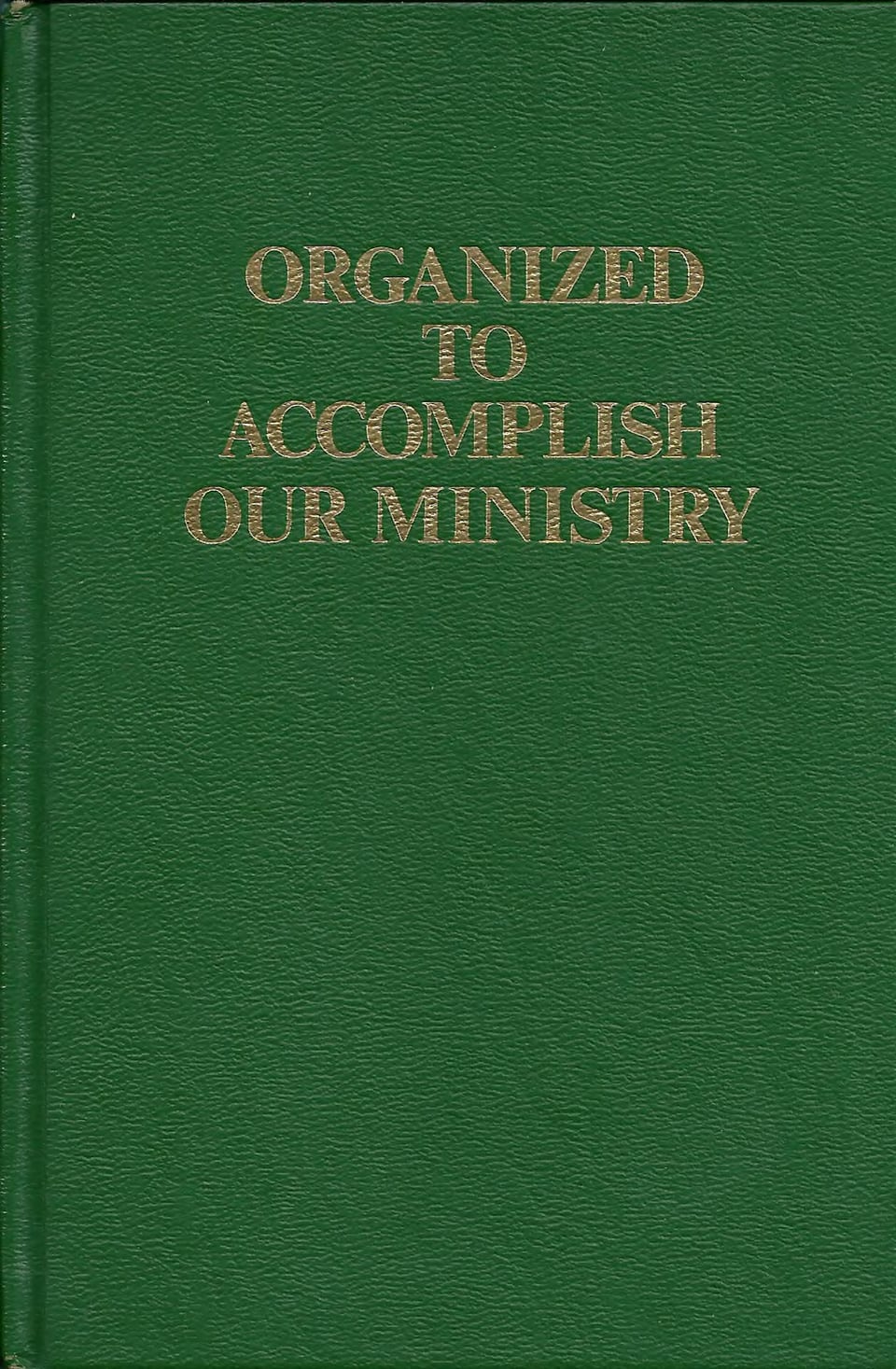
ORGANIZED
ACCOMPLISH
OUR MINISTRY
ORGANIZED TO ACCOMPLISH OUR MINISTRY
"You, though, keep your senses in all things suffer evil, do the work of an evangelizer fully accomplish your ministry."—2 Tim. 4:5.
© 1983,1989 WATCH TOWER BIBLE AND TRACT SOCIETY OF PENNSYLVANIA All rights reserved
Publishers WATCHTOWER BIBLE AND TRACT SOCIETY OF NEW YORK, INC. INTERNATIONAL BIBLE STUDENTS ASSOCIATION Brooklyn, New York, U.S.A.
Organized to Accomplish Our Ministry English (om-E)
Made in the United States of America CONTENTS
CHAPTER PAGE
1 Organized to Accomplish Our Ministry 5
2 Benefiting From Theocratic Subjection 12
3 Recognizing Christ’s Role in God’s Arrangement 17
4 How the Congregation Is Organized and Governed 21
5 Overseers to Shepherd the Flock 28
6 Ministerial Servants Render Valuable Service 55
7 Arrangements for Regularly Assembling Together 60
8 Ministers of the Good News 81
9 Ways to Expand Your Ministry 110
10 How the Ministry Is Supported 119
11 Holding to Jehovah’s Righteous Standards 127
12 When Difficulties Arise 138
13 A Worldwide Association of Brothers 153
14 Enduring With Life in View 161
Appendix: Questions for Those Desiring to Be Baptized 171
Subject Index 219
NOTE: Bible quotations in this book are from the New World Translation of the Holy Scriptures, 1981 edition, unless otherwise indicated.
Dear Fellow Ministers:
Organized to Accomplish Our Ministry is published for Jehovah's Witnesses. It draws attention to our basic Scriptural responsibilities. By reading it you will get an overall view of how the Christian congregation operates today. Its counsel and direction will help us to remain at unity with our brothers everywhere, who are busily 'engaged in the holy work of the good news of God.'—Rom. 15:16.
In addition to preaching the good news of the Kingdom worldwide, our aim is to help those thousands of people newly associating with us. Many of them desire to meet the Scriptural requirements for becoming dedicated and baptized witnesses of Jehovah. They, too, need to become familiar with Jehovah's organization and how to share the Kingdom good news with others. To that end, information has been included in this book that is especially beneficial to such persons.
General information is here published concerning the duties of elders and ministerial servants, judicial procedures and various features of congregation organization. Details regarding these matters are reviewed from time to time in The Watchtower, Our Kingdom Ministry and other publications of the Society.
It is our prayer that the reading and application of what is contained in this publication will bring Jehovah's blessing and will play a vital role in helping all of us to be theocratically organized to 'fully accomplish our ministry.'—2 Tim. 4:5.
The Publishers CHAPTER 1 ORGANIZED TO ACCOMPLISH OUR MINISTRY
AS THE great God of purpose, Jehovah is working out something good for those who love him. He is gathering and instructing a great multinational crowd of dedicated, cleansed people to worship and serve him. (Isa. 2:2,3) Are you not happy to be one of such persons having the gladsome prospect of surviving the approaching end of this present wicked system of things and living on into a righteous new world? (2 Pet. 3:13) Surely you are, and especially since this unique work of ingathering is proceeding irresistibly toward its successful conclusion!—Isa. 55:10, 11.
What God is accomplishing through his glorified Son, Jesus Christ, should concern each one of us. Why so? Because our spiritual security now and our everlasting future are involved. Mankind today is adversely affected by the administrations operating under human rulerships. God's way of ruling, or managing affairs, is far superior to the way imperfect men have been ruling for thousands of years. Happily, in his wisdom and mercy, Jehovah has purposed "an administration . . . to gather all things together again in the Christ, the things in the heavens and the things on the earth." (Eph. 1:9, 10) Through this arrangement obedient ones from among mankind are being reconciled to God as a united family. —2 Cor. 5:18, 19.
This unifying activity on God's part commenced at Pentecost in the year 33 C.E. with the outpouring of holy spirit on about 120 disciples of ORGANIZED TO ACCOMPLISH OUR MINISTRY
Jesus Christ. Some three years later it was extended to uncircumcised Gentiles. (Acts 10:1-48) In these modern times there is a gathered remnant of joint heirs with Christ, who are destined to be united with him in a heavenly inheritance. These constitute part of the "little flock" who Jesus indicated would be approved by Jehovah for a share in the heavenly Kingdom. (Luke 12:32) For about the past half century, however, there has also been a 'gathering of things on the earth,' or of things destined for the earth, a bringing together of a "great crowd" of "other sheep," who entertain prospects of life eternal in an earthly Paradise. Truly, an increasing throng is being affected in a wholesome, spiritual and uplifting way by God's purpose to have one united flock under Christ.—Rev. 7:9, 10; John 10:16.
THEIR WORK AS MINISTERS
All these dedicated and baptized followers of Jesus Christ have a most important work to do. The anointed remnant serve as "ambassadors substituting for Christ." They invite others: "Become reconciled to God." (2 Cor. 5:20) Their loyal companions, the "other sheep," support them in their ministry of reconciliation, all working together as one unified organization.—2 Cor. 6:1.
Under divine command, the work of these ministers involves preaching the Kingdom good news in all the earth and making disciples of people of all the nations. (Matt. 24:14; 28:19, 20) This activity also includes sounding the divine warning of the approaching "great day of God the Almighty." (Rev. 16:14-16; Ezek. 33:6-9) Being worldwide in scope, this work is indeed significant. The fact that it must be completed soon adds to its importance.
Mankind's state of affairs today forcefully reminds us of the apostle Paul's words at 1 Corinthians 7:29,31, that "the time left is reduced" and that "the scene of this world is changing."
In view of this, the question arises: Will this vital work be completed in the time divinely allowed for it? By Jehovah's undeserved kindness it will.
We recall how Jesus himself declared to religious opposers that if his disciples remained silent concerning his kingship, the very stones would cry out. (Luke 19:40) Our faith in Jehovah and his Word assures us that the ingathering work will be successfully accomplished.—Compare Isaiah 14:24, 27.
Through his Son, Jehovah has equipped us well with the things we need. (Heb. 13:20, 21) Above all, we have the provision of His inspired Word and holy spirit. Material facilities are available to publish and distribute the Kingdom message. As the God of order, Jehovah has arranged for us to be organized so as to 'fully accomplish our ministry.' (2 Tim. 4:5; 1 Cor. 14:33) It is evident that Jehovah and his Son are with us. Therefore, the work continues to move on to its grand climax soon in vindication of Jehovah's name and word.
MINISTRY MORE URGENT NOW
The establishment of God's Kingdom in the invisible heavens in 1914 inevitably forced this present system of things into its foretold "last days." (2 Tim. 3:1-5; Rev. 11:15, 18) Shortly after World War I Jehovah's people were revitalized by God's spirit to put forth a special effort in proclaiming the good news. From that time forward a tremendous witness has been given, resulting in a dividing of the people. During this period Jesus Christ, along with his holy angels, has been separating lovers of righteousness from those who are indifferent to, or who actively oppose, the truth.
This separating, or dividing, work was foretold in Jesus' illustration of the sheep and the goats. (Matt. 25:31-46) Consequently there is no question about the profound effect that the established Kingdom of God is having on the people and nations of this world.
We are now nearing the end of the present ungodly world. (2 Pet. 3:7, 11, 12) The ministry has become more urgent than ever before. (John 9:4) This calls for faithful Christians to be filled with zeal. They cannot loiter at their God-assigned work or be indifferent to its being fully accomplished. (Rom. 12:11) This is no time for independent thinking or conflicting actions on their part. More than ever before, the remnant of Kingdom heirs, along with the increasing number of "other sheep," are determined to work together as a united body. As one organized flock they follow Christ's lead so as to finish the global witness before the outbreak of the "great tribulation."—John 10:14-16; Matt. 24:14, 21.
ATTITUDE TOWARD THE MINISTRY
When Jesus was on earth, what did he do following his baptism in the Jordan River? The Bible record clearly shows that he commenced preaching and teaching about God's Kingdom. (Matt. 4:17; Luke 4:43) Such activity was carried out with a sense of purpose and in a limited time. In Jesus' case it was necessary to complete this work his Father had given him to do before Jesus submitted to a sacrificial death on the torture stake. Faithfully he finished his earthly assignment. (John 17:4) We are urged to follow his steps closely and to acquire the same mental attitude that he lovingly displayed.—1 Pet. 2: 21; 4:1, 2.
As a chosen apostle assigned by the Lord Jesus to accomplish a ministry among the nations, Paul followed Christ's footsteps closely.
Therefore, he urged his fellow workers to become imitators of him. (1 Cor. 11:1) What was his point of view toward the ministry?
When recounting his experiences of joys and hardships in his ministry, Paul said to the assembled overseers from Ephesus: "Nevertheless, I do not make my soul of any account as dear to me, if only I may finish my course and the ministry that I received of the Lord Jesus, to bear thorough witness to the good news of the undeserved kindness of God." (Acts 20:24) He maintained a keen sense of responsibility before Jehovah to preach the good news to all who would hear. Do you see the 'necessity laid upon you' to do likewise?—1 Cor. 9:16.
It was not easy for Paul to accomplish his assigned ministry. Besides dangers of an external kind and suffering at the hands of opposers, he acknowledged his own fleshly weaknesses and limitations. (Rom. 7:18) But did this cause him to develop a negative attitude? To the contrary, he came to appreciate why he had to rely fully on Jehovah. (Phil. 4:13) He was confident about the outworking of Jehovah's purpose and continued to be appreciative of Jehovah's undeserved kindness in assigning him to the ministry. (Eph. 3:7-9) That appreciation was demonstrated in his not giving up under any circumstances. He knew that Jehovah would not fail to give him the needed support, in time of trials, as long as he remained faithful in caring for his treasure of service. (2 Cor. 4:7-9, 16) Are we imitating his outstanding example?
Having established such a fine record himself, Paul could write to his fellow worker Timothy: "I solemnly charge you before God and Christ Jesus, who is destined to judge the living and the dead, and by his manifestation and his kingdom, preach the word, .
. do the work of an evangelizer, fully accomplish your ministry." (2 Tim. 4:1-5) That charge to Timothy, who was also a Christian overseer and a missionary, included various responsibilities within the congregation of believers as well as outside. Note that the work of evangelizing is stressed as being an essential part of Timothy's ministry. His teaching by example and by word would result in saving both himself and all those who would listen. 1 Tim. 4:11-16.
The work of the other first-century Christian disciples also provides us with fine examples. (Acts 1:8) People of Samaria became believers and were baptized in response to the preaching of Philip. They were empowered with holy spirit through representatives of the governing body of apostles and older men who visited them from Jerusalem. (Acts 8:9-17) Later Philip was directed by holy spirit to speak to an Ethiopian proselyte who accepted the good news and was baptized. (Acts 8:26-38) An outstanding example of Jehovah's working through his Christian organization to expand the preaching of the good news is recorded in Acts chapter 10. There we read about Cornelius and his family who received help through the ministry of the apostle Peter. They became the first uncircumcised Gentile converts to the Christian faith.—Acts 10:1-48.
Jehovah blessed those individuals and groups of persons who came into association with the organization he was using. The Christian congregations continued to grow as they responded favorably to the Scriptural and organizational direction provided by the apostles and the body of older men in Jerusalem.
Luke calls this to our attention when he writes: "Now as they traveled on through the cities they would deliver to those there for observance the decrees that had been decided upon by the apostles and older men who were in Jerusalem. Therefore, indeed, the congregations continued to be made firm in the faith and to increase in number from day to day." (Acts 16:4,5) What about those associating with God's organization today? Do they not find and experience a similar pattern of growth?
ORGANIZED FOR THE MINISTRY TODAY
By following the examples of Jesus Christ and his early disciples we can share in marvelous results. These are seen in the benefits being reaped by those who have become modern-day witnesses of Jehovah, organized for the ministry. True to his promise, Jesus Christ has appointed and identified a "faithful and discreet slave," giving him charge "over all his belongings." (Matt. 24: 45-47) That 'faithful slave' has dispensed abundant spiritual food for the household of God so that millions more of distressed mankind can hear the good news and learn about God's Kingdom and eventually share in serving God. Jehovah's faithful organization continues to encourage and direct our individual and united efforts to fulfill the commission to make known the good news.
The vast majority of those associated with Jehovah's organization today are dedicated and baptized. However, it may be that you have begun to associate regularly with the congregation of Jehovah's people and are considering the steps of dedication and baptism. Whatever the case may be, the pages that follow will call your attention to the way in which Jehovah's spirit-directed organization operates today. This will help you to have a share in the marvelous work that is being accomplished through it.
As you make it your aim to work unitedly with Jehovah's people the fruitage of Kingdom witnessing as well as of God's spirit will be manifest in your life. You will be helped to see how to "conduct yourself in God's household." (1 Tim. 3:15; Matt. 13:23; John 15:8; Gal. 5:22, 23) Be sure to look up and note how all the cited scriptures apply, as these, too, will enhance your appreciation. May this book help all of us to work closely with Jehovah's organization and to use the remaining time wisely in fully accomplishing our ministry.
CHAPTER 2
BENEFITING FROM THEOCRATIC SUBJECTION
SUBJECTION to God as the Universal Sovereign is essential if we are to accomplish our ministry fully. Recognition of his Son's headship over the Christian congregation is also necessary. And it is important to observe, in a relative sense, the principle of subjection in other areas of life. Such theocratic subjection benefits everyone concerned.
To render such subjection properly, we need to recognize the headship principle that the apostle stated simply at 1 Corinthians 11:3: "But I want you to know that the head of every man is the Christ; in turn the head of a woman is the man; in turn the head of the Christ is God." So this indicates that other than Jehovah, every person is subject to headship in this overall arrangement.
Most persons today do not recognize or observe these principles. Why? Trouble started in Eden when mankind's parents deliberately chose to take themselves out from under God's sovereign headship. (Gen. 3:4,5) When this occurred, they did not attain to greater freedom. Instead, they came under the influence of a wicked spirit creature, Satan the Devil. The first rebellion alienated mankind. (Col.1:21) As a result, today the majority of mankind still remains in the power of the wicked one.—1 John 5:19.
By learning and acting upon the truth of God's Word we have come out from under Satan's influence. As dedicated, baptized Witnesses, do we not accept Jehovah as the Sovereign of our life? Do we not agree with loyal King David who acknowledged Jehovah as "head over all"? (1 Chron. 29:11) Certainly! We humbly confess that "Jehovah is God. It is he that has made us, and not we ourselves. We are his people and the sheep of his pasturage." (Ps. 100:3) Our recognition of Jehovah's greatness and the need for being totally submissive to him takes into consideration his worthiness and the reasons why he created all things. (Rev. 4:11) As ministers of the true God, we follow Jesus Christ who is a perfect example of subjection to God.
What did Jesus learn by the things he suffered while on earth? Obedience to God's will even under adversity. (Heb. 5:8) Furthermore, Jesus did not do a single thing of his own initiative; he did not speak of his own originality nor did he seek his own glory. (John 5:19,30;6:38;7: 16-18) During his ministry he found delight in doing his Father's will, even though this course brought opposition and persecution. (John 15: 20) Nonetheless, he showed subjection to God by 'humbling himself' even to the point of "death on a torture stake."
(Phil. 2:5-8) The outcome of his complete subjection was rewarding in many ways, resulting in everlasting salvation for mankind, exaltation and perfection for himself and glory to his Father.—Heb. 5:9; Phil. 2:9-11.
AREAS IN WHICH WE BENEFIT
Truly, subjection to God is most beneficial. Briefly reflecting on our own everyday life as Jehovah's dedicated worshipers should make this self-evident. By putting God first in our life, doing his will, we are directed in the right way. (Compare Jeremiah 10:23.) We escape many of the anxieties and frustrations that overtake those who refuse to submit to Jehovah's sovereignty. Our Adversary, the Devil, constantly seeks to ensnare and devour us. We pray for and experience deliverance from that wicked one, provided we take a stand against him and humble ourselves before Jehovah in willing subjection.—Matt. 6: 10, 13; 1 Pet. 5:6-9.
The benefits of subjecting ourselves to God extend to our relationships with others. These are measurably improved, sparing us the problems that beset those who reflect this world's spirit of independence. Thanks to Jehovah God, we can enjoy happy marriage and family life, as well as better relationships with fellow workers and employers, and we can conduct ourselves lawfully and with good conscience toward worldly governments and authorities. We can also have the best of association with our Christian brothers.
Within the marriage and family structure, husbands are assigned the position of headship since "the head of a woman is the man." At the same time, men are to be in subjection to Christ, while the head of Christ is God. (1 Cor. 11:3) Wives are to be in subjection to their husbands, and children to their parents.
(Eph. 5:22-24; 6:1) When each family follows the headship principle, peaceable fruit results.
This requires that husbands exercise headship in a loving way, imitating Christ. (Eph. 5:25-29) When they do not abuse or abdicate their headship, it is a delight for the wife and the family to show subjection. The wife's role is that of a helper, or complement. (Gen. 2:18) By patiently giving support and respect to her husband, she gains favor from her husband and praise from God. (1 Pet. 3:1-4) When husbands and wives follow Bible counsel on headship, they thus set an example for children in showing subjection to God.
Subjection to God also affects our view of worldly governments, the "superior authorities," that have been "placed in their relative positions by God." (Rom. 13:1-7) As law-abiding citizens, Christians pay taxes; they pay back "Caesar's things to Caesar, but God's things to God." (Matt. 22:21) Being submissive and obedient to the duly constituted authorities over us in everything that is not in conflict with Jehovah's righteous law, we are able to direct our efforts and apply our energies to the important work of preaching the good news of God's established Kingdom.—Acts 5:29; Mark 13:10.
By adherence to Bible principles, Christians are able to improve their employer-employee relationships. Even though this may at times be difficult, servants of God seek to be at peace with all men. They serve honestly and reliably at their secular jobs. (Rom. 12:18; 1 Pet. 2:18) Thus, they do not become involved in distressing controversies or violate their Bible-trained conscience.
Within the Christian congregation, subjection to God is reflected by obedience to his Word in all that we say and do. This includes our ministry, meeting attendance and participation, relationship with elders and cooperation with organizational arrangements. Yes, it takes in our conversation, attitude and conduct. Subsequent chapters in this publication will help you to become better acquainted with the Bible-based principles and rules that all in "God's household" are exhorted to observe.—1 Tim. 3:15.
Our subjection to God allows us to enjoy the peaceful security of a truly theocratic order. Such theocratic order is not oppressive. (1 John 5:3) Jehovah's divine qualities are reflected by a harmonious society of godly subjects. (1 Cor. 14:33, 40) Our own observations and experience with Jehovah's organization today have led us to express sentiments similar to those of God's servant David. After noting the contrast between Jehovah's servants and wicked ones who boast in their own power and riches, he exclaimed joyfully, "Happy is the people whose God is Jehovah!" Ps. 144:15.
Theocratic subjection affects all aspects of our life. It benefits us now so that we are organized to accomplish our ministry fully. By faith we see the day when all obedient mankind will be brought into subjection to Jehovah God. This will be accomplished through the good offices of Christ Jesus. (Heb. 2:7,8;1 Cor.15:27,28) It is essential that we recognize his role in God's arrangement, since being submissive to Christ is a part of our being in subjection to God.
CHAPTER 3
RECOGNIZING CHRIST'S ROLE IN GOD'S ARRANGEMENT
THE rebellion in Eden temporarily interrupted mankind's relationship with God. However, Jehovah's purpose for the earth and mankind remained unchanged. Even as he pronounced sentence upon those who rebelled against his sovereignty, God's words gave promise of a deliverance for Adam's offspring. There would be a restoration of true worship and God would destroy the wicked one together with all his evil works.—Gen. 3:15.
This he would accomplish through his Son, Jesus Christ. (1 John 3:8b) Therefore, all who wish to receive the benefits that come from being in subjection to God must recognize Christ's role in God's arrangement.—Acts 4:12; Phil. 2:9, 11.
WHAT CHRIST'S ROLE IS
During Christ's earthly ministry it became clear just what that role would be. The reconciliation of obedient mankind to God would be accomplished through him. (John 14:6) He gave himself as a ransom in exchange for many, to their salvation. (Matt. 20:28) All authority in heaven and on earth was assigned to him. (Matt. 28:18) So Jesus was to serve as more than just an example of godly conduct. He became the key figure in Jehovah's purpose for mankind. He is our only means of being restored to God's favor. Acts 5:31; 2 Cor. 5:18, 19.
In his first letter to the Corinthians, Paul explained the role of Jesus Christ in these words: "For he must rule as king until God has put all enemies under his feet.
But when all things will have been subjected to him, then the Son himself will also subject himself to the One who subjected all things to him, that God may be all things to everyone." (1 Cor. 15:25, 28) Also, in the inspired letter to the Hebrews we read about Jesus: "You made him a little lower than angels; with glory and honor you crowned him, and appointed him over the works of your hands. All things you subjected under his feet.' For in that he subjected all things to him God left nothing that is not subject to him. Now, though, we do not yet see all things in subjection to him." —Heb. 2:7, 8.
We are assured that Jesus Christ was resurrected from the dead as a spirit creature and was rewarded with immortality. (1 Pet. 3:18) He was exalted to God's right hand to exercise rulership over his subjects here on earth. (Acts 2:32-36) Being alive in the heavens, he has not needed a succession of substitutes to serve in his stead during his physical absence. From his heavenly position Christ personally has been able to oversee the congregation. As its head he has exercised watchful care, thus fulfilling his promise: "And look! I am with you all the days until the conclusion of the system of things."—Matt. 28:20.
WHAT RECOGNITION OF HIS ROLE MEANS
Jesus' followers in the first century recognized fully the role of Christ in God's arrangement. They looked to no man as their leader. They worked in unity under the headship of Christ, submitting themselves to his direction expressed through holy spirit and through the inspired Scriptures. (Acts 15:12-21; Rev. 1:1) The apostle Paul clearly stated the understanding of the Christian congregation at that time when he wrote: "Speaking the truth, let us by love grow up in all things into him who is the head, Christ.
From him all the body, by being harmoniously joined together and being made to cooperate through every joint that gives what is needed, according to the functioning of each respective member in due measure, makes for the growth of the body for the building up of itself in love." Eph. 4:15, 16.
Also, in his letter to the congregation in Colossae he wrote concerning Christ: "He is the head of the body, the congregation. He is the beginning, the firstborn from the dead, that he might become the one who is first in all things; because God saw good for all fullness to dwell in him, and through him to reconcile again to himself all other things by making peace through the blood he shed on the torture stake, no matter whether they are the things upon the earth or the things in the heavens."—Col. 1:18-20.
Through Christ's administrative rule of the congregation, the remaining ones of his anointed followers have been brought into unity with him during these last days. (Matt. 24:31) Additionally, he has supervised the gathering together of a great crowd of "other sheep" who, together with the anointed remnant, make up one flock under the Fine Shepherd.—Matt. 25:31-46; John 10:16.
From his heavenly position, Jesus Christ as our High Priest administers the benefits of his propitiatory sacrifice in behalf of his dedicated followers here on earth. (Heb. 4:14-16; 1 John 2:2) In this way he provides them with needed help in view of their inherent human weaknesses. The apostle Paul explained: "For we have as high priest, not one who cannot sympathize with our weaknesses, but one who has been tested in all respects like ourselves, but without sin."
(Heb. 4:15) He then encourages those who exercise faith to take full advantage of this arrangement by God, saying in verse 16: "Let us, therefore approach with freeness of speech to the throne of undeserved kindness . . . for help at the right time."
AN INVINCIBLE LEADER
Just as was true with the Christian congregation in the first century, so we today have no need for a human leader. Jesus, alive in the heavens, lovingly serves as Head of the congregation in this 20th century. He still gives direction through holy spirit, enlightenment from the Holy Scriptures and the use of qualified undershepherds who are accountable to him and his heavenly Father as they care for the flock of God. (1 Pet. 5:2,3; Heb. 13:17) Speaking prophetically of the Christ, Isaiah wrote: "Look! As a witness to the national groups I have given him, as a leader and commander to the national groups." (Isa. 55:4) Jesus confirmed the fulfillment of this prophecy in himself when he told his disciples: "Neither be called 'leaders,' for your Leader is one, the Christ."—Matt. 23:10.
As an example of his mental attitude and willingness to help us in our weaknesses, Jesus extended the invitation to those who listened in his day: "Come to me, all you who are toiling and loaded down, and I will refresh you. Take my yoke upon you and learn from me, for I am mild-tempered and lowly in heart, and you will find refreshment for your souls. For my yoke is kindly and my load is light." (Matt. 11:28-30) By ruling over the Christian congregation with mildness and in a way that has brought refreshment and strength to our souls, Jesus Christ has proved himself to be like his heavenly Father, Jehovah God.—Isa.
40:11.
World events fulfilling Bible prophecy prove beyond doubt that since 1914 Jesus Christ has been entrusted with Kingdom power. He is now ruling in the midst of his enemies. (Ps. 110:1, 2; 2:1-12) What does this portend for those now living on earth? As to his enemies, his role as King of kings and Lord of lords will be powerfully demonstrated when he executes divine judgment against them. (Rev. 11:15; 12:10; 19: 16) Jehovah's promise of deliverance expressed at the beginning of man's rebellion will soon be fulfilled toward those on his right hand of favor. (Rom. 16:20) How happy we are to have recognized Christ's role in God's arrangement and to be organized to accomplish a worldwide ministry under his leadership during these last days!
CHAPTER 4
HOW THE CONGREGATION IS ORGANIZED AND GOVERNED
AN IMPORTANT basic truth about God was expressed by the apostle Paul in his first letter to the Corinthians when he wrote: "For God is a God, not of disorder, but of peace." Then, commenting further with regard to congregation meetings he said: "But let all things take place decently and by arrangement."—1 Cor. 14:33, 40.
At the very beginning of this same letter the apostle gave admonition concerning reported dissensions within the Corinthian congregation. Paul exhorted the brothers there to "speak in agreement" and to be "fitly united in the same mind and in the same line of thought." (1 Cor. 1: 10, 11) He then proceeded to give counsel with regard to various matters that were affecting the unity of the congregation.
Using the illustration of a perfect human body, he showed clearly the need for unity and cooperation. Hence all those making up the Christian congregation, regardless of their position, are urged to care for one another in a loving way. (1 Cor. 12:12-26) Such harmonious cooperation among the various members of the congregation implies an orderly arrangement—organization.
But how was the Christian congregation to be organized? Who would organize it? What kind of organization would it have and who would be in charge? A key thought for our protection today, as it was for the first-century Christians in Corinth, is what the apostle stated at 1 Corinthians 4:6. There he gave the rule: "Do not go beyond the things that are written." By letting the Bible be our guide, we can get clear answers to our questions.
ORGANIZED THEOCRATICALLY
The Christian congregation was established in 33 C.E. on the Jewish festival day of Pentecost. It was organized and governed theocratically, that is, under God (theos) rule (kratos). The inspired account of what took place there in Jerusalem nearly 2,000 years ago leaves no doubt that the congregation of anointed ones was established by God. (Acts 2:1-47) It was his building, his household. (1 Cor. 3:9; Eph. 2:19) It is important for us to learn what we can about the congregation back there because the same pattern of organization and operation that was established during the first century is adhered to by the Christian congregation of God today, which has now been enlarged by the addition of the "great crowd."
Rev. 7:9,10.
The early congregation began with about 120 members. Holy spirit was poured out first upon these in fulfillment of Joel 2:28, 29. (Acts 2: 16-18) But that same day 3,000 others were baptized in water and brought into the spirit-begotten congregation. They had embraced the word about the Christ and "continued devoting themselves to the teaching of the apostles." After that, "Jehovah continued to join to them daily those being saved."—Acts 2:41, 42, 47.
The growth of the anointed congregation in Jerusalem became such that the Jewish high priest accused the disciples of having filled Jerusalem with their teaching. The new disciples in Jerusalem included many Jewish priests who became part of the congregation.—Acts 5:28; 6:7.
Jesus had said: "You will be witnesses of me both in Jerusalem and in all Judea and Samaria and to the most distant part of the earth." (Acts 1:8) And so it was that when a great persecution arose in Jerusalem following the death of Stephen, the disciples living there were scattered throughout Judea and Samaria. But wherever they went they continued declaring the good news and making more disciples, including some from among the Samaritans. (Acts 8:1-13) Still later the good news began to be preached with good success among the uncircumcised non-Jewish nations. (Acts 10:1-48) All this preaching activity and the making of many disciples resulted in new Christian congregations being formed outside Jerusalem.—Acts 11:19-21; 14:21-23.
Arrangements were made for each newly established congregation to be organized and governed God's way, hence theocratically. This involved the appointment of older men to care for the flock.
Paul and Barnabas made such appointments in the congregations that were organized during their first missionary journey. (Acts 14: 23) Acts chapter 20 relates information about the apostle Paul's meeting with the older men of the congregation in Ephesus. Paul said to them: "Pay attention to yourselves and to all the flock, among which the holy spirit has appointed you overseers, to shepherd the congregation of God, which he purchased with the blood of his own Son." (Acts 20:28) These were older men in a spiritual sense who qualified for appointment because of their spiritual qualifications. (1 Tim. 3: 1-7) Paul's fellow worker Titus was authorized to make appointments of older men in the congregations of Crete.—Titus 1:5.
As more congregations were formed, the apostles and the older men in the Jerusalem congregation continued to serve as the principal overseers of the expanded international congregation of the first century. From their position in the Jerusalem congregation they served as a governing body for the entire Christian congregation. It was their responsibility to consider matters affecting Christians everywhere. They sent out letters and decrees, all of which strengthened the congregations and made it possible for the disciples to remain united in thought and action. The congregations followed the direction of the governing body and, as a result, they received Jehovah's blessing and prospered.—Acts 8:1, 14, 15; 15:1, 2, 22-3l; 16:4, 5.
The apostle Paul, in writing to the congregation in Ephesus, explained that the unity of the Christian congregation would be maintained through adherence to the headship of Jesus Christ and by the operation of holy spirit.
He urged Christians there to cultivate humility and to observe a oneness of the spirit in peaceful association among all members of the congregation. (Eph. 4:1-6) Then he quoted Psalm 68:18 and applied it to Jehovah's provision for spiritually qualified men to serve the needs of the congregation as apostles, prophets, evangelizers, shepherds and teachers. Such men, as gifts from Jehovah, would build up the entire congregation to a spiritual fullness that would be pleasing to God.—Eph. 4:7-16.
CONGREGATION TODAY FOLLOWS APOSTOLIC PATTERN
Today a similar pattern of organization is followed in all the congregations of Jehovah's Witnesses. These collectively form a united worldwide congregation built around the nucleus of spirit-anointed ones. (Zech. 8:23) This is possible because Jesus Christ, true to his promise, has loyally remained with his anointed disciples "all the days until the conclusion of the system of things." (Matt. 28:20) They dedicate their life unreservedly to Jehovah God and faithfully do his will. Those brought into the growing congregation today embrace the good news of God and are baptized as disciples of Jesus Christ. (Mark 1:14; Acts 2:41) They recognize the headship of Jesus Christ not only over the anointed members of the congregation but also over the entire flock which includes the "other sheep."—John 10:16; Eph. 1:22, 23.
Unity is maintained by loyally recognizing the headship of Christ and also by submitting to an organizational channel, "the faithful and discreet slave." What has the Master appointed this "slave" to do? Jesus answered that the "slave" was to provide spiritual food at the proper time and to care for all His "belongings," or Kingdom interests on earth.
(Matt. 24:45-47; Luke 12: 42-44) Rather than being an individual Christian, the 'faithful slave' today is the remnant, still living on earth, of the composite body of Christ's anointed footstep followers. Such remaining ones are a part of spiritual Israel, the anointed congregation of God. (Gal. 6:16; compare Isaiah 43: 10.) This remnant is faithfully discharging the responsibilities of the "slave" during this time of the end by taking the lead in the preaching of "this good news of the kingdom" throughout all the earth and by providing spiritual food at the proper time for the household of faith.—Matt. 24:14.
USE OF RELIGIOUS CORPORATIONS
During these last days of the present wicked system of things, the "belongings" of the Master have increased abundantly throughout all the earth. This has placed a heavy responsibility on the 'faithful slave.' In discharging its responsibility to provide spiritual food at the proper time and in order to get the good news of the Kingdom preached before the end comes, the remnant on earth, as "the faithful and discreet slave" class, has formed certain agencies, or legal entities. It has proved to be the course of wisdom for the 'faithful slave' to organize certain corporations that are recognized by the laws of various countries. These religious corporations own and operate printing facilities that produce and distribute Bibles and Bible literature on a worldwide basis for use in the Kingdom ministry.
The first in time and the principal corporation used in this way is the Watch Tower Bible and Tract Society of Pennsylvania. This nonprofit religious society was incorporated in 1884, is made up of dedicated, baptized Christians and is exclusively devoted to advancing the interests of true worship in the earth.
The Watch Tower Society has extended its works worldwide, establishing branch offices in various countries. Also, in compliance with local governmental regulations, a number of other religious societies have been legally formed, such as the Watchtower Bible and Tract Society of New York, Inc. (1909) and the International Bible Students Association in London, England (1914). All these legal instrumentalities cooperate with one another. These and other legal corporations are used by the modernday Governing Body of Jehovah's Witnesses to facilitate the preaching of the good news worldwide and to care for the spiritual needs of the entire congregation of God in all parts of the earth.
STRUCTURE UNDER BRANCH ORGANIZATION
Whenever a branch office is established, a Branch Committee of three or more elders is appointed to care for the various responsibilities involved in looking after the work in the country or countries under the jurisdiction of that particular branch. One member of the committee serves as the coordinator of the Branch Committee.
Local congregations under each branch organization are arranged into circuits and a number of circuits make up a district. Circuits and districts may be of various sizes depending on geographical and language considerations, as well as the number of congregations within the area assigned to a branch. A circuit overseer is appointed to serve the congregations in each circuit. District overseers visit the different circuits, serve at circuit assemblies and spend some time serving congregations, usually with the circuit overseer present.
The duties of traveling overseers are set out from time to time in Our Kingdom Ministry as well as in correspondence addressed to them by the Society.
All in the organization recognize God's way of theocratic control. The congregations acknowledge and conform to the guidance of the Governing Body as it outlines organizational arrangements for the benefit of all. They accept the appointments made of older men to oversee the branches, districts, circuits and congregations. They look to "the faithful and discreet slave" for spiritual food at the proper time. (Matt. 24:45-47) The 'faithful slave' remnant and its Governing Body, in turn, adhere strictly to the headship of Christ, hold to Bible principles and submit to the direction of holy spirit. As all work together in unity, the results are the same as those experienced by the congregations in the first century. We are told at Acts 16:5: "Therefore, indeed, the congregations continued to be made firm in the faith and to increase in number from day to day."
CHAPTER 5
OVERSEERS TO SHEPHERD THE FLOCK
DURING his earthly ministry Jesus proved himself to be the Fine Shepherd. (John 10: 11) We are told that once, upon viewing the crowds following him, "he felt pity for them, because they were skinned and thrown about like sheep without a shepherd." (Matt. 9:36) Peter and the other apostles observed closely his loving concern. How different he was from the false shepherds of Israel who neglected the flock to such an extent that the sheep were scattered and spiritually starved!
(Ezek. 34:7,8) By observing Jesus' fine example of teaching and caring for the sheep, even to the point of laying down his life for them, the apostles learned how to help those with faith return to Jehovah, the Shepherd and Overseer of their souls.—1 Pet. 2:25.
By precept and example Jesus reinforced the serious responsibility he had laid upon the apostles to care for the sheep. They never lost sight of it. On one occasion Jesus impressed very strongly upon Peter's mind and heart the importance of feeding and shepherding the sheep. (John 21: 15-17) Peter was deeply moved by this as indicated later in his exhortation to older men. In his first inspired letter he wrote: "Therefore, . . . shepherd the flock of God in your care, not under compulsion, but willingly; neither for love of dishonest gain, but eagerly; neither as lording it over those who are God's inheritance, but becoming examples to the flock."—1 Pet. 5:1-3.
Peter's words apply with equal force to overseers in the congregation today. The need for having overseers in the congregations today is the same as it was back there in the first century, namely, to shepherd the flock of God. In his letter Peter emphasized the proper attitude that overseers should have in caring for such responsibility. Imitating Jesus, they should serve willingly, eagerly and as examples to the flock, taking the lead in Jehovah's service.
We can indeed be grateful for having spirit-appointed overseers in the congregation today. The benefits we receive are many. For example, overseers give spiritual encouragement and personal attention to the needs of individual memORGANIZED TO ACCOMPLISH OUR MINISTRY
bers of the congregation. Each week with earnestness they preside at congregation meetings where all are nourished in the faith. (Rom. 12:8) Their efforts to protect the flock from harmful elements and wicked men contribute to our spiritual security. (Isa. 32:2; Titus 1:9-11) Moreover, by their example and lead in the field ministry we are encouraged to keep active in preaching the good news regularly each month. (Phil. 3:16, 17; Heb. 13:15-17) Through these "gifts in men" Jehovah has provided well for the building up of the congregation.—Eph. 4:8, 11, 12.
QUALIFICATIONS FOR OVERSEERS
To ensure proper care of the congregation, men appointed to serve as overseers must meet the requirements set out in God's Word. Only if they do qualify could it be said that they have been appointed by holy spirit. (Acts 20:28) The Scriptural standards for Christian overseers are admittedly high, since these men have the serious responsibility of taking the lead in Jehovah's worship and being exemplary in Christian conduct. (1 Cor. 11:1; Heb. 13:7; 1 Pet. 5:3) But the standards are not so high that they cannot be met by Christian men who have a real love for Jehovah and a willingness to be used by him. The high standards provide a guarantee that those appointed as elders will be good examples in the congregation. It should be obvious to all that the overseers are individuals who apply the counsel from the Bible in all affairs of life.
The apostle Paul wrote down the basic Scriptural requirements for overseers in his first letter to Timothy and in his letter to Titus. At 1 Timothy 3:1-7 he wrote: "If any man is reaching out for an office of overseer, he is desirous of a fine work. The overseer should therefore be irreprehensible, a husband of one wife, moderate in habits, sound in mind, orderly, hospitable, qualified to teach, not a drunken brawler, not a smiter, but reasonable, not belligerent, not a lover of money, a man presiding over his own household in a fine manner, having children in subjection with all seriousness; (if indeed any man does not know how to preside over his own household, how will he take care of God's congregation?) not a newly converted man, for fear that he might get puffed up with pride and fall into the judgment passed upon the Devil.
Moreover, he should also have a fine testimony from people on the outside, in order that he might not fall into reproach and a snare of the Devil."
Paul's words to Titus state: "For this reason I left you in Crete, that you might correct the things that were defective and might make appointments of older men in city after city, as I gave you orders; if there is any man free from accusation, a husband of one wife, having believing children that were not under a charge of debauchery nor unruly. For an overseer must be free from accusation as God's steward, not selfwilled, not prone to wrath, not a drunken brawler, not a smiter, not greedy of dishonest gain, but hospitable, a lover of goodness, sound in mind, righteous, loyal, self-controlled, holding firmly to the faithful word as respects his art of teaching, that he may be able both to exhort by the teaching that is healthful and to reprove those who contradict." (Titus 1:5-9) Paul's counsel quoted above emphasizes the need for overseers to maintain a proper attitude toward carrying out their responsibilities, being willing and eager, taking the lead. Other Bible writers more indirectly or by implication set out what would be required of Christian men in order for them to qualify for appointment as overseers, or shepherds, of the congregation.
Jas. 3:13, 17, 18.
Although a first consideration of the Scriptural requirements may prove to be somewhat overwhelming, there should be no reason for Christian men to shy away from desiring the fine work associated with the office of overseer. The fact is that all dedicated Christians should strive to measure up to these high standards. By taking the lead in exhibiting fine Christian qualities, overseers encourage other members of the congregation to do the same. This is indicated by what the apostle Paul wrote in describing how "gifts in men" are provided "with a view to the readjustment of the holy ones, for ministerial work, for the building up of the body of the Christ, until we all attain to the oneness in the faith and in the accurate knowledge of the Son of God, to a full-grown man, to the measure of stature that belongs to the fullness of the Christ." (Eph. 4:8, 12, 13) Since all Christians are to strive to attain spiritual maturity, those standing before the congregation as appointed overseers are required to be exemplary in taking the lead.
As indicated by what Paul wrote to Timothy and Titus, overseers would be selected from among the older men of the congregation. They would not be mere boys or newly converted men, but they would be individuals with experience in Christian living, having a broad knowledge of the Bible, a deep understanding of it and a genuine love for the congregation. They would be individuals who have the courage to speak up when wrongdoing exists and to take the needed action to correct it and thus protect the flock from any who would selfishly exploit them.
(Isa. 32:2) They would be men readily recognized by all in the congregation as spiritually mature men with a genuine concern for the flock of God. Their overall way of life would show this.
Those qualifying for appointment as overseers of the flock of God would be men experienced in life who had demonstrated a measure of practical wisdom in carrying on their own affairs. If married, they would be adhering to the Christian standard for marriage, namely, husband of one wife, and would have demonstrated their ability to preside over their own household in a fine manner. Because of their having believing children who are not under a charge of debauchery nor unruly but who are in subjection with all seriousness, other members of the congregation could confidently approach overseers for counsel and advice on a wide range of personal matters having to do with Christian living. Having conducted themselves properly within the family arrangement as well as within the community in general, these men would also be irreprehensible, free from accusation and have a fine testimony even from people on the outside. No valid charge of improper conduct could be brought against them to mar the reputation of the congregation. They would not have been reproved recently for serious wrongdoing. Others in the congregation would be moved to imitate their fine example and entrust their spiritual life to their care.—1 Cor. 11:1; 16:15, 16; Phil. 2:25, 29; Heb. 13:7.
Such qualified men would be able to serve the Christian congregation in a role similar to that of the older men of Israel who were described as "wise and discreet and experienced." (Deut. 1:13) They would not be without sin. (Rom. 3:23) But they would be known in the congregation and in the community as being upright and God-fearing, men who had demonstrated over a period of time that they conduct their life entirely on the basis of God's principles.
Their blamelessness would give them freeness of speech before others in the congregation.
Men qualifying for appointment as overseers would display moderation in personal habits and in their dealing with others. They would not be fanatics, but their way of life would be characterized by balance, orderliness and self-control. Moderation would be demonstrated in such things as eating, drinking, recreation, hobbies and entertainment. They would not be given to a lot of wine but would be moderate in the use of alcoholic beverages so as not to leave themselves open to charges of drunkenness or of being a drunken brawler. One whose senses have been dulled by intoxicating drink easily loses self-control and so is not in a position to watch over the spiritual interests of the congregation.
Exercising oversight of the affairs of the congregation requires one to demonstrate a measure of orderliness, being systematic in life, habits and work. This includes his personal appearance, his home and his activities. Such one avoids procrastination, is able to see what is required and plans accordingly. He adheres to theocratic order. All of this is what is meant by being moderate in habits and self-controlled.
An overseer must be reasonable. He must be able to work in unity and cooperate with others within the body of older men who are charged with the oversight of the congregation. He should have a proper view of himself in relation to others both within the congregation and outside. As a reasonable person, the overseer would not be opinionated, considering his views and opinions as always superior to those of his fellow elders.
Others may excel in qualities or abilities that he may lack. Reasonableness comes as a result of basing one's conclusions solidly on the Scriptures and striving to imitate the example of Jesus Christ. (Phil. 2:2-8) By showing proper respect for others and considering others as superior to himself, an elder would not become belligerent or be a smiter of others with either physical or verbal abuse. He would not be self-willed, always insisting on his own way or that his point of view must be accepted as best. He would not be prone to wrath but would be peaceable in his dealings with others.
Similarly, one qualifying to serve as an overseer in the congregation should be sound in mind. This means that he should have a good comprehension of Jehovah's principles and their application. He should be levelheaded, not hasty in judgment. He should be receptive to counsel and direction. He should not be double-minded or hypocritical, not fanatical.
The apostle reminded Titus that an overseer should also be a lover of goodness. He should be righteous and loyal. These qualities would be reflected in his dealings with others and in his firm stand for what is right and good. He would be known as one who is unwavering in his devotion to Jehovah and consistent in upholding righteous principles when making judgments. He would be one who is able to keep a confidence.
As one who is sound in mind, of course, he would not be overly demanding in what he expects of others. Neither would the overseer be unduly concerned about material advantages for himself, not greedy of dishonest gain, not a lover of money.
He would not use his office to take material advantage of the brothers under his care nor would he hold back because of the reasonable material sacrifices he may be required to make in order to give generously of his time in caring for the needs of the congregation. His love for the brothers, as well as for strangers, and his self-sacrificing endeavors in their behalf would make him as one who is genuinely hospitable, freely giving of himself and his belongings for the benefit of others.—Acts 20:33-35.
In order to carry out his assignment effectively, one appointed as an overseer, or shepherd, of the congregation would need to be qualified to teach. Paul's words to Titus were that the overseer would be one "holding firmly to the faithful word as respects his art of teaching, that he may be able both to exhort by the teaching that is healthful and to reprove those who contradict." (Titus 1:9) In exhibiting his art of teaching the overseer should have the ability to reason with others, produce evidence, overcome objections and set out with clearness the teaching of the Scriptures in such a way that others would be convinced and have their faith strengthened. The overseer would need to exercise such teaching ability under circumstances both favorable and unfavorable. (2 Tim. 4:2) He would need to have the patience to reprove with mildness one who is in error or convince a doubter and move him to profitable works on the basis of faith. His being qualified to teach either before an audience or on a person-to-person basis would give evidence of his meeting this important requirement.
The apostle Peter wrote that the older men of the congregation who serve in a representative capacity should do so willingly and with eagerness, not under compulsion nor begrudgingly.
They should be enthusiastic in their endeavors. They should be taking the lead, becoming examples to the flock.—Heb. 13:17; 1 Pet. 5:3.
All of this may look like a great deal to expect from one who would serve as an overseer. Certainly none would measure up perfectly to the high standard that has been set forth in the Bible, as outlined here, but none of the appointed elders in the congregation should be so significantly deficient in any one of these qualities that the deficiency could be considered a serious flaw. Some elders will be more outstanding in one quality than in another, whereas others of the body will excel in those qualities in which some may be weak. The effect then is that, generally speaking, as a whole, the body will have within itself all the fine qualities that are necessary for exercising proper oversight of the congregation of God.
When recommending men for appointment as overseers, the body of elders will want to keep in mind their own standing before Jehovah and their relationship with fellow Christians. Romans 12:3 counsels that each one should in no way "think more of himself than it is necessary to think; but to think so as to have a sound mind, each one as God has distributed to him a measure of faith." Each should consider himself as a lesser one. None should prove to be "righteous overmuch" when examining the qualifications of another. (Eccl. 7:16) Having clearly in mind the Scriptural requirements for elders, they would want to determine whether or not one being considered measures up to those standards to a reasonable degree or whether he is so seriously deficient in one or more of the Scriptural requirements that he would not qualify to serve.
Allowing for human imperfections and being free from biased leanings and hypocrisy, appointed elders will make their recommendations in a manner showing due respect for Jehovah's righteous standards and for the good of the congregation. Just as with Timothy and Titus, elders today need to give prayerful consideration to each recommendation and follow the direction of holy spirit. This is one of the serious responsibilities they shoulder, and they must do so in accord with Paul's admonition 'never to lay your hands hastily upon any man.'—1 Tim. 5:21, 22.
Men meeting these high Christian standards are able to protect the congregation from spiritual dangers, and they serve as fine examples of Christian conduct for all to imitate. They have freeness of speech enabling them to be bold in giving needed counsel to those within the congregation as well as being zealous to proclaim the good news in the field ministry.—Heb. 10: 19-23, 35; Acts 4:29; 1 Tim. 3:13.
FRUITAGE OF THE SPIRIT
Such spiritually qualified men would give evidence in their life that they were directed by holy spirit. They would be producing the fruitage of the spirit, described at Galatians 5:22, 23 as "love, joy, peace, long-suffering, kindness, goodness, faith, mildness, self-control." Their oversight of the congregation would be refreshing to the brothers and would serve to unite the congregation in rendering sacred service. Their course of conduct and the fruitae of their labors would give evidence that they are appointed by holy spirit. (Acts 20:28) Having the spiritual requirements for overseers and shepherds stated so precisely in the inspired Scriptures has made it possible for us to have qualified appointed overseers to shepherd the flock today.
REACHING OUT
The office of overseer is to be desired by mature Christian men. (1 Tim. 3:1) However, the appointment means work, self-sacrifice and making oneself available to serve the needs of the brothers, caring for their spiritual interests. Reaching out for the office means striving to meet the qualifications set out in the Scriptures. The overseers of the congregation have a great responsibility as well as an accountability in caring for the souls of those entrusted to their care. Members of the congregation are told: "Be obedient to those who are taking the lead among you and be submissive, for they are keeping watch over your souls as those who will render an account; that they may do this with joy and not with sighing, for this would be damaging to you." (Heb. 13:17) Although the overseers are imperfect men, there is no need for anyone in the congregation to hold back from being submissive since it is Jehovah's arrangement and he will hold the overseers responsible for their actions. They are representing him and his theocratic rule. He will remove from office those overseers who fail to manifest the fruitage of the spirit and whose pattern of life falls short of the Scriptural requirements.
…