Rutherford-Troy Debate (1915)
Download: PDF — Rutherford-Troy Debate (1915)
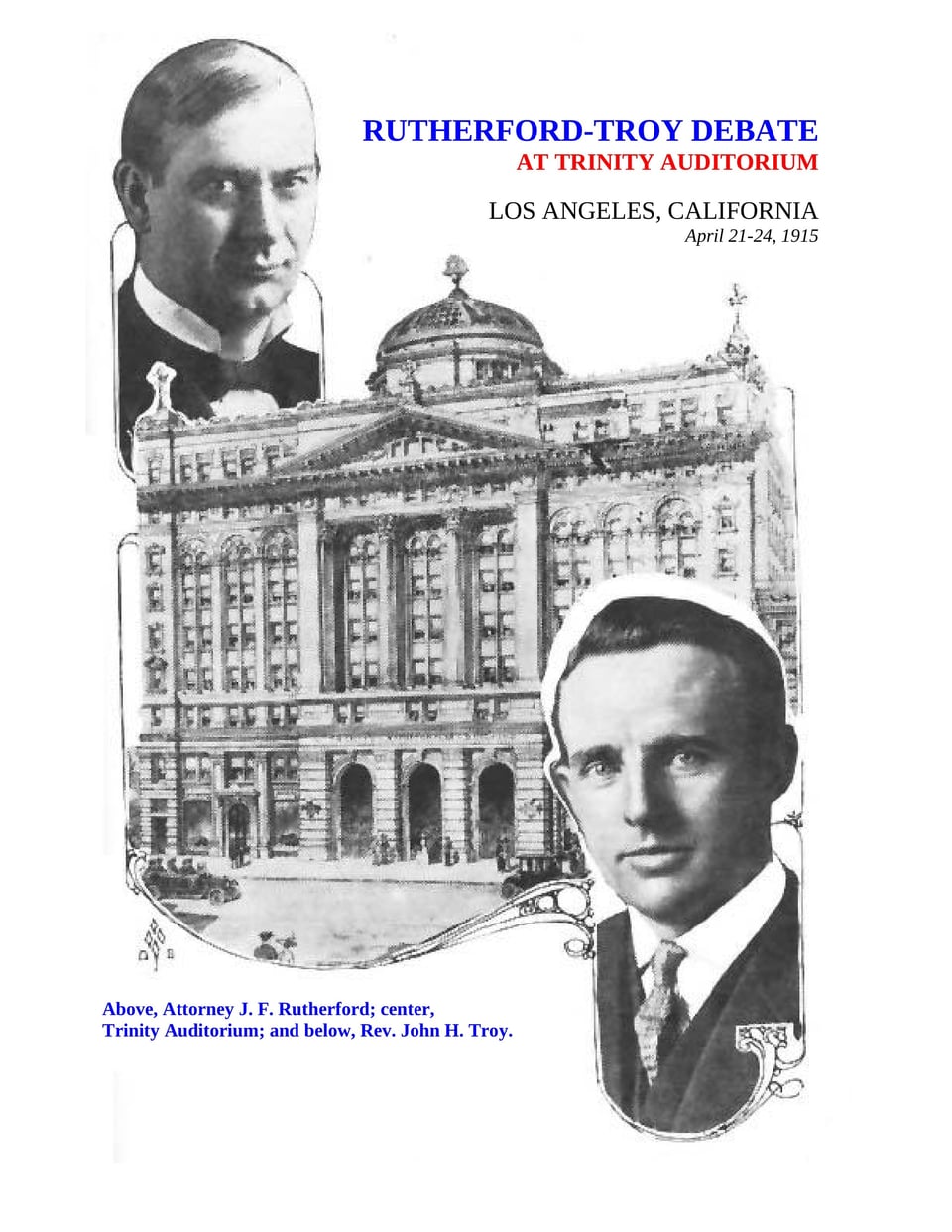
RUTHERFORD-TROY DEBATE AT TRINITY AUDITORIUM
RUTHERFORD-TROY DEBATE
AT TRINITY AUDITORIUM
LOS ANGELES, CALIFORNIA
April 21-24, 1915
Above, Attorney J. F. Rutherford; center,
Trinity Auditorium; and below, Rev. John H. Troy.
TO ARGUE THEOLOGY FOUR DAYS Attorney J.
F. Rutherford, as Religious Opponent of Rev. J. H. Troy arrives in Los Angeles this afternoon.
Loaded down with Scripture texts with which to puncture the arguments of his able opponent, J. F. Rutherford, celebrated New York attorney, will arrive in Los Angeles at 2:10 o'clock this afternoon to pick up the "debate" gauntlet cast at his feet by the so-called orthodox churches, whose teachings differ somewhat from those of the International Bible Students' Association, which Mr. Rutherford represents.
Opposed to Mr. Rutherford in the scheduled four-day verbal encounter next week will be Rev. John H. Troy, of Glendale, who is supported by his own congregation, the First Baptist Church of Glendale, and 50 ministers throughout Southern California who have endorsed him.
The unique contest between a lawyer and minister is to be staged in Trinity auditorium four evenings, beginning Wednesday, April 21, and will probably attract thousands of church-goers who are now about equally divided over the four important questions the two expert debaters will discuss. In fact, the feeling over assertions made by Mr.Rutherford in a lecture here last February runs high among Rev.Troy's supporters and the audience will be keyed to the highest pitch of enthusiasm.
NEW YORKER WELL PREPARED.
In a telegram received at the People's Temple, 755 South Flower street, this week, Mr. Rutherford announced that he had prepared himself in a way that he could without hesitation answer any argument hurled in his direction.
Followers of Rev. Troy assert that their leader has been so absorbed in preparing counter arguments and "verbal bomb-shells," that he has almost daily locked himself up in his study and forgotten that there is such a thing as eating meals regularly. They say he has lined out an attack and defense that would do credit to an expert coast artillery commander.
Four separate questions, one to be discussed each evening, will form the basis of the contest. They involve the principal points of difference between the teachings of the International Bible Students' association as outlined by Pastor Russell, president, and the teachings of the commonly so-called orthodox churches.
FOUR THEMES ON PROGRAM.
In brief, the propositions to be discussed follow:
The state of the dead.
The final punishment of the incorrigibly wicked.
Probation after death.
Christ's second coming.
Sixty minutes are given the speaker who takes the affirmative in which to open the argument. The negative will be given sixty minutes in which to answer, the affirmative fifteen minutes to reply, and the negative fifteen minutes in which to close.
A neutral chairman will be selected to mark time and keep order. The audience itself will be the only judge, the object of the debates being to assist the public to a better knowledge of what the Bible teaches on the four propositions. An interesting feature of the contest is that both speakers have agreed under bond to conduct the discussion on a high moral plane, as Christian gentlemen, to use nothing but the Bible as an authority, and to refrain absolutely from entering into personalities. Admission to Trinity auditorium will be free, and there will be no reserved seats. Doors will be open at 6:30 o'clock and the debates will be started promptly at 7:30 o'clock. No collections will be taken.
Both sides to the controversy are confident that their man will be able to present a superior answer to the questions at issue, and to prove his arguments conclusively by Scripture, while the great mass of people, who are neutral, are waiting with intense interest to be shown.
While Mr. Rutherford is widely known as a Bible student of great learning and has gained renown throughout the country as a debater of excellence, he has spent a great deal of extra time on this issue, because of the feeling aroused when he was here in February. The Southlanders have great faith, however, in Rev. Troy's ability to more than keep up his end of the argument. Dr. T. C. Horton of the Bible institute, this city, who is a warm supporter of the Glendale pastor, says that he believes his man's arguments will prove to be Mr. Rutherford's Waterloo.
MADE STARTLING REMARKS.
In his address in Los Angeles last February, Mr. Rutherford presented some startling Bible evidence respecting the condition of the dead. His utterances not only startled a great many of his hearers, but stirred certain religious people in the city to such an extent that they immediately challenged the attorney to a public discussion of Bible questions.
Mr. Rutherford accepted the challenge without hesitation and the debates were accordingly arranged to take place in Trinity auditorium, each side to pay one-half the expenses.
So many requests for reports of these debates have been made from all over the United States and Canada that it has been decided to run verbatim reports in the Express Thursday, Friday and Saturday, April 22, 23 and 24, and in the Tribune on Monday, April 26.
SUBJECTS OF WIDE INTEREST.
Thousands of copies have already been ordered in advance, so great is the interest in the coming friendly controversy between a minister and a lawyer over questions of vital importance to many churchgoers.
A committee from the People's temple will meet Mr. Rutherford this afternoon and provide a suitable place where he can continue his preparations for the coming debates.
The names of the ministers who have endorsed and are supporting Rev. Troy in this contest follow:
Rev. W. Leon Tucker, Calvary Baptist church, Los Angeles; Rev. Granville S. Williams, Sunnyside Baptist church, Los Angeles; Rev. Bryant Wilson, Immanuel Baptist church, Long Beach; Rev. F. Nelson Baker, Watts Baptist church; Rev. J. O. Burroughs, Baptist church, San Pedro; Rev. William M. Perry, First Baptist church, Ontario; Rev. B. B. Jacques, Calvary Baptist church, Pasadena; Rev. J. S. Watson, corresponding secretary Southern California Baptist convention.
Rev. James W. Kramer, Central Baptist church, Los Angeles; Rev. H. H. Hurley, Orchard Avenue Baptist church, Los Angeles; Rev. J. Lewis Smith, Tremont Baptist church, Pasadena; Rev. C. W. Jackson, Memorial Baptist Church, South Pasadena; Rev. George Lord, First Baptist Church, Morovia.
Rev. A. Sterling Barner, Memorial Baptist church, Los Angeles; Rev. Walter S. Reed, Immanuel Baptist church, Alhambra; Rev. C. Sidney Maddox, Baptist church, Santa Monica; Rev. W. W. Catherwood, Covina Baptist church; Rev. J. Howard Adams, Atherton Baptist church, Los Angeles; Rev. C. J. Coulter Burnett, Baptist church, Long Beach.
Rev. D. Webster Rigg, Baptist church, Azusa; Rev. J. Campbell Jordan; Rev. F. W. Huff, Huntington Park Baptist church, Los Angeles, Rev. Charles G. Willett, Compton Baptist church; Rev. A. H. Bailey, Southern California Baptist church, Gardena; Rev. George M. Lehigh, Highland Park Baptist church, Los Angeles; Rev. John Bentzein, Temple Baptist church, Los Angeles; Rev. A. W. Rider, joint district secretary, Los Angeles; Rev. W. M. Riddle, First Baptist church, Globe, Ariz; Rev. James S. West, Bakersfield Baptist church; Rev. S. L. Warren, First Baptist church, Redondo Beach; Rev J. G. Clark.
East and West Representatives to Debate, with Audiences Judges.
Miss Los Angeles, meet Mr. J. F. Rutherford and Rev. J. H. Troy.
As you can see, the gentlemen have just met. They are smiling and clasping hands.
But they shall meet again! And they will not be smiling; nor will they be clasping hands.
Mr. Rutherford is the noted New York attorney who has come across the continent to accept the challenge cast at his feet by the so-called orthodox churches of the Southland.
And Rev. Troy is the prominent minister of Glendale who has been chosen by the Southland ministers to meet the New York lawyer and beat him -- if possible -- in a theological debate.
The two gentlemen will meet again tomorrow night. The place will be Trinity Auditorium and the time 7:30 o'clock. They will meet also the three ensuing nights.
All arrangements for the big four-day debate have been completed. A. H. MacMillan, Bible lecturer of Nova Scotia, has been agreed upon as chairman for the first debate tomorrow evening. Mayor O. A. Lane of Glendale will be chairman at the second debate. The audience will be the only judge.
Reports of the contest will appear in the Evening Express of Thursday, Friday and Saturday this week and in the Morning Tribune of Monday next week.
(Reprint from Los Angeles Express.) April 21, 1915.
Theological Fight Draws Crowds To City
Keyed up to the highest pitch of enthusiasm over what will probably be the most remarkable series of theological debates ever held on the Pacific coast, scores of Bible students and churchgoers from all over Southern California began arriving in Los Angeles today to attend the first debate between J. F. Rutherford and Rev. John H. Troy at Trinity auditorium tonight.
Not only is a record crowd expected but it is feared that hundreds of late-corners will have to be turned away from the doors. Large squads of Bible students from Southland cities have sent word that they intend making the trip in a body. Many are said to be coming from the northern cities. Hundreds of Los Angeles students and church-goers, representing both factions, also are preparing to secure vantage seats early
MESSAGES FROM EUROPE.
Early today messages began coming from all parts of the United States from friends of the two participants, bringing expressions of moral support and expressing the hope that their favorite will win over the majority of the big audiences. A number of personal cablegrams from friends in Europe were received by Mr. Rutherford wishing him success and "God Speed" in his coming theological battle.
Rain has neither dampened the ardor of the contestants nor of the enthused followers. The subjects chosen for the four debates are considered the most important questions now before the church-going public.
Both the so-called orthodox churches, represented by Rev. Mr. Troy, and the International Bible Students' association, represented by Mr. Rutherford, have an immense following.
Both sides want to be shown -- and they say they are perfectly willing to abide by the opinion they gain from the theological contests.
Are the dead "dead" after the soul has flitted, or are the dead conscious and therefore susceptible to suffering and torment?
DEAD OR CONSCIOUS?
Lawyer Rutherford says the dead are "dead". Minister Troy says the dead are "conscious." And they will thresh out this question in tonight's debate.
There will be no appointed judge. The audiences will judge each contest from the worth of each speaker's assertions and the proof he is able to dig from the Scriptures. Each speaker asserts he will refrain from engaging in personalities, although the feeling between the two participants is liable to run high before the contest is over.
Rabbi I. Meyers has been agreed upon as chairman for tonight and will introduce the speakers. The doors will be opened at 6:30 o'clock and Mr.Rutherford will begin speaking promptly at 7:30 o'clock. He will have one hour in which to open the argument. Rev.Troy will have an hour in which to respond. Then fifteen minutes each will be allotted the contest-ants to close. Clayton J. Woodworth, prominent Bible student of the East, will act as Mr.Rutherford's counsel.
QUESTION TO BE DEBATED.
The exact wording of the question over which the two will debate tonight follows:
The Scriptures clearly teach that the dead are unconscious between the moment of death and the moment of awakening to the resurrection. Mr Rutherford will take the affirmative and Rev. Troy the negative.
Reports of the debate will be printed in full in the Evening Express tomorrow, Friday and Saturday and in the Morning Tribune of Monday.
Both speakers say they are in trim and ready to deliver the best and most forceful arguments ever given in any contest in which they have participated.
There will be no admission charge, no reserve seats held, and no collections taken.
Thousands Hear Opening Debate On Question. "WHERE ARE THE DEAD?"
Rutherford and Troy Resort To Bible To Solve Man's Future State Lawyer, Minister Discuss Life Beyond
Are the dead "dead?" Following are versions of a lawyer and a minister:
LAWYER RUTHERFORD:
Man is a soul; man dies, therefore the soul dies.
If the dead are perished, as the Bible states, how could it be possible for such creatures to be conscious after they have perished?
If Lazarus was at all conscious during the four days that be was dead and in the grave, why is there no proof thereof in the Bible?
Jesus didn't tell Lazarus to put off his asbestos coat and come up out of some conscious condition to Martha.
MINISTER TROY:
Paul taught: Absent from the body; present with the Lord.
Remember the passage: "He whosoever liveth and believeth in me shall never die."
Man is spirit, body and soul -- three distinct things; spirit being a soul, being immortal and existing eternally in some condition of consciousness.
I would to God that the ministers would rise up and teach the word of God correctly.
RABBI I. MEYERS, CHAIRMAN:
Maybe if we live long enough we'll all die and find out for ourselves.
DEBATE ON THEOLOGY EXCITING
Battle Between Rutherford and Troy on Scriptures Draws Great Crowd; 2500 Fail to Gain Admittance.
An immense crowd of men, women and children packed the big Trinity auditorium to the doors last night to hear J. F. Rutherford, representing the International Bible Students' association, and Rev. John H. Troy, representing the so-called orthodox churches of the Southland, engage in a lively, witty and, at all times, eloquent debate on the State of the Dead. Fully 2500 persons were turned away.
As the speakers were divided on the question of "are the dead unconscious after death until the moment of awakening to the resurrection?" so was the huge audience divided. And as the various points were driven home by a witty, grave or emphatic assertion the resultant applause from the followers of the speaker who made the point almost knew no bounds.
Although, as Chairman Rabbi I. Meyers said, it was a "grave" subject,the laughs were numerous and the audience was kept on edge throughout the contest in a way that made the two hours and a half pass quickly. Although it was clearly shown that earthly beings die,as the chairman said again, there certainly were no "dead" ones in the auditorium.
POINTS JOTTED DOWN.
Scores of deeply interested men, and especially women, appeared with notebooks and pencils and jotted down the points and specific Bible references given by the debaters, evidently for further study.
The question under discussion follows:
"The Scriptures clearly teach that the dead are unconscious between the moment of death and the moment of awakening to the resurrection."
In a leading "shot" at his opponent, Mr. Rutherford, who took the affirmative, brought a roar from the audience by announcing that Rev. Troy in signing his name to the agreement to discuss this question had himself in this way refuted any argument he might advance to favor the negative side of the question.
"The use of the word 'awakening,'" asserted Mr. Rutherford, "approves the assertion that the dead are unconscious, otherwise how could they awaken?"
In the first hour's argument, Lawyer Rutherford drove home argument after argument in the brief, punchy style of a trained debater, qualifying his assertions by frequent references to the Scriptures. In conclusion he handed Rev. Troy a paper containing 11 questions on points he had made, asking that they be answered.
REV. TROY REPLIES.
Rev. Troy delivered his arguments in a clear voice that could be heard at every point in the auditorium, but his style of delivery was practically the opposite from that used by Mr. Rutherford. While the lawyer began from the bottom of each point, worked to a climax and then delivered the point with a "punch," Minister Troy made his address an eloquent one, intermingling his points with brief sermons meant to carry a moral.
In conclusion Rev. Troy charged Mr. Rutherford with not interpreting the Bible canonically and dispensationally; said he could not take Job as an authority and quoted the passage from Paul which says: "Absent from the body; present with the Lord."
Shortly afterward Lawyer Rutherford, in giving his rebuttal, referred to the Rev. Troy's assertion concerning Job as follows:
"It seems that my honorable opponent must have prepared his speech beforehand. I haven't mentioned Job once!"
CLOSING ARGUMENT FIERY.
The contestants were given one hour each to open and 15 minutes for rebuttal. Their closing arguments were almost fiery and held the big audience to the seats expectantly. Each man refrained from entering into personalities, as agreed, and each contented himself with rapping the other's method of interpretation.
One of the most interesting points in the debate was made when Rev. Troy quoted Matthew 10:28 -- "fear not them which kill the body, but are not able to kill the soul."
"He should have the whole sentence. The remainder reads: 'But rather fear him which is able to destroy both soul and body in hell.' And that about proves my argument."
"My honorable opponent forgot to finish that sentence and if that is the correct way to interpret the Bible, excuse me," shouted Mr. Rutherford.
CHALLENGE ACCEPTED.
The second debate of the series of four -- on the final punishment of the willfully wicked -- will be taken at Trinity auditorium tonight. The doors will be open at 6:30 o'clock sharp.
The four-day series was brought about as a result of assertions on Where Are the Dead? made early this year by Mr. Rutherford. He was challenged by the so-called orthodox churches and accepted.
The audiences are the only judge of the contests and a neutral chairman presides. Mayor O.A. Lane of Glendale will be in charge of tonight's contest.
Verbatim reports of the theological battle will appear in the Evening Express of today tomorrow and Saturday and in the Morning Tribune of Monday.
Last night's debate follows:
HERE IS RUTHERFORD'S OPENING ARGUMENT.
Mr. Rutherford said:
"Mr. Chairman, I am glad to see you in such a happy mood. And that is the result of having a happy chairman. We chose our good friend here because he has a happy vein. I hope we will all keep up this good period of happiness and kind feeling towards each other as we progress through this discussion.
"Preliminary to the discussion of the proposition read, it is due to you and to my opponent for me to say that I did not seek this debate, nor did I run away from it when it came to me. I am quite certain that my opponent did not seek it. I think some of our friends arranged it. I am not here for the purpose of seeking notoriety or advertisement. I am not here for the purpose of seeking money, because I do not expect to receive any. You know, we are not going to take up any collection.
"I am not here for the purpose of getting some one to join something, because I have joined nothing myself.
"I believe the time in man's history has been reached when the Bible is due to be understood, and may be understood by those who seek knowledge in God's appointed way. Therefore, my sole purpose here is to induce others to study more carefully the Bible, believing, as I do, that it solves all the questions that are perplexing to honest-hearted men. I hope this debate may result beneficially to those who attend. It will so result to everyone who, with open and unbiased mind, honestly seeks the truth.
"In these four debates, I purpose, by God's grace, to point out that Jehovah has a great plan which he is working out in an orderly way; that the Bible discloses this plan, and that the consecrated child of God can grasp and understand it if he applies his mind and heart to the study thereof; that this plan, when worked out, will result in great blessings to everyone of the human race who loves right and hates wrong. In this hour of great distress and sorrow upon the peoples and nations of the earth, God's plan, as set forth in the Bible, is the balm that will soothe and comfort every sorrowful and penitent heart, hence the importance to all to understand it. To aid men in reaching an understanding of his plan as set forth in the Bible, is my desire. I have no selfish purpose to accomplish. I care not whether a man be a Catholic or Protestant, Jew or Gentile, bond or free, if I can be of any aid to him, or turn his mind to an investigation of these great truths, then I shall be glad.
"By reference to our agreement, it is observed that my opponent and myself have limited ourselves to the Bible as authority upon the questions we shall here discuss. I am glad this is true. The Bible is God-made; other authorities are man-made.
PROPOSITION.
"The scriptures clearly teach that the dead are unconscious between the moment of death and the moment of awakening to the resurrection.
"This proposition I affirm, and my opponent denies the truth thereof. If this proposition is not affirmatively true, as stated, then we must find:
"1. That man, after death, continues mentally active; that is to say -- possesses knowledge and continues to exercise his mental functions, therefore conscious.
"2. We must find that there can be no awakening, for the reason that a conscious person must of necessity be awake. Sleep means a temporary loss of mental control, unconsciousness, and the opposite of sleep is to be awake and
"3. We must find that there is no actual or real death, because persons actually dead are not conscious.
DEFINITIONS.
"The word 'Dead' is used in two senses: (a) Legal death, and (b) Actual death.
"The proposition we are here discussing is treated from the standpoint of actual death. That will be conceded by my opponent.
"Legal death means to be utterly cut off from certain or fixed rights and privileges.
"Actual death means destitute of life, inanimate,the state in which the vital organs have ceased to perform their functions.
"These are the definitions given by our best lexicographers -- Webster and others -- and I am going to prove in this argument that these are the Bible definitions and therefore the correct ones.
"To be conscious means to have or possess the faculty of knowing one's own thoughts or mental operations; possessing knowledge.
"Unconscious means, of course, the opposite of conscious; that is to say, having no power of mental perception, having no knowledge, not knowing or regarding anything.
WHAT IS MAN?
"MAN is the subject of this discussion. Is man conscious or unconscious when dead? That is the real issue joined here. Pertinent, then, is the question, What is man? Is man a divine being, or a human being? Is he mortal, or immortal?
"My opponent will tell you that man is a composite creature of three parts -- body, spirit and soul; that the spirit and soul mean practically the same thing; that man is begotten and born like other animals, but at the time of conception God intervenes in some mysterious way and implants in that body a spirit or soul; that that soul is immortal, can never die, lives on forever, and is always conscious.
"If that condition be true it means that God is responsible for every idiot, every born criminal because these are begotten under conditions over which they have absolutely no control. A child is begotten by drunken and debauched parents, and at the very moment of conception, according to my opponent's position, God intervenes and implants in the creature just conceived, an immortal spark. The child is born, necessarily, a depraved creature. It lives on earth a while, dies, and must spend eternity in this miserable condition without choice or election on its part. Such a theory is wholly unreasonable. God is not unreasonable. The creature I have just described is imperfect. God makes nothing imperfect. 'His work is perfect'. (Deuteronomy 32-4.) God is in no wise responsible for the life of imperfect or depraved beings.
BIBLE ANSWER.
"The Bible declares, 'Man is of the earth earthly.' He is not spiritual. (1 Corinthians 15:45-47.) Man is a human being. He is not a spirit being. A spirit hath not flesh and bones. (Luke 24:39.) Spirit beings have spiritual bodies. Human, or natural beings, have human or natural bodies. (1 Corinthians 15:44.) Adam the first man was not spiritual. 'That was not first which is spiritual.' (1 Corinthians 15:46.)
"Man is the highest order of animal life, the crowning glory of God's earthly creation. He is composed of body and breath of life, like other animals. The word 'breath' of life is some-times spoken of as 'spirit' of life, meaning life principle, or that which animates. The uniting of the breath of life with the body produces the soul, or being. The word 'soul' is synonymous to the word 'being.'
"My opponent will not for one moment contend that the body of man is conscious aside from the breath of life, nor will he contend that the breath of life is conscious. He will say that it is the soul that is conscious after death. We desire to meet this issue squarely.
THE SOUL.
"What is the soul? The Scriptures answer: 'The Lord God formed man of the dust of the ground and breathed into his nostrils the breath of Tile, and man became a living soul.' (Genesis 2:7.) "Was the dust of the earth conscious before formed into a body?
No! Was the body conscious when formed before it received the breath of life? It was not! Did the breath of life possess consciousness? Certainly not! What, then, is conscious? We answer, the soul, or being; the creature, the man.
"Every creature that breathes is a soul. God applied the words 'living soul' to the lower order of animals long before the creation of man. (Genesis 1:20 and 30 - margin.) The word 'soul' is applied to both men and beasts in Numbers 31:28. 'And levy a tribute unto the Lord of the men of war which went out to battle; one soul of five hundred, both of the persons and of the beeves, and of the asses, and of the sheep.' God, in his word, declares that all die alike and all go to the same place, 'For that which befalleth the sons of men befalleth beasts; even one thing befalleth them; as the one dieth, so dieth the other; yea, they have all one breath; so that a man hath no preeminence above a beast, for all is vanity. All go unto one place; all are of the dust, and all turn to dust again.' (Ecclesiastes 3:10, 20.)
"Can my opponent, in the face of this, deny that the ox is a soul, when the Bible says it is? Will my opponent for one moment contend that an ox is conscious after death?
"A soul is a moving, breathing, sentient being that has senses and exercises the same. No man has a soul, but every man is a soul. Mark the distinction between having a thing and being that thing!
PENALTY OF THE LAW.
"God said to Adam, 'Thou shalt not eat of the fruit of the tree of knowledge, for in the day that thou eatest thereof dying, thou shalt die.' (Genesis 2:17)-margin. If the soul is immortal, then God did not mean what he said, because an immortal creature could not be put to death. Was this announced penalty of the law to apply to the body only, or to the soul? My opponent will contend that the body died and the soul continued to live, but the Bible answers (Ezekiel 18:4). The soul that sinneth, it shall die, and again, in Psalms 89:48, 'What man is he that liveth and shall not see death, shall he deliver his soul from the grave?'
MAN NOT IMMORTAL.
"Man is a soul. Man dies, therefore the soul dies. There is a distinction between eternal life and immortal life. A creature may live eternally and yet not be immortal. Immortality means that quality of life not subject to cessation; means that the creature cannot die and God, even, has not the power to destroy such an one. Has God power to destroy the soul? Jesus answers, 'Fear him who is able to destroy soul and body.' (Matthew 10:28.) Can a soul that is destroyed still have consciousness? Impossible! My opponent will not be able to produce even one Scripture text which says, 'Man has an immortal soul.'
THE FIRST LIE.
"Jesus, who spake with authority, pointed out that Satan is the author of the theory of undieable or immortal souls, and that this was the beginning of lies. God had definitely said to man, 'Ye shall surely die.'
'The soul that sinneth, it shall die.' Satan appeared to Mother Eve and asked, 'Why do you not eat of the fruit in the midst of Eden?' to which Eve replied, 'God has said, "Ye shall not eat thereof lest ye die,"' to which Satan rejoined, 'Ye shall surely not die.' (Genesis 3:1-5.) Here Satan told the first lie, and from it all other lies have had their birth. In proof of this Jesus states, 'Satan was the father of lies, a liar from the beginning and abode not in the truth.' (John 8:44.) Again, we read in the Scriptures concerning Satan, 'He is the god of this age. The god of this age hath blinded the minds of men lest the light of the glorious gospel should shine unto them.' (2 Corinthians 4:4.) From the day of Mother Eve's deception until now, Satan has been blinding the minds of men to God's glorious plan by this same falsehood -- there is no death, the dead are conscious. The theory that the dead are conscious is not supported by the Scriptures, but is based upon Satan's false-hood and the deception he has so successfully practiced upon the people.
WHO IS IMMORTAL?
"The Bible answers (1 Timothy 6:16), 'God only hath immortality.' There is a wide distinction between man in general and one who has become a real Christian. One line of Scriptures applies to men in general, and another and different line of Scriptures applies to the real followers of Christ. Mark my opponent's argument and see if he rightly divides the word of truth and makes this distinction.
"The New Testament speaks of immortality as a promised reward, not an inherent quality. It is the greatest reward that God has to bestow upon his creatures who love and serve him. To the Christian, St. Paul says, 'Seek ye immortality.' (Romans 2:7.) A man does not seek for that which he already possesses. Again, 'This mortal must put on immortality.' (1 Corinthians 15:53.) If man already possessed Immortality he would not be looking forward to the future when he would receive that which he already possesses. These Scriptures have no reference to the world, but to Christians only. The world of mankind will never possess the quality of immortality. To the church the promise is made, 'Be thou faithful unto death and I will give thee the crown of life.' The highest element of life, immortality. (Revelation 2:10.)
THE DEAD UNCONSCIOUS.
"We have shown that man is a soul; that man-soul is subject to death; that it would be impossible for a dead soul or being to be conscious while dead. Now we offer some corroborative Scriptural proof establishing this fact beyond the question of a doubt, and we believe to the complete satisfaction of every one who believes the Bible.
WITHOUT MEMORY.
"When a man dies, according to the Bible, he ceases to remember, nor can he give praise to God, 'for in death there is no remembrance of thee'; 'in the grave who shall give thee thanks?' (Psalms 6:5.) 'Wilt thou shew wonders to the dead? shall the dead arise and praise thee. Shall thy loving kindness be declared in the grave or thy faithfulness in destruction?' (Psalms 88:10, 12.) If these Scriptures be true, then the dead could not be conscious.
SPEAK NOT.
"They also cease speaking. 'The dead praise not the Lord, neither any that go down into silence.' Psalms 115-17.)
NEITHER BREATHE, THINK, FEEL.
"They also stop breathing, thinking and feeling. 'Thou takest away their breath; they die and return to the dust.' (Psalms 104:29.) 'His breath goeth forth, he returneth to the earth; in that very day his thoughts perish.' (Psalms 146:4.) A person that cannot think and who knows nothing could not be conscious, neither could such an one feel. As an illustration, a man goes to the hospital to submit to a serious operation. Before the surgeon begins to use the knife he puts his patient under the influence of an anesthetic for the express purpose of producing unconsciousness, because he does not wish the patient to feel and thereby suffer pain of the operation.
CEASES TO HATE.
"We must keep in mind that my opponent and myself have agreed that the Bible is the authority by which these questions shall be settled, and mere theory and conjecture should not be tolerated. Then let us have some more Bible proof upon the proposition. A dead man ceases to love, ceases to hate and ceases to envy. (Ecclesiastes 9:6.)
"Furthermore, the Scriptures clearly state that he 'knows not anything.' (Ecclesiastes 9:50.) The dead stop working; there is no more device and no more scheming. 'Whatsoever thy hand findeth to do, do it with thy might; for there is no work, nor device, nor knowledge, nor wisdom, in the grave whither thou goest.' (Ecclesiastes 9:10.)
"I submit that when a man reaches the point where he cannot remember; cannot give thanks; cannot speak; cannot breathe; does not think; has no feeling; neither loves, hates or envies; does not work; and knows not anything, he must be actually and completely dead, therefore unconscious.
PERISHED.
"To perish means to be destroyed; to be cut off; to cease to exist. -- Dr. Strong. Therefore, a creature that has perished cannot be conscious anywhere. Does man perish when he dies? Let the Scriptures answer. 'For he seeth that wise men die, likewise the fool and the brutish person perish, and leave their wealth to others. Their inward thought is, that their houses shall continue forever, and their dwelling places to all generations; they call their lands after their own names. Nevertheless, man being in honor abideth not: he is like the beasts that perish.' (Psalms 49:10,12.) WHY MEN DIE.
"It is a principle of God's law that every perfect, righteous creature is entitled to life. It follows that every unrighteous creature has no legal right to life. God enforced his judgment against Adam in a gradual manner, viz -- by forcing Adam out of Eden, where the food was perfect, and forcing him to obtain his food or sustenance from the unfinished earth, which brought forth or produced poisonous foods. As he partook of these poisonous foods, disease was taken into his blood and the death process began and was gradual until he was completely dead. Adam was legally dead when driven from Eden, actually and completely dead 930 years later.
"Adam was given power, before he sinned, to transmit the spark of life, or life principle, to his children. The judgment of God deprived him of his legal right to life and that judgment pursued the power of reproduction; in other words, his offspring were begotten under the disability that their father was laboring under, viz.: without legal right to life, and the Father Adam transmitted to his offspring the same poison or disease that was in his system. The perfect man Adam begot no children. His children he begot after he was under the sentence of death, and therefore he transmitted to all of his offspring the disease in his own body. Consequently, by operation of God's law, all of Adam's children inherited death and were born legally dead, or without a legal right to life. In proof of this we read, in Psalms 51:5, 'Behold, I was shapen in iniquity, and in sin did my mother conceive me'; and again (Romans 5:12). 'As by the disobedience of one man sin entered the world, and death by sin, therefore death passed upon all men, for all have sinned.' It follows that every man that has died, died because of the judgment that was justly placed against Adam and which by inheritance came upon his offspring. Every man thus justly dying would, of necessity, remain dead forever unless God had made some provision for his redemption and resurrection.
REDEMPTION.
"In John 3:16 we read; 'For God so loved the world that he gave his only begotten Son, that whosoever believeth on him should not perish, but have everlasting life.'
"I submit that these words of the Master conclusively prove that the dead are unconscious until the awakening to the resurrection. A creature that perishes could not have consciousness, and in this Scripture the statement is made that all would perish forever without the provision God made for redemption through Jesus Christ.
"My opponent must concede, if he believes the Bible, that none would be saved without believing on the Lord Jesus Christ. This Scripture is positive that all of us would perish.
MORE PROOF.
asleep in Christ are perished.' Mark, he says that even Christians are perished, utterly destroyed, if there be no resurrection. They are already perished, because dead, and their future life is absolutely dependent upon the resurrection.
"Now I ask my opponent to answer this question: If the dead are perished unless there is a resurrection, how would it be possible for that creature to be conscious prior to the time of being awakened to the resurrection? Resurrection really means re-creation -- bringing again to perfect condition of life.
WHY RESURRECTION POSSIBLE?
"While we must leave for a subsequent argument a more detailed discussion of the philosophy of the ransom sacrifice, it is necessary here to call attention to some of the cardinal points thereof.
"The perfect man Adam sinned, and thereby forfeited all his right to life. Before his sin the entire human race, unborn, was in his loins; that is to say, he had the power to produce the race and in this sense the whole race had a life-standing in Adam. When he sinned all his rights were lost, hence all of his offspring were born legally dead. The apostle emphasizes this fact when he says; 'In Adam all die.'
"God's law provided that his judgment might be satisfied by the voluntary death of another equal to Adam, 'a life for a life.' (Exodus 21:23.) Jesus partook of flesh and blood for the very purpose of redeeming man. (Hebrews 2:9.) He stated (Mark 10:45) that he came to give his life a ransom (corresponding price). By his death and resurrection from the dead the Lord provided the ransom price for Adam and his offspring. This was an absolute guarantee that the entire human race, in God's due time, would be released from the condemnation of death and awakened to a resurrection. Because the penalty of sin is death and death means cessation of life, it was necessary for the man, Christ Jesus, to die in order to redeem mankind from that death sentence; and the fact of his death and resurrection, the apostle argues, is conclusive proof that all the dead shall come forth.
DEATH -- SLEEP.
"Since God has made provision for the awakening of the dead to the resurrection, the Bible frequently speaks of death as sleep. Sleep is a symbol of death, and the word is used in that sense. A man lies down to sleep and we say he will wake again. And so we say with reference to the dead -- 'He shall awake and come again.' As the Prophet Jeremiah beautifully states the matter (Jeremiah 31:15-16), 'Thus sayeth the Lord, a voice was heard in Ramah, lamentation, and bitter weeping; Rachel weeping for her children refused to be comforted for her children, because they were not. Thus sayeth the Lord, refrain thy voice from weeping and thine eyes from tears; for thy work shall be rewarded saith the Lord; and they shall come again from the land of the enemy. Thy children shall come again to their own border." This Scripture proves that the dead were out of existence but there was hope for a resurrection.
"Both the Old and New Testaments abound with expressions referring to the dead as asleep. We read, 1 Kings 2:10, that 'David slept with his fathers and was buried in the city of David.' St. Peter says, 'The fathers fell asleep. (2 Peter 3:4.) St. Paul, speaking of those who had seen Jesus in the flesh, said, 'The greater part remain until this day, but some are fallen asleep.' (1 Corinthians 15:6.) Again, 'I would not have you ignorant, brethren, concerning them that are asleep. Them that sleep in Jesus God will bring forth by Jesus at the resurrection.' (1 Thessalonians 4:3-14.)
SLEEPING -- UNCONSCIOUS.
"Who ever heard of one sleeping soundly and being conscious at the same time? Sleep means suspension of the voluntary exercise of the functions of the body and mind. Sleep is used as a symbol of death. The reality is more pronounced than the symbol. If the symbol represents unconsciousness, the reality does even more so.
"The death sleep is so absolutely a period of unconsciousness that the awakening one will have no knowledge of the lapse of time or the transpiring of events. Now we will prove the truth of this statement by the Lord Jesus' own testimony. In John, 11th chapter, verses 1 to 44 (John 11:1-44), we find this proof, which we paraphrase. Lazarus lived with his two sisters at Bethany. Jesus was often entertained at this home and taught the members of the household. Lazarus became sick. Word was sent to Jesus of Lazarus' illness, but after he heard it Jesus remained in the same place for two days longer. He was preparing to teach mankind a great lesson concerning the dead and how they shall be awakened out of the sleep of death. At the end of the two days, speaking to his disciples, he said, 'Our friend Lazarus sleepeth.' His disciples replied, 'Lord if he sleepeth he doeth well, but Jesus spake of his death, but they thought he had spoken of taking rest in sleep. Then said Jesus unto them plainly, 'Lazarus is dead.' Thomas suggested that they go to Bethany at once. Jesus and his disciples went. Arriving at Bethany they found that Lazarus had been dead and buried for four days. Jesus here performed a great miracle, which testified in no uncertain terms as to the condition of the dead and proves beyond all doubt that the dead are wholly unconscious until the awakening to the resurrection. Mark what he did! He did not call Lazarus out of heaven, nor out of purgatory, nor a lake of fire and brimstone, but after giving thanks to God he went to the grave, which was a cave in the hillside, and cried with a loud voice, 'Lazarus, come forth,' and the dead came forth.
"Let my opponent answer this question if he will: If Lazarus was at all conscious during the four days that he was dead and in the grave, why is there not some proof of it some-where to be found in the Bible? Jesus was here showing how the dead are to be awakened out of the sleep of death. It was of the greatest importance, if Lazarus had been conscious, that some proof of that fact might have been recorded. The fact that nothing is said about his being conscious, taken in con-junction with numerous other Scriptures that show that the dead are wholly unconscious, is conclusive proof that Lazarus was unconscious for four days while dead and likewise conclusive proof that all the dead are unconscious until the moment of awakening.
THE PROPOSITION.
"The proposition under discussion as stated is a clear admission that the dead are unconscious for the reason it assumes -- that there is to be an awakening. Mark the words thereof, 'that the dead are unconscious from the moment of death until the moment of awakening to the resurrection of the dead.' If the dead were already conscious it follows that they would already be awake and therefore there could be no awakening; hence, my opponent admits by the statement of the proposition that his contention is wrong.
"Jesus points out that all the dead are to be awakened to the resurrection. (John 5:28-29.) Awakened from where? we ask. From heaven? Purgatory? An intermediate state? Hell, fire and brimstone, or where? Let my opponent answer, but before he answers let God's word answer, which says, "They that sleep in the dust of the earth shall awake.' (Daniel 12:2.)
WHAT IS TO BE AWAKENED.
"What, then, is to be awakened to the resurrection, the soul, body or what? My opponent will tell you that the soul is still alive, therefore awake; hence could not be awakened. To be consistent, he will be compelled to say that it is the body thatis to be awakened. Then we ask him, if the soul is alive without a body and is enjoying life, and the same old body that it once had is to be awakened, why cumber it with that body? Such a contention is wholly unreasonable. These old bodies have given us a great deal of trouble. Most men who live to maturity, or beyond that, have bodies that are very ugly, and I am sure it would not be a joy to think about carrying around such a body to endless ages.
"But how absurd the proposition that it is this old body that is to be awakened! How would that body ever be gotten together? To illustrate: A man dies and is buried. Later an orange tree is planted upon his grave. The roots, running down into the grave, absorb all the chemical elements of that body and these, in turn, are transmitted to the bud that forms the fruit. The fruit matures. Some of it is fed to pigs and these are shipped away and consumed by man, other parts of the oranges are shipped to different parts of the earth, and thus the chemical elements of that body are scattered everywhere. The further we pursue this illustration, the more absurd bodily resurrection seems. We are not surprised, then, that St. Paul says, in 1 Corinthians 15:35-38, 'Some men will say, how are the dead raised up and with what body to they come? Thou fool; that which thou sowest is not quickened except it die, and that which thou sowest, thou sowest not the body that shall be but God giveth it a body as it pleaseth him.' It is not at all the body that is to be resurrected, and this is clearly shown by the words above quoted, 'God giveth it a body.' What is the 'it?' Mark you, 'it' is that which is resurrected. If my opponent says the body is resurrected and then God gives it a body, it follows that it has two bodies.
"When we get a clear understanding of God's plan, this Scripture is entirely clarified. God formed man of the dust of the earth, breathed into his nostrils, and man became a living soul. The soul was the it. In proof of that mark the words 'The soul that sinneth, it shall die.' Therefore, God made the soul the it. The soul, it dies, and St. Paul says the soul is resurrected, and God gives it -- the soul, the being, the man, the creature -- a body as it pleaseth him. And then, in the context, he points out that some will receive spiritual bodies and others natural bodies.
"We submit, upon the whole, that the Scriptures clearly teach that man is a soul; that the soul is mortal, subject to God's law; that the soul means man, the creature; the soul (man, creature) dies, and would forever remain out of existence, except that God has made provision for redemption, awakening and resurrection, and the Scriptures with one accord conclusively prove that the soul is unconscious from the moment of death to the moment of awakening to the resurrection.
"Keeping clearly in mind these great truths, the debate tomorrow evening will demonstrate, likewise clearly, that God is not a fiend, as has been charged, but a great God of love, justice, wisdom and power.
RICH MAN AND LAZARUS.
"My opponent will cite the rich man and Lazarus in proof that the dead are conscious after death and before awakening to the resurrection. A careful examination of this text shows that it does not sustain his theory. I am going to ask him now, when he does cite that text, to answer this question, Is that scriptural statement to be taken literally or symbolically? Was Jesus describing a reality that then existed, or was he giving a parable to teach some lesson? I don't care which way he answers it, he will be in a hole. If he answers, 'It is to be taken literally,' then you will see the utter absurdity it expresses. If he answers. 'It is a parable,' then it absolutely disproves his position.
MOUNT TRANSFIGURATION.
"Another text my opponent will doubtless use is that concerning Moses and Elijah on the Mount of Transfiguration, to prove that the dead are conscious while dead. But if you will read the context it will readily be seen that Jesus plainly states that this was a vision. Note, he said, as they come down from the mountain, 'Tell the vision to no man until the Son of Man is risen from the dead.' (1 Corinthians 15:20; Colossians 1:18.) Moses and Elijah are yet dead. (Hebrews 11:39.) What really transpired on the mount is this, as the text shows, Jesus caused these disciples to see a vision for the purpose of teaching them a lesson. Moses represented the faithful ones of the Jewish age and who will be members of the earthly phase of Christ's kingdom. Elijah represented the faithful ones of the Gospel age, who will be members of the heavenly phase of Messiah's kingdom. These two phases of the kingdom I will especially set forth in my argument on Friday evening.
MOSES AND THE RESURRECTION.
"Brother Troy will insist that Jesus taught that the dead are alive when he said, 'Now that the dead are raised, even Moses showed at the bush, when he calleth the Lord the God of Abraham and the God of Isaac and the God of Jacob. For he is not a God of the dead, but of the living, for all live unto Him.' (Luke 20:37-38.) But mark, Jesus' words are, 'Now that the dead are raised up.' Moses, Abraham and the other prophets were dead at the time Jesus spoke, but since God's plan provides for their resurrection he spoke of things that are to be as though they were.
(Romans 4:17.) All live from God's standpoint, for the reason he has made provision for their resurrection, not that they are actually alive. Death, therefore, is spoken of, as we have shown, as sleep. The emphatic Diaglott gives this text the proper rendering and makes it plain. It says, 'But that the dead arise, even Moses has declared.' That is to say, Jesus was producing the argument that Moses had shown that there is to be a resurrection of the dead, and that argument was in answer to those who claimed that there was to be no resurrection.
THIEF IN PARADISE.
"My opponent would have you believe that the thief went to heaven the very day that Jesus was crucified upon the cross, because Jesus said, 'Verily, I say unto you, today thou shalt be with me in Paradise.' Does my opponent believe that the thief went to heaven before the Lord Jesus got there? I am sure you do not. We know that Jesus was dead for three days and after his resurrection he stated to the women that sought to take hold upon him, 'Touch me not, for I have not yet ascended to my Father.' Forty days later he ascended into haven. Where was the thief all that time? We answer, the thief was dead, is still dead and will remain dead until the time of the resurrection.
Paradise does not mean heaven; it means the restored earth, the proof of which we will give in our Friday evening argument. The reason this text is misleading is that, when translated, the punctuation mark, the comma, was placed after the word 'thee,' making it read, 'Verily, I say unto thee, today thou shalt be with me in Paradise.' The Greek language had no punctuation marks; the translators had no authority to put this comma where they did. Put the emphasis where it belongs and this text reads, 'Verily, I say unto thee today (that is to say, I am telling you now, this dark day)
Attorney J. F. Rutherford, Who Declares Dead Do Not Suffer.
thou shalt be with me in Paradise,' meaning, when I come into the kingdom and establish the paradise, of earth.
"My opponent cites 2 Corinthians 5:6 for the purpose of showing that the dead are conscious while not in the body of flesh. He does not properly apply this Scripture. The words are not spoken concerning the world in general, but applied only to the faithful Christians. These, at the time of consecration and acceptance by the Lord, are begotten to a heavenly life and thereby become new creatures and from God's standpoint are counted dead as human beings. (1 Peter 1:3, 4; Colossians 3:3, 4.) In the latter Scriptures, St. Paul states that the new creature receives his life at the second coming of Christ Jesus when he partakes of the first resurrection.
"Now, while living in this old body, the Christian is absent from the Lord. And after death and until the second coming of the Lord, and therefore until the resurrection, the Christian dead are completely out of existence except in the memory Jehovah and are spoken of as 'naked,' that is to say, in the grave awaiting the resurrection, and therefore absent from the Lord. But St. Paul expresses his great desire to be invested or clothed with the new spiritual body and thus be at home, the heavenly home with Christ Jesus the Lord. He did not expect this to take place as soon as he died, but at the second coming of Christ, he expressed himself to Timothy, saying: The time of departure is at hand. Henceforth there is a crown of righteousness laid up for me which that righteous judge shall give to at that day, and not to me only, but to all who love his appearing. (2 Timothy 4:7, 8.).
TROY'S ARGUMENT ON STATE OF THE DEAD.
Mr. Troy said:
"Ladies and gentlemen: In explanation of why Mr. Smith awakened the chairman I might say that it was agreed that a signal be given five minutes before the closing time; and, in justice to Brother Rutherford, I suggested that Mr. Smith awaken the chairman to that fact. (Applause and laughter.)
"The questions, which I have glanced over, will be largely answered with the line of argument which I am about to present. I think it might have been well for Mr. Rutherford to have gone on talking, for he was informing me of many arguments that I had no idea of using. (Applause and laughter.)
"Now, getting down to business. The question of death may be handled in at least three ways: As a simple fact of nature; as a problem for speculation, and in the light of divine revelation.
"There comes a messenger to the parsonage. He is an undertaker. He informs the minister that Mr. Jones is dead and that the family desires him to conduct the funeral service, The minister understands just what the undertaker means. A man is dead. A heart has ceased its action. A pulse no longer beats. Flesh is rapidly decaying. The remains must be either cremated or buried away in the cemetery. It is not the time or place to speculate. The relatives, undertaker and minister understand the meaning of the term death and act together in disposing of the body. Now it is not impossible that the minister, the undertaker and each of the relatives severally hold different and conflicting views of death.
But neither speculation nor revelation will cause any misunderstanding as to the simple fact that a man is dead. They all understand the word death in the common, everyday sense of the term.
TERM DEATH CONSTRUED.
"Next in order we shall construe the term death as a problem for speculation. A friend of mine tells me that he has been reading Dr. Hudson's Law of Psychic Phenomena. He further states that this little book has many strange theories relative to the problem of life and death, a subject which interests my friend and upon which he is always ready to converse. Personally he does not feel that the problem can be solved, but being naturally of a speculative turn of mind, he enjoys both reasoning and dreaming. When he speaks of death it is always in connection with speculative philosophy. Such is the second use to which we may put the term death.
"The third and last general construction of the word death brings us to the study of our term in the light of Scripture. We ask a friend what he understands by the biblical expression 'the second death?' Our friend is a Bible student. He believes devoutly in revelation. Therefore, the second death is not a matter of speculation; it is a fact of Scripture. He construes the term death with respect to the pure light of God's Word. The undertaker has nothing to do with the second death. He is satisfied to get a man dead once. The speculative philosopher ridicules the idea of a second death. The believer in God's Word, however, accepts the doctrine of the second death as a fact of Scripture and seeks to understand the expression in the light of Divine Revelation. Here we have the third connection. Here we have the third connection in which the term death may be used.
"The first important fact for the sensible Bible student to recognize in connection with the question under discussion is that death is treated in the Bible in all of these three mentioned connections.
"But when David saw that his servants whispered together, David perceived that the child was dead: and David said unto his servants, Is the child dead? And they said, He is dead.' (II Samuel 12:19.)
"It was a job for the undertaker. Death is here understood as a simple fact of nature.
IN A SPECULATIVE SENSE.
"We shall now quote a few passages in which the question of death is treated in a speculative sense. Do I hear some one saying, 'What, human speculation in the Bible!' Without denying the inspiration of all Scripture we unhesitatingly reply, 'Certainly!' In the word of God we have a faithful record of human acts and divine acts, and a corresponding record of human thoughts and divine thoughts. God is the editor in chief of the sacred library and we recognize from cover to cover the inspiration of Divine superintendence.
"Because the Bible gives a faithful record of the thoughts of man respecting the state of the dead we must not assume that those thoughts are sanctioned by God any more than we should believe the words of Satan, which are also recorded in the book of God.
There is as much reason in accepting as absolute truth every thought recorded in the Bible as to attempt practicing every deed recorded in the Bible, for example, the adulterous and murderous conduct of King David toward Bathsheba, the wife of Uriah the Hittite.
"In this important connection we make reference to the book of Job:
'And it was so, that after the Lord had spoken these words unto Job, the Lord said to Eliphaz the Temanite, My wrath is kindled against thee, and against thy two friends; for ye have not spoken of me the thing that is right, as my servant Job hath.' (Job 42:7.)
"In the colloquy between Job and his three friends, nine chapters record the thoughts of Eliphaz, Bildad and Zophar. Over all of these fine speeches, so full of human thoughts, God has written the words, 'Vain speculations.'
CONFESSION OF IGNORANCE.
"But, it is argued, Job was inspired to speak the truth and nothing but the truth. Does not the verse quoted say that Job spoke that which was right? 'As my servant Job hath.' Yes, but let it never be forgotten that in the preceding paragraph Job makes full confession of his ignorance, something which his three friends had failed to do, and for that reason had not spoken the right thing.
Job had humbled himself. He confessed that he had 'uttered that which he understood not,' and repented of his conceits and self-righteousness in dust and ashes.
"Oh, yes. Job had plenty to say about death; but what he did say was purely of speculative value.
"But man dieth, and wasteth away; yea, man giveth up the ghost, and where is he?' (Job 14:10.) So spake Job and so is he forever quoted by Pastor Russell and the whole school of soulsleepers.
"When Job, however, gets through with his vain speculations God has a few questions to ask him, and among them we read the following:
'Have the gates of death been opened unto thee? Or hash thou seen the doors of the shadow of death? Declare if thou knowest it all.' (Job 38:17-18.)
"It is a perpetual amazement to the student of biblical interpretation that a professed teacher of the Bible can go up and down the land quoting the sayings of Job and the author of Ecclesiastes as final proof that the dead know nothing.
"How pathetic such ignorance. How possible it is to seem to know an awful lot and really know nothing. How possible it is to write volumes on the Bible and on every page do violence to the primary principles of biblical interpretation.
"I would urgently recommend to all students of soul sleeping a thorough course on biblical interpretation. A course in common sense logic would also be beneficial.
…