Scenario of the Photo-Drama of Creation (1914)
Download: PDF — Scenario of the Photo-Drama of Creation (1914)
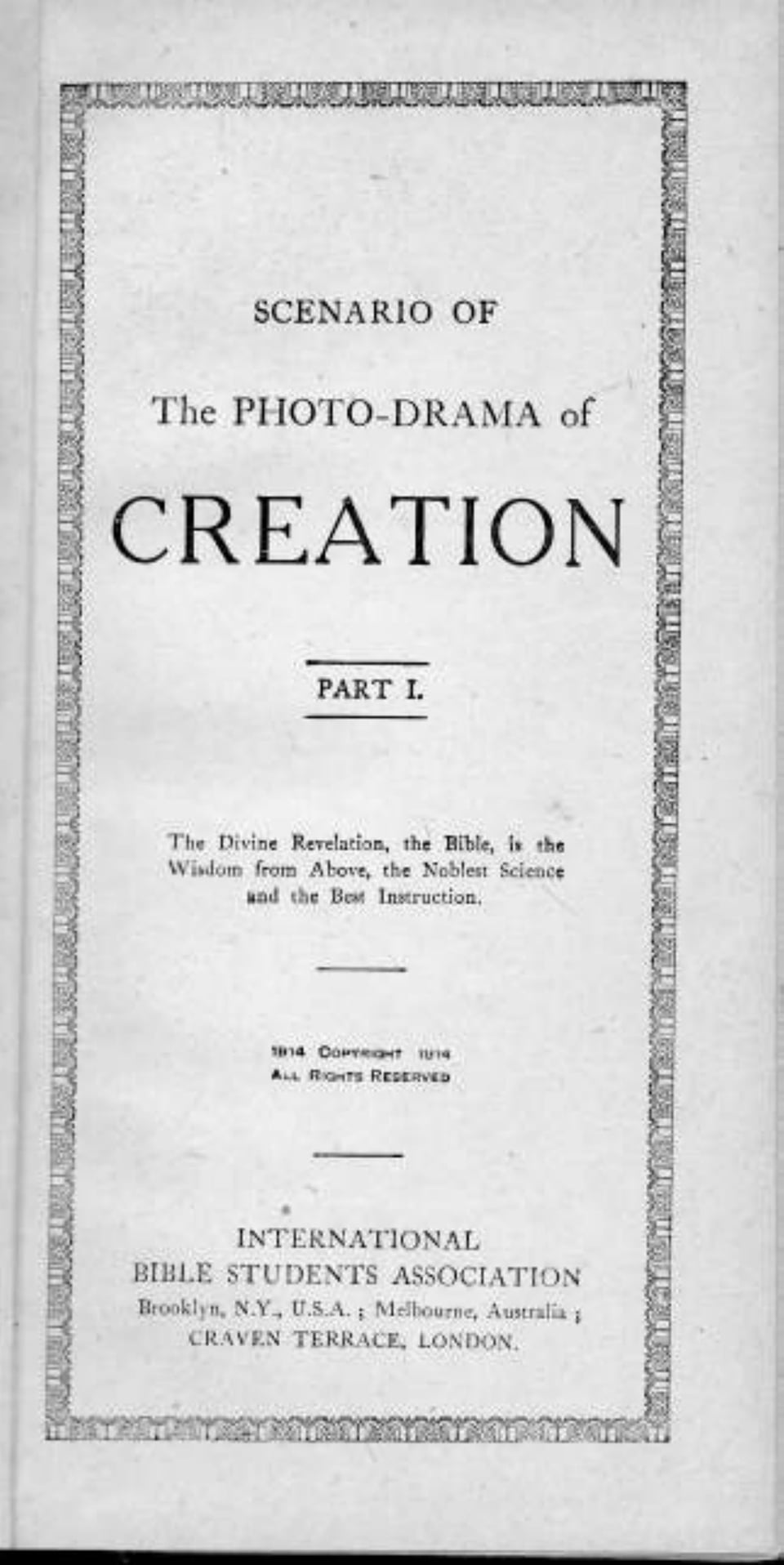
SCENARIO OF
The PHOTO-DRAMA of
CREATION
PART I.
The Divine Revelation, the Bible, is the Wisdom from Above, the Noblest Science and the Best Instruction.
1814 COPYRIGHT 1814
ALL RIGHTS RESERVED
INTERNATIONAL BIBLE STUDENTS ASSOCIATION Brooklyn, N.Y., U.S.A.; Melbourne, Australia; CRAVEN TERRACE, LONDON.
GOD'S GLORY IN THE HEAVENS
THE reverence of Jehovah is the beginning of wisdom." Only the foolish say in their heart, "There is no God." "Day unto day uttereth speech, and night unto night showeth knowledge." "The heavens declare the glory of God."—Paalma 111:10; 14:1; 19:1, 2.
An appreciation of the Infinite Power of the Creator and of our own littleness should make us teachable. The study of Creation is the "Key of Knowledge." Using this Key we begin to realize that the only worthy ambition is to co-operate with our Creator's beneficent designs respecting Ilia Creation. The planets of our System compared with our Sun are as nothing. Imagine the Sun's diameter that of a large flour barrel: Jupiter would compare as a small orange, Earth and Venus as peas, and Mercury and Mars as raspberry seeds.
This sun is one million three hundred thousand times the size of our Earth. A train at thirty miles an hour would require over a month to go round the Earth and more than nine years would be required for it to travel the circumference of the Sun.
Our day and night are the result of the Earth's rotation on its own axis, while its motion around the Sun marks our year. Planets nearer the Sun have shorter orbits, and hence, shorter years, while remote ones have longer years. A year on the planet Mercury would equal three of our months. On Neptune, farthest off, a year equals 164 of Earth's years.
Yet our Sun is only one of the fixed stars, of which the most up-to-date astronomical methods estimate there are one hundred and twenty-five millions. Around each of these fixed stars undoubtedly revolves a planetary System like our own. Thus reckoned, there are one thousand million worlds. Even this is not the limit. If we should stand upon the farthest and dimmest star, we should no doubt from there see as many more beyond. We are appalled at the greatness of the Universe.
The nodal signs illustrate various sections of the heavens, visible at different seasons.
GOD'S GLORY IN THE HEAVENS
THE reverence of Jehovah is the beginning of wisdom." Only the foolish say in their heart, "There is no God." "Day unto day uttereth speech, and night unto night showeth knowledge." "The heavens declare the glory of God."—Psalms 111:10; 14:1; 19:1, 2.
An appreciation of the Infinite Power of the Creator and of our own littleness should make us teachable. The study of Creation is the "Key of Knowledge." Using this Key we begin to realise that the only worthy ambition is to co-operate with our Creator's beneficent designs respecting Ilia Creation.
The planets of our System compared with our Sun are as nothing. Imagine the Sun's diameter that of a large flour barrel Jupiter would compare as a small orange, Earth and Venus as penns, and Mercury and Mars as raspberry seeds.
This sun is one million three hundred thousand times the size of our Earth. A train at thirty miles an hour would require over a month to go round the Earth and more than nine years would be required for it to travel the circumference of the Sun.
Our day and night are the result of the Earth's rotation on its own axis, while its motion around the Sun marks our year. Planets nearer the sun have shorter orbits, and hence, shorter years, while remote ones have longer years. A year on the planet Mercury would equal three of our months. On Neptune, farthest off, a year equals 164 of Earth's years.
Yet our Sun is only one of the fixed stars, of which the most up-to-date astronomical methods estimate there are one hundred and twenty-five millions. Around each of these fixed stars undoubtedly revolves a planetary System like our own. Thus reckoned, there are one thousand million worlds. Even this is not the limit. If we should stand upon the furthest and dimmest star, we should no doubt from there see as many more beyond. We are appalled at the greatness of the Universe.
The nodiacal signs illustrate various sections of the heavens, visible at different seasons.
THE FIRST DAY OR EPOCH
THE Genesis account tells nothing about the formation of the Earth itself. It says, "In the beginning the Earth was—without form and void"—shapeless.
empty. There were neither mountains nor valleys, trees nor shrubs, rivers nor oceans, but the Earth war. How long before that it had been created, is not stated. The account of the Days of Creation given in Genesis relates not to the construction of our globe, but to the ordering of it for human habitation.
There are various theories regarding its formation. We follow the one most closely harmonizing with the Bible. It is called the Vaillian theory. It assumes that Saturn's rings and Jupiter's belts illustrate Earth's development as a planet.
The Earth was once molten, as indicated by the igneous rocks of the Azole period: so called by scientists, but not discussed in the Bible. When the Earth was molten, its water and minerals were thrown off a great distance in gaseous form. As these cooled and took shape, they constituted great rings at a distance from the Earth.
Gradually the motion of the rings became different from that of the Earth in proportion to the distance from the center of gravity. These rings of water and mineral gradually approaching the Earth would be kept off by centrifugal force, particularly strong at the equator. The "brooding" of Holy Energy developed a light, probably resembling the Aurora Borealis-not sunlight. The Sun did not appear until the Fourth Day.
"Let there be light! and there was light." Thus, briefly, is summed up the result of the 7,000 years, styled the First Day. Not that God's Word would not have been sufficient for any miracle, but because He prefers to work out His glorious designs along natural lines.-Genesis 1:3.
There are scientists who claim that the Earth still has one ring about it, an electrical ring which, falling, will in a few years destroy fermentation, microbes and parasites, and greatly assist plant and animal life.
THE SECOND DAY OR EPOCH
THE expressions "evening and morning" and "day" cannot be understood to signify twenty-four-hour days, for neither Sun nor Moon was visible until the Fourth
The word "day" applies to any period, or Epoch, as for instance, the "Day of temptation in the wilderness"—forty years. (Psalm 95:8.) Note again, that we read of the "Day of Christ." evidently referring to the thousand-year Day in which Messiah is to be King over all the Earth. (Isaiah 2:11.) In the common affairs of life we use the word "day" similarly, when referring to Cæsar's day, Napoleon's day, etc.
We follow the theory that cuck of the Seven Days of the Creative Week was a period of seven thousand years. This, seven times seven thousand, equals forty-nine thousand (7 x 7,000=49,000) years, ushering in a grand Jubilee Epoch.
As one after another the encircling rings of water and minerals approached the Earth they would spread out like a great canopy, but would not be permitted to fall upon the Earth because of the circumambient air, referred to in Scripture as a "firmament." Saturn's rings have not yet fallen.
God made the firmament in the second, or Palæozoic Day and separated the waters which were under the firmament from the waters which were above the firmament. (Genesis 1:7.) The strongly mineralized waters above the Earth, held off by the "firmament" and centrifugal force, greatest at the equator, gradually concentrated at the two poles, where later they broke and then reached the Earth, forming layer after layer of mineralized earth deposited by the water which rushed from both poles toward the equator.-Genesis 7:11, 18.
These rings, or belts, of water and minerals followed each other as great deluges upon the Earth-perhaps thousands of years apart. The Deluge of Noah's day was the last, of pure water only, heavier minerals being attracted first. Hence minerals are generally under several layers of shale and soil.
THE THIRD DAY OR EPOCH
AND God said, Let the waters under the heaven be gathered together unto one place, and let the dry land of the Earth appear; and it was so. And God called the dry land earth; and the gathering together of the waters called He seas. And the evening and the morning were the Third Day."
The beautiful simplicity of this statement might mislead us into thinking that the gathering together of the oceans and the erection of mountains were works of magic. While Divine operations are all great and wonderful, they are usually accomplished by reasonable methods, called the "course of Nature." And Nature's course must be marked out by Nature's God,
The ring theory of Cosmogony is that several rings had precipitated themselves upon the Earth during this Third Epoch Day. These, according to the Divine intention, so increased the pressure on the crust of the Earth as to cause it to buckle or wrinkle. These depressions became ocean beds, and the upheavals became mountain ranges. Thus was the work of the Third Day accomplished. The waters were gathered into seas and oceans, the dry land was upheaved and began gradually to drain off in preparation for vegetation. This draining must have required a long time.-Genesis 1:9, 10.
We need not assume that all the continents as we now know them were thrown up on the Third Epoch-Day. In all probability the American continent was thrown up much later than were Europe, Asia and Africa. Earthquake disturbances in our day have changed the surface of the land. They give us a reasonable conception of how the Divine command was executed on the Third Day, preparatory to Earth's vegetation.
Appropriately we next read: "And the Earth brought forth grass, and herb yielding seed after his kind, and the tree yielding fruit." That is to say, vegetation begins on the Third, or Carboniferous Day, though it did not reach its perfection until after the light of the Sun penetrated. There are grasses and other vegetation which prosper best in darksome shades.
It is not necessary to suppose that the Sun and the Moon were created after our Earth. Instead there is a much more reasonable way of viewing the matter. The Sun, the Moon and the Stars were created long before, but had never, up to this time, cast their light upon the Earth because of the impenetrable veil which canopied it.
THE FOURTH DAY OR EPOCH
AND God made two great lights,the greater light to rule the day and the lesser light to rule the night."
The appearance of the Sun and the Moon on the Fourth Day implies that another ring broke at that time and precipitated its great mass of water and mineral upon the Earth. Great gullies were washed between the mountains.
It is supposed that the Earth still had considerable heat in its crust, that oceans were warm and highly carboniferous, and that the air was surcharged with carbon to the extent that no breathing animal could have existed. But those very conditions were extremely favorable to gigantic growths of vegetation.
The atmosphere, heavily charged with carbon, was very favorable to the development of plant life.
This giant vegetation presumably passed into a condition resembling that of the peat-beds of our day. These beds of incipient coal afterwards came under great pressure, as one after another the rings of Earth came down in deluges, burying vegetation under alimy deposits. Our coal-fields are the result.
We are not to assume that the Sun and the Moon shone on the earth then as now. But they were discernible even through heavy banks of fog and carbon-laden atmosphere. The influences of the Sun and the Moon were necessary to prepare for higher forms of plant and animal life.
We may as properly lay stress on the word rule as on the word made in this text. God caused the Sun to rule the day and the Moon to rule the night. Besides, symbolically, it is claimed that the Moon represents the Law Covenant rule, and the Sun the New Covenant rule.
THE FIFTH DAY OR EPOCH
THE carboniferous qualities of the water and the atmosphere having been absorbed into the cretaceous organisms of the sea, which formed beds of limestone, and into the rank vegetation which went to form the coal beds, the atmosphere of Earth began to be pure enough to permit life in breathing animals. To this period, therefore, belong the amphibious developments of animal life, such as the crocodile and other animals which can live either on land or in the water. Birds belong to this period, and in the latter part of it appeared the great Mammoth and the Sloth.
The conflict between Evolution and the Bible has been sharp. Nevertheless, unnecessary friction has been generated.
Only in respect to man does the Bible declare a special, direct creation of God. The statements of Genesis in respect to the lower creatures rather favor something along the lines of specialized Evolution. God said, "Let the waters bring foeth abundantly the moving creature that hath life, and fowl that may fly above the Earth." (Genesis 1:20, 21.) This is exactly in harmony with our scientific findings that the beginning of life came from the waters, and later extended to the birds, and later to land animals.
The Darwinian theory has disappointed those who swallowed it without a sufficiency of demonstration as to its truth. (1 Timothy 6:20.) Recent demonstrations show that every mixture of species and kind, even where partly successful, means a reversion to the original standards within the third or fourth generation in plants, flowers, fruits and in animals.
The correct thought would seem to be that under Divine supervision various orders of creation were brought to a state of development and a fixity of species, not to be turned aside nor thereafter altered. Not one suggestion is offered respecting human evolution from a lower creature; but quite the contrary. The Bible furnishes merely a basis for faith, "that the man of God may be thoroughly equipped."—a Timothy 3:17.
THE SIXTH DAY OR EPOCH
A S the carbon-laden atmosphere became more pure,vegetation became less rank. The animals changed correspondingly. The heavy-boned Sloth and Mammoth
The specialization in the case of man's creation is shown in his vast superiority over the lower animals. The first man Adam, was an image of his Creator, the highest type of fleshly or animal being. That image of his Creator consisted in his moral and intellectual likeness. It is difficult to judge from present human conditions all that is meant by God's image, because we have no sample of perfect humanity for comparison. "All have sinned and come short of the glory of God" in which Adam was created. (Psalm 8:5.) Sin and Death have reigned and the Godlikeness has been lost. All need Restitution.
It was toward the close of the Sixth Day, or approximately forty-two thousand years from the time of beginning the ordering of Earth, that God created Man.
The image of God from this standpoint would mean a human being thoroughly in tune with the Infinite One, one that would have no unrighteousness nor Iniquity in him. Adam's transgression was not the result of ignorance, nor of pure wilfulness. It was the result of temptation, which his limited knowledge accentuated. His responsibility was for the knowledge he possessed. He knew that he was disobeying God.
When thinking of man in the image of God, we instinctively look back to "The Man Christ Jesus," "holy, harmless, undefiled and separate from sinners," and like the first Adam, whose penalty He came into the world to meet.—1 Cor. 15:22.
"After Our likeness let him have dominion." Adam's dominion over the lower animals was like God's dominion over the Universe. Angels, although in God's image, do not have a Godlike dominion over creatures of a lower order. Man's dominion, overthrown by sin, is to be restored by Messiah's Kingdom.—Acts 3:19-21.
THE SEVENTH DAY OR EPOCH
IN this presentation, we are following a line of thought which seems to be growing in acceptance among Bible students. We are living in the Seventh Creative Epoch, or Day that began where the Sixth Day closed, after God had created Adam in His own image and likeness.-Genesis 1:26, 27.
God there rested from His work—from creating. He foreknew the permission of Sin and its dire effects upon humanity. He foreknew the steps He would take in providing ultimately a Redeemer for the race, and that the Redeemer would select a little company of believers, figuratively styled the Bride of Christ. To this Redeemer and His Bride, God intended to give the dominion, control of Earth. God purposed that Messiah's Kingdom of Righteousness should eventually uplift the willing and obedient from Sin and Death conditions.
God rested from His work of creating in that He did not actively employ His Power to overthrow Sin and uplift mankind. God rested the matter in the hands of the Redeemer, Jesus, to be accomplished through His sacrifice for sins and His glorious Reign for the release of mankind from Sin and Death. The Church, God's new creation of this rest period, is Heavenly, not earthly. 2 Corinthians 5:17; Hebrews 3:1; 4:1-4.
It is claimed that, according to the Bible chronology, six thousand years from Adam have already passed. If so, the thousand years of Messiah's Reign, which is to close the great Seventh Epoch-Day, is near at hand.
According to this beautiful theory, the work of Messiah in His thousand-year Reign soon to begin will complete the Creation. Not only will the race be brought to human perfection, but incidentally man will have obtained the needed experience in respect to good and evil. Meantime, also, the Earth will be gradually coming to a state of perfection—Paradise restored world-wide. Both human perfection and the perfection of the Earth were fittingly represented in Eden, when Adam was in his Maker's image—a King.
MOTHER EVE CREATED
AS the Creation of Adam was at the close of the Sixth Day, the Creation of Mother Eve is indicated as having been accomplished in the beginning of the Seventh Day. However we view the matter, the first pair were created approximately in the beginning of the Seventh Day or Epoch, which is now nearly completed. Mother Eve was merely a portion of Adam separated from him for a special purpose—for the propagation of a race. Adam possessed originally in his own person the qualities masculine and feminine which subsequently were divided between him and his wife, when she was taken from his side.—Genesis 2:21-23; 1 Corinthians 11:8.
Adam for a time was alone in Eden, finding no congenial companionship in the beasts and the birds. Mother Eve was his mate, bone of his bone and flesh of his flesh. Their very difference of quality and disposition made them the more companionable to each other, because each found in the other the desired complement. They twain were one; neither one was complete without the other. The feminine qualities of Adam's perfection he still possessed—in Mother Eve.
Adam was the father of the race and failed to give it life. Jesus is to become its second father, the Second Adam, through whom everlasting life may be attained.—1 Cor. 15:21.
Eve was associated with Adam in the sin and disobedience which brought the penalty. So the Elect Church, the Bride of Christ, when completed, glorified, will be His Joint-Heir in His Kingdom, and His associate in the "regeneration" of the world during His Messianic Reign.—Romans 8:17; Matthew 19:28.
Another suggestion has been offered: Jesus declared that those who attain to that resurrection will neither marry nor be given in marriage. As Adam originally possessed all the qualities of character, masculine and feminine, so humanity, when fully restored to the image and likeness of God, will re-attain perfection of individuality. Sex divisions will then be no more Earth will be filled with sufficient population. Luke 20:35, 36.
MOTHER EVE BEGUILED
THE New Testament bears out the story of Genesis, of Mother Eve's deception, and that Father Adam yielded to disobedience through her influence. St.Paul declares that Adam was not deceived, and that he therefore had the greater responsibility. The Scriptures everywhere portray that it is through Adam's disobedience that the condemnation passed upon him entire race. He was its responsible head. "By one man sin entered into the world, and death by sin, and so death passed upon all men."—Romans 5:12.
The Bible account tells of Mother Eve's thirst for knowledge, and of Satan's taking advantage of this, beguiling her into disobedience. We need not suppose that the serpent spoke audibly; rather, as we say, "Actions speak louder than words." It is probable that the serpent spoke in this manner.
God had authorized our first parents to freely eat of all the fruits of Paradise except of the species called "The Tree of the Knowledge of Good and Evil." It was forbidden for a time as a test of their loyalty. The eating of the fruit of this tree, they were forewarned, would bring upon them the curse—the Death Sentence. The serpent ate of various fruits, and seemed especially food of the forbidden fruit. Observation proved that the fruit did not kill the serpent, and the inference drawn by Mother Eve was that God had forbidden the use of the very best tree in Eden. Her conclusion was that God had a selfish motive in forbidding the use of that fruit; that He feared His creatures would become as wise as Himself.
Mother Eve did not broach these suspicions to her husband. She would eat, acquire the knowledge God was withholding and then assist Adam to it—Genesis 3:6.
Adam realized the seriousness of Eve's disobedience. He thought of the long days before he had her companionship. Now, he would be lonely again. In desperation Adam determined to join Eve in the Sin and its penalty. Adam's death was a slow suicide! His dying lasted 930 years.
EXPULSION FROM EDEN
THE Word of God must stand, whether it be the word promising Eternal Life or the sentence of Death. There is no variability with Him, neither shadow of turning. The curse, the Death Sentence, foretold by the Lord, was executed, but not instantly. Adam was not stricken lifeless with a thunderbolt. From the very beginning God foreknew all, and had planned the redemption of Adam, Eve and their children. To this end Jesus came and "died, the Just for the unjust." As a result ultimately the curse of death will be removed. "There shall be no more curse"—no more dying, sighing, or crying, nor any more pain.—Revelation 22:3; 21:4, 5.
All of us were told, and many of us believed fully, that the penalty of Father Adam's disobedience was eternal torture, in which all of his posterity must share, except a few—the saintly, the Elect. Told that this was the teaching of the Bible, we accepted without proof.—1 Thessalonians 5:21.
Now Christian people examine their Bibles more carefully. They find that the curse, or penalty for sin, is a totally different one. "The wages of sin is death." (Romans 6:23.) "The soul that sinneth it shall die." This penalty of death has rested against Adam and his family for six thousand years. It has brought sorrow, sighing, pain and trouble; it has brighted our lives mentally, morally and physically.—Romans 5:12.
It is this curse of death that was pronounced against Father Adam, according to the Genesis account, and also according to the New Testament. "Accursed is the earth for thy sake; thorns and thistles shall it bring forth unto thee. In the sweat of thy face shalt thou eat bread until thou return unto the ground from whence thou wast taken, for dust thou art and unto dust shalt thou return." It is from this curse that Jesus redeemed us by dying, the Just for the unjust. It is from this death-curse that Messiah rescues all by a resurrection from the dead. "By man came death, by man also the resurrection of the dead."—1 Corinthians 15:21.
PRIDE—JEALOUSY—ANGER—MURDER
NO children were born to Adam and Eve in Eden. They labored with sweat of face for quite a time before their first-born came. Doubtless he was birth-marked with a jealous, unhappy disposition. Toil conducted to fretfulness in those who knew a happier lot in Eden. Fault-finding with each other, resentment against the Creator, discontent with their lot, probably marked their offspring—Cain. The world has since been under a "reign of Sin and Death."
Daughters also were born to them, and later another son, Abel, of a very different disposition from their first-born. The experience of life may have mellowed their hearts. They remembered an intimation of hope connected with their sentence; namely, that the Seed of the woman should bruise the serpent's head. Abel's disposition indicates that he had a contrite heart, and desired to please God. It parents realized to what extent mental conditions affect their offspring, all would strive to bestow favorable birth-traits on their children.
Years passed. Cain and Abel were inspired by the promise respecting the Seed of the woman, and the hope for recovery by Divine favor. They approached the Lord with offerings to receive a blessing. Abel's sacrifice of animal life God accepted, because it typified the necessity for Jesus' death as the basis for forgiveness of sin. God's rejection of Cain's offering teaches that without shedding of blood there can be no remission of sins. Cain should have procured an animal for acceptable sacrifice, in obedience to the Divine will. Instead, he allowed anger, malice, hatred, and strife to burn in his heart, and became a murderer.—Genesis 4:5-8.
3t. Paul says that Abel's blood cried to God for justice against Cain. But Jesus' blood cried to God for mercy on the sinner. Every injustice cries to God for justice. By a special covenant, Jesus and His Elect Church lay down their lives sacrificially for Adam and his race. (Romans 12:1.) The "better sacrifices" completed, Restitution follows.
ABEL THE FIRST MARTYR
THE word "martyr" signifies wilness, and is particularly used in reference to those who witness to the Lord's cause faithfully, at the cost of suffering or death. Abel has the distinction of being God's first martyr. It is very remarkable that nearly all the martyrs have suffered at the hands of "brethren." Thus Jesus and the Apostles received their persecution chiefly from Jewish brethren, sharers of the same blessed hopes and promises. (John 16:2, 3.) How strange that it should be thus!
Similarly, during this Gospel Age, Christians have suffered martyrdom at the hands of fellow Christians. Thus the Scriptures foretold, saying, "Your brethren that hated you and that cast you out, said, 'The Lord be glorified. But He shall appear to your joy, and they shall be ashamed.' Every martyr, in proportion to his faithfulness, will ultimately receive a crown of life, while all persecutors will ultimately be ashamed.
The reign of Sin and Death continued for four thousand years before God sent His Son into the world to be its Redeemer and Deliverer. The Redeemer will set it free from bondage to Sin and Death, but He could not do so unless first He paid the death penalty—dying, the Just for the unjust. During those four thousand years vague promises were given from time to time. But no start was made to fulfil them until Jesus appeared. Even those vague promises were confined to the Jewish nation. Outside nations, the Gentiles, received no promises of relationship to God. They were condemned sinners, and no hopes were held out to them. As St. Paul says, they were without hope—"being aliens from the commonwealth of Israel, and strangers from the covenants of promise, having no hope, and without God in the world."—Ephesians 2:12.
For six thousand years, according to St. Paul, we have had a reign of Sin and Death. Christians are still praying for the blessed Day of Messiah, for Satan's binding. Then blessings will displace sin, sorrow and death.—Revelation 21:4.
DEATH LEADS ALL TO SHEOL
THE first death in Adam's family must have cast a great shadow. The hope centered in the Divine promise that the Seed of the woman should bruise the serpent's head was temporarily snuffed out. Shortly after, Seth was born. His name indicates that his parents hoped that he would be the man promised of the Lord—not seeing that the promised One would be the Messiahs, who would come long afterward, and for whose work the world still waits.
It is undoubtedly fortunate for our fallen race that we cannot appreciate deeply the sorrows and difficulties of others. Each individual, each family, has about as large a share of sorrow as it can properly bear. Indeed, the poet, realizing the folly of unrestrained grief, has well sung,
A1 present the population of the world consists of sixteen hundred millions, ninety thousand dying every day.
"Go bury thy sorrow. The world has its share Go bury it deeply. Go hide it with care."
Although we speak of this as the first death, we must not forget that from the Divine standpoint Adam and his race were already dead, in that nose can regain everlasting life except through the Redeemer's work of Sin-Atonement.
Hope, joy and peace come to us through the Divine promise that the time is coming when there shall be no more sorrow or dying, no more sin or pain. For Messiah's Kingdom shall conquer Sin and Death and cause God's will to be done on Earth as fully as it is now done in Heaven.—Matthew 6:9, 10.
Our experiences with Sin and its penalty should make us all sympathetic. We should do nothing to add to the sorrow of others, but everything to relieve. The words of Jesus touch this chord of sympathy, "Come unto Me, all ye that labor and are heavy laden, and I will give you rest." There is no rest for the weary of heart except in union with Christ.
SONS OF GOD, DAUGHTERS OF MEN
LONG before man's creation, angels were created, yet sin was unknown until Adam's day. The beginning of sin, according to the Bible, was in the Garden of Eden. Lucifer, an angel of very high rank, had long cherished in his heart ambitious designs. If opportunity ever offered he would show God and the angels his grand schemes. His thought is expressed by the Prophet: "I would ascend above the stars [angels]. I would be as the Most High"—an Emperor. When Lucifer behold the first human pair, he was tempted to try his experiment. They were a new order of beings in God's moral image. They had procreative powers, which no angel possessed. Their offspring filling the Earth would be his subjects, through whom he would work out his ambitious schemes. Thus Lucifer became Sutzen—God's opponent—Isaiah 14:12-14.
All the holy angels were bewildered. His was the first rebellion against the Almighty's laws. No punishment followed, and the angels queried whether or not God was able to enforce His laws. Centuries rolled on; the human family was wasting; God's penalty, "Dying, thou shalt die," was gradually being enforced. Satan realized that his kingdom of dying subjects would make but a poor showing ever. He conceived a plan to outwit God and develop a new order of beings—hybridized humans, infused with superior vitality.
The angels possessed a God-given power of materialization. They could appear in human bodies resembling those of men. The Bible attests this. (Genesis 18.) The angels were permitted contact with the fallen race to prove whether they could bring mankind back to God.-Hebrews 2:5.
The record of Genesis 6:2-5 is that the "sons of God saw that the daughters of men were fair, and they took unto themselves wives of all they preferred." Thus the angels became the fathers of a new race, distinct from Adam's. The record is that these were giants, physically and intellectually—"men of renown," who filled the Earth with violence.
WHILE THE ARK WAS PREPARING
THE disloyal course of the angels apparently continued for centuries without any outward manifestation of God's ability to check them. Thus all the holy angels were tested, and all who chose "were disobedient in the days of Noah."—1 Peter 3:20.
Noah's family was singled out as exceptional, in the statement, "Now Noah was perfect in his generation"—implying that few or no others were perfectly generated—of pure Adamic stock. (Genesis 6:9.) Noah's family, therefore, included all the uncontaminated—only eight persons. They, by Divine command, built the Ark, and thus witnessed to the world the Divine intention respecting a Deluge.
Noah's message respecting a Divine judgment by a Deluge seemed ridiculous. Until the Deluge there was no rain. The last of the great "rings" which then flooded the Earth was of pure water. For centuries it was spread out over the firmament. The whole Earth was a great hothouse. There were practically no changes of seasons, nor storms, because the great water canopy preserved it in perpetual Summer. Of that period we read: "For as yet there was no rain on the Earth." (Genesis 2:5.) Noah, the preacher of righteousness, was mocked and considered a fool because of his faith in God's Word, just as others of the Lord's people at various times have been mocked by those who lacked faith, and are yet mocked.
Finally, the Deluge came. "The fountains of the great deep [canopy] were broken up." The breaking of the canopy precipitated millions of tons of water at both poles, forming two great tidal waves, covering the Earth for a great depth, deepening the ocean beds, and throwing up additional mountains.
The cradle of the world is supposed to have been in Armenia. Geology tells us that the land of that vicinity was at one time a quiet settling pond, as evidenced by heavy alluvial deposits. In this vicinity the Ark floated, and by Divine protection landed on Mt. Ararat its precious freight for the world's new start.
NEPHILIM DESTROYED
THE account of the fall of the angels from being sons of God to be demons helps us to understand why God decreed the Deluge to wipe out all of the human race except Noah and his family. We perceive that God from the first intended to deal only with Adam and his family. The giant sons of the fallen angels (Nephillim) came into being contrary to the Divine will; hence, properly, no provision was to be made for them. They never had a right to life, nor will they have a resurrection. On the other hand, all of Adam's posterity, redeemed by Jesus' death, must be recovered from death, with full opportunity to secure everlasting life.
After the Deluge, the demon angels dematerialized—resumed their spirit conditions. St. Peter and St. Jude reveal the penalty inflicted upon them. "Those angels which kept not their first estate, but left their own habitation [spirit condition]. God restrained under chains [restraints] of darkness, unto the Judgment of the Great Day."—2 Peter 2:4; Jude 6.
The liberties of the fallen angels—demons—were restrained. They are unable to use deceptions in the light—unable to materialize as formerly. Note, however, that the limitation "unto" implies that when the "great Day of Wrath" shall come, these fallen angels will be permitted to materialize and become potent factors in the strife. Other Scriptures indicate that these fallen angels will have much to do with the great "time of trouble" with which this Age will close, and in which Messiah's Kingdom will be inaugurated.
These fallen angels were cast to ariaras—our Earth's atmosphere. Satan, a cherub-angel of higher rank, is styled the Prince of Demons. They are not in some far-off place stoking fires, but keep as close to humanity as possible. Not permitted to materialize, they seek to obess, to demonize by clairvoyance and clairaudience. Mankind would properly resent them if their true character were known. They therefore personate the dead, communicating through spirit-mediums.
THE END OF THAT AGE
IN the Scriptures, the expression "End of the World" is frequently used. St. Peter tells us that the world came to an end in the Deluge. It was not the Earth which came to an end; merely that order or condition of things which prevailed prior to the Deluge ceased there. A new world, a new order of things, was there ushered in. This is in strict accordance with the proper translation of the Greek. The common translation unfortunately has deceived many. We would better read "End of the Age"—not End of the World.
Ages may end and be succeeded by other ages, but the Bible declares that "the Earth abideth forever;" that "God formed it not in vain; He formed it to be inhabited." It has never been thoroughly habitable, nor has it ever been inhabited, in the proper sense of the term. The work of Messiah's Kingdom will be to make God's footstool glorious, and fit for those restored to His favor. His further work will be to uplift man and restore him to all that was lost in Eden and redeemed at Calvary. He will destroy only the incorrigible.
In the new order of things started by Noah and his family, God allowed humanity to have its way and to work out its own schemes without Divine interference, except in extreme cases. He allowed the world to learn lessons, while He carried out His own great Plan, of which Redemption is the center, and Messiah's Kingdom the circumference, for the recovery of mankind from their fallen estate.—Romans 5:12-14.
The development of God's Plan has been long from the human standpoint, but not so from the Divine, for we read: "A thousand years in Thy sight are but as yesterday;" and again, "A day with the Lord is as a thousand years." During six of these thousand-year Days, in which He rests or desists from interfering with the world's affairs, God has permitted a reign of Evil, but His arrangements are complete whereby Messiah, the Redeemer, will fully restore all the willing and obedient to all that Adam forfeited.—Acta 3:19-22.
MASTODON IMBEDDED IN ICE
WHEN Noah and his family came out of the Ark, they acknowledged God by offering to Him a sacrifice, and God pledged the Rainbow as a sign that He would never again destroy mankind by a flood of waters. A rainbow was never seen before that time, for the reason given in the Bible; there had been no rain. Furthermore, the Sun's ray did not directly strike the Earth, but merely through the canopy, with much the same effect as that of a hothouse.
Many changes were brought about by the removal of the canopy—rains, floods, droughts, thunder-storms, tornadoes, extremes of heat and cold. These things were impossible under the canopy. Noah's intoxication is accounted for along these lines. The juice of the grape had not previously fermented. Hence Noah could not have known of its intoxicating effect.
With the collapse of the watery envelope, came the extreme heat of the tropics and the extreme cold of the polar regions before the ocean currents modified them.
The change must have been almost instantaneous. We have proofs of this. In northern Siberia an antelope was found imbedded in ice. It had green grass in its stomach, which proved that its death occurred suddenly while it was feeding. Similarly, a mastodon was found imbedded in ice with food between its teeth. Thus is demonstrated that the poles were once as equable as the temperate zone, and that in a moment came such a change as could be brought about only by the breaking of the canopy. The great glaciers and heavy ice of the Arctic regions, formed thus suddenly, have existed for centuries. The water did not all congeal into ice, but like a tidal wave carried great glaciers and boulders across the North American continent, and Northwestern Europe, as scientists have clearly traced. They cut through hills with such force that they have left their mark for all time. Equatorial currents, the Gulf Stream and the Japan Stream have since thawed out much of the polar ice.
DEMIGODS OF GREECE AND EGYPT
LONG have the learned wondered what foundation Greek Mythology might have had. Now, taking heed to the sure Word of God, we perceive that the angels who materialized before the Flood were the gods of Mythology while their offspring, the giants, were the demigods. The suggestion may well start a flood of reflection in thinking minds.
Egyptologists have been astonished by their findings in the tombs of the Pharaohs. In some of these, historic tablets have been found, tracing the ancestry of the Pharaohs apparently back to Creation—the first Pharaoh—Adzm. But these tablets show so many more generations than the Bible record that Egyptologists lose all faith in the Genesis account. They become Higher Critics, discount the Bible record and pin their faith to the Egyptian tablets. They confess, however, that these tablets vary, and more or less contradict each other. Concededly, the most accurate is THE ABYDOS TABLET, found in the sepulchre of Seti I.—probably the Pharaoh who made Joseph his Prime Minister and who is supposed to have died about 120 years before Moses was born.
The chief fault found with this Tablet is that it is not so lengthy as some of the others. Nevertheless, Pharaoh, Seti I., preserved this Tablet for us with great care. He sank a shaft sixty feet deep through solid rock. At that level his masons cut out the stone staircase on which THE ABYDOS TABLET is portrayed. An exact copy of it is to be found in the British Museum. At considerable expense and with difficulty we have secured the photograph of it, which we here present. Our object is to show that this best of Egyptian records fully corroborates the Genesis account.
This list of Pharaohs is shorter than the others because it omits the names of gods and demigods. It is the complete Egyptian record of the purely human line of rulers back to Adam. Furthermore, these emissions occur at the appropriate place-at the time of the Deluge.
ADAM (MENA) WAS PHARAOH I.
THE Abydos TABLET fully agrees with Genesis and is often corroborated by the Greek and Egyptian historians, Herodotus and Manetho. It shows Adam as the first Pharaoh, and Noah the twentieth, while the intermediate eighteen correspond with Genesis with remarkable accuracy. Mena's wife was Shesh—Hebrew, Isha—woman. Her first son was Pharaoh II.—Greek, Tetu-Khent—guilty one; Hebrew, Kanighi; Latin, Athos; English, Cain. The tablet for Abel represents him as the non-resistant one.
THE ABYDOS TABLET shows the same order as Moses (Genesis 4-6), giving first the line of Cain down to Jabal, who was Kakan. At that time, evidently, the gods and demigods began to fill the Earth with violence. Seti's list omits the names of these. All demigods were destroyed in the Deluge. Noah is next in order with a regal title. But since he was not of Cain's family, THE ABYDOS TABLET there goes back, mentions Abel and Seth, and Seth's line just as given in Genesis (untitled). down to Noah. These all, as Pharaohs, have their royal ovals, but no supertitle. After Noah (Nofru), Pharaoh XX., the line runs through his son Ham (Chamu Chufu). Appropriately Noah's other sons are ignored; for Shem and Japheth went to Asia and Europe, while only Ham went to Egypt.
Thus wonderfully is the Bible being vindicated by the very inscriptions once supposed to contradict it.
Moses was "learned in all the wisdom of the Egyptians." Besides this, he was Jebovah's Prophet, and so certified by Jesus. Although Moses lived two thousand years after Adam, history connected up very close to his time, see diagram.
<tr><th rowspan="2">Adams
Methuselab
Islae
Amurus
Skens
Leon
Maica
Lines drawn to scale, showing overlapping of Adam's 930 years, Mathuselah's 969, Sham's 600, Isaac's 180, Levi's 137, Amram's 137 and Moses' 130. The overlapping periods were respectively 243 years, 48 years, 50 years, 40 years, 58 years and 31 years.
THE TOWER OF BABEL
YEARS after the Deluge, the world began to be populous. The narrative handed down by Noah and his sons was more or less forgotten, and the bow of promise lost much of its significance. Losing confidence in God, the people began the construction of the Tower of Babel, which was to save them in spite of God from any flood of water of the future. Alas, how short-sighted, like others who possess much worldly wisdom! The Scriptures deprecate such lack of faith among Christians, and attempts to protect themselves and their earthly interests, leaving God and His Plan out of their calculations. Some today ignore God after this manner, saying, Trust not in the Lord for the things promised. If you wait for God to do for you, nothing will ever be done. In other words, we are living in a day when faith in the Divine will and in the Divine Plan and promises seems to be on the wane.
God settled the matter by confounding the language and scattering the people so that they could not co-operate in further foolish undertakings. The Bible refers to this, saying, "He hath determined the times before appointed, and the sounds of their habitation; that they should seek the Lord, if haply they might feel after Him, and find Him."
The diversity of languages is one of the most remarkable things in the world-an effectual harrier to prevent mankind from combining for the accomplishment of their own purposes, selfish or sinful. It has delayed the great Day of Wrath.
Now the language barriers are breaking down, and we find the tendency of humanity to re-unite. Unions and Trusts are being built by the Rich and the Poor—each for self-protection. The rule of kings and princes is threatened by the growth of common language and intelligence in the masses. Had these barriers been removed two thousand years ago, similar results would have come too soon, according to the Divine purpose which is shaping Earth's affairs in preparation for Messiah's Kingdom, which will bless the entire human family.
ABRAHAM GOD'S FRIEND
A BRAHAM became the friend of God by his manifestation of faith, when in response to God's invitation he left his own country and wandered in Canaan. By this obedience he became heir of the Promise, "In thee and in thy Seed shall all the families of the Earth be blessed." St. Paul explains (Galatians 4:23, 24) that Abraham's wife represented this Covenant, or Promise. Sarah's barrenness corresponded to the long-deferred coming of Christ in fulfilment of the Promise. Isaac typified Messiah, the Heit of the Promise. Isaac's bride, Rebecca, typified the Elect Church, the Bride of Christ and His joint-heir in the Promise.
St. Paul says that Hagar typified the Law Covenant made with Israel at Mt. Sinai, and that the nation of Israel was typified in Ishmael. (Galatians 4:25.) As Hagar and Ishmael were cast off when Isaac was born, and had almost perished, so the Jewish people have been cast off from Divine favor for eighteen centuries, and today are nearly famished. As the angel of God pointed to the fountain of water, and Ishmael was revived, so God's message now is pointing the Jews to a spring of water; their Zionistic hopes are reviving.
The sacrifice of Isaac typified the sacrifice of Christ, necessary in order for Him to become the Spiritual Seed of Abraham with power to bless the world.
The servant sent to call Rebecca, the bride of Isaac, is beautifully explained to represent the work of the Holy Spirit in calling the Church to become the Bride of Christ and His associate in the great work of blessing Israel and all the families of the Earth.—Acts 3:19-26.
Rebecca's return with Eliezer represents the Church's journey during this Gospel Age to meet Christ, the Bridegroom who will receive her at His Second Advent. Abraham typified Jehovah God, through whose promise the blessing of all the families of Earth will come. This promise has been the hope of Israel for thirty-five centuries;—Galatians 3:29.
THE DESTRUCTION OF SODOM
THE Sodomites possessed a very rich valley and comparatively avoided that feature of the curse declaring that bread must be won by sweat of face. These conditions
God saw good to make the destruction of the Sodomites an example of the fate of sinners—death, not everlasting turture, St. Jude says. Jesus declares, "Fire came down from God out of heaven and destroyed them all."—Luke 17:29.
were conducive to the selfishness and sin which the Bible charges—"pride, fulness of bread and abundance of idleness; neither did she strengthen the hand of the poor and the needy; and they committed abominations; therefore I took them away as I saw good."—Ezekiel 16:49, 50.
But the Bible teaches that the Sodomites are not hopelessly destroyed—that God's mercy through Christ includes the Sodomites, sinners though they were. Jesus Himself, as well as the Prophet Ezekiel, declares that at His Second Coming in His Messianic Kingdom He will give a trial, or judgment, to the world in general, to all who do not have an opportunity in the present life. The Sodomites will then have opportunity to hear of God's grace, to accept and rejoice in it.
Jesus declared that in that glorious Epoch the condition of the Sodomites will be more tolerable than that of the people to whom He preached at His First Advent. The reason for this He explains, saying that if the Sodomites had been granted the same opportunity afforded the people of Chorazin, Bethsaida and Capernaum, they would have repented in sackcloth and ashes; wherefore, in the future testing time, "it will be more tolerable for them" than for people who heard and rejected the Message.—Matthew 10:15; 11:21-24.
Ezekiel's prophecy (16:49-61) is most explicit. It declares Restitution and blessing for Israel, and incidentally mentions that the Sodomites will receive favor from God at the same time—under the New Covenant, under Messiah'a Kingdom.
"There's a wideness in God's mercy, like the wideness of the sea."
SCENARIO OF
The PHOTO-DRAMA of
CREATION
The Divine Revelation, the Bible, is the Wisdom from Above, the Noblest Science and the Best Instruction.
PART II.
1814 COPYRIGHT 1814
ALL RIGHTS RESERVED
INTERNATIONAL BIBLE STUDENTS ASSOCIATION Brooklyn, N.Y., U.S.A.; Melbourne, Australia; CRAVEN TERRACE, LONDON.
MELCHISEDEC, PRIEST AND KING
MELCHISEDEC was a priest of God, and at the same time King of Salem (peace). Abraham acknowledged him and paid him tithes. God prophetically declared through the Psalmanist, that Messiah would be a Priest of the Melchisedec order, forever.—Psalm 110:4.
The Jews overlooked this prophecy and thought that everything of a priestly character in connection with God's Plan would be fulfilled through the Aarunic priesthood, which was merely typical. Their expectancy of the Messianic Kingdom and glory blinded them to His work as a sin-atoning Priest.
They saw not that Messiah is to be one of many members. Jesus is the Head and the Elect Church the Body of the Melchisedec Priest. Christians are deeply interested in the Messianic Reign; also in the fact that to become members of that Royal Priesthood means a participation with Jesus in the sacrifice of earthly life, as St. Paul exhorts, in Romans 12:1.
The declaration that Melchisedec was without father or mother, without beginning of days or end of years, has puzzled Bible students until recently. The interpretation is now quite satisfactory and simple: Melchisedec was without father or mother in the priesthood. He did not inherit this priesthood. He was without beginning of days and years in respect to his office, in that no record was made when his priesthood began, nor any provision made for a successor. In these respects he typified Messiah.—Hebrews 7:2-4.
Melchisedec is supposed to have been one of the Shepherd Kings who invaded Egypt and built the Great Pyramid, covering twelve acres, known for ages as one of the Seven Wonders of the world--about 2170 B. C. Astronomers tell that its measurements indicate the length of the year, the weight of the Earth, the distance to the sun, etc. Its interior passages represent human history-Downward, the course of sin and death; Upward, the Law Age, the Gospel Age, the Kingdom glory of the Church, and Human Restitution.
JOB'S ADVERSITY AND RESTITUTION
THE story of Job, Prophet of Uz, a contemporary of Abraham and Melchisedec, is full of interest to Bible students. Not only the facts, but their typical significance, interest us, when we learn that Job's experiences represented the fall and rising again of humanity.
Job was wealthy, honored and prosperous. Suddenly disaster came upon him. A bolt of lightning struck the house where his sons and daughters were having a birthday party. They were all killed. Then he lost his sheep, asses, goats, camels and herds. Under the stress, he lost his health and broke out with boils from head to foot. Next he lost his friends, who declared that all this meant his utter repudiation by God. Finally, his wife turned against him and said, "You are cursed of God; I wish you would die!" Poor Job wished the same and prayed, "O that Thou wouldst hide me in Sheol [the tomb] until Thy wrath be past; that Thou wouldst appoint me a set time and [in resurrection] remember me." (Job 14:13.) Messiah will fulfil this prophecy.
All of this loss of health, strength, friends and wealth taught Job valuable lessons. Similarly, poor humanity is learning important lessons of its need of Divine care.
Under God's providence Job was restored to prosperity, health, etc. He got back just as many children, twice as many oxen, sheep, camels and asses. Bible students tell us that it ultimately will be so with humanity, according to the Bible; that the curse of sin and death will be removed—that instead the blessing of God will flow down upon the human family for a thousand years, giving back life to all who have gone down into death, and multiplying the blessings of the Earth more than double. This lesson is further illustrated in Israel's Jubilee Year, when all debts were canceled and the people returned to their original possessions. (Leviticus 25:13.) This typed the period referred to as the "Times of Restitution."—Acts 3:19-23.
SEEKING A BRIDE FOR ISAAC
BIBLE students seem well agreed that Isaac represents Christ. As Abraham gave his son Isaac, in whom centered the promises, to be sacrificed, so the Heavenly Father gave His Son, Jesus, to be the Sin-Offering for Adam and his race, and received Him again from the dead, as Abraham figuratively received Isaac.-Hebrews 11:17-19.
Isaac's bride, Rebecca, typified the Church of Christ, which is to become His Bride in the resurrection, at His Second Coming. The correspondencies are remarkable. If Isaac represented Jesus, then Abraham would represent the Heavenly Father, and Elsexer, the servant, sent to get the bride, would typify the work of the Holy Spirit, the Spirit of Truth.
The custom in olden times respecting marriage differed from the custom of our day. God evidently arranged that Jewish customs should illustrate spiritual things. Thus, instead of Isaac's seeking a bride, Abraham sought a bride for him, sending by Eliezer. Thus the picture is complete, as Jesus declared, "No man can come unto Me except the Father which hath sent Me draw him"—invite him—John 6:44.
As Rebecca was found with the sheep, watering them, so those called to be the Bride of Christ are usually found, not in fellowship with wolves, but with the Lord's sheep. Moreover, Rebecca and the sheep were found at the well, symbolically representing the desire of the Little Flock class for the Water of Life—the well representing the Bible.
Rebecca was found serving water to the flock, representing well those whom Jesus would select for His Bride class. He is seeking, not for those who would lord it over the sheep, but those who feed, refresh and serve them.
The blessing upon Rebecca was, "Be thou the mother of thousands of millions." (Genesis 24:60.) To some Bible students this implies that the Church of Christ will mother in regeneration the millions of Adam's race, as the glorified Redeemer will be their "Everlasting Father."—Isaiah 9:6.
JACOB'S LADDER DREAM
WHATEVER uninspired writers have said in condemnation of Jacob, the inspired writers of the Bible say nothing in special condemnation, but much in his praise. His faith was specially commended.
Jacob was the acknowledged heir of the great Covenant God made with his grandfather Abraham. This promise was considered so important, and faith in it so necessary, that God subsequently confirmed it by His oath. Divine Wisdom indicated beforehand that the blessing would not come through Ishmael, but through Isaac.—Genesis 21:12.
St. Paul states that this Divine decision was made before either Jacob or Esau had done anything bearing upon the choice. God simply foreordained that the blessing should come through Abraham, Isaac, Jacob, and later through Jacob's family, the children of Israel.—Romans 9:11, 12.
Esau loved pleasure and sport. Jacob, his twin brother, born a moment later, loved the Abrahamic Promise, and counted all earthly possessions as nothing in comparison to the gaining of that prize. Both men were hungry one day; Jacob had prepared himself a feast, but instead of giving one half to his brother, he offered him the whole of it in exchange for his inheritance in the Promise made to Abraham. Esau gladly accepted, esteeming the food more precious than a promise which seemed likely never to be fulfilled.—Genesis 25:32-34.
Jacob's mother, knowing Esau's lack of character, concluded that Jacob, having purchased the birthright, might properly impersonate Esau and obtain the blessing. She knew that it would mean to him loss of home and risk of life. Fleeing from home Jacob lay down at night by the way, and had the dream of a ladder reaching from his headstone clear up to Heaven, with angels ascending and descending. The dream represented the fulfilment of the Abrahamic Covenant, in which Jacob was deeply interested, the reestablishment of peace and fellowship between Heaven and Earth.
JOSEPH'S COAT IDENTIFIED
JACOB had become a patriarch, the father of twelve sons, the younger two of whom were Joseph and Benjamin.
JACOB had become a partisan, the father of twelve sons, the younger two of whom were Joseph and Benjamin. The elder ten kept the flocks. Joseph went to them as his father's messenger to learn of their welfare, and to take them delicacies. His brethren hated him through jealousy, sold him into slavery in Egypt, and took his elegant coat of many colors, bedraggled it in the blood of a kid and the dust and brought it to their father. Jacob identified it as Joseph's; and heart-broken he cried bitterly, "I will mourn for my son Joseph until I join him in Sheol." (Genesis 37:33.) Sheol is the Hebrew word for tomb.
This is the first use of the word Sheol in the Bible. Sheol is the only word translated hell in the Old Testament, Common Version. All scholars now admit it really signifies the tomb, the death-state. Jacob did not think of his beloved son as having gone to a Sheol of eternal torture, nor did he have the thought of joining him there. Jacob knew of no such place as Dante and others describe.
The explanation is simple. In old English literature the words "hell," "grave" and "pit" were used interchangeably, as in the translation of the Old Testament. Sheol is translated grane and pit more times than it is translated hell in our Common Version. Its equivalent in New Testament Greek is Hades, also signifying the tomb, the grave, as all scholars agree. Jesus was in Hades, Sheol, but was raised the third day by Divine Power, from the tomb, the death condition.
The translators of the Revised Version Bible refused to translate these words, Sheol and Hades, by our English word Hell, because the gradual change of language has attached a totally different meaning from what it originally had—the grave. See marginal readings of Psalms 55:15; 86:13.
The learned translators, however, could not agree to render these words grave and tomb, and left them untranslated. Compare versions and margin of Isaiah 14:9, 11.
JOSEPH HONORED BY PHARAOH
JOSEPH, sold into slavery in Egypt, was under Divine supervision. His trials and difficulties worked for his development and faith. God ultimately honored him in Egypt with a position second only to Pharaoh. In harmony with his dream, there were seven years of plenty, and then seven years of drought and famine. Acting under the guidance of his dream, as the king's agent, Joseph stored up wheat enough in the first seven years to carry the people over the famine. Thus Joseph was their savior—life-giver.
…