Russell-White Debate (1912 edition)
Download: PDF — Russell-White Debate (1912 edition)
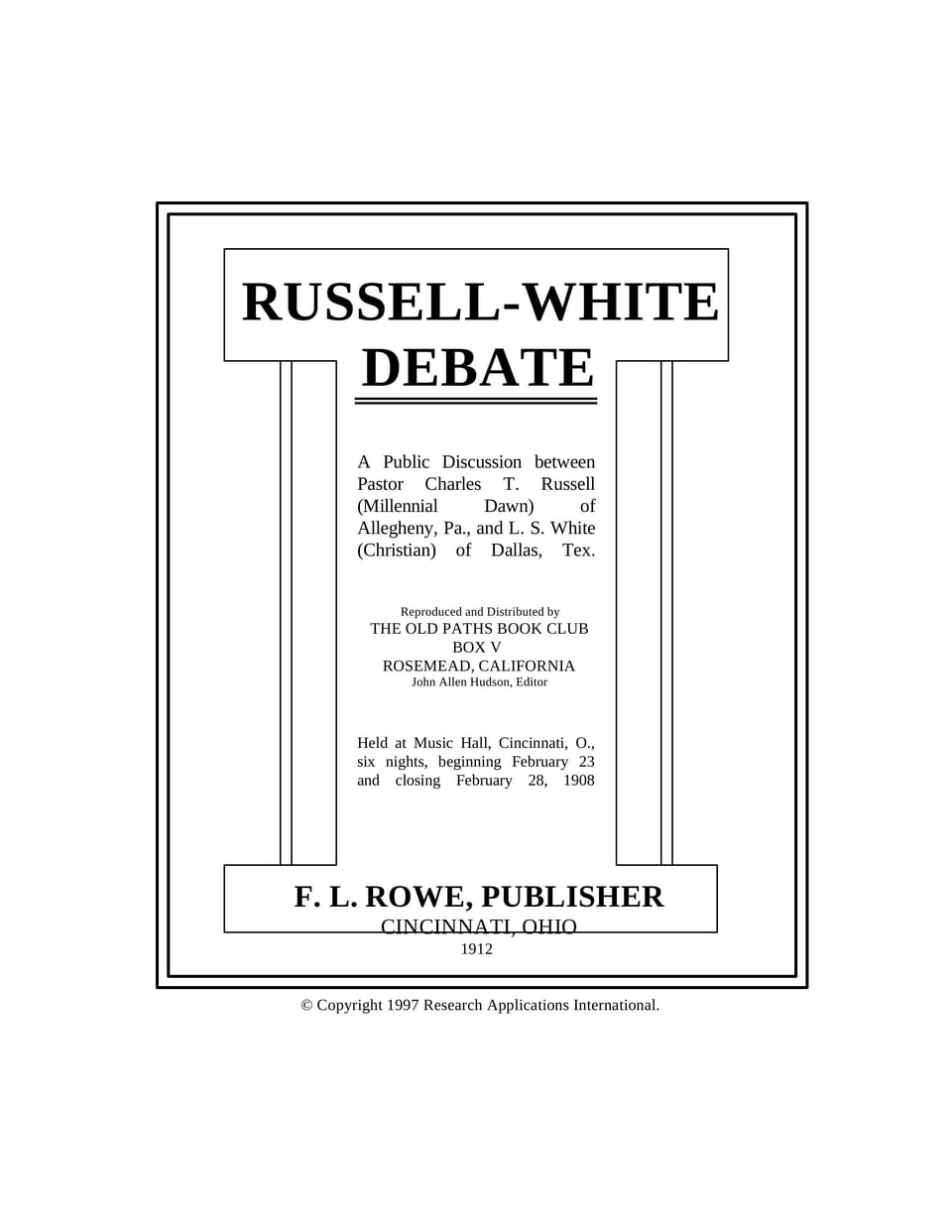
RUSSELL-WHITE
DEBATE
A Public Discussion between Pastor Charles T. Russell (Millennial Dawn) of Allegheny, Pa., and L. S. White (Christian) of Dallas, Tex.
Reproduced and Distributed by THE OLD PATHS BOOK CLUB BOX V ROSEMEAD, CALIFORNIA John Allen Hudson, Editor
Held at Music Hall, Cincinnati, O., six nights, beginning February 23 and closing February 28,1908
F. L. ROWE, PUBLISHER CINCINNATI, OHIO
1912 RUSSELL-WHITE DEBATE.
L. S. WHITE
CHAS. T. RUSSELL
PREFACE TO SECOND EDITION
In the second decade of the Twentieth Century this writer heard Pastor Charles T. Russell lecture on his dispensational theory, the premillennial kingdom, the earthly reign of Christ, etc. He was evidently very thoroughly sold on his theory.
Pastor Charles Russell, as he seemed to like to be called, was an ingenious man. He founded the International Bible Students' Association, and the Watchtower Bible and Tract Society in Brooklyn, New York. He was a prolific writer, producing the series of volumes on the Millennial Dawn. Undoubtedly he was a more gifted man than Judge Rutherford who succeeded to the main body of the disciples which Pastor Russell brought into being Pastor Russell was also a more humble man, less egocentric. Judge Rutherford was filled with gasconade and pretention. He built upon another's foundation, and then sought to rob his predecessor of his honor. His chief effort in this was to seek to kill off the influence and name even of the devotees and followers whom he captured. He changed the name to Jehovah's Witnesses. Basically, there is no difference in doctrine taught by the two men. Pastor Russell taught that Christ would come to the earth, appear to the "little flock", and give them the kingdom in the seventh thousand year period. He taught that the sixth thousand year period or dispensational era, was drawing to a close and that he was ushering in the seventh. Pastor Russell overlooked the fact that when Jesus said: "Fear not little flock, for it is the Father's good pleasure to give you the kingdom" he was talking to his disciples, and not to the disciples of Pastor Russell, or of Judge Rutherford. He was speaking of an era two thousand years ago almost, and Pastor Russell was talking to another group in these latter days. Pastor Russell thought that the "little flock", meant his followers, and Judge Rutherford thought it meant Jehovah's Witnesses! How mistaken each was! Pastor Russell thought Christ would come to his flock in 1914 and give them his kingdom; Judge Rutherford later said Jesus would come to his flock in 1920! When there was no visible appearing the "Judge" decided that Jesus did come, but secretly!
So set are these people on the earthly kingdom idea that they do not have churches, but kingdom halls.
Pastor was so convinced that he would defend his theory; Judge PREFACE TO SECOND EDITION (cont.)
Rutherford would not. See the correspondence at the close of this book which took place in 1933. Taking note of this correspondence our Sunday Visitor, a national Catholic paper said that Judge Rutherford flatly refused to meet this writer in debate. L. S. White, a well known preacher of the Church of Christ, had the distinction of being the only man who ever got the chance to oppose the false theories of these men in public discussion.
PUBLISHER'S ANNOUNCEMENT.
This debate was brought about after a correspondence covering nearly eight months of time between Mr. Russell and myself. In June, 1907, Mr. Russell wrote to me that if I would find a "fair, honorable, straightforward servant of truth," and a representative man and properly indorsed, he would meet him in public debate.
I immediately took the matter up with M. C. Kurfees and R. H. Boll, of Louisville, Ky., and they made selection of L. S. White, of the Pearl and Bryan Streets Church of Christ, Dallas, Texas. In October, Mr. White was presented to Mr. Russell, by correspondence, as the one selected to meet him. The two then entered into correspondence, and after two months decided on the propositions discussed in this book.
Mr. White wanted a much longer time given to each proposition. He also requested that the disputants be governed by the rules laid down in "Hedge's Logic," and that each debater be confined to the proposition discussed. To both of these propositions, Mr. Russell declined to agree.
Mr. White came with the indorsements of the best brethren throughout the South and South-west. He has spent fifteen years in the evangelistic field. He has been the champion of seventeen debates, extending from Tennessee to California. While only forty years of age, and in appearance on the platform young enough to be Mr.Russell's own son, he nevertheless bandied his part of the program in a manner that proved him to be a master of the occasion.
It is also important to state that Mr. D. A. Brown, an expert stenographer of national reputation, was employed by me to take the full debate. Mr. Brown is not a member of either church, and his report can be regarded as the only full and impartial report published.
F. L. ROWE.
MUSIC HALL, CINCINNATI, OHIO
INTRODUCTION
It has been a pronounced conviction with me for years, that the method of debate is one of the most powerful and successful methods of eliciting truth and exposing error, that has ever been employed since the establishment of the Church of God on earth. It was adopted and frequently used by the Master himself, as demonstrated from the very beginning of His public ministry to the last "clash of arms" which marked its tragic close. He came in contact with all the conflicting and warring parties of Pharisees, Sadducees, Lawyers and Doctors of His time, and their hypocrisies and inconsistencies drew forth His most powerful shafts of criticism. Even when a boy, twelve years of age, He was "in the temple, sitting in the midst of the teachers, both hearing them and asking them questions." He was not only the great Teacher and Reasoner of His age, but the greatest the world has ever seen. Whether in the temple, on the public highway, by the seaside, or by the vine-clad hills of His native country, His speeches were masterpieces of invincible logic, going straight to the hearts of men, whether delivered in quietness or amid the storm of controversy. Once when presenting the principles of His kingdom with the facts of His own divine origin, He was openly attacked by the Jews in a fruitless effort to defend their system against His claims, but He promptly joined issue with them, and the sharp debate which followed was unique in the fact that, being unable to meet His logic, they broke up the discussion by taking up stones to east at Him.
Turning now from the life of the Master to that of Paul, we find an almost unbroken series of sharp contentions with the enemies of the truth. With the grace and polish of a trained dialectician, he was at home in debate, whether reasoning in the school of Tyrannus, answering the proud philosophers of Athens, combating the devotees of Diana in Ephesus, or contending with the chief of the Jews in Rome; and his speeches are models oF systematic argumentation and impassioned appeal.
It may be added that truth in all ages has flourished in the soil of controversy. It never fears defeat, but courts fair, manly, dignified, and courteous investigation; and when its advocates raise the flag of truce in the presence of the enemy, it will not be long till the enemy is master of the field. It is, therefore. a matter for genuine congratulation among all lovers of the truth that in this age of religious compromise and latitudinarian tendencies, religious debates are still in order. It is error, and not truth, that suffers INTRODUCTION (cont.)
from investigation, and the Cincinnati debate will be found to be no exception to the rule. Religious controversy, indeed, is the search-light which reveals both truth and error in vivid outline. It is the torch which lights the path of progress, and by it, reformers in every age have led the people out of the wilderness of error.
Concerning the debate which constitutes the present volume, it would be out of place here to pre-judge the case and thus attempt to bias its readers touching the success or failure with which the two disputants defended their respective positions, but it can not be improper to save them from disappointment, if not chagrin, by apprising them of the fact, in advance, that they will not find the discussion conducted in accordance with the rules and regulations which, with almost universal consent, should govern in religious debates, and in all other debates, for that matter.
It is not only customary in religious discussions to have moderators, but also for the disputants to agree to be governed in the conduct of the discussion, by some such rules of controversy as those laid down in Hedge's Logic, but Mr. Russell peremptorily refused to have either, demanding simply a chairman to preside over each session of the debate, and to have a different chairman at each session; and, as to rules of controversy, he would agree to nothing except that "each speaker be allowed full liberty to .order his subject according to his best judgment, and that it shall be in order for him to present his argument as may please him best." This arrangement was accepted by Mr. White as the only condition on which the debate could materialize. Accordingly, in some instances, Mr. Russell paid no attention to his opponent's line of argument, but proceeded to present his own as if nothing had been said on the other side; and a part of the time he had his negative speech prepared and written out before hearing the speech to which it was to be given as a reply. Then, after listening to the affirmant's speech, he would read his written negative as if nothing had been said on the affirmative side. To many of the audience, this appeared to be a singular way to debate, and the reader's knowledge of it in advance will pave the way for a better appreciation of the merits of each side.
It should also be noted here that a universally recognized rule of controversy is that the issue shall be so clearly understood and defined that everything else is excluded, save the single point in dispute. It was unfortunate that this rule, as well as some others, should not have governed throughout the debate, but especially in discussing the proposition relating to the future punishment of the wicked. Mr. Russell has a conception of it which he puts forth as the popular or common view, but which is neither deducible from the proposition affirmed by his opponent, nor is it taught, so far as I know, by any religious body on earth. Under the baleful influence of mediaeval theology and an over-wrought imagination, he paints the revolting picture of a cruel and revengeful God who actually takes delight in punishing, through all eternity, his helpless creatures. His favorite representation is, to use his own words, that this God tyrannically and arbitrarily consigns his INTRODUCTION (cont.)
disobedient children to "fire-proof devils," created and employed for the special work of torturing them through eternity. He appeals to human fathers to know if they would be guilty of such horrible cruelty to their children, and, of course, every father, not wicked or insane, will say no.
But, whether the awful doctrine of endless punishment for the wicked is or is not taught in the Holy Scriptures, this hideous bugbear in Mr. Russell's thoughts in no way correctly represents the commonly accepted view which holds that there is a necessary connection between sin and its punishment after death. This view represents sin as an awful reality which may require eternity itself, with a gleam from the "unapproachable light" which envelops the Lord, to enable us to see it in all its terrible and hideous deformity, and to comprehend, in any just measure, its ruinous effects upon the moral government of the universe. According to this view, poor, finite, and shortsighted mortals, should close their lips in reverential silence and not presume to say what punishment it should have; and that God has not only graciously interposed a way of escape from sin, but He has graciously warned the wicked against its consequences, against the legitimate and inevitable outcome of a sinful life. This view claims to find in Jesus the same solemn conception of it when, with the world's woe weighing upon His great heart, He prayed: "My Father, if it be possible, let this cup pass away from me." It claims that He would fain have escaped the terrible ordeal awaiting Him, provided there was any other possible way to save the world; and that the sequel shows that there was no other way; and that, therefore, nothing remains for those who reject this way but to meet the fearful consequences of sin, since "whatsoever a man soweth, that shall he also reap." Instead of contending that the Lord determines the harvest by tyrannical and arbitrary enactment, this view contends that the sowing determines the reaping, and that in infinite love the Lord gives timely warning by telling men that the Gehenna into which the wicked will go is a place "where their worm dieth not, and the fire is not quenched," and that into it they "shall go away into eternal punishment." Moreover, the common view, instead of representing God as cruel and merciless, represents Him as yearning with infinite compassion for the salvation of all men, and it appeals to such passages as declare that He "is long-suffering to you-ward, not wishing that any should perish, but that all should come to repentance."
This is the commonly accepted view, and whether it or the one held by Mr. Russell was sustained in the discussion, the reader is respectfully left to decide by consulting the arguments on both sides.
I cheerfully commend this discussion to the reading public, believing that a careful perusal of the arguments on both sides will greatly assist the reader in the effort to find the truth. The subjects of discussion include the question concerning a chance of repentance and salvation after death, whether the dead are conscious or unconscious, the punishment of the wicked, the First Resurrection, Baptism for the remission of sins, and the Second Coming of Christ preceding the Millennium.
INTRODUCTION (cont.)
I am glad this debate has been held, and I believe it will accomplish good in counteracting error and spreading the truth.
The brethren in particular, and the public in general, owe a debt of gratitude to the publisher, Mr. F. L. Rowe, whose deep interest in the debate, coupled with diligent and tireless industry which made the needed preparation to have it stenographically reported, has made it possible to circulate it in printed form. May the Lord lead the reader into the way of truth.
M. C. Kurfees Louisville, Ky.
STENOGRAPHER'S CERTIFICATE.
This will certify that the accompanying stenographic report of the debate between Chas. T. Russell and L. S. White, at Music Hall, Cincinnati, O., on six nights beginning February 23 and ending February 28, 1908, as published by F. L. Rowe, is a full transcript of the stenographic notes taken by me at the time; that I have carefully compared the same with the daily report published in the Cincinnati Enquirer, in which report I found many it/accuracies of omission and otherwise, due to the haste, presumably, in which it was transcribed for publication. I believe the report herewith from my notes to be as full, complete and accurate as possible to make it.
DOUGLAS A. BROWN, CINCINNATI, O., March 10, 1908. Stenographic Reporter, PROPOSITIONS FOR DISCUSSION.
The Scriptures clearly teach that all hope of salvation, today, is dependent upon accepting the Gospel of Christ as revealed in the Scriptures,and that such acceptance is confined to this present life.
L. S. White, affirmative.
C. T. Russell, negative.
The Scriptures clearly teach that the dead are unconscious between death and the resurrection-at the second coming of Christ.
C. T.Russell, affirmative.
L.S. White, negative.
The Scriptures clearly teach that the punishment of the (finally incorrigible) wicked will consist of conscious, painful suffering, eternal in duration.
L. S. White, affirmative.
C. T. Russell, negative.
The Scriptures clearly teach that the first resurrection will occur at the second coming of Christ, and only the saints of this gospel age will share in it; but that in the resurrection of the unjust (Acts 24:15) vast multitudes of them will be saved.
C. T. Russell, affirmative.
L. S. White, negative.
The Scriptures clearly teach that immersion in water "in the name of the Father and of the Son and of the Holy Spirit," of a believing penitent is for, in order to, the remission of sin.
L. S. White, affirmative.
C. T. Russell, negative.
The Scriptures clearly teach that the second coming of Christ will precede the millennium, and the object of both—the Second Coming and the Millennium-is the blessing of all the families of the earth.
C. T. Russell, affirmative.
L. S. White, negative.
RUSSELL-WHITE DEBATE
Sunday Evening, February 23, 1908.
(Chairman, J. F. RUTHERFORD, Attorney, Boonville, Mo.)
FIRST PROPOSITION,
The Scriptures clearly teach that all hope of salvation, today, is dependent upon accepting the Gospel of Christ as revealed in the Scriptures, and that such acceptance is confined to this present life.
L. S. White, affirmative.
C. T. Russell, negative.
L. S. WHITE'S FIRST SPEECH.
Mr. Chairman, Ladies and Gentlemen:
I count myself happy to have this opportunity of meeting such a splendid audience of people and to discuss with my present, distinguished opponent a great Scriptural question of much interest and vital importance unto all of us.
Any person should be open to conviction; and any person who is not willing to receive the truth as taught from the Word of God, is not yet ready for the Kingdom of God. I take much pleasure in affirming the proposition which has just been read, viz.:
"The Scriptures clearly teach that all hope of salvation, today, is dependent upon accepting the Gospel of Christ as revealed in the Scriptures, and that such acceptance is confined to this present life;" and I am glad to meet, perhaps, the ablest representative of the opposition in America, or in the universe, for that matter; so that if his cause goes down in this investigation, it will not be on account of the Weakness of the man, but because of the weakness of the cause which he has espoused.
This proposition is one of much interest and great importance unto all of us. God's purpose in perpetuating the human family today is that they might seek and find Him. (Acts 17:26-27.) Paul says that "God hath made of one blood all the nations of men for to dwell on all the face of the earth, and hath determined the times before appointed, and the bounds of their habitation; that they should seek the Lord, if haply they might feel after him and find him, though he be not far from every one of us."
It is important that the terms of this proposition be clearly defined. One of the rules of controversy, as given in Hedge's Logic, says: "The terms in which the question in debate is expressed, and the precise point at issue should be so clearly defined that there could be no misunderstanding respecting them." Then the definition of the terms of this proposition: "The Scriptures," Word of God; "all hope of salvation," all hope of being saved. "Today," the present time. And you notice carefully that there will be an issue as to whether this refers to the present time or to some past time. The proposition positively states "today"the present time. "The Gospel of Christ" (the plan of salvation offered through Jesus Christ). "Confined to this present life"that is, there will be no opportunity to accept the Gospel and be saved after the close of this life.
My opponent will not deny for one moment that all hope for salvation today depends upon accepting the Gospel of Jesus Christ as revealed in the Scriptures; but the point at issue on this question is, will there be an opportunity of people being saved by the Gospel after the toils and cares of this life are done? He is really in the affirmative of this proposition, affirming that there will be another chance of salvation beyond the grave, which I most gladly deny.
I want, now, to introduce a number of Scriptural and clearly logical arguments in support of this proposition:
Today is the day of salvation. Heb. 3:7-11: "Wherefore (as the Holy Ghost saith, Today if ye will hear his voice, harden not your hearts, as in the provocation, in the day of temptation in the wilderness: when your fathers tempted me, proved me and saw my works forty years. Wherefore I was grieved with that generation, and said, They do always err in their heart; and they have not known my ways. So I sware in my wrath, They shall not enter into my rest)."
God says today is the day of salvation. We are both agreed upon that fact.The question is,is he right in contending,in addition to what God says,that there will be another chance of salvation in the future life?
The reign of Christ began after His ascension. Acts 2:30: "Therefore, being a prophet, and knowing that God had sworn with an oath to him, that of the fruit of his loins, according to the flesh, he would raise up Christ to sit on his throne."
And His reign will end at His descension or second coming. Then He will deliver up the kingdom to the Father. I. Corinthians 15:24-26: "Then cometh the end, when he shall have delivered up the kingdom to God, even the Father; when he shall have put down all rule, and all authority and power. For he must reign till he hath put all enemies under his feet. The last enemy that shall be destroyed is death."
Any salvation, therefore, offered after that would be salvation without Christ as King, consequently without the name of Christ. But there is none other name given under heaven or amongst men whereby we can be saved. Acts 4:12: "Neither is there salvation in any other; for there is none other name under heaven given among men whereby we must be saved." Therefore, the possibility for salvation at all is confined to the time before the second coming of Christ, when the Master will rise up and shut to the door. Luke 13:23-27: "Then said one unto him, Lord are there few that be saved? And he said unto them, Strive to enter in at the strait gate; for many I say unto you will seek to enter in, and shall not be able. When once the master of the house is risen up, and hath shut to the door, and ye begin to stand without, and knock at the door, saying, Lord, Lord, open unto us; and he shall answer and say unto you, I know not whence ye are. Then shall ye begin to say, We have eaten and drunk in thy presence, and thou hast taught in our streets. But he shall say, I tell you, I know you not whence ye are; depart from me, all ye workers of iniquity."
The grace of God brings salvation; but it brings salvation to those only who live in this present world, which precedes the second coming of Christ. We are to look for His appearing. Tit. 2:11- 14: "For the grace of God that bringeth salvation hath appeared to all men, teaching us that denying ungodliness and worldly lusts, we should live soberly, righteously and godly in this present world, looking for that blessed hope and the glorious appearing of the great God and our Saviour Jesus Christ, who gave himself for us that he might redeem us from all iniquity, and purify unto himself a peculiar people, zealous of good works."
Therefore, any salvation offered after this life, and any saved then, would be without the grace of God.
The seal of the covenant of grace is the blood of Christ.The seal, and that of which it is a seal are co-extensive.Each lasts just as long as the other,and no longer.Christ's blood is to be remembered until he comes.I. Cor.11:26:"For as often as ye eat this bread,and drink this cup, ye do shew the Lord's death till he come." Therefore,the new covenant sealed by that blood will continue only until Christ comes. Then if any are saved after he comes,they will be saved without either the new covenant or the blood of Christ. But the new covenant,of which the blood of Christ is the seal,is the one which gives life.(Gal.3 and Heb.8.) Therefore,salvation without the new covenant would be salvation without life.
From such please excuse me. But this is just what Elder Russell's after-death salvation proposes.
Judgment, not salvation, comes after death. Heb. 9:27-28: "And as it is appointed unto men once to die, but after this the judgment, so Christ was once offered to bear the sins of many; and unto them that look for him shall he appear the second time without sin unto salvation," or without a sin offering. Christ came into the world once to save sinners. I. Tim. 1:15, "This is a faithful saying, and worthy of all acceptance, that Christ Jesus came into the world to save sinners, of whom I am chief." The next time he will come for a different purpose. He will come next time without a "sin offering." If the people can be saved after Christ comes, they can be saved without an offering for sin. "But Christ shed his blood for the remission of sin" (Matthew 26:28). Therefore, if people can be saved after Christ comes, or after this life, they can be saved without a sin offering, the blood of Christ, which is impossible, "for without the shedding of blood is no remission." (Hebrews 9:22.)
Because of our sins we can not approach God without a mediator. (Isaiah 59:1-2.) "Behold, the Lord's hand is not shortened that it can not save; neither his ear heavy, that it can not hear; but your iniquities have separated between you and your God, and your sins have hid his face from you that he will not hear."
Jesus Christ is our mediator. 1. Tim. 2:5, "For there is one God, and one mediator between God and men, the man Jesus Christ." But Christ is now in heaven in the presence of God for us. (Hebrews 9:24.) "For Christ is not entered into the holy places made with hands, which are the figures of the true; but into heaven itself, now to appear in the presence of God for us." But Christ is to appear in the presence of God but the one time for us. (Hebrews 9:25-26.) "Nor yet that he should offer himself often, as the high .priest entereth into the holy place every year with blood of others; for then must he often have suffered since the foundation of the world, but now once in the end of the world hath he appeared to put away sin by the sacrifice of himself."
But if Christ comes back to this world to offer the people another chance of salvation after death, he will then be in the presence of the people instead of God. But the Bible teaches that He shall stand in the presence of God to intercede for the people. Therefore, if people can be saved after this life, they can be saved without a Mediator, which is utterly impossible.
If there be another chance of salvation after death, for those who lose out in this life, who knows but that they may have a third, or a fourth chance, and on without limit? Can Elder Russell tell? But it has been shown that Christ will never appear again in the presence of God for us after He comes; but at His coming, He will take vengeance on them who did not accept Him in obedience to the Gospel in this present life. (II. Thessalonians 1:7-10.) "And to you who are troubled rest with us, when the Lord Jesus shall be revealed from heaven with his mighty angels, in flaming fire taking vengeance on them that know not God, and that obey not the Gospel of our Lord Jesus Christ; who shall be punished with everlasting destruction from the presence of the Lord, and from the glory of his power; when he shall come to be glorified in his saints, and to be admired in all them that believe (because our testimony among you was believed) in that day."
God is no respecter of persons. (Acts 10:34.) "Then Peter opened his mouth, and said, Of a truth I perceive that God is no respecter of persons." If this be true, and it most certainly is, then it is as reasonable and certainly as possible, that God would have given the Jews, who rejected the law of Moses, a second chance by that law, as to say that He will, through the Gospel, give a second chance to those who now reject it. But He did not give the Jews a second chance for the blessings of the law they despised; and Paul teaches that our chances are even less than theirs. (Hebrews 10:28-29.) "He that despised Moses' law died without mercy under two or three witnesses. Of how much sorer punishment, suppose ye, shall he be thought worthy, who hath trodden under foot the Son of God, and hath counted the blood of the covenant, wherewith he was sanctified, an unholy thing, and hath done despite unto the Spirit of grace."
If it be contended that a second chance, or an opportunity for salvation after death, will be given the Jews, but that said opportunity will be offered by the Gospel now in vogue, I answer that this will not, in fact, be a second chance, but the first opportunity on a new proposition. Then, to be consistent, God will have to offer to those who now refuse the Gospel an entirely new proposition, even a new Christ; otherwise He will be a respecter of persons then in not offering them as new a proposition as He will the Jews.
If God gives the Jews, who lived under the law, a chance by the Gospel after this present life, and if He is to give to those who have heard the Gospel in this age, another chance after death and the resurrection, then, to be consistent and not a respecter of persons, he will have to raise the heathen from the dead, give them an opportunity by the Gospel, and if they or any of them refuse the first opportunity after death; then he must have them die and again raise them from the dead in order to give them a second chance so as to put them on an equal footing with us; otherwise, if the contention of my present distinguished opponent be true—which is doubted God would be a respecter of persons. If every one except the heathen has two lives of probation, in either of which he has an opportunity offered for his salvation, I shall insist that the heathen shall have two lives and two opportunities after this life.
The Jews have had one opportunity through the law of Moses, and rejected it; they had another by the Gospel of Christ, and rejected that. If the contention of Elder Russell be true they will have another chance for salvation after death, making three chances of salvation for the Jews.
Then God will have to give the heathen a chance after death, let them die a second time, raise them again to life, let them die a third time and raise them again in order to give them a third chance of salvation, and thus put them on an equal with the Jews, and Himself avoid being a respecter of persons. Who doubts that some of them even in the third chance will reject the Gospel? This is one of the absurdities that the post-mortem salvation of Elder Russell leads to.
In Matthew 25:1-13, our Saviour gives us the parable of the ten virgins, in the following language:
"Then shall the kingdom of heaven be likened unto ten virgins which took their lamps, and went forth to meet the bridegroom. And five of them were wise and five were foolish. They that were foolish took their lamps and took no oil with them; but the wise took oil in their vessels with their lamps. While the bridegroom tarried, they all slumbered and slept. And at midnight there was a cry made, Behold, the bridegroom cometh; go ye out to meet him. Then all those virgins arose and trimmed their lamps. And the foolish said unto the wise, Give us of your oil, for our lamps are gone out. But the wise answered, saying, Not so, lest there be not enough for us and you; but go ye rather to them that sell, and buy for yourselves. And while they went to buy, the bridegroom came; and they that were ready went in with him to the marriage; and the door was shut. Afterward came also the other virgins, saying, Lord, Lord, open to us. But he answered and said, Verily, I say unto you, I know you not. Watch, therefore, for ye know neither the day nor the hour wherein the Son of man cometh."
The coming of the bridegroom represents the coming of Christ; the wise virgins represent those who are ready for his coming, while the foolish virgins represent those who are unprepared for his coming. You will observe that the foolish virgins thought they could get ready after the coming of the bridegroom, just like my present distinguished opponent teaches. But they were not permitted to enter and be present at the marriage, for none have the promise of entering heaven, except those who do the will of God in this present life. (Matthew 7:21.) "Not every one that saith unto me, Lord, Lord, shall enter into the kingdom of heaven; but he that doeth the will of my Father which is in heaven." But if, as Elder Russell teaches—so contrary to the Word of God—that there will be another chance of salvation after the coming of Christ, and this chance be a better one, last longer and be more easily accepted than the present one as he teaches, then Christ has it wrong; the wise virgins were the foolish ones, and the foolish virgins were the wise ones in waiting till the coming of the bridegroom, Christ, to get ready. when they would have so much easier time to make preparation. I wonder if they had any of this second-chance preparation idea that my opponent is teaching? But you see, they were shut out and had no second chance.
Great men sometimes differ. Christ taught it one way and my opponent teaches in another and different way. Which will you take?
When the Holy Spirit came to the apostles to guide them into all truth he, through them, was to reprove the world of sin and of righteousness and of judgment. (John 16:7-8.) "Nevertheless I tell you the truth; it is expedient for you that I go away; for if I go not away, the Comforter will not come unto you, but if I depart, I will send him unto you. And when he is come, he will reprove the world of sin and of righteousness and of judgment."
The great apostle Paul, acting under the commission of Jesus Christ, preached the Gospel to Felix, the wicked and adulterous Governor of Judea. (Acts 24:25.) Felix trembled under the power of God's word, but he put the matter off for a convenient season and another opportunity, just as my dear friend and opponent teaches, and was lost.
Better be wise and take the present opportunity. Will Brother Russell answer the following question: Will Felix have another opportunity of salvation?
There is no hope for the truth after people go down into the grave. (Isaiah 38:18.) "For the grave can not praise thee, death can not celebrate thee; they that go down into the pit can not hope for the truth." (Romans 6:20-23.) "For when ye were the servants of sin, ye were free from righteousness. What fruit had ye then in those things whereof ye are now ashamed? For the end of those things is death. But now being made free from sin, and become servants to God, ye have your fruit unto holiness, and the end everlasting life. For the wages of sin is death; but the gift of God is eternal life through Jesus Christ our Lord."
This present life is man's last chance of salvation. (!. John 2:17-18.) "And the world passeth away, and the lust thereof; but he that doeth the will of God abideth forever. Little children, it is the last time; and as ye have heard that antichrist shall come, even now are there many antichrists; whereby we know that it is the last time." This clearly teaches us God has given us His last revelation and this life is the last time, the last chance in which we will have to prepare for the life to come. (Hebrews 1:1-2.) "God, who, at sundry times and in divers manners, spake in time past unto the fathers by the prophets, hath in these last days spoken unto us by his Son, whom he hath appointed heir of all things, by whom also he made the worlds." (Ephesians 1:7- 10.) "In whom we have redemption through his blood, the forgiveness of sins, according to the riches of his grace; wherein he hath abounded toward us in all wisdom and prudence; having made known unto us the mystery of his will, according to his good pleasure which he hath purposed in himself: That in the dispensation of the fullness of times he might gather together in one all things in Christ, both which are in heaven, and which are on earth, even in him." But when was this purpose of God made known?
(II. Timothy 1:9-10.) "Who hath saved us, and called us with an holy calling, not according to our works, but according to his own purpose and grace, which was given us in Jesus Christ before the world began, but is now made manifest by the appearing of our Saviour Jesus Christ, who hath abolished death, and hath brought life and immortality to light through the gospel." Thus you see this purpose of God was made known through Jesus Christ. When did the fullness of time come? The fullness of time came when Christ came. (Galatians 4:4.) "But when the fullness of time was come, God sent forth his Son, made of a woman, made under the law." There is the fullness of time in the church of the living God, the body of Christ here on earth today.
(Ephesians 1:22-23.) "And hath put all things under his feet, and gave him to be the head over all things to the church, which is his body, the fullness of him that filleth all in all." (Romans 1:16.) "For I am not ashamed of the gospel of Christ; for it is the power of God unto salvation to every one that believeth; to the Jew first, and also to the Greek." Then the purpose of God to save the human family through the Gospel of Christ, which is the power of God unto salvation, is manifest through Christ in these last days, last dispensation, which is the last time, and in it there is fullness; therefore, if saved by the Gospel, it must be in this present life.
Many of the human family are saved by faith in Christ and obedience to Him. (Acts 2:41, 47.) "Then they that gladly received his word were baptized; and the same day there were added unto them about three thousand souls ... praising God, and having favour with all the people. And the Lord added to the church daily such as should be saved."
(Galatians 3:26-27.) "For ye are all the children of God by faith in Christ Jesus. For as many of you as have been baptized into Christ have put on Christ."
(Hebrews 7:25.) "Wherefore he is able also to save them to the uttermost that come unto God by him, seeing he ever liveth to make intercession for them." (Hebrews 5:8-9.) "Though he were a Son, yet learned he obedience by the things which he suffered; and being made perfect, he became the author of eternal salvation unto all them that obey him." (Rev. 22:17.) "And the Spirit and the bride say, Come. And let him that heareth say, Come. And let him that is athirst come. And whosoever will, let him take the water of life freely."
These Scriptures show that the Gospel was addressed to these people, that they were capable of understanding it, obeyed it and were saved by it. These people were exponents of the moral and mental condition and responsibility of all mankind. All men having these powers and responsibilities in this life, and who refuse to avail themselves of such opportunities, are not entitled to further opportunities in the next life.
C. T. RUSSELL'S FIRST REPLY.
I am reminded, dear friends, of the remark in my letter of acceptance, that, in so far as this first proposition is concerned, I accepted it as you prefer to have it, but only with the understanding that it is not two propositions, but one; for I am not prepared to deny the first part of the same. In other words, dear friends, we do not deny that, so far as the present life is concerned, there is not a trial of or a test upon those who now come to a knowledge of the truth, that they have responsibility that is a life and death question with them; and that includes you and me, if we are of those who are the Lord's people. Tile essence of our argument is this: That God has a plan which is wider and deeper and broader than we had once supposed.
I agree with very much that our friend has said, and with all of the Scriptures quoted, but I wish to call your attention to the fact that nearly all of those Scriptures relate to the present age and do not relate to the world at all, but relate to the church; and some one may inquire: "Do you make a distinction between the world and the church?"
I answer, Yes. Our dear brother has been discussing the conditions that are upon those whom the Lord is calling now, those whom the Scriptures term the elect, of whom the Scriptures say that there is but a "little flock."
"Fear not, little flock, for it is your Father's good pleasure to give you the Kingdom."
Our dear brother says the Kingdom came some time ago, but the Lord says that it is God's good pleasure to give us the Kingdom. I hold, dear friends, that you never got the Kingdom. I am sure I never got the Kingdom. I remember very well that our Lord said to the disciples: "I will give to you to sit with me in my throne." I remember very well that the same dear Master told us to pray, "Thy Kingdom come, thy will be done on earth as it is in heaven." I assure you, dear friends, that the Kingdom has never come in Allegheny, and I do not believe that you will contend that the Kingdom of God has come in Cincinnati.
And so I believe we are safe in saying that God's Kingdom has not yet come, his will is not yet done on earth as in heaven. Now, dear friends, I would have you to notice Some Scriptures which make a distinction between the church and the world, as, for instance, "God has spoken unto us by his Son;" that is one of the texts that our dear friend quotes. Very good. He has spoken unto us by his Son; but to whom has he spoken? Has he Spoken to the heathen? I tell you nay. Has he spoken to you? Blessed are your ears, for they hear. Blessed are your ears, for they hear. But every one has not heard, my dear friends. The apostle Paul is our authority for saying that the god of this world has blinded their minds and stopped their ears, and so the whole world is deaf to this mystery. Only certain ones can hear now; they are the blessed ones, they are the peculiar, people that God is now selecting.
He is selecting a people for a purpose.
Take another text along the same line: "Behold, the Lamb of God, that taketh away the sin of the world." Mark you, the sin of the world. It is one thing to deal with the church and the sin of the church; it is one thing to refer to the church, and another thing to refer to the world, and our Lord is declared to have come to take away the sin of the world, not merely the sin of the church. But you say they are both the same. I answer no. The Scriptures clearly distinguish between the sin of the world and the sin of the church. Let me give you one illustration: "He is the propitiation"—the word "propitiation" means satisfaction; He is the satisfaction for our sins, the church's sins; not for ours only, but also the sins of the whole world.
Now you see, dear friends, that according to the Scriptures there is a class, that is, the church, and they have the satisfaction given for their sins; and there is a class called the world that have also a propitiation for their sins; but the two classes are separate and distinct, and whoever has not learned this matter has not learned what the apostle Paul calls "rightly dividing the word of truth." Another Scripture along the same line: "God so loved the world that he gave his only begotten Son, that whosoever believeth in him should not perish, but have everlasting life." It is not merely that God so loved the church; and yet, dear friends, it will be admitted on all hands that the church is a very small minority. Take the city of Cincinnati, with some three hundred and fifty thousand people; how many do you suppose are of the Church of Christ from the Scriptural standpoint of this church? How many are disciples indeed? How many are of that class that are mentioned by our Lord, when he says, "If any man will be my disciple, let him take up his cross and follow me, and where I am there will my disciples be"? And of the class of which he says, "Strait is the gate and narrow is the way that leadeth unto life, and few there be that find it." Few there be that find it.
Now, my dear friends, admitting the fact that there is a narrow way and that few are going to find it, and that this church class is the only class that God is now saving, and that that is the teaching of the Word all the way through, we must become dead with.him if we would live with him. We must suffer with him if we would reign with him; but this is of the church class, not the world. The world is never invited to suffer with Christ. Men are called to repentance, but it is not all the world that is called to be the bride of Christ. It is those that have repented; it is those who have turned from sin, who have believed in the Lord Jesus Christ; these are the ones who are invited to be the little flock and to be joined here with Christ and to lay down their lives for his cause. If then we can get this matter differentiated in our minds, let us remember the words of the apostle on this subject of the mystery of Christ. He distinctly tells us that there is a mystery class.
Did you ever hear of a mystery class? The Scriptures tell us that the church is a mystery. Let me quote you what the apostle says: "The mystery hidden from ages and generations, and now made manifest." When made manifest? In the days of the apostles, from Pentecost day on, this mystery class began. In other words, "The church is a mystery the world knoweth not of, even as it knew Him not," is the Scriptural way of putting it. Why does the world know it not? Because it is this little flock that the Lord is selecting out from the world—a very peculiar people. Not many great, not many wise, not many learned, hath God chosen, but this select class whom he is now selecting from the world, a peculiar people, every one of them to be copies of his Son. How many will that leave out? Dear friends, that will leave out nearly all the people in Cincinnati and nearly all the people of Allegheny, and Pittsburg, too. Do you know many that are copies of God's dear Son, in Cincinnati? I hold that you do not. I hold that there are not many in Cincinnati who will claim to be copies of God's dear Son. Yet the Scriptures tell us that that is the kind that God has predestined; these are the ones who are to constitute the very elect, that peculiar people who are to make their calling and election sure. Election to what, you say? The Scriptures answer, election to share with Christ in the heavenly kingdom, to worship with him in his heavenly kingdom. What kingdom? The kingdom for which we pray when we say, "Thy kingdom come, thy will be done on earth as it is in heaven." When will that kingdom come? At the end of this age, dear friends. Why at the end of this age? Because this gospel age has been appointed for this very purpose of selecting this kingdom class. The Lord is now taking this class out of the world. What does he call them? In one illustration he calls them the bride, the Lamb's wife; and in another illustration he calls them jewels, and in another he calls them members in particular of the body of Christ. All of these are very select terms, you see, and they represent a very careful selection on the Lord's part—an elect class—the very elect.
I need not call your attention to the many Scriptures which speak of the elect of God, the very elect, but shall point out that the church is a very peculiar people and that they are all saints.
Mark the illustration that is given to us in the Word respecting the resurrection "Blessed and holy are all they that have part in the first resurrection, on such the second death hath no power; they shall be kings and priests unto God and shall reign on the earth." They will be kings and priests unto God and shall reign on the earth at that time; that is what it means—reigning kings and priests; they are both. The two offices will be combined.
Let me read you a few more of these texts about the mystery. The apostle says, in Colossians 1:27, "Christ in you, the hope of glory." Again he says, Ephesians 3:9, "The fellowship of the mystery, which is Christ in you."
So in Revelation, you remember, it is finally brought down—Rev. 10:7, we are pointed out the time when the mystery of God shall be finished. The mystery class began with Pentecost. There was no mystery class before that. The church is this mystery class. The world knoweth not what God is doing—and I am sorry to say that I did not know for a while what God was doing, and perhaps you did not know what God was doing; that he was taking out of the world a people for his name; that he was not at any time trying to take in the world, but he was trying to take out of the world a people for his name; as the apostle Peter expresses the matter, "Taking them out for a purpose ;" as we have already had it called to our attention in Ephesians, the apostle states that in the ages to come—h, there are ages to come. This is not the last age; there is work for this age, and also for the ages to come, and in the ages to come, says the apostle, "He shall show forth the exceeding riches of his grace and his lovingkindness toward us in Christ Jesus."
Who are the "us"? The church, the "little flock," the bride class. The class that shall sit with him in his throne-when he has a throne—for he is delaying the sitting on his throne until he has the bride class completed.
Now, my dear friends, if we can get before our minds that there is on God's part a great plan of salvation that is partly outlined in the statement in many Scriptures, to the effect that God so loved the world that he gave his Son for the world and not merely for the church, and that Jesus was the propitiation for our sins, and not ours only, but also for the sins of the whole world; if we get that be/ore our minds, we see that in the present time he is taking the church, finding the little flock, and then by and by the little flock associated with him in his Kingdom will be the power of God associated with Jesus for the blessing of all the families of earth.
I might call your attention to some of the various pictures by which this is represented in the Scriptures. We are told, for instance, that the whole world is not called, but that he that hath an ear to hear let him hear. The implication is that all have not an ear to hear. The apostle Paul says, "The god of this world hath blinded the minds of all them that believe not." How many of them are there? We will all agree that the heathen are blinded and they know not God. How many of them are there today? Twelve hundred million of heathen that are blinded today, that know not God because the eyes of their understanding are shut—fast shut. Then they come here to civilized America, the most highly civilized country in the world; yet how many here know God? to how many here has God spoken? He has spoken in these last days unto as by his Son. But I ask you, how many have heard?
Suppose, now, that the audience here were all deaf and dumb people, and suppose I addressed this message to them; how many would hear? The deaf and dumb certainly would not. Who would hear? Those who had ears to hear would hear. And so the Scriptures tell us, "He that hath an ear to hear, let him hear;” and that is the message that you and I have today.
Wherever we go with the Gospel of Christ, whoever hath an ear to hear, let him hear, and we are glad to let him hear.
We have not any second chance at all; there is no second chance for anybody that hath an ear to hear. His responsibility begins where his hearing begins, and in proportion to his hearing. What we are claiming is that God has not passed by the twelve hundred millions who have no ear to hear, that God is not passing by the people of Cincinnati and the people of Pittsburg who have no ear to hear, but God has a glorious provision of which he tells us in the prophecy, that by and by all of the blind eyes shall be opened and all the deaf ears shall be unstopped. That will be done by the Lord in the name of the everlasting Son. That will be a good time. I am glad that God is going to open their ears by and by.
The Lord tells us that the god of this world hath blinded their eyes. Who is the god of this world? It is not Christ Jesus, but Satan. How has he blinded their eyes? By error, and superstition, and gross darkness that is about the people; darkness covers the earth. The first Scriptures tell us of that great darkness. Who caused that darkness? Satan. Who permits it? Our heavenly Father permits it; our heavenly Father permits this gross darkness that the people are in. If he did not, would they be in darkness? How could there he otherwise than what he would permit? So then, dear friends, if God is now permitting them to be in gross darkness, is now permitting Satan to be the prince ,of this world, and is now permitting him to blind the hearts of them that believe not, let us also rejoice when he tells us that the time is coming when Satan, the old serpent, the old devil, shall be bound for a thousand years, to deceive the nations no more till the thousand years are finished. When Satan is bound and his deceptions are ended, all the blind eyes shall be opened and all the deaf ears shall be unstopped.
So the Scriptures represent the present time as a time of darkness; darkness covers the earth, the gross darkness of the people. The heathen are in gross darkness; civilization is in darkness also, although not as gross as heathendom; but the Lord tells us that there are some of his people who are following the lamp: "Thy word is a lamp to my feet and a lantern to my footsteps." Those are the ones who have the hearing ear, who take heed to the Word. Let us be glad that our ears have heard something of the grace of God. Let us be glad that we have come from darkness into his marvelous light.
Our dear brother wanted to tell you about my side. I thank him for the endeavor, but I prefer to tell my own side, dear friends, and it will be a little different. I want to tell you that we do not have any second chance to preach to anybody, except in the general sense that I will show you; for instance, that you are enjoying now a second chance, I am enjoying a second chance now. For instance, according to the Scriptures, by one man's disobedience sin entered into the world.
That was Father Adam's sin. On account of his sin and sentence to death, death came upon him and that hath come down to all his family. So you and I, as members of Adam's family, are all dying, we are all suffering under his death penalty.
Now, then, God has had mercy upon us and hath sent his Son to redeem us, and He has paid the price for it. Christ died for our sins, tasted death for every man, gave himself a ransom for all. Blessed good tidings that! Mark you, not merely that He gave himself a ransom for the church, but for all; and the next stanza says, "To be testified in due time." Now, it has been testified to you and to me that Christ died for our sins, and because we have had the ear to hear, we have been rejoiced by the mystery. To whatever extent we have received it, we have had a blessing from it, and whoever have not heard it have not had that blessing. It is to be testified to all in due time. God has a due time for you to hear and for me to hear; he has a due time for all to hear. This is the apostle's statement, you remember, in I. Timothy 2:5-6. After the Scriptures, dear friends, have brought our attention to the fact that we are in the narrow way now, they tell us why this narrow way is made narrow. Why is it? That God would make a special test of you and of me and of all he is now selecting. He is selecting some who are to be kings and priests, who are to occupy very high positions in the divine class. This is the invitation. Now we shall be joint-heirs with Jesus Christ our Lord. Is not that a high station to be invited to? I believe you will all agree with me that this is a wonderfully high calling, as the apostle speaks of it, a high calling of God in Christ Jesus. How high is that calling? To be heirs of God, to be joint-heirs with Jesus Christ our Lord. Joint-heirs of what? Joint-heirs of his throne. Joint-heirs of his Kingdom, to sit with him in his throne, to be associated with him in his great work. What is his great work? I answer, his great work is the blessing of all the families of the earth. God's plan, dear friends, was never intended to merely gather up a mere handful and take that mere handful to glory, and then, as Jonathan Edwards has declared, that they should look over the battlements of heaven and see the balance of mankind writhing in agony and in fire because they were not elected. God has selected a little flock, and instead of having their portion as Jonathan Edwards has described, God's arrangement is that they shall be joint-heirs with Christ in the work of disseminating the blessings and lifting up mankind out of the dunghill, when in the ages to come he shall show the exceeding riches of his grace. As our brother quoted the text awhile ago, he will by and by gather together in one—under one head, the Greek word means—he will by and by gather under one head all things in Christ Jesus, and not merely the church. He is already the Head of the church, which is his body, and this is a little flock; but after the church is glorified, then the work of the church will be with her Lord to scatter the blessings of divine forgiveness and divine grace.
Now you can readily see, dear friends, the propriety on the part of the apostles for their addressing most of their remarks to the church. The object of the gospel age is not to discuss the millennial age, but the special object of tile gospel age is to prepare a people for His name. The object of the gospel age is to instruct the church as to how they can make their calling and election sure; therefore, the majority of the New Testament Scriptures is written for the church. So you will find all of the Epistles are addressed not to the world, but to the saints; for instance, at Corinth, to the holy ones at Corinth, and the holy ones also here in Cincinnati and Pittsburg, the message of God comes; and, no matter whom he may address, the holy ones are the only ones that will hear it and heed it anyway. And the object of God, in dealing with these holy or consecrated ones, is that they may make their calling and election sure; that they may not only have the robe of Christ's righteousness covering their blemishes, but that it will be an embroidered robe; as represented in the Psalms, the bride is to be presented to the bridegroom in raiment of fine needle-work, which represents the righteousness of the saints and the inwrought character that God would have you develop in your heart, that you may be made meet for the inheritance of the saints. There shall none enter into that glorious condition until they are fully developed. No wonder, then, dear friends, if the Lord lays down very strict lines for the church he is getting a peculiar people.
Our brother tells us that he thinks we believe it is going to be very much easier for the world. Well, the Scriptures say that a highway shall be there. Where? In the millennial age. A highway shall be there. There is no highway here. The word "highway" in the Hebrew signifies a broad, traveled way. What is there now? A strait gate, a narrow way, and few there be that find it; but about that highway of the future, the Scriptures say a highway shall be there, and the way shall be called the way of holiness, and all the redeemed of the Lord may go up thereon. Who are the redeemed of the Lord? All for whom Christ died. The whole host will have the privilege of going up on that highway. But now is the special privilege, the special opportunity of the present time, to walk the narrow way; you and I are invited, and it is a special thing, and only those who have the hearing ear can know about this and can understand this mystery. It is a mystery to others, the apostle says. What is the mystery? The mystery is this, dear friends: God hath said, away back in the time of Abraham—you remember he then declared the Gospel to Abraham. The word "gospel," I will remind you, means good tidings. He first preached the Gospel to Abraham, saying: "In thy seed shall all the families of the earth be blessed." Who is this seed? Messiah is the seed. The Israelites were looking for a Messiah for over sixteen hundred years, and when He came He was indeed the one that was promised to bless the families of the earth.
…