Louvre—Bible in Hand (1994)
Download: PDF — Louvre—Bible in Hand (1994)
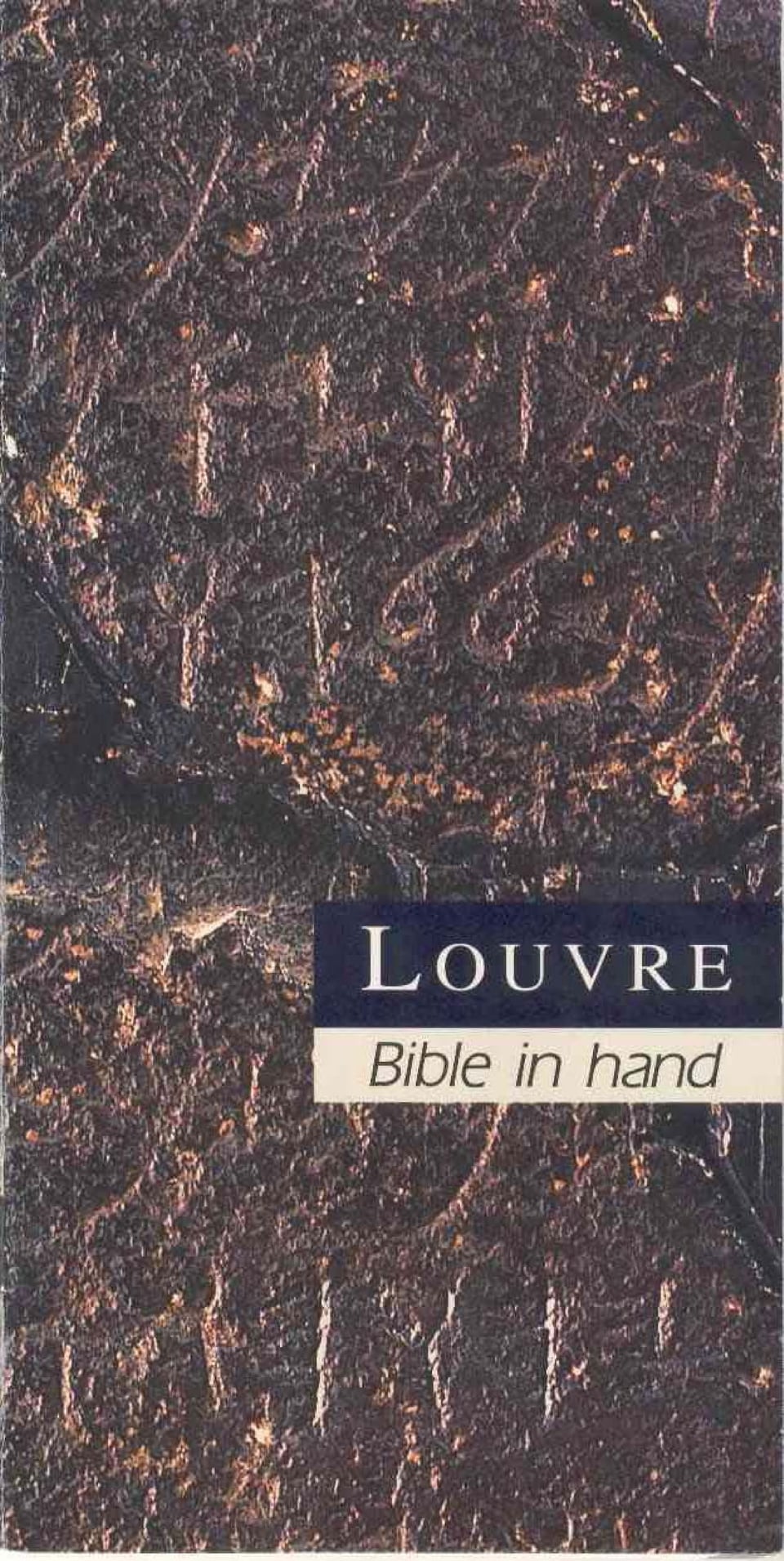
LOUVRE
Bible in hand LOUVRE Bible in hand
The Louvre is open from 9:00 a.m. to 6:00 p.m. every day except Tuesdays. Evening opening hours: until 10:00 p.m. on Mondays (RICHELIEU wing only) and Wednesdays (all departments).
The museum's Handbook can be obtained from the Information Desk, open from 9:00 a.m. to 9:45 p.m., tel. (1) 40205317 Video screens indicate which rooms are closed.
The Louvre consists of seven departments, identified by different colors. This brochure discusses various objects from three departments Oriental Antiquities Egyptian Antiquities, and Greek, Etruscan, and Roman Antiquities. Certain exhibits may be unavailable for viewing due to restoration work, or because they are on loan.
ABBREVIATIONS
Insight on the Scriptures. Watchtower Bible and Tract Society of N.Y., Inc.New York, 1988.
Awake! Watchtower Bible and Tract Society of N.Y. Inc., New York.
The Watchtower, Watchtower Bible and Tract Society of N.Y., Inc. New York.
Association "les Tempins de Jehovah"
B.P. 63
92105 Boulogne-Billancourt Cedex
© 1994. Association "Les Témoins de Jéhovah"
Cover: The Moabite Stone [detail] ARRONDISSEMENTS
10 9 8 7 6
RICHELIEU
Main Entrance → SULLY
DENON
Oriental Antiquities
Egyptian Antiquities
Greek, Etruscan and Roman Antiquities
Medieval Louvre
Niveaux
Rapid Reference Guide
Code of Hammurabi
Page
Human-headed winged bulls
Moabite
Stone
Seated
Scribe
Triad of Osorkon II
Toment of Marsyas
Triad
of Osorkon II
Toment
of Marsyas
Archers of Darius
Archers
of Darius
RICHELIEU
Starting from under the Pyramid, escalators lead into ee wings. DENON, SULLY, and RICHELIEU. Each divided into sections. Head for RICHELIEU.
Head for Antiquités orientales. Take the escalator leading to Mesopotamie archaique (straight ahead). The tour follows the route designed by the curators of the seum. Exhibits are identified by their inventory number.
room 1a
Mesopotamia
Certain motifs reappear throughout the visit:
The horn is a symbol of strength and power. (Deuonomy 33:17) A crown or headpiece with horns identifies a god or a deified human. - w86 12/15, 28.
The bull was worshiped as a symbol of deities Marduk, Molech, Baal, and Apis. The sun-god was of represented by bulls, the horns signifying the rays, and bull's strong reproductive power, the sun's power as ver of life." One of the most important signs of the diac. it-1, 207,374. For sun worship, compare Kings 23:11; Ezekiel 8:16.
The flowing vase: a vase providing life-giving water recurring theme in Mesopotamian mythology, perhapsecting the account in Genesis 2:10. Compare Eze- 47:1, 12; Revelation 22:1, 2.
The ring and rod, symbols of authority. Gene- 38:18; it-2, 817.
Stele of the Vultures, AO 16109. One side, conered people in a net (compare Habakkuk 1:14-17); othside, king and troops with hair let down for war. Compare Judges 5:2.
Room2
Mesopotamia: 2350-2000 B.C.E.
[Right] Naked captives. Fragment of an Akkaan king's victory stele, SB 3. A good illustration ofiah 20:1-4, although dealing with a different king.
RICHELIEU
\textcircled{1} Top of an Akkadian king's victory stele, SB 2. Captives in a net. — Compare Ezekiel 12:13.
\textcircled{2} Victory stele of Naram-Sin, king of Akkad, SB 4. Naram-Sin, deified in his lifetime, as shown by his horned helmet, was given the name god of Akkad." The inscription tells of his claim to rule the universe. (See his Vase, AO 74, in showcase Empire
d'Akkad) Note the triad of solar divinities.
\textcircled{2} Showcase: Cylinder seals, art of the Akkad Empire (Accad in Genesis 10:10, city on the Euphrates). Babylonia is sometimes subdivided into Akkad in the north and Sumer or Chaldea in the south. Among the ancient cities in Babylonia were Adab, Akkad, Babylon, Borsippa, Uruk (Erech), Kish, Lagash, Nippur and Ur. The Akkadians apparently surpassed the Sumerians in the art of seal-making. The moon-god Sin, the sun-god Shamash, and the fertility goddess Ishtar, are exhibited along with the fire-god Nergal, mentioned in 2 Kings 17:29,30. it-1. 36,238,974; it-2,493.
RICHELIEU
\textcircled{3} Showcase: Ille dynastie d'Ur
Weight decorated with crescent moon, AO 22187. Half a mina [here 248 g] from the temple of the moon-god Sin, protector of Ur. Terah, Abraham's father, who lived in Ur, perhaps worshiped this god. - Genesis 11:27, 28; Joshua 24:2, 14; it-1, 1169; it-2, 1087.
\textcircled{4} Statue of Ur-Ningirsu, AO 9504. The pedestal shows tribute-bearers acting as a 'footstool for his feet.' Psalm 110:1.
\textcircled{5} Showcase: Mobillier des temples et des tombes (Temple and tomb artifacts)
Fragment of bas-rellef dedicated to the goddess Ninsun, mother of Gllgamesh, AO 2761. The epic of this hunter and king of Uruk (Erech in Genesis 10: 10) describes his fear of dying after his friend Enkidu's death. It tells of his strenuous but futile attempts to attain immortality. The eleventh of 12 tablets recounts the story of the flood. g80 7/8,13-16; g90 4/22,3.
Miniature bas-rellief figurines, AO 16716 and others. Household gods or idols [Genesis 31:30, 34], also used in Israel. - 1 Samuel 15:23; 19:13; it-2, 1087-8.
Room 3 Mesopotamia: 2n d and 1n l millennium B.C.E.
\textcircled{1} Palace of Mari (model). Testifies to the brilliant civilization of the city of Mari, whose archives yielded some 20.000 clay tablets. The names of Pe-
20,000 clay tablets. The names of Peleg, Serug, Nahor, Terah, and Haran are listed as cities of northern Mesopotamia, reflecting Genesis 11:18-26; w80 10/1.7. Note the upper rooms and the terraced roofs common in Bible times.
\textcircled{2} Showcase: Mari-Terqa, début du 11e millénaire av. n. ère (Start of 2nd millennium B.C.E.)
Models of divining livers, AO 19829-44. Both in Babylonia and in Assyria, the liver, considered the seat of vitality and emotion, was examined to look for omens. - Ezekiel 21:21, 22; it-1, 637.
\textcircled{3} Showcase: Hammurabi de Babylone et son temps (Hammurabi of Babylon and his time)
Worshiper of Larsa, AO 15704. Hammurabi(?) is shown throwing a kiss as a sign of worship and prayer. (Compare Job 31:26-28.) As king, Hammurabi enlarged and fortified Babylon which became his capital. - w82 12/1, 5; it-1, 236.
3 RICHELIEU
Law Code of Hammurabi, king of Babylon, SB 8. Based on earlier legislation, its purpose was to give judges jurisprudence. It embodies many customs from the patriarchal system. Some similarities with the later Mosaic law code have led some to claim that Moses used it as his inspiration. However, many of its laws are cruel and less fair than those in the Mosaic Law. The king is standing before Shamash, the sun-god. w58,431; it-1,551.
RICHELIEU
\textcircled{5} (In front of window) Kudurru of Melishipak II, SB 22. boundary stone. (Deuteronomy 19:14] Title deeds were placed under the protection of divinities, represented by their astral symbols: moon (Sin), star (Ishtar) and sun (Shamash). The marru (pointed hoe), emblem of Marduk (Merodach), patron-god of Babylon, appears on the third register. — Compare Jeremiah 50:2; it-1.360.
\textcircled{5} Showcase: La Babylonie au 1er millénaire av. n. ère [1st millennium B.C.E]
Astrological calendar, AO 6448. Note the 12
divisions corresponding to the months and signs of the zodiac. The Babylonians based their decisions on astrology and magic. [Ezekiel 21:21] The worship of heavenly bodies associated planets with deities: Jupiter with Marduk, Venus with Ishtar, Saturn with Ninurta. Mercury with Nebo, and Mars with Nergal. it-1,974.
RICHELIEU
Horned dragon head, symbol of Marduk. AO 4106. Principal god of Babylon, where 55 temples were dedicated to him. Considered to be the city's founder. it-1.974.
Vase, SB 608. According to the inscription, part of the royal dinner service of Nabuchodonosor II [Nebucadnezzar].
Babylonian New Year's festival, MNB 1848. This took place near the spring equinox. The festival which lasted 11 days, involved a ritual of exorcism to expel the 'demons of chaos' and revolved around the worship of Marduk. The rulers of Babylon were not installed by coronation, but became kings by taking hold of the hand of the golden image of Marduk. The ceremony was repeated each year at the New Year's festival. g86 12/22. 21; it-2380.
"Esagila" clay tablet, AO 6555. Ancient copy giving dimensions of the temple of Marduk (the Esagila), and the ziggurat (E-temenan-ki: House of the Foundation of Heaven and Earth). measuring 91 m (300 ft) to a side and possibly 90 m (295 ft) high. This may have been built on the site of the tower of Babel. Genesis 11:1-9.
\textcircled{5} Fragment of a victory stele, AO 2776. Illustrates the cruelty of the Assyrians. One prisoner has his eyes bored out. Compare Nahum 3:1; it-1, 201.
\textcircled{6} Showcase: Le bitume [bitumen]
Brick, AO 372. Bitumen was used for mortar. Genesis 11:3.
\textcircled{7} Passing lion, AO 211118. Enam- eled bricks from Babylon's Processional Way, such as the captive Jews would have seen. The Bible uses the lion as a symbol of Babylon. Compare Jeremiah 50:17; Daniel 7:4.
Room 4 Courtyard of Khorsabad
The palace covered about 2 acres. Built by Sargon II, it was deserted a year or so after its inauguration, when the king was killed and replaced by his son, Sennacherib. The total wall space occupied by the reliefs equals an overall distance of about 1.5 mi. - it-1, 148; it-2, 866.
\textcircled{1} Human-headed winged bulls. AO 19857-61. One of the inscriptions specifies that Sargon II "struck down Samaria, all the house of Omri." (Compare 2 Kings 17:5, 6.) The outspread wings are reminiscent of Isaiah 8:7, 8.
RICHELIEU
\textcircled{2} Sargon II and a dignitary, AO 19873-4. Once considered fictitious by prominent scholars. Sargon II is now one of the best-known Assyrian kings. The discovery of the ruins of Khorsabad confirmed Isalah 20:1. it-1,148.
\textcircled{3} Transport of wood by sea, AO 19889-91. Cedars of Lebanon for the palace of Sargon II being felled and transported to Assyria. - Compare I Kings 5:8. 9.
Exit the Cour de Khorsabad. Directly opposite.
Mesopotamia Northern Syria
Room 6
\textcircled{1} Showcase: Arslan Tash, viii slècle av. n. ère
Ivories. The use of ivory in furniture brings to mind the words of the prophet Amos [6:4]. See Room C, showcase 8. ivory inscribed with the name Hazael, the king of Damascus mentioned In 1 Kings 19:15.
RICHELIEU
\textcircled{2} Showcase: Époque néo-assyrlenne, 1 xe-v i re siècles av. n. ère (Neo-assyrian era, 9th-7th centuries B.C.E.)
Fragment of the annals of Sennacherib, AO 7747. recording a campaign against Merodach-baladan king of Babylon. Compare Isaiah 39:1; 2 Kings 20:12 it-2.380.
Bronze fragment commemorating the restoration of Babylon, AO 20185. representing Assyrian king Esar-haddon who is mentioned in 2 Kings 19.37. it-1, 757.
Prism F: Military expeditions of King Ashurbanipal, AO 19939, the Asenappar of Ezra 4:10. Responsible for the massive relocation of populations, he is best known for his literary interests, assembling a great library of some 22,000 cuneiform tablets. - it-1,188.
\textcircled{3} Nineveh: Bas-reliefs: Scenes of combat and lines of deportees. AO 19903-11. (Compare 2 Kings 17: 24-26; 18:13.J During the reigns of Sargon, Sennacherib (2 Kings 18:13). Esar-haddon and Ashurbanipal, Nineveh reached the height of its blood-letting and deportations. Ezra 4.2; w60, 149; it-1, 415.
Head for Room 8 (rotunda).
\textcircled{1} Showcase 2: Cachette jar, SB 2723. It contained all the items on display in the showcase. Sometimes documents, such as deeds of purchase, were placed in earthenware jars for safekeeping. Compare 2 Corinthians 4.7; it-2.1154.
\textcircled{1} Showcase 2. Suse I (Susa): Bowl with geometric and animal designs: swastika and stick-animalsb SB3153.The archaeologist V. Childe explains that the swastika and the cross were religious or magical symbols that have retained their character in the modern world. it-1,240.
Return to Room 8 and head for Room 10.
\textcircled{1} Bronze sacrificial altar, SB 185.
decorated with serpents, deities and flowing waters. Note the drainage holes for the victim's blood. The serpent was a symbol of fecundity, of sex goddesses and often an object of worship. The shedding of its skin was used as a symbol of continuing life. it-2.898.
\textcircled{1} Sit-Shamsi, SB 2743. Bronze model of a high place similar to the kind used by the Canaanites. Besides the two kneeling priests are steles, basins and a sacred grove. Compare 2 Kings 23:8; 2 Chronicles 14:3; Isaiah 17:8; 27:9.
\textcircled{1} The Moabite Stone [Stèle de Mesha]. AO 5066. Inscription relates the Moabite version of the events related in 2 Kings 3:4, 5, 21-27. This stele is the oldest non-Biblical text discovered containing the divine name, in Hebrew-Phoenician (השפה), on the 18th line on the right. [See front cover, under the title.] — w90 4/15, 30.
\textcircled{2} Architectural model of a sanctuary, AO 21689. It may be linked with a form of idolatry similar to the worship of the sacred pole. It comes from Tirzah, capital of
SULLY
the ten-tribe kingdom during the reigns of Nadab, Baasha, Elah, Zimri, and Omri. -1 Kings 15:33.
\textcircled{1} Funerary stele, AO 3026, with an inscription in Aramaic, one of the languages of the Bible.
\textcircled{1} Showcase 8: Ivory of Hazael, AO11489. Compare 1 Kings 19:15; it-1, 1046.
\textcircled{1} Showcase: Ras-Shamra: Bronze and gold plated statuettes. Baals and goddesses. (Compare Judges 10:6.) At Ras-Shamra (Ugarit), on the Syrian coast, numerous religious objects and hundreds of clay tablets were found, describing a religion similar to that of the Canaanites. it-1.152.
\textcircled{2} Stele of the storm-god Baal, AO 15775. Baal's spear, tipped with vegetation, symbolizes fertility.
\textcircled{3} Showcase: Byblos, objets de luxe: "The golden calf," AO 14680, miniature found at Byblos.
Exit Room A (SULLY 4), go down the stairs Escalier Henri II. Follow Louvre médiéval to reach Antiquités egyptiennes.
Louvre médiéval
The excavations that took place during the renovation and enlargement of the museum produced numerous items, including a piece of slate bearing the name of Jehovah in Hebrew characters [not on display.]
Exit the Louvre medieval and enter the Crypte du Sphinx.
\textcircled{1} Large Sphinx in the likeness of Amenemhat II. A 23, found at Tanis, the Greek name for Zoan, mentioned
in Numbers 13:22. The name of Pharaoh Sheshonk I (Shishak) is inscribed on the left shoulder. — 1 Kings 11:40; 2 Chronicles 12:1-9, it-2, 934.
Go up the stairs and head for Antiquités égyptiennes.
Black Sea
Samothrace
GREECE
Great Sea
Samaria
Tirzah
Jerusalem
Nahor
MOAB
Tanis
(Zoan)
EGYPT
Nile
Denderah
Red Sea
The Near East in Antiquity
The Near East in Antiquity
Caspian Sea
Khorsabad
Ninevah
ASSYRIA
MESOPOTAMIA
Tigris
Tash
Haran
Euphrates
Mari
BABYLONIA
AKKAD
Kish
Nippur
Adab
CHALDEA
SUMER
Uruk
Larsa
Lagash
Ur
ELAM
Persepolis
PERSIA
PERSIAN Gulf
ARABIAN DESERT
Room 2
\textcircled{1} Mastaba, funerary chapel where family and priests prayed for the deceased person's soul. Proof that long before Greek philosophers and Christendom's churches, the
Egyptians believed in the immortality of the soul. Compare Ecclesiastes 9:10; Ezekiel 18:4.
SULLY
Room 5
\textcircled{1} The Seated Scribe, E 3023. The history of Egypt was written by such scribes, trained by priests who did not hesitate to delete from the records anything uncomplimentary to the ruling pharaoh or his gods. This likely explains why the events related in Exodus, chapters 12 to 14, are not mentioned in Egyptian historical records it-1,695-6.
Room 6
\textcircled{2} [Right] Bedouins dying of hunger, E 17381 Compare Genesis 41:30.31.
Rooms 8 and 9
\textcircled{1} Vlsceral vases, E 11257-58. 25273. bearing the crux ansata, symbol of life to the Egyptians. It probably represented the male and female reproductive organs combined. ---it-1.975.
\textcircled{2} Sphinx, A 21. of an earlier pharaoh, later usurped by Ramses II, then by his son Merneptah. An example of the unscrupulousness of the Egyptian pharaohs.
Turn right.
Galerie Henri IV
\textcircled{1} Head and feet of colossal statue. A 18-19 usurped by Ammenhotep III. On the pedestal are depicted conquered peoples under pharaoh's feet. Compare Psalm 18:40.
Go down into the Crypte de l'Oslris.
Crypte de l'Osiris
\textcircled{1} Mummy of the sacred ram, E 3089. The ram was dedicated to different gods, including Amon-Ra and Khnum. Most of the sacrifices offered by the Israelites would have been highly offensive to the Egyptians Exodus 8:26. 27: it-1. 690.
\textcircled{2} [Ceiling] Zodiac from Denderah, E 13482/D 38. In Greek, the word "zodiac" means "circle of animals." Nut, the Egyptian sky-goddess, was conceived of as a cow having the stars affixed to her belly. Compare Job 26:7; 2 Kings 23:5; it-1, 976; it-2, 1240.
Exit the Crypte de l'Osirls and return to the gallery, continuing on the right-hand side.
Galerie Henri IV
\textcircled{2} Triad of Pharaoh, Osiris, and Horus, A12. The reigning pharaoh was considered as a god and not just as a representative of the gods. Pharaoh's word was law. This explains why the commission Jehovah entrusted to Moses was so difficult. --- Compare Exodus 5:1. 2; it-2. 624.
\textcircled{3} Colossal statue of a pharaoh, A 20. usurped by Ramses II.
\textcircled{4} Statue of Hekatefnakht, E 25499. His Persian costume is proof of Persian domination in Egypt. Compare Isaiah 43:3; Esther 1:1; it-1, 698-9.
On exiting the Galerie Henri IV, go up the Escalier Saint-Germain-l'Auxerrois to the first landing.
\textcircled{1} Stele commemorating the burial of an Apis bull, N 404. Bull worship. In Egypt the living bull was an incarnation of the god Osiris or Ptah. A period of national mourning was declared upon its death. This idolatrous
worship likely influenced the Israelites, causing them to accept calf worship. Psalm 106:19.20; Acts 7:39-41; it-1.393-4; it-2.370.
Room A
\textcircled{1} Showcase: Model of a granary, E 11938. The scribe is noting the amount of grain stored in the silo. Compare Genesis 41:35, 48, 56.
\textcircled{2} (Far end of room, left-hand corner) Showcase: Model of a court of offerings, E 26927. The deceased appears through a false door.
SULLY
Room B
\textcircled{1} (Left) Showcase: The Horse. All of the exhibits prove that horses were used in Egypt in Moses' day. Historians questioned this up until quite recently. Compare Exodus 14:9.
Salle C
\textcircled{1} [Third window] Showcase: Slistrums. Musical instruments. 2 Samuel 6:5.
Room D
\textcircled{1} Showcase 10: Small painted Ivory, E 14374, showing a young prince (perhaps Tutankhamen) picking grapes. Proof that grapes grew in ancient Egypt. contrary to claims by the Greek historian Herodotus. Compare Genesis 40:9-11.
SULLY
\textcircled{1} [First window recess] "Stele of the Necklaces, C213. Pharaoh is rewarding a servant with gold neck-
laces. Illustrates Genesis 41:42.
\textcircled{2} Jewelry showcase:
Seal rings. Genesis 41:42.
Triad of Osorkon II, E 6204. composed of Horus, Osiris and Isis. Triads of divinities existed long before Christendom's churches adopted the Trinity.
\textcircled{3} Stele of the head artist, Dedla, C 50. representing offerings made to a trinity composed of Horus, Osiris and Isis.
Room F
\textcircled{1} (Between the two windows) Showcase:
Papyrus "Book of the Dead," N 3070. The soul hovering above the body of the deceased illustrates the belief in the immortality of the soul.
Casket with the deceased watching his heart being welghed. These scenes are reminiscent of the "Last Judgment," similar to those on the central porch of Notre Dame cathedral in Paris.
\textcircled{2} (Window recess) Taharqa, E 25276.3916. This pharaoh is probably the Tirhakah mentioned in Isaiah 37:9. it-2.1109.
Room G
\textcircled{1} (Left) Illustrated presentation of the gods of Egypt.
THE TEN PLAGUES
SOME GODS AND GODDESSES HUMILIATED (it-1, 976)
Amon-Ra, the king of the gods (10th plague).—Exodus 12:12.
Apls, the sacred bull (5th plague).—Exodus 9:1-6.
Hapl, the Nile-god (1st plague).—Exodus 7:19-21.
Hathor, the cow-goddess who welcomed the dead (5th plague).—Exodus 9:1-6.
Heqt, the frog-goddess (2nd plague).—Exodus 8:5-14.
Horus, god of light (9th plague).—Exodus 10:21, 22.
Isis, protecting deity with invincible magical powers (6th plague).—Exodus 9:8-11.
Mln, the fertility-god, protector of the crops (8th plague).—Exodus 10:12-15.
Ptah, a god possessing healing abilities (6th plague).—Exodus 9:8-11.
Ra, sun-god (9th plague).—Exodus 10:21, 22.
Thoth, baboon-shaped god of the moon, connected with magical arts, rain and thunder, and possessing healing abilities. (3rd, 6th, 7th and 9th plagues).—Exodus 8:18, 9:11, 23-26; 10:22, 28.
Cross two rooms to enter Room 74.
Room 74
Salle des sept cheminées
\textcircled{1} The 18th-century paintings by J.- F. de Troy hung in this room depict the Bible account of Esther.
Turn right and cross Room 33 (Antiquités étrusques) to visit Room 32.
Room 32 Salle des bronzes antiques
The armor \textcircled{1} , candelabras or lamp stands \textcircled{2} and mirrors \textcircled{3} clarify the texts at Ephesians 6:14-17, Matthew 5:15 and 1 Corinthians 13:12.
Return to Room 74 [Salle des sept chemlnées], and go into the next room.
Room 34 Salle du trésor de Boscoreale
\textcircled{1} [Central showcase] Cup decorated with skeletons, BJ 1924. The skeletons represent famous writers and philosophers. One of the cups bears the inscription: "Rejoice while you are still alive,the next day is uncertain." Compare 1 Corinthians 15:32.
Cross the rotunda. At the Victolre de Samothrace go down the Escaller Daru. Turn right at the bottom of the stairs, and head for the Venus de Mllo. Turn left into the Salle des Carlatides.
Room 17
Salle des Cariatides
\textcircled{1} Bust of Alexander the Great, MA 436. Compare Daniel 11:3, 4.
\textcircled{2} Torment of Marsyas, MA 542. Illustrates the meaning of the Greek words stauros (stake) and xylon (wood, tree), not a cross. - Matthew 27:40; Acts 5:30.
\textcircled{3} [Further on the left] Antiochus III, MA 1204. Syri an king who defeated the king of Egypt. Ptolemy V. Thus Palestine, dominated by the "king of the south" since 312 B.C.E., came under the control of the "king of the north." — it-1,699.
SULLY
\textcircled{4} (Opposite Marsyas) Seleucus I Nlcator, MA 3597. General who took over Mesopotamia and Syria upon the death of Alexander. He was the first 'king of the north' in opposition to the Ptolemaic "king of the south" [see Room 11]. Daniel 11:4; w77, 490-1.
\textcircled{5} Hermes, MA 83. — Acts 14:12.
Exit the Salle des Carlatides and turn left towards the Vénus de Mllo.
Room 11 Corridor de Pan
\textcircled{1} Ptolemy I Lagus, MA 849. One of Alexander the Great's generals and first "king of the south." In 312 B.C.E., he conquered Jerusalem. - Daniel 11:5; w77, 490-1.
Room12
\textcircled{1} Venus de Mllo, MA 399. Goddess of fertility, counterpart of the Greek Aphrodite, the Canaanite Astarte, and the Babylonian Ishtar.
Room16
\textcircled{1} Melpomene, MA 411. (the Muse of Tragedy). Illustrates the etymology of the word "hypocrite." it-1. 1164.
Return to Room 5 (rotunda) and turn left into the Petite Galerie or Appartements d'Anne d'Autriche.
Rooms 23-25
Salle des Saisons
Note the elaborate female hairstyles. 1 Timothy 2:9:1 Peter 3:3.
\textcircled{1} Relief of "Domitius Ahenobarbus," MA 975. Note the large shield" of each soldier. Ephesians 6:16; it-1,171.
\textcircled{2} Statues of Augustus Caesar. — Luke 2:1.
\textcircled{3} (Left) Portrait of Tiberius Caesar, MA 1255. Luke 3:1; it-1,458.
\textcircled{4} Portrait of Titus, MA 3562, who besieged and destroyed Jerusalem in 70 C.E.
\textcircled{5} [Right] Portrait of Claudius, MA 1226. Acts 11: 28: 18:2.
Room 27 Antiquité tardive [Late Antiquity]
\textcircled{1} (Opposite, on the steps) Bust of Constantine, MA 1021. who used the "Christian" religion to consolidate his empire. — w937/1, 9.
Galerie des Mosaiques
\textcircled{1} Display "L'enfant" [Children]: Showcase: Schoolbook of Theodorus, MNE 914. The tutor wrote a master text [hypogrammos] on a waxed tablet that the student tried to copy perfectly. — I Peter 2:21; w86 12/1, 17.
\textcircled{2} Display "Les jeux" (The Games); Showcase: Convict thrown to the animals, CA 2613. See also CA 6483.
At the time of going to press, some of the rooms in the Grand Louvre have not yet been opened. The undisplayed objects which follow are of interest to the Bible student.
Palais de Suse
Baked-brick panels. Susa, capital of ancient Elam and administrative center of the Persian empire, was located between Babylon and Persepolis (royal Persian city). w88 3/15, 28; it-2, 327, 612.
Capital and cedar beam, AOD 1, which Nehemiah probably saw, as they come from the residence of Darius I, Xerxes I (Ahasuerus), and Artaxerxes. Nehemiah 1:1; 2:1; Esther 1:2; it-2, 939.
The archers of Darlus, AOD 488. [See p. 31.] According to Herodotus, 'from the age of 5 until 20, [the Persians] only taught their sons three things: riding, archery, and truthtelling.' Their cavalry were experts even when shooting backward. They overwhelmed the enemy under a hail of arrows, thus keeping them at a distance. it-1,157; it-2,613.
Human-headed llons under the emblem of Ahura Mazda (a winged circle), the principal deity of Zoroastrianism. it-1,977.
Showcase. Pottery and jewellery found at Susa. Read Esther 2:3, 8, 5:1, 2. Note the goblet in elec trum, an alloy mentioned at Ezekiel 8:2.
Showcase: Cylinders and signet rings from Susa. Esther 8:2.10.
Palmyra, Sidon and Carthage
Triad of Baal Shamin (or Baal-Shemaim) of Palmyra, AO 19801. Baal, described as "lord of heaven," appears between the moon-god and the sun-god. 2 Kings 17:16; it=1, 229.
Mithraeum of Sidon or sanctuary of Mithra. a Persian sun-god whose birth was celebrated on December 25, at the winter solstice. w7812/15.15.
Steles, MNB 898-9, commemorating child sacrifices to the goddess Tanit (Astarte) and to Baal, according to the ceremony followed in the worship of Mo lech. They come from Tunisia where the Phoenicians established several colonies. 2 Kings 17:17:23:10; it-2,424.
Urn, AO 5991, containing the remains of a sacrificed child. w86 10/1.25.
Palestinian Antiquities
Shebnayahou seal, AO 6216. The inscription reads: "[belonging] to Shebnayahou, servant of Uzziah." No doubt a high official whose name is an invocation to Jehovah.
Head of Herodian princess, AO 1206, found at Samaria.
Cast, AO 20147. An Inscription forbidding non-Jews, under pain of death, from entering the temple of Jerusalem. Acts 21:27-29; Ephesians 2:14, ftn.; it-2, 1080.
Cast, AO 1310. Inscription from Siloam telling of the construction of Hezekiah's tunnel, at the end of the 8th century B.C.E., to supply Jerusalem with water. Compare 2 Kings 20:20; 2 Chronicles 32:30; it-1, 1104.
Jar, AO 20147, which contained some of the Dead Sea Scrolls. it-2.315.
Brlck, AO1211. The Inscription "LXF" stands for "Legionis Decimae Fretensis." the Tenth Legion which occupied Jerusalem after its destruction by Titus in 70 C.E.
12:30