Russell-Eaton Debate (1903)
Download: PDF — Russell-Eaton Debate (1903)
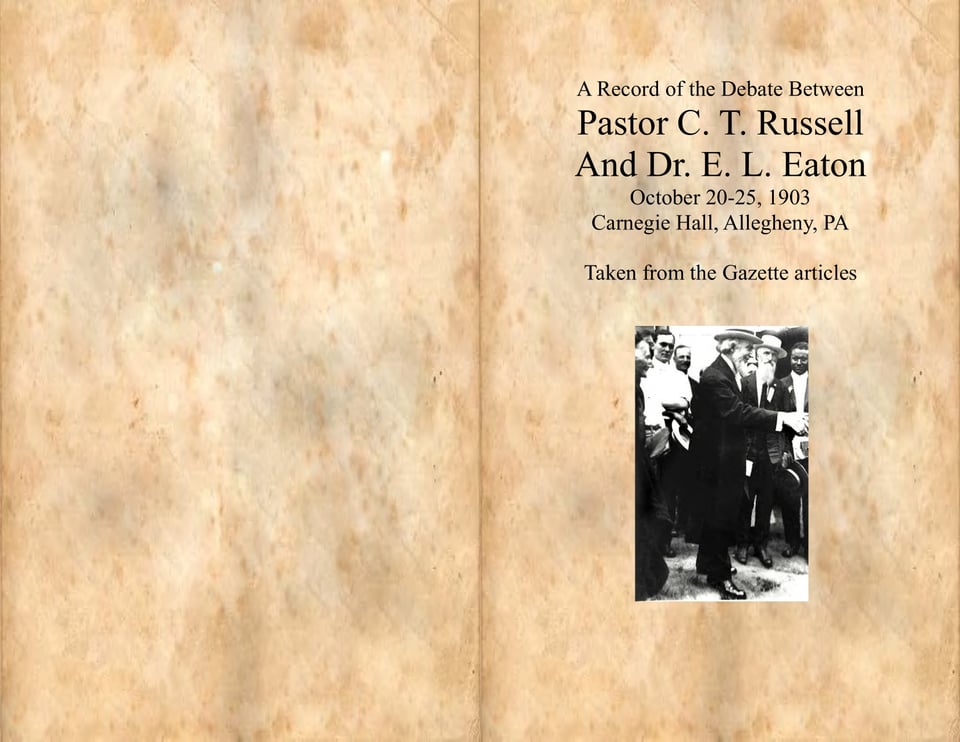
A Record of the Debate Between Pastor C. T. Russell And Dr. E. L. Eaton
October 20-25,1903 Carnegie Hall, Allegheny, PA
Taken from the Gazette articles
October 20-25, 1903
Carnegie Hall, Allegheny, PA
Taken from the Gazette articles
The image provided does not contain any text. It appears to be a grayscale photograph of a group of people in formal attire, possibly at a conference or event.
This image contains a placeholder for a background image. The placeholder is a rectangular area with a light beige texture. It is designed to represent a blank space where actual content can be placed.
ARE THE DEAD REALLY DEAD?
Debate on the Proposition that the Soul is then Unconscious Awaiting Judgment
IMMENSE AUDIENCE LISTENS TO THE REV. DR. E. L. EATON AND PASTOR C. T. RUSSELL—MANY COMPELLED TO STAND REPRINTED FROM THE GAZETTE OF OCTOBER 21
The second of a series of debates between the Rev. E. L. Eaton and Pastor C. T. Russell was held last night in Carnegie music hall, Allegheny. The big hall was crowded. The gallery was full, all the seats in the body of the auditorium were occupied, and in the rear aisle more than 100 persons were standing. The big audience remained until the last. The Rev. Dr. Henry D. Lindsay, pastor of the North Presbyterian church, presided over the meeting.
The topic debated was the proposition: "The scriptures clearly teach that the souls of the dead are unconscious while their bodies are in the grave." Mr. Russell took the affirmative side, Dr. Eaton denied the proposition. Each speaker spoke 50 minutes in turn and then each had 10 minutes for reply to the other.
The third of the debates will be held tomorrow evening, when this proposition will be debated: "The scriptures teach that all of the saved will become spirit beings and after the general judgment will enter heaven." Dr. Eaton will take the affirmative side and Mr. Russell the negative.
Last night's debate opened at 8 o'clock, Dr. Lindsay calling the meeting to order and saying a few words in explanation. Having the affirmative Mr. Russell led off as follows:
FORMING CHARACTER AFTER DEATH
Truth is stranger than fiction, is an old adage, but, nevertheless, a true one. We expect to show you this evening that the truth on the subject under discussion was lost sight of during the "Dark Ages," and that fiction has taken the place of truth in the minds of the people. I ask you, therefore, to have patience while you hear the testimony of the Scriptures, and that we remember that there is no one in this world competent to give a decision on this subject unless our heavenly Father has given the decision in the Scriptures.
The fiction is that which is entirely unsupported by the word of God, but which is generally recognized amongst Christian people in respect to the condition of mankind in death. The general view is that the moment of death is the turning point, and that all mankind at death either pass into a kind of awful misery, such as our brother described on Sunday, when a drop of water would be a tremendous blessing, and that a comparatively small number are fit, have characters formed, and are fit to be in the presence of God and the holy angels. That they are a little flock, and that the great mass of mankind, not having formed a character which God could approve, are unworthy and unready to enter into the glorious things of God, is, I think, an almost indisputable proposition. We are not to suppose for a moment that heaven is a great school in which people shall piece out the information and experiences of this present life, and there form character; but, on the contrary, there shall "enter into it nothing that defileth" or that would be imperfect in any sense, and, hence, according to our friends's consideration, only a little flock shall get to glory and all the remainder of mankind, hundreds of thousands and millions, are surely on the way to an eternity of trouble.
Our Catholic friends help out the matter a little by saying there will be a purgatory condition, and that after spending thousands of years there, they will be something better, as they make character.
BAD OUTLOOK FOR A MAJORITY
Dr. Eaton suggested to us Sunday afternoon that those going to their future condition at death shall have no chance of change after they get there. The whole matter is settled; whoever is fit to go to the right side of the gulf stays there, and whoever goes to the wrong side never gets farther. According to the great majority of Christians the most of mankind are pretty sure to go to the bad place, for the most of them have never even heard the only name given amongst men whereby they must be saved. Brother Eaton tells us they are prepared to go there, even if they have never heard the name of Jesus. That is a very different gospel than I ever heard, but I think it is to be credited to the brother's love of mankind, in that he was unwilling to think of the majority of the world suffering torture, even though they didn't know Christ, and he must get them into a good place without the help of the Redeemer. I cannot agree with his head, but I believe he has a good heart. (Applause)
On the side of the truth, the Scriptures teach that the whole world of mankind when they die are dead. It seems a strange proposition to have to make to an intelligent audience, that when a man dies he is dead; but, nevertheless, it is necessary to show this, because the majority of people, under the dominion of tradition from the dark ages, have come to the conclusion that when a man dies he is more alive than he ever was. (Laughter) The Scriptures teach that he is dead, and only when he gets a resurrection will he have reached a life condition. The resurrection and the atonement for sin go hand in hand in the Scriptures-they are the two most important themes of the Bible! The atonement, as the means of release from sin by the death of Christ, and the resurrection as the time when the release shall be accomplished by the power of the Redeemer.
NO WISDOM IN THE GRAVE
We wish to show that it is the divine plan and teaching of the Lord's word, that all go to sheol; the good and the bad; all have been redeemed from sheol, and all shall return from it. "As by one man's disobedience sin entered into the world," so through the death of Jesus Christ life and redemption have been found. As all go into sheol, and as all have been redeemed by the sacrifice of Christ from sheol, so all are in due time to be called forth from sheol. Sheol is not a place of life and activity. Our dear brother quoted a text on Sunday from Ecclesiastes in which it is distinctly declared that there is neither wisdom, device nor knowledge in the grave, whither thou goest. The word "grave" is "sheol," as our brother then declared. If there is no wisdom in the grave, the good cannot know anything there; likewise the wicked cannot know anything; if no knowledge is there, they cannot enjoy it, and if there is no device there, they cannot do anything. There is no pain
nor trouble nor torment there.
Our proposition that death is death, and that our dear ones, when they pass from us, are really dead, that they are neither alive with the angels nor with demons in a place of despair, is the teaching of the Scripture. It will not do for us to say that we prefer this or that arrangement of this matter; we must accept the Scriptural teaching as to God's plan, and whether it is agreeable to our minds or not, it is our duty to realize that God will not alter his plan one iota for our preference.
REASON FOR BEING GLAD
If we might feel a preference that our friends were in glory immediately at death, think, on the other hand, that there is good reason for being glad that those who we know are wicked and not fit for blissful conditions are not suffering the pains of everlasting torture as soon as they go out from this life; and we must admit that most of our friends and relatives have died out of Christ, have not lived up to that only standard of Scriptures which could gain for them an entrance into heavenly conditions — " sanctified, and meet for the Master's use."
Since the Master exhorted that his disciples should be "sanctified through Thy truth; Thy word is truth," all of us should be studious to obey the truth, remembering the other statement of the Scriptures, "He that loveth or maketh a lie" is not of the Lord.
I call your attention to the fact that all Christian people are practically agreed respecting original sin, that .it is taught in the Scriptures, that it is taught by the Apostle Paul, in Romans 5:12, "By one man's disobedience sin entered into the world, and death by sin." He does not say by one man's disobedience sin entered into the world, and eternal torment as the result of sin; but he does say death is the result of sin. The great error was made in the dark ages, the time when they burned each other, and gouged out each other's eyes saying, "It is better to give them a little torment now, to save them from falling into God's hands after a while, and having them endure an endless torture of a far worse kind.
The record in Genesis is that God created our first parents in his own image and likeness, and placed them upon trial for life. He gave them a command, and made a test to them of obedience, not whether they would commit murder or villainy, but whether they would be obedient to him, that they might live. If they would disobey him they should die!
They disobeyed — weare not excusing them; God justly put upon them the penalty of their sin. But the question is, what was the penalty for sin? Was it any kind of torment? No, the Scriptures declare most explicitly, "The wages of sin is death," not torment at all. We read the account in Genesis 2, concerning the command given to Adam. If God intended that his child should go to eternal torment on account of that act of disobedience, why did he not say so? Could a sane man give an excuse for an Almighty, heavenly, Father dealing with his child in paradise, and deceiving him into thinking that the penalty was something else than what he really intended, if he intended on account of that sin to turn him over to devils, to roast and boil and burn him to all eternity? Is there anything of that kind in the record?
I have not seen it.
Theologians have taken this wrong view of the matter from the expression "in the day," as it occurs here, and they weave various kinds of interpretations about the day mentioned; but we find it very plain when we read Peter's explanation, "A day with the Lord is as a thousand years." Here is the statement of the Lord in Genesis to Adam that he should die within a day, and he did die within the thousand-year day of the Lord's reckoning.
After the sin the Lord pronounced the sentence upon the guilty pair, a sentence which extended to every member of their race: "Dust thou art, and unto dust shalt thou return." But does it not say something else about that in the Scriptures? Does it not say that they would not die? Yes, Satan appeared to Eve, and guaranteed, "Ye shall not surely die," and as a matter of fact do we not see that the whole world is believing Satan, that when a man dies he will be more alive than ever, and disbelieving God's statement, that when a man dies he is truly dead.
We read of the curse all through the Scriptures. What does it mean? It means this sentence of death which came by disobedience, on account of which the whole human family is groaning and travailing in pain together, as declared by the apostle in Rom. 8: 17-23-they are suffering the effects of the curse, mentally, morally and physically, all leading to the ultimate end, death itself. "The soul that sinneth it shall die," and "the wages of sin is death," are the emphatic scriptural declarations.
Where is the hope? In the statement, "God so loved the world that He gave His only begotten Son, that whosoever believeth in Him should not perish"—here referring again to the terms of the sentence not eternal torment, but perishing, death—" but have everlasting life." The sentence of perishing was eternal, were it not for the fact that God provided a redemption through Jesus Christ, who is represented in the Scriptures as "the Lamb slain" (taking the place in death of the condemned race) "from the foundation of the world."
The release from this death condition is to come through a resurrection of the dead. There could not be a resurrection of the dead if there is nobody dead. It is only those who are dead who have part in the resurrection of the dead. This is what the Scriptures call to our attention as the good tidings of salvation, deliverance from the penalty upon us of eternal death. The whole stress lies upon the work of Jesus Christ; if there had been no sacrifice for sins then the sentence would have remained, the penalty or curse would have everlastingly continued. So the apostle suggests that "He is the propitiation for our (the church's) sins, and not for ours only, but also for the sins of the whole world." How many does that leave out in this great salvation, which began to be spoken by our Lord? (Applause)
It was never spoken before; there never was a hope in the resurrection set forth in a definite way, because the ransom price had not been paid previously. The most that could be done was to give a suggestive hope, as the Lord did to Abraham, "In thy seed (when your seed shall come) all the families of the earth shall be blessed."
THOUGH LIVING, WE ARE DYING
We speak of "being saved," but only in the reckoned sense. Actually we are still subject to the pains, distresses and difficulties incident to the penalty of death; but those who are trusting in the Lord are accounted as saved from the death penalty, and are looking for the blessing of the salvation "which shall be revealed in us ... in due time—inthe resurrection. We have death working in us actually, but the life through Christ, by faith, by trust in the life-giver.
If the penalty of sin had been eternal torment then would our dear Redeemer have gone to that condition in order to be our ransom price, if He would suffer in our stead. But the Scriptures declare, "Christ died for our sins, and rose again for our justification." In the present time only a small class have ever come to an opportunity to know of the life giver; very few, and those only since the first advent have ever heard the name of the Lord Jesus.
God's purpose is that in due time there may come forth, for God's will is that all may be saved and come to the knowledge of the truth." Not saved with eternal salvation, but saved from this destruction in death, which Christ redeemed them from with His own death. They are saved in the sense that they will come forth from the tomb and have the opportunity of accepting the only name whereby we must be saved.
I agree with my brother Eaton entirely that all the dead go to sheol, but this is a word very little understood amongst people except Hebrew scholars. The Hebrew word stands for "the hidden state." In the old Testament Scriptures, the authorized version, the word sheol is 31 times rendered hell; the same word sheol is 31 times rendered grave; in other words, the grave is hell, and hell is the grave. It is a pretty dark place, damp, cold and lonely, which is sometimes pictured to us as so hot! Jacob, speaking about his son, Gen. 37: 35, says, "I will go down into the grave to my son mourning" — otherwise translated. "I will go down into hell to my son mourning."
THE APPEAL OF JOB
And again, "O, that thou wouldst hide me in the grave"—the translators might just as well have translated it hell; but it didn't refer to the theological hell; Job was suffering with his boils and disasters, and was longing for release; then he called to God to hide him in the grave; "Then thou shalt call and I will answer thee, for thou shalt have desire unto the works of thy hands." He was going down to hell, and yet he knew that in due time God would answer him and bring him forth — when? In the resurrection.
"In the grave (sheol) who shall give thee thanks?" David evidently didn't know anything about a compartment in hell where he would sing praises to God. Psalm 16:10, "Thou wilt not leave my soul in hell (sheol)" — Christ'ssoul was not left in the grave, and so Peter applies it in the Book of Acts, stating that it was not David speaking of himself, but being a prophet, he spoke of Christ. God raised him from the dead after he was three days in the grave. Psalm 18:5. Psalm 31:17. "Let them be silent in the grave" — insheol. Then there will be no cursing of God and blaspheming and shouting at all!
Psalm 49:15, "Like sheep they are laid in the grave" insheol " their beauty shall consume in the grave" insheol " death shall feed upon them." When we understand that sheol is a part of the same sentence of death that came upon all, and that David here desired that God would raise him up out of the power of it, by a resurrection from sheol, we get the scriptural thought in harmony with the entire word of God. Again, "Whatsoever thy hand findeth to do, do it with thy might, for there is neither wisdom, device nor knowledge in the grave whither thou goest." Isaiah 38:10, "I shall go to the gates of the grave. The grave cannot praise thee as I do this day."
THE PRAYER OF HEZEKIAH
This occurs in Hezekiah's prayer, when the prophet told him he was to die. He did not think it was a good place to go to, and God did not inform him of a misconception regarding sheol, by assuring him that sheol was a desirable, fit and proper condition, and a place of bliss and happiness; but God answered Hezekiah's prayer and gave him 15 more years of life in which to praise God, knowing that that could not be done in sheol. Psalm 6: 5. "In death there is no remembrance of thee; in the grave who shall give thee thanks?" Nobody. There must be a resurrection before they can give God thanks. "Wilt thou show wonders to the dead? Shall the dead praise thee? Shall the loving kindness be declared in the grave, or thy faithfulness in destruction? Shall wonders be known in the dark and thy righteousness in the land of forgetfulness?" The grave is the land of forgetfulness. Psalm 146: 4, "His breath goeth forth; he returneth to his earth; in that very day his thoughts perish." How much can we think about then? Ecc. 9: 5, "The living know that they shall die, but the dead know not anything." Ecc. 9: 10, 12: 7; Isaiah 38: 18; Deut. 31: 16.
Then a few texts in which this matter is spoken of as a sleep. Deut. 31:16; 1 Kings 2:10, 11:43; 2 Chron. 12:16; 2 Chron. 21:1. Some of these men were good, and some bad, but they all went to sleep when they died. Matt. 9:24, "The maid is not dead but sleepeth." John 11:11, "Our friend Lazarus sleepeth, but I go that I may awake him out of sleep." 1 Thess. 9:13, "I would not have you ignorant concerning them which are asleep." "Them which sleep also in Jesus will God bring from the dead by Him." Psalm 17:15; Dan. 12:2. Of David it is declared, "He is not ascended into heaven, but his sepulchre is with us unto this day." He is still asleep; he will be satisfied when he awakes in the morning. Job 14:14, "All the days of my appointed time shall I wait until my change come; thou wilt call and I will answer; and thou shall have respect unto the work of thy hands." In the resurrection morning the Lord will call Job and all others from their sleeping condition, in sheol, in the tomb, in their present state of oblivion.
DR. EATON'S REPLY
Dr. Eaton, in denying the proposition, said:
Our friend Russell has made an excellent speech, and he has done exceedingly well. It is surprising how much there is on both sides of this proposition, and you have to decide it according to the best evidence we have. This subject in the main has been thoroughly well treated, and I have been impressed with the case as he has stated it. I will point out a few errors, however, as we proceed.
In the first place, these Old Testament Scriptures are somewhat obscure. The men themselves did not have a very clear understanding concerning the matter. We have had a very full array of Old Testament texts, but we cannot rest the case entirely on any class of statements, for we shall find texts on both sides. We must realize that revelation is progressive and growing and evolving, and the New Testament, the last word that God has had to say to men, is very much more distinct than the first. There is a good deal of indistinctness about the early addresses, but they grow clearer as time advances. So we have to interpret the old by the new. The matter of sleep: I grant that death is often spoken of in that way, but only in figurative sense. We often speak of death as a sleep, but did you ever hear anyone speak of the sleep of death? I never did. All poetical minds tried to represent the harsh and severe things of death by the poetical term sleep. A precious friend died after a long sickness and I telegraphed to a friend far away, "Mary fell asleep at midnight," but I did not believe in soul sleeping, and I didn't believe she was asleep. Everybody uses that expression. Jesus said to the disciples, "Lazarus is sleeping, and I go to awake him out of sleep." When they showed a misunderstanding he said plainly, literally, "Lazarus is dead," he was dead — he was not asleep. When Jesus wanted to explain a thing he dropped the figure and spoke in plain terms; and that is all there is of it.
When God made Adam He formed his body of the dust of the earth; that was his body, his animal body, which could not continue forever alive, unless God specially intervened, through the sacramental use of the tree of life, or some other way. He also breathed into his nostrils the breath of life or lives, and man became a living soul. That soul is the thing created in God's likeness and image, and the likeness consists of the qualities or elements of that soul, not the body. That likeness consists of the intellect, sensibility and will, as all psychologists today agree, that the human soul is thus composed, possessing the power to decide, choose and act. In that respect a soul is like God. We can think God's thoughts because he gave us a thinker, a soul, to do it with; hence, this thinker is in His likeness, and this thinker is immortal; immortal in this sense only, that it was made to live. It is never called immortal and there is no such expression in the Scriptures as "immortal soul" but the expression "a living soul" does occur frequently I mean a soul that is made to live until something kills it and prevents its further existence.
When that first soul was created and sinned, the penalty given was death. Death to the body death to the soul also; physical death and moral death. Annihilation? Extinction? No. Christ said to the Jews, "Let the dead bury their dead." What did he mean? Let those who are morally dead bury those who are physically dead. If he did not mean that, what did he mean? Death of the body is only one element of the sentence; physical, animal death is one element; the second element is the death of the soul, namely, moral death, depravity. "Awake thou that sleepest, and Christ shall give thee life." What sort of death are you to rise from? Moral death; the curse that came upon all men. There is another kind of death, eternal death. "The wages of sin is death, but the gift of God is eternal life." Over against eternal life stands death, eternal death—whatever that may mean.
The one is the antithesis of the other.
THE THEORY OF PURGATORY
Now we will talk a little about the intermediate state. That is the state of conscious existence between death and the resurrection for the entire human race, in sheol, in the Old Testament, and hades of the New Testament. The reformers rejected the doctrine of the intermediate state, because they feared it would bring in the doctrine of purgatory and future probation. I do not teach that it is a state of probation at all, or of purgatory. The Catholic doctrine of purgatory is based upon this, that Christ did not die for the sins of all men — thathe paid the penalty for the great sins, the mortal sins, and that to the church is left the work of providing satisfaction for the venial small sins. It is not in the Scriptures at all. We are saved through Jesus Christ from all things from which we could not be justified by the law of Moses.
Our diagram show the features illustrating the intermediate state; these diagrams are a good thing to help the eye. Here a dark wedge begins immediately after infancy and increasingly separates those inclined toward righteousness and those inclined toward evil, the saints from sinners. It is only a speck at the beginning, but is wide and deep at the end of life, and life ends every prospect of altering the situation. There is a good deal of inspiration in this map-Edison said inspiration consisted of 2 per cent inspiration and 98 per cent perspiration.
The old King James version of the Bible, which translates sheol 65 times and translates it every time, never transliterates it, 31 times hell, 31 times grave and three times pit, every time wrongly. The revised version does a little better; but the American revision never translates sheol once nor hades once, but uses common sense and transliterates. Sheol is an English word, just as Jehovah, or Hallelujah, and hades is an English word similarly. Everybody should know what these words mean. They do not mean heaven, because the Hebrew word for heaven, chayin, is used 720 times in the Old Testament quite independently. It never means grave; it has no physical idea attached to it. Qeber is the word used for grave. It means just what it says, the place and state into which the entire human race go when they die; not heaven, not hell, but sheol. The Hebrews did not know what that state was.
ANOTHER TRANSLATION OF SHEOL
Our brother gives a good many texts which give an obscure idea of their meaning, but there are a few texts which show what it does mean clearly. The Greek version of the Old Testament, the Septuagint, prepared for the Greeks by learned Hebrew-Greek scholars three centuries before Christ, almost always used the word hades in translating sheol in the Greek, and hides means the place where people go when they die. You cannot get away from that. (Loud applause) I might quote a lot of texts which make that very clear. If it was the grave, why didn't the Hebrews translate it with that word when making their Greek translation? "I will go down to sheol to my son mourning." Old Jacob had just been told his son had been eaten up with wild beasts, and he believed it. In other words, this was a grief which he said would kill him, and he would go down to his son, he would die of grief, and he would meet his son. The son's body was in the stomach of a lion. (Laughter) Did he expect to crawl into the stomach of a lion to meet his
son? He thought there was some conscious state of existence where he would go to meet his son.
"Like a flock they are laid in the grave." That translation is simply awful! A flock of sheep laid in the gravel A poetical Hebrew writing such a thing as that! (Laughter) Read the revised version: "Like a flock of sheep they are appointed to sheol"— everybody.Like a flock of sheep, excited, and following their leader over the highest corner of the fence, they are rushing to sheol.
"Whatsoever thy hand findeth to do with thy might, for there is neither wisdom device nor knowledge in the grave." Does that mean you will go to sleep? Well what motive have you to do with your might if that is true? The idea is that whatsoever thy hand findeth to do to win the favor of God do it with your might, for you cannot do it in sheol. To read it as in the authorized version is simply a delusion. I have a right to manufacture Scripture in this sense, upon the authority of the Apostles Peter and Paul. Peter said: "He that prophesieth must prophesy according to the analogia of faith." You cannot take Scriptures and read them against the whole word of God. Peter says: "No prophecy is of any private interpretation." The word of God teaches that there is no chance to be saved in sheol, therefore do the best you can in this life, and do it at once.
SCRIPTURAL REFERENCES TO HELL
Psalm 55:15: "Let them go down alive into sheol." Our brother says they always died. "The wicked shall be turned into sheol, and all the nations that forget God." That is not a very determinative text, however, it might do on either side. "If I make my bed in hell, 10, thou art there; there shall thy hand lead me." God is everywhere, and all conscious beings could go to Him." Jonah's nautical experience would be in harmony with this. He found God in the uttermost part of the sea. "Hell from beneath is moved for thee, to meet thee at thy coming." This is the picture of the great jambouree in hell, the taunting, laughing devils greeted him with their derisions. A scene like that in the grave? That is a great place to look for it. O, my brother, you will have to give it up.
The dark side of sheol: Tartarus, the lower sheol. "Out of the belly of hell cried I and thou heardest my voice." I maintain that Jonah was dead, and although I could not prove it, unless this Scripture proves it, I think he went into the sea and sank there, died and went to sheol, and after an interview with Jehovah received inspiration to go to Nineveh. He was not unconscious. He was more alive than he ever was. "The waters compassed me about. Weeds were wrapped about my head." This is a reference to his lying at the bottom of the sea. The Hebrews held the idea of sheol vaguely, indistinctly, so that we cannot get it clearly from the old Testament. It is very doubtful if you could find immortality in the old Testament. But we have no difficulty when we get to the new.
When sheol means hell it is always accompanied by a modifying word, "Hell from beneath is moved." "Thou deliverest my soul from the lowest hell." "Her guests are in the depths of hell."
NOT AN ETERNAL STATE Sheol is not an eternal state, just as the diagram indicates.
"Thou wilt not leave my soul there. God's power goes down and brings hi. 'm up. Our brother thinks there is a long sleep before that time, but my idea is that the conscious state of existence continues until the resurrection.
We come now to the most complete and perfect representation in the world in the sixteenth chapter of Luke, the rich man and Lazarus. "In hades he lifted up his eyes." He was on the lower side. A great gulf was fixed, so that he could not pass over, nor Lazarus pass to him. Every element of hades and sheol is all in that parable, and though our brother strives tooth and nail to get some other mystical meaning out of it, it is a clear study of character. The gulf of character is there, that separates the human race into saints and sinners in this life.
My answer to soul-sleeping is the intermediate state. If anybody can understandingly study the intermediate state and fairly grasp it and stick to soul sleeping he can do more than I. There is a conscious state for all mankind. He goes on living; he will continue to live until something will stop that existence, and there is nothing in the soul itself that can bring about that.
"I saw a pale horse, whose name was death, and hades followed with him." Death goes to take the bodies and hades to take the souls. "Death and hades gave up the dead that were in them." Death gives up the bodies and hades the soul." "The last enemy that shall be destroyed is death." "Death and hades were cast into the lake of fire;" that is the end of the intermediate state. I agree with our brother in his opinion that everybody has not gone to heaven. The theologians are foolishly giving us a lot of rot in preaching folks to heaven. Every funeral you go to the minister declare that the dead are in heaven. John Wesley said no human being has gone to heaven. He said they went to hades. "No man hath ascended into heaven." — John3: 13. "No man hath seen God at any time." Jesus knew what He was talking about. Our brother quoted, "David is not yet ascended into heaven." Nobody has gone to heaven; nobody will go to heaven until after the resurrection and judgment. Then comes the eternal state of heaven and gehenna. But we are not going into that now; that will come later.
AGREE UPON SOME POINTS Pastor Russell, in reply to Dr. Eaton's contention, said:
I am very glad there are some points of agreement; that our brother believes that the scriptures are true, that all go into sheol, and that the word hades of the New Testament is the exact equivalent of the word sheol in the Old. The two words are identical in their meaning, the one from the Greek and the other from the Hebrew. Whatever is true in respect to the use of the Hebrew word is true also in respect to the Greek word. Therefore if there is neither wisdom nor knowledge nor device in sheol, neither is their wisdom, knowledge or device in hades, whither thou goest.
This is a very interesting chart, but one of the most interesting features is that there is very little Scripture about it. You notice that our dear brother knows all about this matter I do not know how. (Laughter and applause) He has pointed
out that here is Tartarus, and there is something else, but how does he know? What do the Scriptures say? The word Tartarus occurs only once in the New Testament, and it is never associated with hades at all. It refers to the condition in which the spirits in prison are. And that gulf, which our dear brother has chosen for his whole theory! If that parable were not there, I am wondering what our dear brother would have done! (Laughter and applause).We are going to hold that parable, it is too good to give right away. But we want you to think of this. That poor rich man in the parable has some resemblances to every one of you. I see some here with white linen; I see by your aces that you have fared sumptuously today. Those were two of the items which were recorded against the rich man. You have no sores, nor are you reclining at the rich man's gate.
APPLICATION OF A PARABLE
Now watch out! If you are going to apply the parable as our brother has you will have to apply to yourselves the fate you give the rich man! Our brother thought I was fighting tooth and nail about this parable, but this is the first time I have mentioned it. He has been the one who has been worrying about it. Wait awhile, dear friends, and meantime think that to carry that precious cup of water across the gulf, when a whole bucketful would evaporate before it got to hades, would be a most extraordinary procedure.
Our brother wants to know whether Jacob looked to go to his son Joseph in the belly of the lion. By no means. We did not claim that the word grave is the full translation of the word sheol; we do claim that grave is a better translation of it than hell. "The nearest English thought is "the hidden state." Jacob did expect to go into the death state to his son, because he anticipated that that was where his son had gone. If you will take an unabridged dictionary you will find that at the time of the translating of our Bible in the old version they used this word "hell" in a very general way. A man would speak of "helling" his house — hemeant that he was going to thatch it. Or he would speak of "helling" his potatoes — heintended to cover them in a pit, in a dark, damp condition, without any suggestion of heat or light or intelligence. We shall have something to say about this entire matter, and a satisfactory explanation of the rich man and Lazarus in due time.
I agree very well with our brother regarding the "flock of sheep." They do rush to sheol. The people are all rushing to the tomb, the place into which they have been consigned until the time for awakening of them all, the dismal, dark place, where "the dead cannot praise thee; in sheol who shall give thee thanks!"
THE LOWEST HELL
The "lowest hell" signifies the most complete destruction. "Hell from beneath is moved to meet thee at thy coming." You will see, if you will take your Bibles, and read carefully this statement in Ezekiel 14, that the whole matter is figurative language; it represents the fall of a great dynasty, a great government, just the same exactly as the Lord spoke of coming upon Capernaum — "exalted to heaven cast down to hell" brought down to a death condition, to utter overthrow. Just so with Babylon, which is now completely desolated without inhabitant. "Then shall be brought to pass the saying that is written, "0 death where is thy sting; O grave where is thy victory?" The prophet points out that the time is coming when hades is to be destroyed.
How will he destroy hades? By bringing the people out of it. "All that are in their graves" shall be awakened, and there won't be hades any longer. God pointed out in advance how the great work of Christ should be to redeem the world by the sacrifice of Himself, and that having given the sacrifice on behalf of the whole world He should release the world from hades, and grant to all men the opportunity of life. To some special ones, who are specially favored, there will be particular privileges — the Lord is blessing you and me with the knowledge of His plan so that we may be reckoned as already passing from death unto life, but the time for the world to have the opportunity of coming out will be future, when their time of resurrection shall come, the general resurrection. The church shall have part in the first resurrection, and the world in the general resurrection. Then shall be brought to pass the saying that is written, "0 death where is thy sting, 0 grave where is thy victory?" This sting has been on the race all the time since the fall, it is stinging the whole world, but in God's due time it shall be removed.
CLOSE OF THE DEBATE
Dr Eaton in closing the evening's debate said:
It is very interesting to see how very much in common we hold in this doctrine of the intermediate state. The only question is whether it is a conscious existence or not, and, of course, that has its tremendous influences on the other discussions to follow. I did my best to bring him out on the rich man and Lazarus, but I could not. He won't say what he thinks and he is very wise that he does not. We will get it, however, in due time, and he hopes I will be out of breath by that time. If he could only make a figure out of it he would be all right. He says we don't know anything about Tartarus? The word is used as a verb in 1 Pet. 3:18, and means that God tartarused them to hades. Tartarus is the hell of hades. All Greek scholars knew of Tartarus, but they thought of it as eternal, while we see that it is only until the resurrection.
The Lord's words to the thief, "Today thou shalt be with me in Paradise." That was a conscious state of existence, not the grave. Paul says, "I knew a man in Christ, caught up to the third heaven" — the throne of God. And then he goes on, "I knew a man who was caught up to Paradise, and heard unspeakable words." In those words Paul describes two experiences, two visions, one in heaven, the other in the Paradise of hades.
To him that overcometh will I give to eat of the tree of life that grows in the Paradise of God." Peter says the soul of Jesus went to hades, in quoting the 16th Psalm, while His body went to the tomb. Jesus himself said He would go to Paradise in speaking to the thief. And Jesus said immediately upon His resurrection to one of the disciples, "Touch Me not, for I am not yet ascended to My Father." He had gone to hades, to Paradise, He did not go to the Father. Is not that right? Paradise is the intermediate state, where all the good go at death. Tartarus is the intermediate state where all the evil go at the same time.
CLEARNESS OF SCRIPTURAL TEACHINGS DEBATED ON BY ALLEGHENY BIBLE EXPERTS Both Speakers Make Telling Points and Earn Much Applause AUDIENCE VERY ENTHUSIASTIC REPRINTED FROM THE GAZETTE OF OCTOBER 23
Standing room was at a premium in Allegheny Carnegie Music hall last night where the third joint debate between the Rev. Dr. E. L. Eaton of the North Avenue Methodist Episcopal church, Allegheny, and Pastor C. T. Russell of the Bible House congregation opened. The entire floor, gallery and the vestibule leading to the big hall were crowded with people. The audience was probably the largest since the debate began last Sunday afternoon.
The Rev. J. W Sproull, D. D., presided at the meeting, and after announcing the subject for discussion introduced the debaters. Besides the discussion of the subject, there was a lively and learned debate on the Hebrew words, their definition and application as used in the Scriptures. During the discussion the original subject was almost lost sight of for a time while the speakers discussed Hebrew words.
The usual devotional exercises preceded the discussion and a number of hymns were rendered during and at the close of the speeches. Prof. B. Frank Walters of the Bible House congregation, presided at the organ. The stage was occupied by a large number of ministers.
The subject of the debate last night was that "The Scriptures clearly teach that all of the saved will become spirit beings, and after the general judgment will enter heaven."
Dr. Eaton affirmed and Pastor Russell denied. Dr. Eaton opened the affirmative side as follows:
THE BASIS OF THE DOCTRINE
Mark Hopkins was one of the most distinguished teachers that this country ever produced, and he had a way of teaching what he thought was truth and what was false in evolution, and I will give you a little idea of his that will become the basis of the doctrine I am going to speak of tonight, namely, regeneration. His idea was that the first great law of nature, the most extensive and universal, was the law of gravity, and the next law of nature, not so extensive, but more intensive, was the law of cohesion, which held the particles of matter together. Gravity pulls down, but cohesion holds together in spite of gravity, so that the former is a law higher than the latter, but does not grow out of the latter, it contains all there is in gravity plus something more, and that something more is from above, and comes by a creative act. It is not therefore evolution, that is, atheistic evolution, but evolution by creation.
Next above cohesion we get chemical affinity, higher than cohesion, containing all there is of cohesion, gravity and chemical affinity plus something more, and that something is from above, by creation.
Next is the law of vegetable life. We have the vegetables that contain all tile first three principles in operation, and something above, the product of a creative act. When we reach life, we reach the great question that has been occupying the minds of scientists specially for the past fifty years and particularly the last twenty-five. Such men as Hegal, Huxley, Spencer, M. Pasteur and Tyndall, keenest brains, are practically agreed that life comes from preexistent life, that dead matter cannot become living matter until it comes under the influence of matter previously alive. Life is a creation from God. I am an evolutionist of that kind, theistic evolution. Science stands by that, and I stand by science.
DARWINISM NOT SUSTAINED
Next above life is the production of species. Charles Darwin spent his life in trying to show that species originated by natural causes, but Huxley before his death, stated that to place Darwin's doctrine beyond a possibility of assault, ought to have shown two things, namely, that varieties within one-species could be so widely divergent by raising or breeding as to be no longer fertile one with another; secondly, that hybrids could be made fertile. Neither of these propositions is sustained, and Darwin's doctrine falls to the ground. Next above the animal kingdom is man; his body, which is like every other animal, only a little better built, although I have seen some men that do not seem to be so handsome as dogs, and some women that are more homely than horses. But man was made of the dust of the ground, of material things, just as the tower animals were. In many respects the animals excel as animals, not in all; the superiority of man is not in this physical nature chiefly. I thoroughly believe the word of God, which states that he formed man's body of the dust of the ground, and breathed into his nostrils the breath of life, and man became a living soul. He breathed something into that body, the breath of life. In the Hebrew whenever animals are said to have the breath of life it is always the word ruach chai, although it is never said to have been breathed into animals; when man is said to have the breath of life it is always nishma chai? All men and animals died at the flood "in which was the breath of-life"— nishmaruach chai — thecombination showing that destruction of both animals and men.
The creation of man in the image and likeness of God signifies that God constituted man in his basic faculties like God — hehad sensibilities like God; he had a will like God; all the beings in the universe can think, feel and act, believe, love and obey; all the beings in the universe that believe God, love God and obey God, are God's children, wherever they live. To have consecrated that intellect to God, by believing in him, and that heart to God by loving him, and that will to God by obeying him, constitutes them God's children, whether they were born in heathen or Christian lands. If they did that, they are God's children. That is what Peter said to Cornelius when he said, "In all nations he that feareth God is working righteousness and is accepted by Him."
But man does not stop when he has a soul. That soul is a mortal soul, in the sense I described the other night, in the sense that there is no self-existent condition; in
the sense that it was made to live, and not to die; in this only is it properly a living soul—itis nowhere in the Scriptures called an immortal soul. The soul's nature is to live, and therefore it cannot sleep or go into none-existence; it is a living soul. Originally it was sinless, but it lost that, as our brother taught the other night. Depravity has smitten the race. What is depravity? It is a moral twist. Depravity does not add any faculty; it does not add any intellectual or physical or moral faculty; but it does subtract, blur, weaken them. We all come into the world with that twist, but, thank God, we come with a Redeemer already provided.
When a man builds a state he founds a prison; when God established the world He provided a Redeemer. My brother said that in Christ, as the seed, all the families of the earth shall be blessed; they are being blessed. There would have been no one blessed if it had not been for Christ. God was not mean enough to make Adam and Eve the father and mother of the race without a Redeemer, and therefore He has blessed every man, woman and child of the race. They are all blessed in Christ.
REGENERATED MAN IS A TRICHOTONATE
The spiritual nature comes by regeneration. The animal condition is gravity, cohesion, chemical affinity, vegetable life, plus; man is animal, vegetable and all below it, plus. Plus what? Plus the soul. But does he stop when he gets a soul? No; man is soul, animal, vegetable, and all below, plus a spirit nature. How does spirit come to him? By regeneration. God did not make him a spirit being originally; man was originally a bichotonate — having two parts, having a body and soul. When he becomes regenerated he is a trichotonate three parts, body, soul and spirit. That which makes one a trichotonate is a thing nota quality nor an attribute nor an experience; but a thing, as a body is a thing, a soul is a thing, an identity; a spirit entity is bestowed upon us, or comes within us, in regeneration.
Go to the first chapter of John, and there you strike regeneration squarely. Until you get to John you would never dream that there is any such thing as regeneration Matthew, Mark or Luke say nothing of it. How did Matthew get people saved? He said, "Accept the Messiah and join the procession." But John did not teach that. You cannot be saved by joining the church, nor the procession. You have got to have regeneration, by the power of the Holy Ghost, in this life (Applause)
The first chapter of John has these words, "To those that received Him, to them gave He power (right, authority) to become the children of God." Were they not children before? No. I repudiate this nonsense that is going about all over the country that everybody is a child of God because he is a human being; that is unscriptural. God's children are those who are born again, by the power of the Holy Ghost. (Applause)
We hear much of the brotherhood of man, which I affirm, and the Fatherhood of God, which I deny. It is not a corollary. I believe in the unity of humanity, but not that mankind belongs to God unless they get to Him by regeneration. This text proves it. You cannot be born saved, as the followers of Islam believe; you cannot be born saved, as the Catholics believe; nor as some of the members of the Methodist church believe. Belonging to a church won't save anybody. Nothing can save you but being born of the Holy Ghost.
That is the doctrine of regeneration squarely.
CAN MANUFACTURE SCRIPTURE
We have this gain in the third chapter of John, "Except a man be born from above he cannot inherit the kingdom of God. "That which is born of the flesh is flesh;" that is simple. "That which is born of the spirit (meaning the Holy Ghost) is a spirit." Manufacturing Scripture again, am I? I said I had a right to manufacture Scripture, to borrow Paul's and Peter's direction. Why do I put in "a" there? Because every Greek scholar knows that when a noun has no article before it he must put in an indefinite article in order to make sense. "That which is born of the flesh is flesh; that which is born of the spirit is spirit."
Now you have your spiritual nature, a deposit from the Holy Ghost in men, an entity, not a quality, a faculty; but a thing from God. You are a trichotomy, a three-part being, body, soul and spirit; you are complete now. It goes on to say, "Except a man be born of water and the spirit he cannot see the kingdom of God." In regeneration there are two distinct things to think of. One is, the soul needs cleansing of its impurity. It is crooked; it needs straightening; it is weak, it needs strengthening. All the work upon the soul is symbolized by water — baptism, if you choose; immersion, if you choose. I take the whole thing and won't quarrel about it.
Water is the symbol of what is to be done to the soul. Depravity must be cured, and is cured by regeneration. The other part is the importation of the divine nature, by what is called the breathing in of the spirit. That is the doctrine of regeneration; that is the great thing to be done to the soul in human life, if he is ever made a child of God. The Bible does not call him a child of wrath, a child of the wicked one anything but a child of God. I do not frequently use the word, "a child of the devil," because if I had a son who was wicked and remained unconverted, and I called him a child of the devil, it might reflect on me. But if he went to the devil I guess he would have to be called that.
A NATURAL AND A SPIRITUAL BODY
"There is a natural body, and there is a spiritual body"— "natural" here is from the Greek psuche, which means soul, translated seven times soul and 41 times life in the New Testament. "There is a soulical body" — I am making an adjective now to fit the word—a soulical body; I am looking at a thousand soulical bodies now humanbeings. "There is a soulical body and there is a pneumaticon body." The pneumaticon body is the one that you will have in the resurrection. "The first man Adam was made a living soul" — psuche.You cannot find an Old Testament text that calls an unconverted unregenerate man a spirit or a spiritual man. Oh, yes, it speaks of Pharoah having "lost his spirit." The word ruach is sometimes used in the psychological sense for mental state; when Pharoah lost his spirit he lost his courage. But you cannot find the word applied literally to any unregenerate unconverted man in the Bible. "The first man is of the earth, earthy; the second man is the Lord from heaven." "On heaven," says the revised version. The old translators thought there was a contrast here between the Lord and Adam; it is not so at all; it is a contrast between the first and the second man, between "I," unregenerate, on the one hand and "I," regenerate, on the other.
A spiritual man belongs to another species; he is not another variety of man; he belongs to spiritual and heavenly things. Where shall I place him? Not in another form, but in another kingdom. I am just a common Methodist preacher, but I don't preach any more that regeneration means merely quitting your meanness although I would like to have that; I don't mean that regeneration is merely being good. I teach, on the authority of science and the Word of God that in order to be a spiritual man you will have to be made so by the power of the Holy Ghost. "The psuche man receiveth not the things of the spirit of God, for they are foolishness unto him; neither can he know them, for they are spiritually discerned." You have to be regenerated to see spiritual things. That is why so many unregenerated fools go about and say "I don't think there is anything in the Bible." They are psuche men. They are not regenerated.
PETER TOLD OF PROMISES
Our Lord in dying spoke of his "spirit" — pneuma, as did Stephen, but of unregenerate persons in the New Testament this word is not used. Ananias and Sap-phira are referred to as giving up the ghost — psuche. Jude 9, the apostle in describing terribly wicked people, who did not have a spirit nature, and refers to them as psuchechon, soulical people. Peter tells us about exceeding great and precious promises whereby we are made partakers of the divine nature. Do we become divine and become gods? I do not say that at all; we are made partakers of the divine nature, by being regenerated; but imputed a child of God, not politically a child of God, not incorporated a child of God, nor adopted a child of God — heis made a child of God. That is where God gets His children, by nature, by nature they become His, by the incoming of His own nature.
To every son of Adam's race, if they turn to God as loyal children. He will give them the great and precious promises to become His spiritual children. Little children when they come to years of accountability, if they follow the right will receive it unconsciously, and it will be a normal thing, so that they cannot recognize the time when they became God's children, as thousands of Christians today cannot recognize such a time. If those children die before accountability I do not know what will be their conditions, nor does anybody else know; but we have the Lord's words, "Of such is the kingdom of heaven." GOd will provide some method of regeneration, and they must get regeneration before they will be made angels. If a man backslides, what comes in? Does he lose his spirit nature? No, but he perverts it, and it becomes devilish, just as those who were possessed of the evil spirits in our Lord's time. He is more able to do devilish things than he was before, and the last state of that man is worse than the first.
A hymn was rendered by the audience at the conclusion of Dr. Eaton's speech and then Pastor Russell arose and said in reply:
AGREES WITH HIS OPPONENT
I have great pleasure in being able to agree to much that our dear brother has presented this evening, but not all. I have special pleasure in noticing his keen line of demarcation between the animal and the spirit being, that which is begotten of the flesh and that which is begotten of the spirit, "That which is born of the flesh is flesh, and that which is born of the spirit is spirit."—that these must be "born again," that is to say, that all who are called to be God's people in this present time must be begotten of the spirit and must ultimately be born of the spirit, else they cannot enter the kingdom of God, they can have no part or place in that great kingdom of Christ, the millennial kingdom, which is to bless the whole world of mankind, and bring order out of present confusion.
You see that I thus agree with much our brother said, respecting bichotomy and trichotomy, that the natural man, the animal man, is along the lines of the flesh, earthly. He cannot receive, appreciate or understand the things of the spirit. Only those who are begotten of the spirit can understand spiritual things.
I am glad to notice that our brother has a measure of future probation also. I do not know whether you noticed that or not, because it is quite a step of progress for our brother. He has been somewhat converted since our last meeting! (loud applause) Our brother notices that the children are not begotten of the spirit unless they accept the privilege at maturity. Our brother notices that none of those who preceded our Lord's first advent were begotten of the spirit. They all went to hades, to sheol, and he says that they never can become spirit being until they be begotten of the spirit, and we agree to that. Our brother seems to have the impression that somehow they will become spirit, and that all children who die in infancy and before they are begotten, will have that privilege some time in the future
Our dear brother is more of an evolutionist than we claim to be. We do not find any evolution in the Bible, and therefore we have none of it in our view. "The world by wisdom know not God," therefore we shall not attempt to prove anything by Darwin, Huxley or any other worldly-wise man! (Applause)
RESPECTS THE OLD TESTAMENT
Now to come back to this matter as a whole—while these different topics are discussed separately they are all connected, and some features previously mentioned must be considered. I have great respect for the Old Testament as well as the New, and I do not forget that our Lord when he quoted always used the Old Testament, and the apostles always quoted from the Old. There wasn't any New Testament to quote from! (Applause) The Apostle Paul write to Timothy, "The word of God is able to make thee wise unto salvation," and he referred to the Old Testament, the only word of God there was at that time.
We agree with our brother that none are immortal. There is no suggestion that immortality was possessed by Adam or anybody naturally. There is a promise of immortality, a hope of immortality, and we are exhorted to "seek for glory, honor, and immortality," and nobody seeks for what they have. The apostle declares, "God only hath immortality, dwelling in light which no man can approach unto." Now we come to a little difference. Our brother holds that in sheol there is consciousness, and he has three texts represented on his chart to prove it theyare all he has — barringthose texts which represented the dancing of devils when the king of Babylon was coming down, which we pointed out previously as highly figurative, representing the terrible fall of Babylon from its exalted position to a condition of overthrow and silence, death, the tomb. But the three texts which are held by our brother are:
(1) Tartarus, a word which occurs but once in the scriptures, and it is not used in respect to men at all, but to those angels which kept not their first estate, and were cast down to Tartarus, signifying the atmospheric heaven where these fallen beings have been confined, "restrained under chains of darkness," that they should not assume
human form again and must operate through spirit mediums and as they have always sought to do through wizard, witches, etc., God restraining them from any communication directly. They are evil spirits which personate the dead and represent that they are the dead.
THE THIEF'S DYING WORDS
Second — The words of the Lord to the dying thief, who asked, "Lord, remember me when thou comest into thy kingdom." We won't dispute that the thief went to hades, but did he get paradise there? Paradise once existed in Eden; it was a paradise, a garden of God; but that paradise was lost through sin and disobedience, and God in His Word has promised that through the redemption — that is, in Christ Jesus-paradise shall be restored in the millennial kingdom. But there is no paradise now. The thief's request was, "Remember me when thou comest into the kingdom," and our Lord's reply, "Verily, verily," was in effect, "So be it, amen, amen;" in other words, the Lord was promising him what he had asked. But did the Lord come into his kingdom that day? Surely not. He was in the tomb for three days, and even after his resurrection the kingdom was not attained, else why do we still pray, "Thy kingdom come, thy will be done on earth as it is in heaven."
…